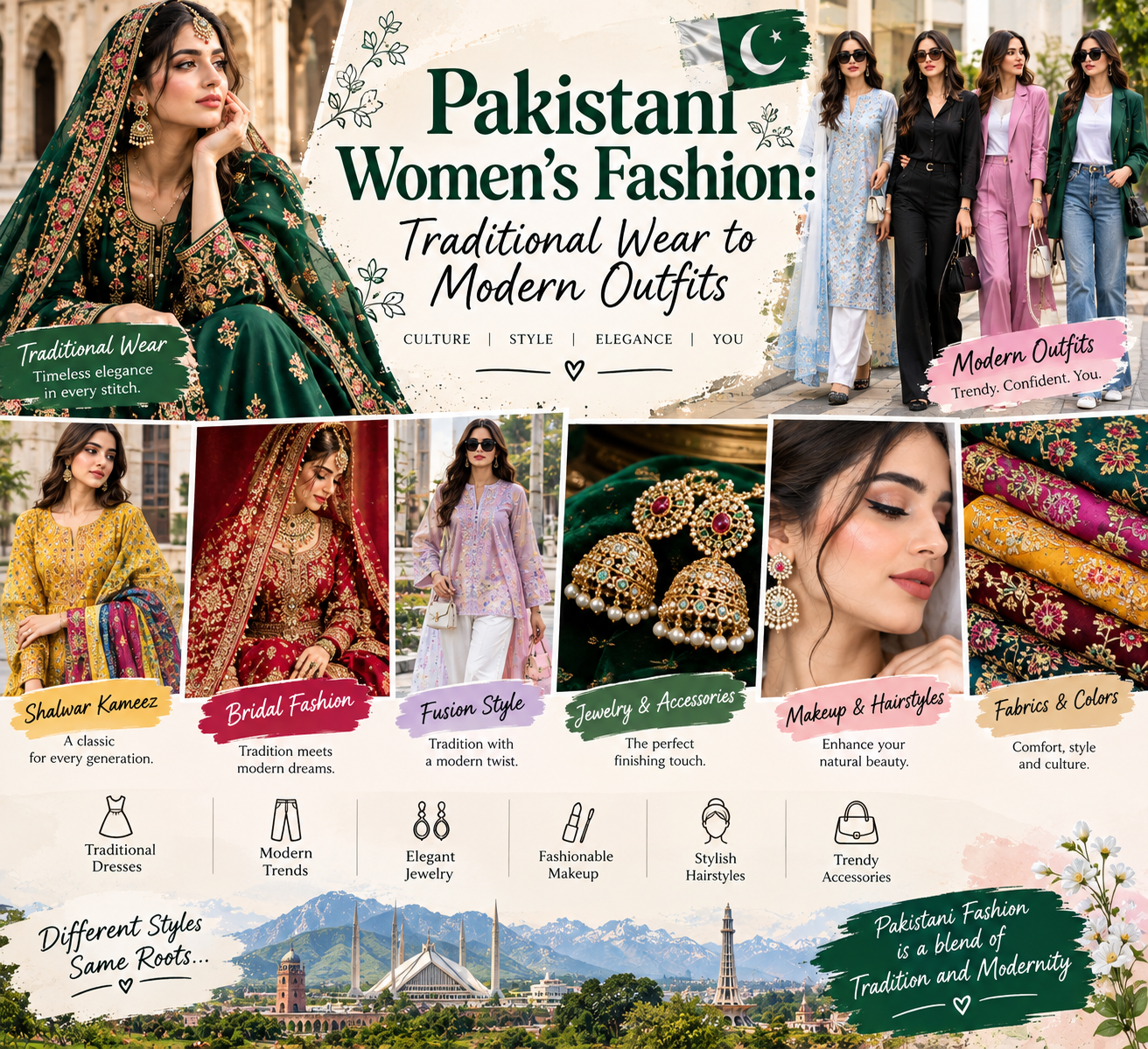
Pakistani women’s fashion is a diverse combination of traditional clothing, modern designs, regional culture, embroidery, accessories, and changing lifestyle preferences. From the timeless shalwar kameez to contemporary western-inspired outfits, Pakistani women have a wide range of clothing choices for everyday life, work, university, family gatherings, weddings, Eid, and other special occasions.
Fashion in Pakistan has developed considerably over time. Traditional clothing remains an important part of everyday and formal wardrobes, while modern cuts, fabrics, colors, and international influences have introduced new possibilities. Pakistani designers and clothing brands have also helped create a fashion industry that combines cultural heritage with contemporary trends.
The beauty of Pakistani women's fashion lies in its flexibility. A traditional outfit can be styled in a modern way, while a contemporary outfit can include traditional embroidery or jewelry. This ability to combine different influences has created a distinctive fashion culture.
The Importance of Fashion in Pakistani Culture
Clothing in Pakistan is closely connected with culture and social occasions. Traditional outfits are commonly worn during Eid, weddings, religious celebrations, family gatherings, and other important events.
Fashion can also reflect regional identity. Different parts of Pakistan have their own clothing styles, embroidery techniques, fabrics, colors, and accessories.
At the same time, urban lifestyles have introduced more contemporary clothing choices. Women may have separate wardrobes for casual wear, professional settings, formal events, and traditional celebrations.
This variety makes Pakistani women's fashion both practical and culturally rich.
Shalwar Kameez: A Timeless Choice
The shalwar kameez remains one of the most recognizable forms of women's clothing in Pakistan.
A traditional outfit generally consists of a kameez, shalwar, and dupatta. However, modern versions can feature different cuts, lengths, sleeves, trousers, and decorative details.
Simple cotton suits are suitable for everyday wear, while embroidered and embellished versions can be worn for formal occasions.
The versatility of shalwar kameez is one of the main reasons it has remained popular across generations.
Evolution of the Kameez
The design of the kameez has changed considerably over time.
Traditional long shirts remain popular, but modern fashion also includes straight shirts, A-line shirts, short shirts, asymmetrical designs, layered shirts, and other silhouettes.
Necklines, sleeves, borders, embroidery, and fabric choices also change according to current fashion trends.
This evolution allows the traditional outfit to remain relevant to modern wardrobes.
Different Trouser Styles
The shalwar is no longer the only option worn with a kameez.
Modern Pakistani fashion includes:
Straight trousers
Cigarette pants
Wide-leg trousers
Palazzo pants
Tulip trousers
Traditional shalwars
Flared trousers
Different trousers can completely change the appearance of the same shirt.
Straight trousers can create a clean appearance, while wide-leg styles can provide a more contemporary look.
The Dupatta in Women's Fashion
The dupatta remains an important element of Pakistani women's fashion.
It can add color, texture, and traditional character to an outfit.
Dupattas are available in cotton, chiffon, silk, organza, net, lawn, and other fabrics.
Some are printed, while others feature embroidery, borders, lace, beads, sequins, or other decorative details.
Modern styling has introduced different ways to drape and coordinate dupattas.
Casual Pakistani Fashion
Everyday fashion in Pakistan often focuses on comfort and practicality.
Cotton and lawn suits are particularly popular during warm weather.
Simple prints, small embroidery details, plain fabrics, and comfortable cuts are suitable for daily activities.
Women may style casual clothing with simple earrings, comfortable footwear, handbags, and easy hairstyles.
The result is a practical appearance that still reflects Pakistani fashion.
Summer Fashion in Pakistan
Pakistan's hot summers influence women's clothing choices.
Lightweight fabrics such as lawn and cotton are popular because they are comfortable in warm weather.
Floral prints, geometric patterns, pastel shades, and bright colors are common in summer collections.
Loose and breathable silhouettes are also useful during hot weather.
Summer fashion can be both colorful and practical.
Winter Fashion for Pakistani Women
Winter provides opportunities to use heavier fabrics and layered outfits.
Khaddar, linen, velvet, wool, and other warm fabrics are commonly used.
Long shirts can be paired with trousers, shawls, coats, jackets, or sweaters.
Dark colors such as maroon, navy, brown, black, and deep green are often seen in winter collections, although lighter shades are also available.
Winter accessories such as scarves, shawls, boots, and handbags can complete the look.
Formal Pakistani Fashion
Formal clothing is designed for special occasions such as dinners, parties, weddings, and family events.
Formal Pakistani outfits may include detailed embroidery, embellishments, decorative borders, luxurious fabrics, and coordinated accessories.
Chiffon, silk, velvet, organza, and other formal fabrics are frequently used.
Formal clothing can range from moderately decorated outfits to heavily embroidered designer pieces.
Wedding Guest Fashion
Weddings are an important part of Pakistani fashion culture.
Women attending weddings often choose colorful and decorative outfits.
Lehengas, shararas, ghararas, embroidered shirts, long dresses, and formal suits are popular choices.
Jewelry and accessories can be selected according to the outfit.
Makeup and hairstyles may also be more elaborate than everyday styling.
Eid Fashion
Eid is another major occasion for Pakistani women's fashion.
Many women choose new outfits for Eid, ranging from simple printed suits to heavily embroidered formal dresses.
Pastel colors, bright shades, traditional prints, embroidery, and modern cuts are all common.
Accessories such as earrings, bangles, handbags, shoes, and dupattas can be coordinated with the outfit.
Bridal Fashion
Bridal fashion represents one of the most elaborate forms of Pakistani women's clothing.
Traditional bridal outfits can include lehengas, ghararas, shararas, heavily embroidered shirts, and other formal designs.
Red has traditionally been associated with bridal clothing, but modern brides also choose pink, gold, maroon, green, peach, ivory, and other colors.
Bridal fashion combines clothing with jewelry, makeup, hairstyles, and mehndi.
Regional Women's Fashion
Pakistan's regional diversity has a major influence on women's clothing.
Punjabi Fashion
Punjabi fashion often features colorful clothing, embroidery, traditional jewelry, and lively prints.
Shalwar kameez and various embroidered outfits are popular.
Sindhi Fashion
Sindhi clothing is known for distinctive embroidery, mirror work, and ajrak-inspired designs.
Traditional craftsmanship is an important part of Sindhi fashion.
Balochi Fashion
Balochi women's clothing is recognized for detailed embroidery and distinctive cultural designs.
The embroidery can cover large portions of the outfit and may require considerable craftsmanship.
Pashtun Fashion
Pashtun women's clothing has its own traditional styles, fabrics, embroidery, and accessories.
Regional variations can be seen in colors and decorative techniques.
Northern Pakistani Fashion
The northern regions have unique clothing traditions influenced by local communities, climate, and cultural history.
Warm fabrics, shawls, embroidery, and regional accessories can be important parts of traditional clothing.
Western Fashion in Pakistan
Western fashion has become increasingly common, especially in urban areas.
Jeans, shirts, jackets, skirts, sweaters, coats, and other contemporary garments are widely available.
Women may choose western clothing for casual activities, university, travel, or other settings.
However, traditional clothing remains an important part of many wardrobes.
Fusion Fashion
Fusion fashion combines traditional Pakistani elements with contemporary clothing.
For example, an embroidered Pakistani shirt can be paired with modern trousers.
Traditional jewelry can be worn with a western outfit.
A modern jacket can be combined with a traditional dress.
Fusion fashion allows women to experiment while maintaining a connection with Pakistani culture.
Ready-to-Wear Fashion
Ready-to-wear clothing has become increasingly popular in Pakistan.
Instead of purchasing fabric and arranging custom tailoring, customers can buy complete outfits in standard sizes.
Ready-to-wear collections are available for casual, semi-formal, formal, and festive occasions.
This trend has made fashion more convenient for women with busy lifestyles.
Unstitched Clothing
Unstitched fabric remains an important part of Pakistani fashion.
Many women prefer purchasing fabric and having it tailored according to personal measurements and preferences.
Unstitched collections may include printed shirts, embroidered fabric, trousers, and dupattas.
This option provides flexibility in choosing the final design.
Pakistani Embroidery
Embroidery is one of the defining features of Pakistani women's fashion.
Different techniques include threadwork, mirror work, zari, beads, sequins, and other decorative methods.
Traditional embroidery can be incorporated into modern outfits.
Handmade embroidery is particularly valued because it represents skilled craftsmanship.
Fabrics and Their Role in Fashion
Fabric strongly influences the appearance and comfort of clothing.
Cotton and lawn are popular for summer.
Linen can be suitable for transitional weather.
Khaddar and wool are commonly associated with winter.
Chiffon, silk, velvet, and organza are frequently used for formal clothing.
Choosing the right fabric according to weather and occasion can make clothing more practical.
Colors in Pakistani Women's Fashion
Pakistani fashion includes a wide range of colors.
Bright colors such as red, orange, yellow, green, pink, and blue are common in festive collections.
Pastel colors such as peach, lavender, mint, ivory, and soft pink are also popular.
Black, navy, maroon, brown, and deep green are frequently used for evening and winter clothing.
Color choices depend on personal preference, season, event, and current fashion trends.
Minimalist Fashion
Minimalist fashion has gained attention among women who prefer simple and clean designs.
Plain or lightly embroidered suits, neutral colors, simple jewelry, and uncomplicated silhouettes can create an elegant appearance.
Minimal fashion can be practical for work, university, casual gatherings, and everyday life.
It also allows individual accessories to become more noticeable.
Statement Fashion
Some women prefer bold fashion choices.
Statement outfits may include bright colors, large embroidery, dramatic sleeves, decorative borders, or distinctive cuts.
Statement jewelry and accessories can also be used to create a stronger fashion appearance.
Both minimalist and statement fashion have a place in Pakistani women's wardrobes.
Jewelry and Accessories
Accessories can transform a simple outfit.
Popular choices include:
Jhumkas
Earrings
Bangles
Necklaces
Rings
Bracelets
Handbags
Clutches
Scarves
Hair accessories
Traditional jewelry can give a modern outfit a Pakistani character.
Minimal jewelry can also be used with heavily embroidered clothing to maintain balance.
Footwear and Pakistani Fashion
Footwear is another important part of styling.
Traditional khussas remain popular with Pakistani outfits.
Sandals, heels, flats, sneakers, and boots can also be combined with different clothing styles.
For weddings, embellished footwear is often selected.
For everyday activities, comfortable shoes are generally more practical.
Fashion for University
University fashion often combines comfort with personal style.
Simple shalwar kameez, jeans with shirts, long tops, modest western outfits, and fusion clothing can all be practical options.
Comfortable footwear and simple accessories can make daily routines easier.
Fashion choices may also vary depending on campus environment and personal preference.
Fashion for Work
Workwear usually requires practical and presentable clothing.
Women may choose simple shalwar kameez, trousers with shirts, long formal tops, or other modest contemporary outfits.
Neutral and soft colors can create a professional appearance, although colorful clothing can also be suitable depending on the workplace.
Simple jewelry and neat hairstyles can complete the look.
Social Media and Women's Fashion
Social media has dramatically changed the way women discover fashion.
Instagram, TikTok, YouTube, Pinterest, and other platforms provide styling inspiration from Pakistani designers, influencers, fashion brands, and international creators.
Women can discover new clothing combinations, hairstyles, makeup looks, and accessory ideas from home.
Social media has also helped local businesses reach customers across Pakistan.
Pakistani Fashion Influencers
Fashion influencers play an important role in promoting clothing and styling ideas.
They may share outfit combinations, seasonal trends, brand collections, wedding looks, or everyday fashion.
Influencer content can provide inspiration, but individual preferences and practical needs remain important when selecting clothing.
Online Shopping and Women's Fashion
Online shopping has made Pakistani fashion more accessible.
Women can purchase ready-to-wear clothing, unstitched fabrics, jewelry, footwear, handbags, and accessories online.
Online platforms can be especially useful for customers who do not live near major shopping centers.
However, customers should check size charts, fabric descriptions, seller information, return policies, and reviews before purchasing.
Affordable Women's Fashion
Fashion can be enjoyed at different budgets.
Simple clothing can be restyled through accessories, different dupatta arrangements, and new combinations.
Local markets often provide affordable fabrics and clothing.
Artificial jewelry can also offer fashionable alternatives to expensive jewelry.
Buying versatile pieces that can be worn for multiple occasions can make a wardrobe more practical.
Sustainable Fashion Choices
Sustainable fashion is becoming increasingly relevant.
Instead of purchasing clothes for every new trend, women can build wardrobes around versatile pieces.
Old clothes can be repaired, altered, restyled, or combined with different accessories.
Traditional Pakistani clothing is particularly adaptable because shirts, trousers, and dupattas can often be mixed and matched.
Supporting local artisans can also help preserve traditional craftsmanship.
The Influence of International Fashion
International fashion trends have influenced Pakistani clothing, particularly through social media and digital platforms.
Cuts, colors, layering techniques, accessories, and western clothing styles can become popular in Pakistan.
However, Pakistani fashion often adapts these trends rather than copying them exactly.
Traditional fabrics and embroidery can be combined with international silhouettes, creating unique fusion designs.
The Growing Pakistani Fashion Industry
Pakistan has a growing fashion industry involving designers, textile manufacturers, boutiques, tailors, artisans, photographers, makeup artists, stylists, influencers, and online retailers.
The industry provides opportunities for both established companies and small businesses.
Digital marketing has made it easier for new fashion brands to reach customers.
This growth also provides opportunities for women entrepreneurs who want to establish clothing, jewelry, beauty, or accessory businesses.
Women Entrepreneurs in Fashion
Fashion has created opportunities for women to build businesses from home or through physical stores.
Women can start small clothing brands, jewelry businesses, tailoring services, embroidery businesses, makeup studios, or online fashion stores.
Social media provides a relatively accessible platform for showcasing products and connecting with customers.
This has contributed to the expansion of Pakistan's fashion entrepreneurship.
The Future of Pakistani Women's Fashion
The future of Pakistani women's fashion is likely to combine traditional culture with modern lifestyles.
Traditional clothing will continue to be important, while modern silhouettes and fusion fashion will provide additional choices.
Online shopping and social media will continue influencing trends.
Sustainable fashion, local craftsmanship, ready-to-wear collections, and personalized styling may also become increasingly important.
The ability to mix traditional and contemporary elements will likely remain one of the strongest features of Pakistani fashion.
Conclusion
Pakistani women's fashion is a dynamic combination of tradition, culture, modern design, regional identity, and personal expression. The shalwar kameez remains a timeless part of the wardrobe, while contemporary trousers, fusion outfits, western clothing, ready-to-wear collections, and modern accessories have expanded the choices available to women.
Regional embroidery and craftsmanship continue to provide cultural depth, while social media and online shopping have made fashion more accessible.
Whether a woman prefers simple everyday clothing, formal embroidered outfits, western fashion, traditional dresses, or a mixture of different styles, Pakistani fashion offers a wide range of possibilities.
The future of women's fashion in Pakistan will likely continue to balance cultural heritage with modern lifestyles, creating new styles while preserving the traditions that make Pakistani fashion distinctive.
FAQs
1. What is the most popular traditional clothing for Pakistani women?
The shalwar kameez remains one of the most popular and recognizable traditional clothing styles for Pakistani women.
2. What fabrics are popular in Pakistani women's fashion?
Lawn, cotton, linen, khaddar, chiffon, silk, velvet, and organza are among the commonly used fabrics for different seasons and occasions.
3. Is western fashion popular among Pakistani women?
Yes. Western and contemporary clothing such as jeans, shirts, jackets, sweaters, and fusion outfits are widely available and worn alongside traditional clothing.
4. What is fusion fashion in Pakistan?
Fusion fashion combines Pakistani traditional elements, such as embroidery or jewelry, with modern or western-inspired clothing and styling.
5. How has social media changed Pakistani women's fashion?
Social media has made fashion inspiration, designer collections, styling ideas, and online clothing brands more accessible to women across Pakistan.




