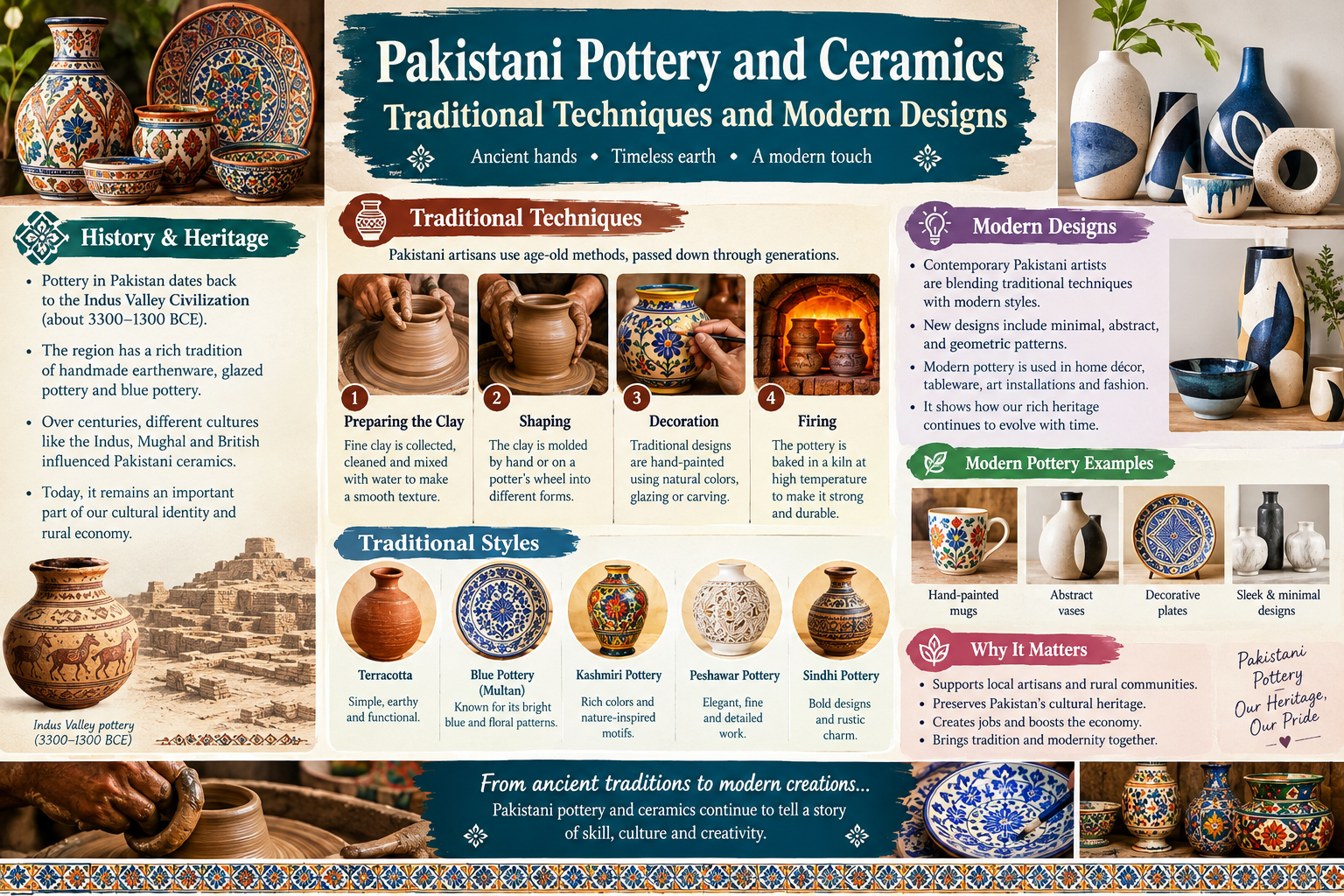
Pakistani pottery and ceramics are important parts of the country's artistic and cultural heritage. From simple clay pots used in everyday life to beautifully decorated tiles, plates, vases and modern ceramic artwork, pottery has played an important role in communities across Pakistan for centuries.
Pottery is one of the oldest forms of human craftsmanship. Clay is easily available in many areas, can be shaped into different forms and becomes durable when properly dried and fired. In Pakistan, traditional potters have developed techniques for making useful household objects as well as decorative pieces.
Different regions of Pakistan have developed their own pottery traditions. Multan is particularly famous for its decorative blue pottery, while other areas are known for terracotta products, painted vessels, traditional water pots and handmade ceramics. Regional designs often include floral patterns, geometric shapes, calligraphy and colorful decoration.
Today, Pakistani pottery continues to combine traditional craftsmanship with modern design. Artists and ceramicists are creating contemporary tableware, home decorations, sculptures and architectural products while maintaining connections with older techniques.
What Is Pottery?
Pottery is the process of making objects from clay and hardening them through drying and firing.
Clay can be shaped by hand or with a potter's wheel. After shaping, the object is allowed to dry before being fired in a kiln or traditional firing system.
Pottery can be used to make:
Water pots
Bowls
Plates
Cups
Cooking vessels
Storage containers
Vases
Decorative objects
Tiles
Sculptures
Pottery can therefore be both practical and artistic.
What Are Ceramics?
Ceramics are objects made from clay or other mineral materials that are shaped and then hardened through heat.
The term is broader than traditional pottery.
Ceramic products can include:
Tiles
Plates
Cups
Decorative objects
Sculptures
Sanitary products
Architectural elements
Modern ceramic art can also involve experimental shapes, textures and glazing techniques.
History of Pottery in Pakistan
The history of pottery in the region that is now Pakistan goes back thousands of years.
Archaeological discoveries from ancient settlements demonstrate that pottery was an important part of everyday life.
The Indus Valley Civilization, one of the world's major ancient civilizations, produced a wide range of pottery.
Archaeological sites such as Mohenjo-daro and Harappa have provided important evidence of ancient ceramic traditions.
Mohenjo-daro
Harappa
Ancient pottery was used for storage, cooking, serving food and other household purposes.
Pottery in the Indus Valley Civilization
The Indus Valley Civilization developed sophisticated pottery techniques.
Archaeologists have discovered:
Storage jars
Bowls
Plates
Cups
Painted pottery
Decorative vessels
Terracotta objects
Some pottery features geometric patterns, animals, plants and other designs.
These objects provide information about the daily life and artistic skills of ancient communities.
Terracotta in Pakistan
Terracotta is fired clay that usually has a reddish or earthy appearance.
It has been used for centuries to make practical and decorative objects.
Terracotta products can include:
Pots
Tiles
Figurines
Lamps
Decorative panels
Architectural elements
The natural appearance of terracotta makes it popular in traditional and modern design.
Traditional Clay Pots
Clay pots have historically been important in Pakistani households.
Before modern refrigeration and widespread industrial containers, clay vessels were commonly used for storing water and food.
Traditional clay pots can also help keep water relatively cool because of the properties of porous earthenware.
Different communities developed different shapes according to local needs.
Matka
The matka is a traditional earthen water container found across South Asia.
It is generally made from clay and designed for storing water.
The shape allows water to remain cooler than the surrounding air under suitable conditions through evaporation from the porous surface.
The matka is both a practical object and an example of traditional pottery knowledge.
Pottery and Everyday Life
Traditional pottery was closely connected with everyday life.
Potters produced objects needed for:
Cooking
Water storage
Food storage
Serving meals
Household decoration
Agricultural activities
This practical role helped pottery remain an important craft.
The Potter's Wheel
The potter's wheel is one of the most important tools in traditional pottery.
A rotating wheel allows the potter to shape clay into symmetrical forms.
The basic process involves placing prepared clay on the wheel and controlling its shape while the wheel rotates.
The potter uses hands and tools to create the desired height, width and opening.
Developing control over the wheel requires practice.
Hand-Building Techniques
Not all pottery requires a wheel.
Potters can shape clay by hand using techniques such as:
Pinching
Coiling
Slab construction
Molding
Hand-building allows artists to create irregular or experimental shapes.
It is also useful for decorative ceramic art.
Preparing Clay
The quality of pottery depends heavily on clay preparation.
Raw clay may contain stones, roots or other unwanted materials.
Traditional potters prepare clay by removing impurities and mixing it with water.
The clay is then kneaded or processed until it reaches a suitable consistency.
Proper preparation makes the material easier to shape.
Drying Pottery
After shaping, pottery must dry before firing.
Drying needs to be controlled carefully because rapid or uneven drying can cause cracks.
Traditional potters develop knowledge about weather, moisture and the behavior of different types of clay.
Firing Pottery
Firing is the process of heating clay to a high temperature so that it becomes hard and durable.
Traditional pottery may be fired in simple kilns, while modern ceramics often use controlled electric or gas kilns.
Temperature and firing time can affect the final appearance and strength of the object.
Glazing
Glaze is a coating applied to ceramic surfaces before or during firing.
It can create:
Gloss
Color
Smoothness
Water resistance
Decorative effects
Different glaze formulas produce different results.
Glazing is particularly important in decorative ceramics and tableware.
Blue Pottery of Pakistan
Blue pottery is one of Pakistan's best-known decorative ceramic traditions.
It is particularly associated with Multan.
The craft is recognized for its distinctive blue and turquoise tones, often combined with white and other colors.
Floral, geometric and calligraphic patterns are commonly used.
Blue Pottery in Multan
Multan has a long association with decorative ceramic traditions.
Local artisans have produced tiles, plates, vases, bowls and other decorative objects.
Blue pottery can be found in homes, cultural spaces, shops and architectural decoration.
The designs often reflect Islamic and Central Asian artistic influences while developing a distinctive local character.
Multani Tile Work
Decorative tile work is an important part of Multan's artistic heritage.
Tiles may be used to decorate:
Mosques
Shrines
Walls
Gates
Decorative panels
Floral and geometric designs are often combined with calligraphic elements.
The bright colors can create striking architectural surfaces.
Kashi Kari
Kashi kari is a traditional form of glazed tile decoration associated particularly with Sindh and Punjab.
The term is commonly connected with decorative ceramic tile work.
It can be seen in historic religious and architectural sites.
Patterns may include:
Flowers
Leaves
Stars
Geometric shapes
Calligraphy
The tradition demonstrates the connection between ceramics and architecture.
Pottery in Sindh
Sindh has a rich pottery tradition influenced by its long history and local communities.
Traditional Sindhi pottery may include decorative painting and distinctive forms.
Clay vessels have historically been important for storing water and household goods.
Modern craftspeople continue to produce pottery inspired by regional traditions.
Pottery in Punjab
Punjab also has a long pottery tradition.
Local potters produce practical and decorative clay objects.
Traditional designs may vary from one area to another.
Pottery can be found in village craft markets and urban handicraft shops.
Pottery in Balochistan
Balochistan has its own traditions of clay work and ceramics.
Local crafts may reflect regional patterns and practical needs.
The use of locally available materials is an important characteristic of many traditional crafts.
Pottery in Khyber Pakhtunkhwa
Traditional pottery is also practiced in Khyber Pakhtunkhwa.
Clay vessels may be made for household use and decoration.
Regional craft traditions can influence shapes, patterns and finishing techniques.
Decorative Patterns in Pakistani Pottery
Pakistani pottery often contains decorative patterns.
Common designs include:
Floral motifs
Leaves
Geometric shapes
Birds
Calligraphy
Repeated borders
Abstract patterns
Artists may paint designs by hand or use traditional tools to create impressions.
Floral Designs
Flowers are common in Pakistani ceramic decoration.
Floral designs can be painted across bowls, plates and vases.
They may also be incorporated into architectural tile patterns.
The use of flowers connects pottery with broader Pakistani decorative traditions.
Geometric Designs
Geometric patterns are another important element.
Repeated circles, diamonds, stars and lines can create balanced designs.
Geometric decoration is especially common in Islamic architectural traditions.
Calligraphy on Ceramics
Arabic and Urdu calligraphy can also appear on ceramic surfaces.
Calligraphy may be combined with floral or geometric decoration.
Ceramic tiles featuring Arabic writing have been used extensively in religious architecture.
Pottery and Islamic Art
Islamic art has influenced ceramic decoration in Pakistan.
Common artistic elements include:
Geometry
Repeated patterns
Floral designs
Arabesque forms
Calligraphy
These elements can be found on tiles, bowls and architectural ceramics.
Pottery and Architecture
Ceramics are not limited to small household objects.
Tiles can become an important part of architecture.
Historic mosques, shrines and buildings may feature decorative ceramic surfaces.
Tiles protect surfaces while also providing visual decoration.
Pottery in Historic Buildings
Historic Pakistani buildings demonstrate how ceramic decoration can transform architecture.
Colorful tile work may cover walls, arches and domes.
In some monuments, the ceramic decoration is one of the most recognizable features.
This creates a strong relationship between craftsmanship and architecture.
Pottery and Home Decoration
Modern Pakistani homes can use ceramic products for decoration.
These include:
Vases
Plates
Pots
Lamps
Wall pieces
Decorative tiles
Sculptures
Handmade ceramics can add cultural character to interior spaces.
Pakistani Ceramic Tableware
Ceramic plates, bowls, cups and serving dishes are widely used in modern homes.
Local manufacturers and artisans produce a variety of designs.
Traditional patterns can be combined with modern shapes.
This creates tableware that connects contemporary lifestyle with Pakistani decorative traditions.
Handmade vs Mass-Produced Ceramics
Handmade ceramics have characteristics that distinguish them from factory-made products.
Small variations in shape, texture and color can occur because the objects are produced individually.
Mass-produced ceramics are usually designed for consistency and large-scale production.
Both have different purposes and markets.
Handmade pottery often appeals to people who value craftsmanship and individuality.
Role of Pakistani Potters
Potters are skilled craftspeople who understand the properties of clay and the techniques needed to shape and fire it.
Their knowledge may include:
Clay preparation
Wheel throwing
Hand-building
Drying
Firing
Glazing
Painting
Finishing
Many traditional potters learn these skills through family-based training.
Pottery as a Family Tradition
In some communities, pottery skills are passed from parents to children.
Young people may begin by helping with simple tasks before learning more advanced techniques.
This system allows traditional knowledge to continue across generations.
However, changing economic conditions can make it difficult for younger generations to continue family craft businesses.
Economic Importance of Pottery
Pottery provides income for artisans, workshops and craft businesses.
Products can be sold through:
Local markets
Craft shops
Tourism centers
Exhibitions
Online stores
Interior design businesses
The craft can therefore contribute to local economies.
Pottery and Tourism
Tourists often look for handmade products that represent local culture.
Pakistani pottery can serve as a cultural souvenir because each region may have distinctive designs.
Craft markets can provide visitors with opportunities to see artisans working and purchase handmade products.
Tourism can therefore support traditional pottery communities.
Modern Pakistani Ceramic Art
Contemporary Pakistani artists are using ceramics in new ways.
Modern ceramic art can include:
Sculptures
Abstract objects
Installation art
Wall pieces
Experimental vessels
Mixed-media work
Artists may use traditional techniques while exploring modern themes.
Ceramic Sculpture
Ceramic sculpture allows artists to move beyond traditional household objects.
Clay can be shaped into human figures, animals, abstract forms and large artistic installations.
After firing, the sculpture becomes a durable artwork.
Ceramics in Art Schools
Art schools and universities in Pakistan teach ceramics as part of visual arts education.
Students can learn:
Clay preparation
Wheel work
Sculpture
Glazing
Firing
Surface decoration
Education can help connect traditional craftsmanship with contemporary art.
Digital Design and Ceramic Art
Modern technology can also influence ceramic production.
Artists can use digital tools to develop patterns and shapes before producing physical objects.
Some workshops use modern machinery for cutting, molding or printing designs.
Technology can improve efficiency while traditional handmade finishing can preserve artistic character.
Challenges Facing Pakistani Pottery
Traditional pottery faces several challenges.
Mass-produced plastic and metal containers can be cheaper and more convenient than handmade clay products.
Traditional kilns can also require significant fuel and maintenance.
Young people may prefer other careers, making it harder for family pottery businesses to continue.
Access to modern markets can also be difficult for small artisans.
Preserving Traditional Pottery
Preservation can involve several approaches.
Training Young Artisans
Teaching pottery skills to younger generations can help maintain traditional knowledge.
Supporting Craft Markets
Local craft markets can provide direct opportunities for artisans to sell products.
Museum Collections
Museums can preserve historical pottery and document traditional techniques.
Tourism
Cultural tourism can increase demand for regional crafts.
Online Selling
Digital marketplaces can help artisans reach customers beyond their local areas.
Sustainable Pottery
Pottery can also contribute to discussions about sustainable materials.
Clay is a natural material, although its environmental impact depends on extraction, transportation and firing methods.
Traditional and modern producers can explore more efficient firing techniques and responsible sourcing of raw materials.
Reusable ceramic products can also provide alternatives to some disposable household items.
Pakistani Pottery and Modern Fashion
Ceramic jewelry and accessories can combine traditional patterns with modern design.
Artists may create:
Pendants
Earrings
Brooches
Decorative buttons
These products demonstrate how ceramics can enter fashion and accessory markets.
Pottery and Interior Design
Interior designers often use ceramics to add texture and color to spaces.
Handmade vases, tiles, lamps and decorative plates can provide cultural accents.
Traditional Pakistani patterns can be incorporated into contemporary interiors.
Pottery and Restaurants
Restaurants and cafes can use handmade ceramics to create distinctive dining experiences.
Locally produced plates, cups and serving dishes can add a traditional character to food presentation.
This also creates opportunities for ceramic artists.
Pottery and Cultural Identity
Pottery reflects local history and everyday life.
A traditional clay vessel can show how communities used local resources to meet practical needs.
Decorated ceramics can also reveal artistic preferences and cultural influences.
This makes pottery both an everyday craft and an important cultural record.
Future of Pakistani Pottery
The future of Pakistani pottery depends on preserving traditional skills while encouraging innovation.
Traditional potters can benefit from modern marketing, tourism and online sales.
Contemporary ceramic artists can experiment with new materials, forms and techniques.
Educational institutions can help connect younger generations with traditional craftsmanship.
If artisans receive fair economic opportunities, pottery can remain a living part of Pakistan's cultural heritage.
Why Pakistani Pottery Matters
Pakistani pottery matters because it connects ancient craftsmanship with modern creativity.
From archaeological pottery of ancient civilizations to contemporary ceramic studios, clay has remained an important artistic material.
Regional traditions such as Multani blue pottery and decorative tile work demonstrate the diversity of Pakistani ceramics.
The craft also provides employment and supports local communities.
Most importantly, pottery shows how a simple natural material can become a useful object, a decorative piece or a work of art.
Conclusion
Pakistani pottery and ceramics represent thousands of years of craftsmanship and artistic development. From ancient pottery associated with the Indus Valley Civilization to traditional clay vessels, Multani blue pottery and modern ceramic artwork, the craft has continued to evolve.
Different regions have developed their own techniques, designs and traditions. Floral patterns, geometric forms, calligraphy and colorful tile work demonstrate the variety of Pakistani ceramic art.
Pottery also plays a practical role in everyday life. Clay vessels, tableware and decorative objects connect craftsmanship with ordinary household activities.
Today, modern artists are combining traditional techniques with contemporary design, while digital tools and online markets are creating new opportunities.
Preserving traditional knowledge, supporting artisans, encouraging young people to learn pottery and promoting regional crafts can help ensure that Pakistani ceramics remain an important part of the country's artistic heritage.
g traditional clay work, Multani blue pottery, kashi kari, regional crafts and modern ceramic art.
FAQs
1. What is Pakistani pottery?
Pakistani pottery includes handmade clay and ceramic objects produced through traditional and modern techniques across different regions of Pakistan.
2. Which city is famous for blue pottery in Pakistan?
Multan is particularly famous for its traditional blue pottery and decorative ceramic tile work.
3. What is kashi kari?
Kashi kari is a traditional form of decorative glazed tile work associated particularly with regions of Pakistan such as Sindh and Punjab.
4. What designs are common in Pakistani pottery?
Common designs include flowers, leaves, geometric patterns, birds, calligraphy and repeated decorative motifs.
5. Why is Pakistani pottery important?
Pakistani pottery preserves traditional craftsmanship, reflects regional culture, supports artisans and connects ancient ceramic traditions with modern artistic design.




