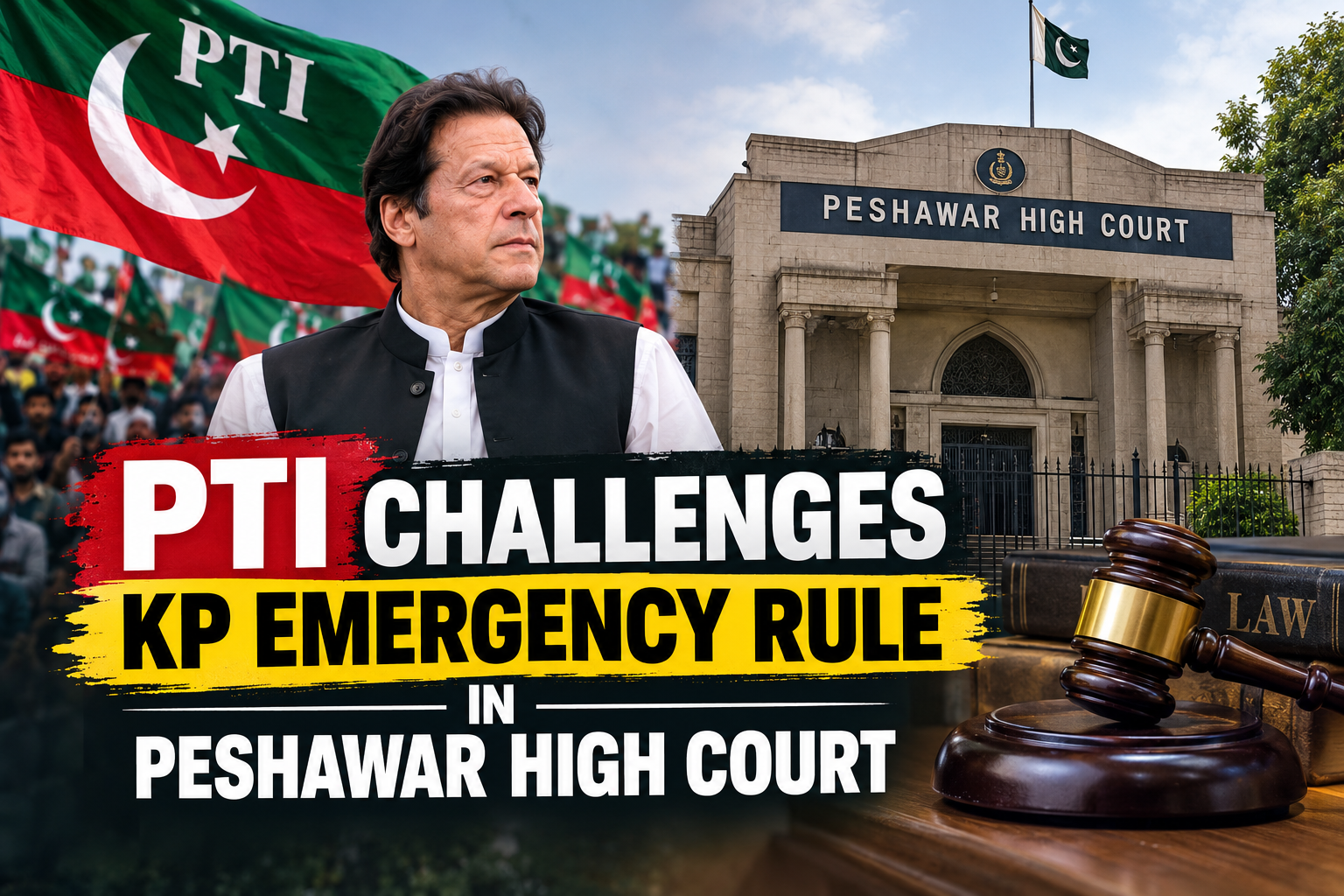
Pakistan’s political situation entered another important phase on October 14, 2026, as the Pakistan Tehreek-e-Insaf (PTI) challenged the federal government’s emergency measures in the Peshawar High Court. The party is seeking legal relief against the imposition of emergency and governor’s rule in Khyber Pakhtunkhwa, as well as the suspension of its provincial government.
The legal challenge comes amid growing disagreement between the federal government and PTI over security, constitutional authority and the future of provincial administration. President Asif Ali Zardari announced the emergency on October 11, citing security concerns and the provincial government's handling of militancy. PTI, however, has argued that the decision undermines provincial autonomy and has political implications.
The case has become a major development in Pakistan’s current political affairs because it places questions about emergency powers, elected representation and constitutional safeguards before the judiciary. The outcome could influence the next stage of the dispute between the federal authorities and PTI.
For residents of Khyber Pakhtunkhwa, the central concerns include the continuity of public services, the effectiveness of security arrangements and the future of the province’s elected administration.
PTI Turns to the Judiciary
PTI has approached the Peshawar High Court to challenge the emergency proclamation and the measures associated with governor’s rule. The party is seeking the restoration of its provincial government and has asked the court to examine the legality of the federal intervention.
The decision to pursue legal proceedings marks an important step in the party’s response. Rather than limiting its opposition to political statements, PTI is asking the judiciary to consider the constitutional questions surrounding the emergency.
The court's role is significant because disputes involving the powers of federal and provincial institutions require careful examination of the Constitution, relevant legal provisions and the circumstances surrounding the challenged decision.
The filing of a petition does not itself mean that the court has accepted the party’s arguments. It begins a legal process through which the parties can present their positions and the court can determine the issues that fall within its jurisdiction.
The proceedings may require the government to explain the legal basis for the emergency, the evidence relied upon and the procedures followed. PTI, in turn, will need to establish the grounds on which it believes the measures should be overturned.
The eventual outcome will depend on the applicable law, the arguments presented and the court’s findings.
Background to the Emergency in Khyber Pakhtunkhwa
Khyber Pakhtunkhwa is an important province in Pakistan’s federal structure and has a particularly significant role in national security because it shares a border with Afghanistan. Several districts have faced persistent militant violence, creating serious challenges for law enforcement, local administration and community safety.
The federal government has argued that stronger coordination is necessary to address the security situation. During parliamentary discussions on October 14, government representatives described the emergency as a response to internal disturbances and what they considered inadequate provincial engagement in counterterrorism efforts
PTI has disputed the justification for the intervention. The party maintains that removing its government is not an appropriate solution to the province’s security problems and argues that the decision threatens the authority of an elected provincial administration.
These competing positions have turned the emergency into a broader debate about governance in Pakistan. At the heart of the dispute is a difficult question: under what circumstances should the federal government intervene in provincial affairs, and what constitutional protections apply when extraordinary powers are exercised?
The answer requires more than political statements. It involves examining the Constitution, the evidence presented by the authorities and the safeguards intended to prevent emergency powers from being used beyond their lawful purpose.
Why the Peshawar High Court Case Matters
The Peshawar High Court is an important judicial institution for resolving constitutional and administrative disputes arising in Khyber Pakhtunkhwa. Its consideration of PTI’s challenge could help clarify the legal issues surrounding the emergency.
Courts are responsible for applying the law to the disputes brought before them. In cases involving government authority, judges may need to consider whether the relevant constitutional provisions were followed, whether the decision falls within the powers of the institutions involved and whether the legal requirements for such action have been satisfied.
The court may also need to consider the relationship between federal responsibilities and provincial autonomy. These principles are both important to Pakistan’s constitutional framework, although their application can become complicated during a security crisis.
For PTI, the case offers an opportunity to seek a legal remedy against the suspension of its provincial administration. For the federal government, the proceedings provide an opportunity to defend the constitutional and factual basis of its decision.
The judicial process can also help establish a clearer public record of the arguments being made by both sides. This is particularly valuable when political statements offer sharply different interpretations of the same events.
However, it is important to distinguish between a petition being filed, a hearing being scheduled, an interim order being issued and a final judgment being delivered. These are separate stages of legal proceedings, and one should not be mistaken for another.
As of October 14, the central development is PTI’s challenge to the emergency measures. The final legal outcome should not be assumed in advance.
Constitutional Questions at the Centre of the Dispute
Pakistan’s Constitution establishes a federal system in which responsibilities are distributed between the federal government and the provinces. It also provides mechanisms for dealing with exceptional circumstances that may threaten public order or the operation of constitutional government.
The emergency announced for Khyber Pakhtunkhwa has brought Articles 232 and 234 into the public discussion. The federal government referred to these provisions when explaining the measures. Article 232 addresses emergency proclamations in specified circumstances, while Article 234 deals with situations involving a failure of constitutional machinery in a province.
The precise application of these provisions depends on their wording, the facts of the case and the relevant constitutional procedures. Their mention in a government announcement does not, by itself, settle every question about the legality of a particular action.
The court may need to consider whether the conditions required by the relevant provisions existed and whether the required procedural steps were followed. It may also have to examine the scope of the powers exercised under the proclamation.
Another important question concerns the relationship between parliamentary approval and judicial review. Parliamentary consideration is part of the constitutional process, but it does not necessarily remove every possible legal question from judicial examination.
Similarly, filing a constitutional petition does not automatically invalidate a government decision. The decision remains subject to the applicable legal framework unless the competent authority or court determines otherwise.
This distinction is important for readers seeking accurate information about the case. The legal process is designed to determine questions through evidence, arguments and established procedures rather than assumptions about which political side should prevail.
The Federal Government’s Position
The federal government has defended the emergency as a necessary response to security concerns in Khyber Pakhtunkhwa. Its representatives have argued that militant violence requires effective coordination and that the province’s administration did not adequately cooperate with federal counterterrorism efforts.
During the National Assembly debate, Law Minister Azam Nazeer Tarar described the emergency as a last resort in response to the deteriorating law-and-order situation. Government representatives also cited the number of reported terrorist incidents in the province as part of their justification.
From the government’s perspective, the central responsibility is to protect citizens and ensure that public institutions can respond effectively to security threats.
The federal government may argue that when existing administrative arrangements are considered inadequate to address a serious situation, constitutional mechanisms must remain available. It also maintains that security challenges require cooperation among law enforcement agencies and different levels of government.
Nevertheless, the strength of the government's position depends on the relevant evidence and whether the measures satisfy constitutional requirements. Claims about administrative failures or security threats should be examined carefully, particularly when they are used to justify extraordinary powers.
The court proceedings could therefore become an important forum for clarifying the government's reasoning and the legal basis for its action.
PTI’s Objections and Demand for Restoration
PTI has strongly rejected the federal intervention and has sought restoration of its provincial government. The party argues that the emergency undermines provincial autonomy and has questioned the motives behind the decision. It has also linked the development to the wider political confrontation involving its jailed founder, former prime minister Imran Khan.
From PTI’s perspective, the suspension of its administration raises concerns about the electoral mandate of the people who voted for its representatives. The party argues that disagreements over security policy should not automatically result in the removal of an elected provincial government.
Its legal challenge seeks to have these concerns examined through the judicial system. The party will need to rely on the relevant constitutional and legal arguments rather than political objections alone.
The distinction between political criticism and legal grounds is essential. A party may believe that a government decision is unfair or politically motivated, but a court must determine the legal issues according to the evidence and applicable law.
PTI’s petition therefore represents one stage in a larger dispute. The filing demonstrates the party’s intention to contest the measures legally, but it does not establish that the requested relief will necessarily be granted.
The proceedings will be important for understanding how constitutional safeguards operate when elected provincial administrations face extraordinary federal intervention.
Provincial Autonomy and Democratic Representation
Provincial autonomy is a fundamental issue in Pakistan’s political system. It concerns the ability of provincial institutions to exercise the responsibilities assigned to them under the Constitution and applicable laws.
The emergency in Khyber Pakhtunkhwa has raised concerns about how far federal authority may extend during a serious security crisis. Supporters of the federal decision emphasise the need for national coordination, while critics stress the importance of protecting provincial decision-making and electoral representation.
These principles are not necessarily incompatible. A federal system must provide ways for different levels of government to cooperate on national challenges while preserving the responsibilities assigned to each institution.
Problems can arise when disagreements are handled primarily through confrontation. If the federal and provincial governments cannot agree on security priorities or administrative responsibilities, cooperation may weaken at precisely the time it is most needed.
Clear communication, established procedures and independent review can help address these tensions. They provide ways to resolve disputes without relying entirely on political pressure.
The case also highlights the importance of public confidence in constitutional institutions. Citizens are more likely to trust government decisions when authorities explain their reasons, follow the law and allow appropriate scrutiny.
The long-term significance of the case may therefore extend beyond the immediate question of which administration exercises executive authority in Khyber Pakhtunkhwa.
Possible Effects on Public Administration
The emergency has raised questions about how provincial departments will operate and how responsibilities will be assigned under the new administrative arrangements.
Public administration involves much more than the political leadership of a province. Government departments are responsible for implementing policies, maintaining records, managing public facilities and providing services to residents. Any change in executive authority must account for these continuing responsibilities.
For citizens, the practical effects may be more important than the political debate itself. People need access to healthcare, education, identity documentation, municipal services and other essential facilities. Government offices must communicate any changes in their procedures clearly and ensure that routine work continues wherever possible.
Schools and colleges also need accurate instructions about schedules, examinations and any local security arrangements. Parents and students should rely on official announcements rather than unverified social media posts.
Healthcare facilities require particular attention during periods of uncertainty. Hospitals, clinics and emergency services must continue to meet patients’ needs, while officials should ensure that responsibilities for staffing and resources remain clear.
The emergency does not automatically establish that all these services will be disrupted. Their actual operation depends on the administrative instructions issued and the decisions made by the relevant authorities.
Monitoring service delivery will be one way to assess the effectiveness of the new arrangements. If public offices continue operating efficiently and residents receive clear information, administrative uncertainty may be reduced.
Security Concerns Remain a Central Issue
Security is one of the main reasons cited by the federal government for imposing emergency measures in Khyber Pakhtunkhwa. The province has faced militant attacks and other threats that have affected communities, law enforcement personnel and public institutions.
Addressing these challenges requires coordinated planning, reliable intelligence, effective policing and cooperation among the relevant authorities. Changes in political leadership alone cannot guarantee better security outcomes.
A successful strategy must be assessed by its practical results. Relevant indicators include whether attacks decrease, whether residents feel safer, whether public services operate consistently and whether affected communities can resume normal activities.
Transparent reporting is also important. Public authorities should distinguish confirmed incidents from unverified claims and provide reliable information about the measures being taken.
Security policy must also consider the experiences of ordinary residents. Communities affected by violence need access to essential services, opportunities for economic recovery and confidence that their concerns will be heard.
The judicial challenge does not resolve these security problems by itself. Instead, it addresses questions about the authority under which the government has acted. Security planning and constitutional accountability remain related but distinct responsibilities.
Political Dialogue Could Help Reduce Tensions
The dispute over Khyber Pakhtunkhwa comes amid wider tensions between PTI and the federal government. The emergency has deepened disagreement over governance, security cooperation and the future of the provincial administration.
Political dialogue could provide a way to address some of these concerns. Discussions between the relevant parties may help clarify security responsibilities, establish communication channels and reduce uncertainty about administrative decisions.
Dialogue does not require either side to abandon its legal position. PTI can continue to pursue its case through the courts while the federal government presents its defence. At the same time, political representatives can explore areas where cooperation would benefit the public.
For example, both sides have an interest in protecting residents from violence, maintaining essential services and ensuring that public institutions operate effectively. These shared responsibilities could provide a starting point for practical cooperation even while disagreements continue.
Parliamentary debate, judicial review and political negotiations serve different purposes. Parliament considers policy and constitutional matters, courts resolve legal disputes within their jurisdiction, and political dialogue can help institutions manage disagreements.
Using these mechanisms constructively could help prevent the dispute from causing unnecessary disruption to public administration.
What Could Happen Next?
Several developments will determine the next phase of the emergency and PTI’s legal challenge.
First, the court proceedings will need to advance. The parties may present their arguments about the constitutional provisions, the circumstances of the proclamation and the measures taken by the authorities. Any interim orders or final decisions could affect the next stage of the dispute.
Second, the federal government will need to explain its administrative plans. Clear instructions about departmental responsibilities and the continuity of public services can help residents understand what the emergency means in practice.
Third, security conditions will remain important. The government’s stated justification is closely connected to counterterrorism, making reliable evidence of security outcomes essential for evaluating its approach.
Fourth, political responses will shape the wider environment. Statements, negotiations and public demonstrations may influence how the dispute develops, although their effects will depend on the actions of the relevant institutions and political parties.
Finally, constitutional accountability will remain central. The way authorities respond to legal challenges may influence public understanding of emergency powers and the protections available under Pakistan’s constitutional system.
These are possible areas of development, not predictions of a particular court ruling or political outcome.
Why This Case Matters Beyond Khyber Pakhtunkhwa
The legal challenge has implications for the broader relationship between federal authority and provincial governance in Pakistan.
Every federal system needs rules for responding to exceptional circumstances. Those rules must be sufficiently effective to address serious threats, but they must also provide safeguards against the unnecessary or unlawful use of extraordinary powers.
The Khyber Pakhtunkhwa case offers an opportunity to examine how these competing considerations are handled within Pakistan’s constitutional framework.
It also illustrates why independent institutions are important during political disputes. Courts can examine legal questions, legislatures can debate government decisions, and the media can help inform citizens about developments.
For the public, reliable reporting is particularly important when political parties present conflicting explanations. Readers should distinguish between confirmed events, statements made by political actors and questions that remain unresolved.
The case should ultimately be assessed through the evidence, the applicable law and the practical consequences for residents.
Conclusion
PTI’s decision to challenge emergency rule in the Peshawar High Court is a significant development in Pakistan’s political and constitutional affairs. The party is seeking restoration of its provincial government and has questioned the legality and implications of the federal intervention.
The federal government, meanwhile, maintains that the emergency was necessary because of security concerns and shortcomings in the province’s response to militancy.
The court proceedings will provide an important opportunity to examine the legal arguments surrounding the dispute. However, the filing of a petition should not be confused with a final judicial decision, and the outcome remains dependent on the legal process.
Beyond the courtroom, the priorities remain clear: public safety, uninterrupted essential services, constitutional accountability and peaceful management of political disagreements.
The coming developments will show how Pakistan’s institutions respond to this challenge and whether the dispute can be managed in a way that protects both the public interest and the country’s constitutional framework.
FAQs
1. Why has PTI challenged emergency rule in Khyber Pakhtunkhwa?
PTI argues that the federal intervention undermines provincial autonomy and has challenged the legal basis of the emergency measures.
2. Which court is hearing PTI’s challenge?
PTI has approached the Peshawar High Court to contest the emergency proclamation and seek restoration of its provincial government.
3. When was the emergency in Khyber Pakhtunkhwa announced?
President Asif Ali Zardari issued the emergency proclamation on October 11, 2026.
4. Why does the federal government support the emergency?
The federal government cites worsening security conditions, militant violence and concerns about provincial cooperation in counterterrorism efforts.
5. What could happen if PTI’s legal challenge succeeds?
The consequences would depend on the court’s specific ruling and applicable constitutional procedures. The court could provide legal relief within its authority, but the outcome should not be assumed before a decision is announced.




