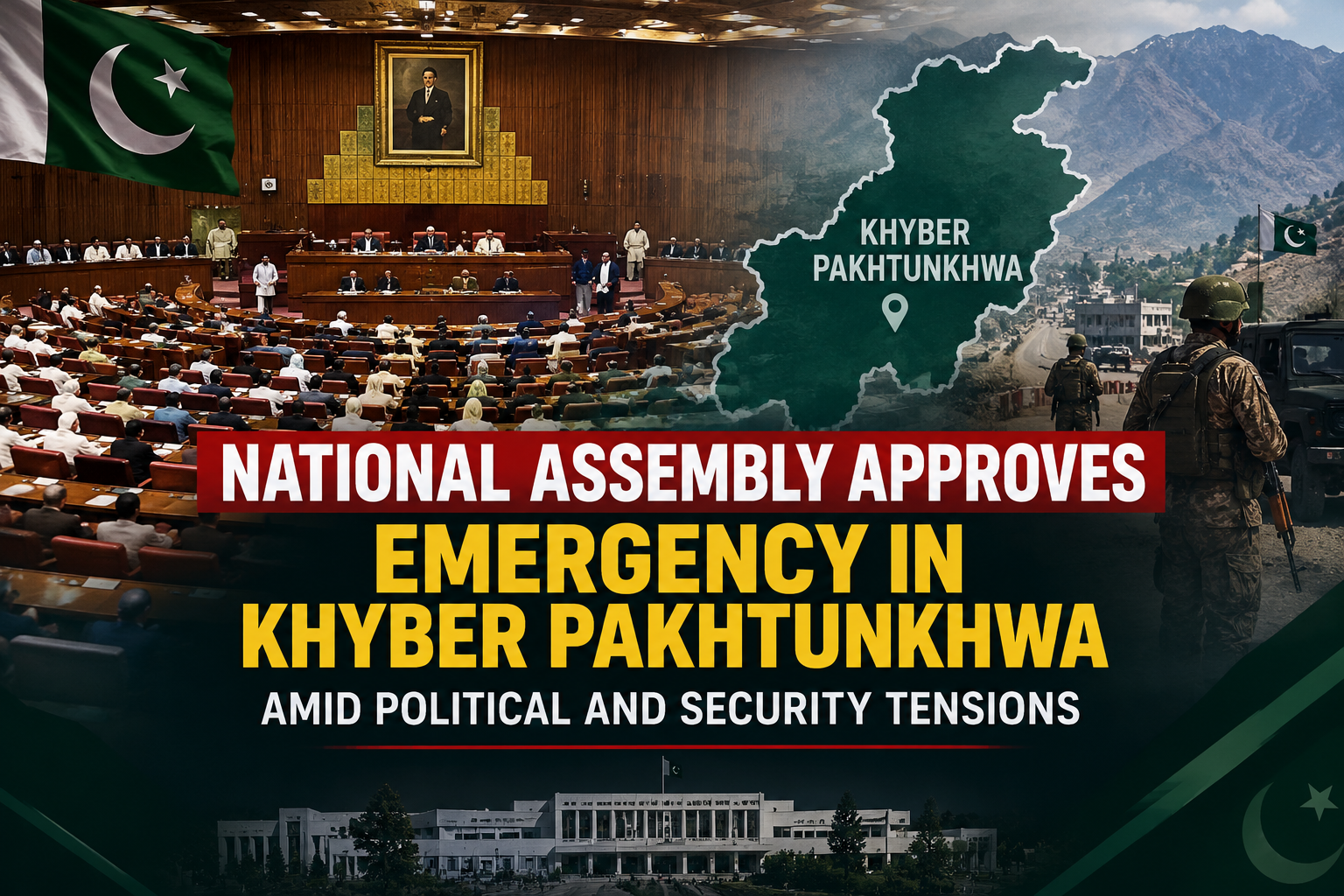
The development is important because Khyber Pakhtunkhwa occupies a strategically significant position along Pakistan’s border with Afghanistan and has experienced persistent security challenges. The emergency decision therefore raises questions not only about political authority but also about how Pakistan can improve public safety while protecting constitutional processes and democratic representation.
Background: Why Was an Emergency Declared in KP?
The emergency declaration came after the federal government expressed concern over the province’s security situation and its approach to counterterrorism. According to federal officials, the provincial administration had not been sufficiently engaged in efforts to address militant violence. The government cited security concerns and what it described as a lack of effective coordination as reasons for taking extraordinary constitutional measures.
Khyber Pakhtunkhwa has long been an important part of Pakistan’s national security discussion. Its geographical position, mountainous terrain, border districts and connections with Afghanistan create complex challenges for law enforcement and public administration. Some districts have faced militant attacks, threats to local communities and difficulties in maintaining consistent security.
These circumstances have made cooperation between federal and provincial institutions particularly important. Counterterrorism operations, intelligence sharing, border management, policing and support for affected communities all require coordination between different levels of government.
However, disagreements over the best approach to security are not unusual in a federal political system. Provincial administrations may have different priorities or assessments, while the federal government is responsible for national-level security policies. When the two levels of government disagree, constitutional procedures become especially important.
The current emergency has brought these longstanding issues into sharper focus. The central question is whether extraordinary federal intervention will improve security coordination and public safety, and how the government will address concerns about democratic representation and provincial authority.
National Assembly Approves the Resolution
On October 14, the National Assembly took up the presidential proclamation of emergency for Khyber Pakhtunkhwa. Federal Minister for Parliamentary Affairs Tariq Fazal Chaudhry presented the resolution, while Law Minister Azam Nazeer Tarar explained the government’s position during the parliamentary discussion.
The House suspended its Question Hour to address the emergency proclamation. Following debate, the resolution received majority support in the National Assembly. The government maintained that parliamentary approval was required under the constitutional procedure associated with the emergency declaration.
The parliamentary vote gave the federal government an important institutional endorsement for its position. At the same time, the vote did not eliminate political disagreement over the decision. Questions about the circumstances leading to the emergency, the proportionality of the measures and their implications for provincial governance remain central to the debate.
Parliamentary proceedings are particularly significant in situations involving emergency powers because they provide a formal setting in which elected representatives can examine the government’s reasoning. Members can raise concerns about public safety, legal authority, civil liberties and the practical consequences of the measures being implemented.
For citizens, the vote also highlights the role of Parliament in major constitutional decisions. National institutions are expected to operate within established legal frameworks, while elected representatives are responsible for scrutinising decisions that affect millions of people.
Senate Also Endorses the Emergency
The developments on October 14 extended beyond the National Assembly. The Senate also approved a resolution endorsing the federal government’s emergency measures in Khyber Pakhtunkhwa. This meant that both houses of Parliament had considered and supported the proclamation.
The involvement of both houses is important because Pakistan’s Parliament consists of the National Assembly and the Senate, which performs a distinct role in representing the federation’s constituent units. The Senate is particularly relevant to discussions about provincial interests because representation in the upper house is designed to give provinces a voice at the federal level.
Approval by both houses strengthens the parliamentary basis of the emergency decision. Nevertheless, parliamentary approval and public acceptance are not necessarily the same thing. Political parties, legal experts, civil society organisations and citizens may continue to disagree about whether the decision was justified and how it should be implemented.
The broader debate is therefore likely to involve more than the outcome of a single vote. It concerns how Pakistan balances security needs with federalism, the authority of elected provincial institutions and the constitutional rights of citizens.
What Does Emergency Rule Mean for Provincial Governance?
An emergency declaration is an extraordinary constitutional measure. It can alter the way public authority is exercised, depending on the relevant constitutional provisions and the terms of the proclamation.
In the case of Khyber Pakhtunkhwa, the federal government announced emergency and governor’s rule on October 11. Officials said the provincial government's executive powers would cease to operate in their previous form, with authority transferred to the governor and a newly established advisory arrangement.
Under ordinary circumstances, a provincial government is responsible for managing matters assigned to the province, including significant aspects of administration, public services and local governance. The chief minister leads the provincial executive, supported by the cabinet and relevant departments.
Emergency arrangements can change how those responsibilities are managed. This makes the legal details, duration of the proclamation, administrative instructions and applicable constitutional safeguards especially important.
It is also necessary to distinguish between a change in executive authority and the permanent abolition of representative institutions. The precise consequences depend on the applicable legal orders and subsequent decisions. The public should therefore avoid assuming that every provincial institution has automatically disappeared or that every aspect of provincial administration has changed in the same way.
For residents, the immediate practical questions concern continuity. People need to know whether public offices will remain operational, whether government employees will continue their duties, how local security decisions will be made and whether services such as healthcare, education and municipal administration will continue without disruption.
A successful administrative transition would need to maintain essential services while clarifying responsibilities for officials and citizens.
The Federal Government’s Position on Security
Federal officials have argued that the emergency was necessary because the security situation in Khyber Pakhtunkhwa had become increasingly concerning. During the parliamentary discussion, Law Minister Azam Nazeer Tarar referred to internal disturbances, cross-border infiltration and the need for a stronger response to terrorism. He also cited a government figure of 3,787 terrorist incidents recorded in the province over the preceding year.
That figure should be understood as a claim presented by a government official in Parliament, rather than an independently verified assessment of every incident. A comprehensive assessment would require clear definitions of what was counted, the period covered, the geographical distribution of incidents and corroboration from relevant security data.
Nevertheless, the government’s stated rationale places counterterrorism at the centre of the debate. Authorities contend that the state must be able to respond effectively to threats and that coordination between institutions is essential when public safety is at risk.
From this perspective, the emergency is intended to address what the federal government views as weaknesses in the existing security response. Officials have presented the measure as a means of strengthening administrative coordination and placing greater emphasis on counterterrorism.
The effectiveness of that approach, however, cannot be determined solely by the announcement or parliamentary vote. It will depend on practical outcomes, including whether attacks decline, communities become safer, law enforcement operates effectively and residents experience improvements in daily life.
PTI Rejects the Federal Intervention
The Pakistan Tehreek-e-Insaf has strongly opposed the emergency measures. The party has argued that the intervention undermines provincial authority and is politically motivated. It has also challenged the federal decision through legal proceedings.
PTI’s objections are closely connected to its political position in Khyber Pakhtunkhwa, where it previously led the provincial administration. The party views the suspension of its government as a major challenge to its electoral mandate and has questioned whether the security justification adequately explains the federal action.
The federal government and PTI therefore offer different interpretations of the same development. Federal officials emphasise security concerns and the need for stronger coordination. PTI argues that the intervention threatens provincial autonomy and has political implications.
These competing positions should be examined separately from the verified procedural facts. The emergency was proclaimed, and both houses of Parliament approved resolutions endorsing it. Whether the decision is ultimately upheld against legal challenges, and whether its implementation achieves the stated objectives, are separate questions.
In a democratic system, political disagreement does not by itself establish that a decision is unlawful. Equally, approval by a parliamentary majority does not make scrutiny, judicial review or public debate unnecessary.
The situation calls for evidence-based discussion of the government’s reasons, the legal framework and the consequences for the people of the province.
Legal and Constitutional Questions
One of the most important aspects of the emergency is its constitutional basis. The federal government announced that the measures were taken under Articles 232 and 234 of Pakistan’s Constitution. Article 232 concerns the proclamation of an emergency in specified circumstances, while Article 234 addresses situations involving a failure of constitutional machinery in a province. The government’s October 11 announcement referred to both provisions.
The application of these provisions raises several questions that are relevant to legal experts, elected representatives and the general public.
First, what evidence supports the declaration? Emergency powers are significant because they permit extraordinary responses to situations that the government considers serious. The factual basis for such a decision is therefore important when assessing its legality and necessity.
Second, what procedures must be followed? Constitutional provisions establish rules for the exercise and review of public authority. Compliance with those rules helps ensure that exceptional measures do not become a substitute for ordinary democratic governance.
Third, how long should the measures remain in place? Emergency arrangements raise questions about duration, oversight and the circumstances under which normal governance should resume. These issues should be addressed through the relevant constitutional procedures rather than political assumptions.
Finally, what remedies are available to those who challenge the decision? Courts can play an important role in examining disputes about constitutional authority, subject to the applicable law and the cases brought before them.
These questions are not unique to Pakistan. Governments in many countries face the challenge of responding to security threats while preserving constitutional accountability. Pakistan’s experience demonstrates why clearly defined powers, independent scrutiny and transparent decision-making matter during periods of political tension.
Impact on Provincial Autonomy
Provincial autonomy is a central feature of Pakistan’s federal structure. It concerns the distribution of authority between the federal government and the provinces, including the responsibilities assigned to provincial institutions.
The emergency in Khyber Pakhtunkhwa has revived debate about how that distribution should operate when federal authorities believe a province is not responding adequately to a serious security challenge.
Supporters of the federal decision argue that national security cannot be separated from provincial administration. If government institutions fail to coordinate effectively, they contend, the federal government must have the ability to respond within the Constitution.
Critics, meanwhile, warn that extraordinary intervention can weaken representative government and create uncertainty about the independence of provincial institutions. They argue that political disagreements should not automatically result in the removal or suspension of an elected administration.
Both the principle of public security and the principle of representative government are important to the discussion. The practical challenge is to determine how constitutional mechanisms can address genuine security concerns without unnecessarily undermining democratic accountability.
The situation also raises questions about how federal and provincial governments can cooperate more effectively in the future. Regular security consultations, clear divisions of responsibility, transparent reporting and agreed mechanisms for resolving disputes could help prevent disagreements from escalating.
A stable federal system requires institutions to work together even when political parties disagree. Security cooperation is more sustainable when it is supported by clear procedures, reliable information and public confidence.
What Could the Emergency Mean for Ordinary Citizens?
For people living in Khyber Pakhtunkhwa, the most important issue is not simply which political institution holds executive authority. It is whether the change improves safety and protects access to essential public services.
Residents need reliable information about the operation of government departments, local administration, schools, hospitals and other public facilities. Uncertainty surrounding major political decisions can create anxiety, particularly in communities that have already experienced insecurity.
The government must therefore communicate practical information clearly. Citizens should be able to understand which offices are responsible for particular services, where official announcements can be obtained and how administrative complaints will be handled.
Public safety should also remain a priority during any transition. Local communities need effective law enforcement, emergency response services and mechanisms for reporting threats. These responsibilities require coordination among the institutions involved in security and administration.
At the same time, residents should not be treated merely as observers of a political dispute. Their experiences provide important evidence about whether government policies are working. Reports of disrupted services, security concerns or administrative difficulties can help authorities identify problems that need attention.
The impact will also differ between districts. Areas affected by security operations may face different challenges from larger urban centres, where concerns may focus more on transport, public gatherings or access to government offices.
For this reason, an assessment of the emergency should consider conditions across the province rather than relying on a single overall description.
Implications for Schools, Healthcare and Public Services
Major changes in government authority can raise questions about the continuity of essential services, even when no immediate disruption has been announced.
Education is one area where clarity matters. Students, teachers and parents need accurate information about school schedules, examinations and any local security arrangements. Decisions affecting educational institutions should be communicated through official channels and should take local circumstances into account.
Healthcare is equally important. Hospitals, clinics, emergency departments and public health programmes must continue to serve communities regardless of political developments. Clear administrative responsibilities can help ensure that staffing, supplies and patient services remain organised.
Municipal services, transport arrangements and local development projects also require attention. Residents depend on government departments for documentation, sanitation, infrastructure maintenance and other everyday needs.
The emergency does not automatically mean that every service will be suspended or altered. The actual impact depends on the instructions issued by the relevant authorities and how the administrative transition is managed.
Officials should provide timely updates whenever changes affect the public. Transparent communication can reduce confusion and help residents distinguish confirmed instructions from speculation circulating on social media.
Continuity of services is also a useful measure of administrative performance. A government arrangement that maintains essential services while addressing security concerns is more likely to retain public confidence than one that leaves residents uncertain about basic responsibilities.
Security Challenges and the Importance of Local Communities
Khyber Pakhtunkhwa’s security challenges cannot be understood solely through political disagreements in Islamabad or Peshawar. Local communities experience the consequences of violence, insecurity and disruption in their daily lives.
A sustainable security strategy generally requires more than changes in administrative control. It depends on effective policing, reliable intelligence, coordination among relevant institutions, functioning courts and cooperation with communities.
Local residents can help authorities understand security concerns, identify service gaps and communicate the needs of affected areas. However, communities must also be protected from intimidation and should have confidence that information provided to authorities will be handled responsibly.
Economic opportunities and public services can also influence long-term stability. When people have access to education, healthcare, employment and functioning local institutions, communities are better positioned to recover from disruption and participate in civic life.
Security operations may be necessary in response to specific threats, but their broader effectiveness should be assessed through measurable outcomes. These can include changes in incident levels, civilian safety, the ability of people to travel safely and the restoration of ordinary economic activity.
The emergency will therefore be judged not only by the administrative changes it introduces but also by whether people experience a meaningful improvement in security.
Political Stability and the Need for Dialogue
Pakistan’s political environment has experienced persistent tensions between major political parties and state institutions. The emergency in Khyber Pakhtunkhwa adds another significant issue to an already difficult political landscape.
When parties disagree over the legitimacy or purpose of government decisions, public debate can become increasingly confrontational. This can make it harder for institutions to focus on shared challenges, including security, economic stability and public service delivery.
Dialogue does not require political parties to abandon their positions. Instead, it provides a way to discuss disagreements, examine evidence and identify areas where cooperation is possible.
The federal government and PTI could benefit from clear communication about the security measures being pursued, the responsibilities of the relevant authorities and the procedures governing the emergency. Legal disputes should proceed through the appropriate institutions, while political representatives should avoid statements that unnecessarily increase public anxiety.
Other political parties, parliamentary committees, lawyers and civil society organisations may also contribute to discussions about constitutional safeguards and public accountability.
A peaceful political environment is important for governance because uncertainty can distract institutions from their regular responsibilities. Businesses, educational institutions and public services benefit when administrative rules are clear and political disputes are managed through established procedures.
Ultimately, stability requires more than the absence of protests. It also requires confidence that public institutions operate lawfully, that security concerns receive serious attention and that citizens have meaningful ways to seek accountability.
What Happens Next?
The next stage will depend on how the emergency is implemented, how the relevant legal questions develop and whether the authorities can demonstrate improvements in security.
Several developments deserve attention.
1. Implementation of the emergency measures
The authorities will need to clarify administrative responsibilities and explain how the new arrangements will operate. Consistent instructions can reduce uncertainty for government employees, local officials and members of the public.
2. Legal challenges
PTI has opposed the intervention and pursued legal avenues to challenge it. The progress and outcomes of any relevant proceedings will be important in determining how the dispute develops.
3. Security conditions
Changes in the frequency and severity of security incidents will be important indicators of whether the government's stated objectives are being achieved. Reliable data and transparent reporting will be necessary to assess progress.
4. Continuity of public services
Residents will need clear information about education, healthcare and other government services. Any administrative changes should be communicated promptly.
5. Political dialogue
Further engagement between political parties and state institutions could help reduce tensions and establish clearer expectations about security cooperation and constitutional responsibilities.
These developments will determine whether the emergency becomes a temporary response to a specific crisis or leads to a longer period of political and administrative uncertainty.
Why This Development Matters for Pakistan
The National Assembly's approval of the emergency in Khyber Pakhtunkhwa is significant because it brings together several major national concerns: security, federalism, constitutional authority and political representation.
The federal government maintains that extraordinary measures are necessary to address serious security challenges. PTI contests the intervention and argues that it undermines provincial autonomy. Both positions form part of a wider debate about how Pakistan should manage security threats while maintaining democratic institutions.
For the public, the most useful way to assess the situation is to distinguish confirmed developments from political claims. The parliamentary approvals are established events, while the ultimate legal implications and long-term effects remain dependent on subsequent decisions and evidence.
The effectiveness of the emergency should ultimately be measured against clear objectives. Are communities safer? Are government services functioning? Are constitutional procedures being followed? Is political disagreement being managed peacefully? These questions offer a more meaningful basis for evaluating the outcome than political statements alone.
Pakistan's long-term stability depends on institutions that can respond to security challenges while maintaining public trust. Transparent administration, effective law enforcement, legal accountability and constructive political engagement can all contribute to that goal.
As developments continue, Khyber Pakhtunkhwa will remain an important focus of national attention. The coming weeks will be particularly significant in showing how the emergency affects security, governance and the relationship between the federal government and provincial political institutions.
Conclusion
The National Assembly's approval of the emergency in Khyber Pakhtunkhwa on October 14, 2026, marks an important development in Pakistan's political and constitutional affairs. The Senate also approved the measure, following the presidential proclamation issued on October 11.
The federal government has defended the intervention on security grounds, while PTI has challenged its political and constitutional implications. The disagreement highlights the difficult balance between maintaining public safety and protecting provincial autonomy.
The real test will be the results. Effective security measures, continued public services, transparent decision-making and respect for constitutional procedures will be essential in determining the impact of the emergency.
For Pakistan, this moment presents an opportunity to demonstrate that security and democratic accountability can be pursued together. The priority should remain the safety, rights and well-being of the people of Khyber Pakhtunkhwa.
FAQs
1. What happened in Pakistan on October 14, 2026?
Pakistan's National Assembly approved a resolution endorsing the emergency imposed in Khyber Pakhtunkhwa. The Senate also approved a resolution supporting the measure.
2. Why did the federal government impose an emergency in Khyber Pakhtunkhwa?
The federal government cited security concerns, militant violence and what it described as insufficient provincial engagement in counterterrorism efforts.
3. Who announced the emergency in Khyber Pakhtunkhwa?
President Asif Ali Zardari issued the emergency proclamation on October 11, 2026, following the federal government's recommendation.
4. How has PTI responded to the emergency?
PTI has opposed the federal intervention, questioned its political and constitutional implications, and pursued legal avenues to challenge it.
5. How could the emergency affect the people of Khyber Pakhtunkhwa?
Its effects will depend on implementation. Security arrangements, administrative responsibilities and the continuity of essential public services will be important issues for residents.