Introduction
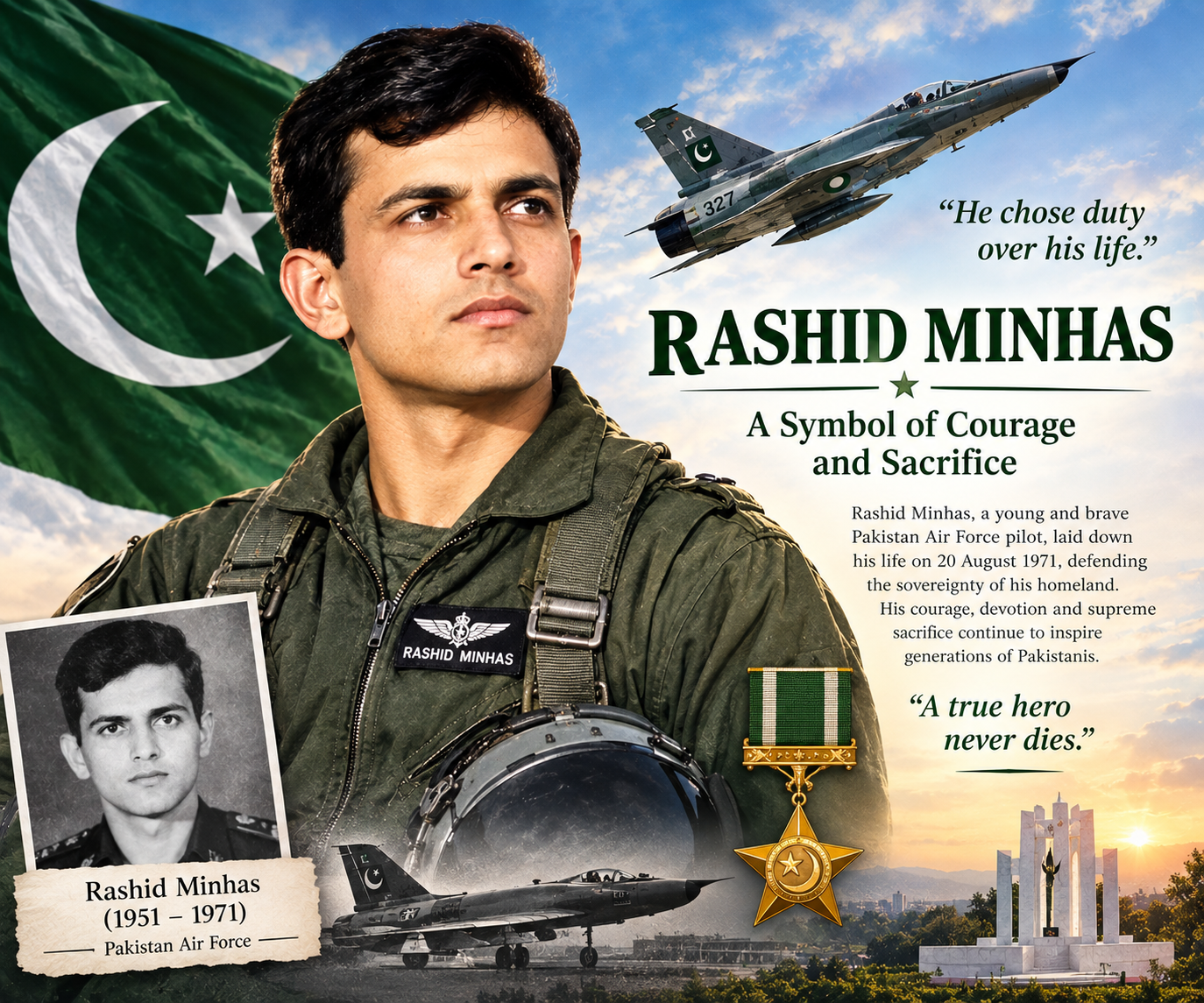
Rashid Minhas was one of the most respected fighter pilots in the history of Pakistan. He served in the Pakistan Air Force (PAF) and became famous for his courage, sense of duty, and sacrifice for his country. Although his life was very short, his service and the circumstances of his death made him an important figure in Pakistan's history.
Rashid Minhas is especially remembered for the events of 20 August 1971, when he was involved in an aircraft incident involving another PAF officer. During the incident, Minhas attempted to prevent an aircraft from being taken out of Pakistan. His actions ultimately cost him his life, and he was later awarded the Nishan-e-Haider, Pakistan's highest military award for acts of extraordinary bravery.
His story is often taught to young Pakistanis as an example of courage, loyalty, patriotism, and dedication to duty. His life also shows how professional training and a strong sense of responsibility can become extremely important during a crisis.
Early Life of Rashid Minhas
Rashid Minhas was born on 17 February 1951 in Karachi. He belonged to a family that valued education, discipline, and professional development.
From an early age, Rashid showed an interest in aviation and technology. Aircraft were becoming an increasingly important part of modern defense, and flying attracted many young people who were interested in science, engineering, and adventure.
Rashid was known for being serious about his studies and future. He understood that becoming a military pilot was not an ordinary career. It required extensive education, technical knowledge, physical preparation, and discipline.
His early education helped him build the foundation for his future career. He developed an interest in subjects related to aviation and engineering, which eventually encouraged him to pursue a professional path in the Pakistan Air Force.
Interest in Aviation
Aviation requires a combination of scientific understanding and practical skill. A pilot must understand how an aircraft behaves in the air, how its systems work, and how to respond to changing conditions.
Rashid Minhas became increasingly interested in flying as he grew older. He was attracted to the technical and professional nature of the aviation field.
His interest was not simply a childhood dream. He worked toward turning it into a career through education and preparation.
This aspect of his life is important for students because it demonstrates the value of converting an interest into a clear goal. Many young people have dreams, but achieving those dreams requires study, discipline, and consistent effort.
Rashid's journey from a young student interested in aviation to a trained military pilot reflects that process.
Joining the Pakistan Air Force
Rashid Minhas joined the Pakistan Air Force and began the process of becoming a professional military pilot. He received training in aviation, aircraft operations, navigation, communication, and military procedures.
Pilot training is physically and mentally demanding. Trainees have to learn how to control aircraft accurately while also understanding technical information and responding to instructions.
For fighter pilots, the training is even more demanding because military aircraft operate in complex environments and pilots may have to deal with emergencies or combat situations.
Rashid successfully completed his training and became a commissioned officer in the Pakistan Air Force. He began serving as a young officer at a time when Pakistan's political and military environment was under significant pressure.
His career was still in its early stages, but the skills he had developed through training soon became extremely important.
Becoming a Young Fighter Pilot
Rashid Minhas became associated with the Pakistan Air Force's fighter aviation and trained to operate military aircraft.
A fighter pilot has to maintain strong concentration and understand aircraft controls, navigation systems, communication procedures, and emergency actions.
Rashid was a relatively young officer, but his training had prepared him to handle responsibilities that came with military aviation.
His story is especially remarkable because he had not spent decades in military service before becoming nationally famous. His recognition came because of one extraordinary event during his early career.
This shows that historical importance is not always connected with the length of a person's career. Sometimes a person's actions during a single critical moment can become an enduring part of national history.
Pakistan in 1971
To understand Rashid Minhas's story, it is important to understand the circumstances of 1971.
Pakistan was experiencing a serious political and military crisis. The country was divided geographically into West Pakistan and East Pakistan, with significant tensions and conflict affecting the state.
The situation eventually led to war between Pakistan and India, and the political circumstances of the country were highly unstable.
In this difficult environment, military personnel were carrying out demanding duties. The Pakistan Air Force was also operating under challenging conditions.
Rashid Minhas was serving during this tense period. His professional responsibilities became closely connected with the rapidly changing circumstances of 1971.
The Incident of 20 August 1971
The most important event in Rashid Minhas's life took place on 20 August 1971.
According to the established Pakistani account, Minhas was preparing to fly from a PAF base when another officer, Pilot Officer Matiur Rahman, entered the aircraft and attempted to take control of it.
The aircraft was a Lockheed F-86 Sabre, a fighter aircraft used by the Pakistan Air Force at the time.
Minhas realized that the aircraft was being diverted. He attempted to regain control and prevent it from leaving Pakistan.
This situation developed rapidly and placed Minhas in an extremely dangerous position.
Minhas's Attempt to Regain Control
As the aircraft was already airborne, Rashid Minhas tried to regain control of the plane.
The exact technical details of the struggle inside the aircraft are part of historical accounts, but the central point is that Minhas understood that the aircraft was being taken in a direction he was not authorized to fly.
He attempted to stop the diversion and fulfill his duty as a military pilot.
The situation required immediate decisions. Aviation emergencies are dangerous even under normal circumstances, and the situation was further complicated by the struggle over control of the aircraft.
Minhas continued trying to prevent the aircraft from reaching its intended destination.
The Final Flight
The aircraft eventually crashed in the Thatta area of Sindh.
Rashid Minhas was killed in the crash. He was only 20 years old.
The event became one of the most famous stories in the history of the Pakistan Air Force because Minhas had attempted to prevent the aircraft from being taken out of Pakistan.
His death was therefore remembered not simply as an aviation accident but as an incident involving military duty, national security, and personal sacrifice.
The tragedy also emphasized the dangers faced by military pilots, especially during periods of political and national crisis.
Award of the Nishan-e-Haider
After his death, Rashid Minhas was awarded the Nishan-e-Haider.
The Nishan-e-Haider is Pakistan's highest military decoration and is awarded for exceptional acts of valor in the face of extraordinary danger.
Rashid Minhas became the youngest recipient of the Nishan-e-Haider in Pakistan's history at the time associated with his recognition.
The award made him a national symbol of courage and sacrifice.
His name was added to the country's list of military heroes, and his story became part of Pakistan's national educational and military narratives.
Why the Nishan-e-Haider Is Important
The Nishan-e-Haider is a highly significant military award in Pakistan. It recognizes extraordinary bravery by members of the armed forces.
Receiving such an award after death means that the recipient's actions are considered to have demonstrated exceptional devotion to duty.
For Rashid Minhas, the award was connected to his final actions during the 20 August 1971 incident.
The recognition ensured that his short life would continue to be remembered by future generations.
Students often encounter his name when learning about Pakistan's military history because his story combines bravery, sacrifice, and national service.
Rashid Minhas as an Example of Courage
Courage is one of the most important themes in the story of Rashid Minhas.
He was in a dangerous situation but continued trying to protect the aircraft and prevent it from being diverted.
His actions are remembered as an example of courage under pressure.
However, courage should not be understood simply as acting without fear. In professional settings, courage often means remaining committed to one's responsibilities even when circumstances are difficult.
Minhas's story is frequently used to illustrate this idea.
His actions during the final flight reflected a strong commitment to the responsibilities associated with his role as a Pakistan Air Force officer.
Patriotism and Sense of Duty
Another important theme in Rashid Minhas's life is patriotism.
As a military officer, Minhas had taken an oath to serve Pakistan. During the aircraft incident, he attempted to prevent the plane from being taken away.
His actions are therefore remembered as an expression of loyalty to his country and his military duties.
Patriotism can take different forms in civilian life as well. It can include working honestly, respecting laws, helping communities, studying seriously, and contributing positively to society.
For students, the story of Rashid Minhas can therefore be understood as an example of taking responsibility for one's role.
A Very Short Life
One of the most striking aspects of Rashid Minhas's story is how young he was when he died.
At only 20 years of age, he had already entered a demanding professional career and achieved a place in Pakistan's military history.
His short life reminds us that age does not necessarily determine the importance of a person's actions.
Young people can also demonstrate responsibility, discipline, and courage.
At the same time, his story should be understood within the broader context of the risks associated with military aviation. Fighter pilots are trained for dangerous conditions, and their work involves serious responsibilities.
Rashid Minhas and the Pakistan Air Force
Rashid Minhas remains closely associated with the Pakistan Air Force.
The PAF has a long tradition of honoring officers and pilots who have demonstrated courage and dedication. Rashid Minhas is among the most famous figures in that tradition.
His story has been remembered in military ceremonies, educational material, historical accounts, and public discussions.
The PAF's institutional history includes many pilots who served during wars and difficult periods. Rashid Minhas stands out because his final mission became a defining event in his life.
His story is therefore an important part of the history and culture of the Pakistan Air Force.
The Role of Training in His Story
Rashid Minhas's actions also demonstrate the importance of professional training.
A pilot must know how to respond when something unexpected happens. Training provides the knowledge and skills required to act in emergencies.
Minhas had been trained as a professional military pilot, and that training became crucial during the aircraft incident.
This is an important lesson for students. Training may sometimes seem repetitive, but repeated practice prepares people to respond when circumstances suddenly become difficult.
Whether a person wants to become a pilot, engineer, doctor, teacher, lawyer, or business professional, preparation plays an important role in future performance.
Technical Side of Fighter Aviation
The story of Rashid Minhas also provides an opportunity to understand the technical nature of fighter aviation.
A military pilot has to understand aircraft controls, engines, navigation systems, communication equipment, and emergency procedures.
The F-86 Sabre was a well-known jet fighter aircraft used by several countries during the Cold War period. It required trained pilots to operate it effectively.
Flying a high-performance military aircraft requires careful attention to speed, altitude, direction, communication, and aircraft status.
This technical complexity helps explain why professional military pilots require extensive training.
Rashid Minhas was still a young pilot, but he had undergone the preparation necessary for his role.
His Place in Pakistani History
Rashid Minhas occupies a unique place in Pakistan's national history.
Unlike historical figures whose careers lasted for decades, his public legacy was created by a single event during a very short military career.
The story of his final flight became a part of the national memory of 1971.
His name is frequently mentioned alongside Pakistan's other recipients of the Nishan-e-Haider.
In this way, Minhas became more than an individual pilot. He became a symbol associated with courage, sacrifice, and national duty.
Memorials and Recognition
Rashid Minhas has been remembered through a variety of memorial and educational efforts.
His name has been used for roads, buildings, institutions, and public facilities in Pakistan.
Such recognition helps preserve the memory of national figures and allows later generations to learn about their contributions.
Schools and educational organizations have also referred to Rashid Minhas as an example of courage and determination.
Public remembrance is important because historical stories can help students understand the values and challenges of earlier generations.
Rashid Minhas in Educational Discussions
The life of Rashid Minhas is often discussed in schools because it offers several straightforward lessons.
Students can learn about discipline, duty, courage, professional responsibility, and national service through his story.
His short life is also a reminder that education and preparation are important long before a person faces a major challenge.
His example can encourage students to take their studies seriously and develop their abilities.
It also highlights the idea that responsibility comes with every professional role.
Lessons for Young People
There are many lessons young people can take from Rashid Minhas's life.
The first is discipline. A military pilot has to follow strict procedures and maintain professional standards.
The second is preparation. Minhas was able to respond during a crisis because he had received professional training.
The third is responsibility. He took his role seriously even when the situation became dangerous.
The fourth is courage. He did not simply abandon his responsibilities when faced with a serious threat.
The fifth is service. His career was centered on serving his country.
These values are useful in ordinary life as well. Students can apply them to education, career planning, family responsibilities, and community life.
Importance of Professional Integrity
Rashid Minhas's story is also connected with the idea of professional integrity.
Integrity means remaining committed to one's responsibilities and principles.
In any profession, people are trusted to perform certain duties. Pilots are responsible for aircraft and passengers or, in military aviation, for missions and national security.
Minhas's final actions are remembered because they reflected his understanding of that responsibility.
The broader lesson is that professional integrity matters in every field.
A student who develops honesty and responsibility early in life is better prepared for future professional roles.
His Legacy Among PAF Personnel
Within the Pakistan Air Force, Rashid Minhas has remained a particularly respected figure.
His name is associated with sacrifice and the highest level of military recognition.
The PAF has continued to honor its heroes as part of its institutional heritage, and Minhas remains an important part of that tradition.
His story is especially powerful because he achieved such recognition at a very young age.
For younger officers and cadets, his life can serve as a historical example of dedication to duty.
Rashid Minhas and National Identity
National heroes often become part of a country's identity because their stories are repeated across generations.
Rashid Minhas is one such figure in Pakistan.
His name appears in historical accounts, military ceremonies, educational lessons, and public memorials.
His story helps preserve the memory of a difficult period in Pakistan's history and highlights the role of individuals during national crises.
For many Pakistanis, Rashid Minhas represents the idea that loyalty and responsibility can have lasting significance.
The Human Side of His Story
Behind every historical figure is a human life filled with hopes, ambitions, family relationships, and future plans.
Rashid Minhas was only 20 when his life ended. At that age, many young people are just beginning university, careers, and adult life.
Minhas had already chosen a demanding profession and begun serving in the Pakistan Air Force.
His early death reminds us of the personal sacrifices that can accompany military service.
It also explains why his story continues to receive emotional attention in Pakistan.
Why Rashid Minhas Remains Famous
Rashid Minhas remains famous because his story combines several powerful elements of Pakistani history.
He was a young fighter pilot, a member of the Pakistan Air Force, a participant in a critical event during 1971, and a recipient of the Nishan-e-Haider.
His age at the time of his death also made his story particularly memorable.
The combination of youth, military responsibility, crisis, and sacrifice helped ensure that his name remained known long after his death.
Comparison with Other Pakistani Air Force Heroes
Pakistan's Air Force has produced many famous pilots and military heroes. Figures such as M. M. Alam and Cecil Chaudhry are remembered for their service and wartime experiences, while Rashid Minhas is especially known for his actions in the 1971 aircraft incident.
Each of these figures represents a different part of Pakistan's aviation history.
M. M. Alam became particularly famous for his aerial combat record during the 1965 war.
Cecil Chaudhry was remembered for his service in major conflicts and later educational work.
Rashid Minhas is remembered primarily for his final act of duty and the sacrifice that followed.
Together, their stories illustrate the varied experiences of Pakistani military pilots.
A Role Model for Students
Rashid Minhas can be considered a historical role model because of the qualities associated with his service.
Students can learn from the discipline required to become a pilot and the responsibility associated with military service.
His story encourages young people to take their goals seriously and work consistently toward them.
It also highlights the importance of remaining responsible during difficult situations.
Students do not need to enter the military to learn from his example. The principles of preparation, commitment, honesty, and service are relevant in every career.
Remembering Rashid Minhas
Remembering national heroes is one way of preserving history.
Rashid Minhas's story continues to be remembered because it is connected with one of the most important periods in Pakistan's history.
His name remains familiar to students and military personnel, and his story continues to appear in educational discussions.
The fact that a young pilot from Karachi became a national figure demonstrates how historical events can shape individual lives and national memory.
His legacy therefore belongs not only to the Pakistan Air Force but also to Pakistan's broader history.
Conclusion
Rashid Minhas was a young Pakistani fighter pilot whose life became a lasting part of the country's history. Born in Karachi in 1951, he pursued his interest in aviation and joined the Pakistan Air Force, where he trained as a military pilot.
His most famous moment came on 20 August 1971, when he attempted to prevent an aircraft from being taken out of Pakistan. The aircraft eventually crashed in Sindh, and Minhas lost his life at only 20 years of age.
For his actions, he was awarded the Nishan-e-Haider, Pakistan's highest military award for extraordinary bravery. His recognition made him one of the best-known military heroes in Pakistan.
Rashid Minhas's story teaches important lessons about courage, discipline, preparation, responsibility, and service. His life was short, but his legacy has continued for generations.
For students, his story is a reminder that age does not prevent a person from making an important contribution. It also shows that goals require preparation and that responsibility matters most when situations become difficult.
Rashid Minhas remains an important name in Pakistan's military and aviation history. His story continues to be remembered as an example of courage and sacrifice, and his place in the history of the Pakistan Air Force remains secure.
FAQs
1. Who was Rashid Minhas?
Rashid Minhas was a Pakistani fighter pilot and officer of the Pakistan Air Force. He became famous for his actions during an aircraft incident in 1971.
2. When did Rashid Minhas die?
Rashid Minhas died on 20 August 1971 after the aircraft he was flying crashed in the Thatta area of Sindh.
3. Which award did Rashid Minhas receive?
He was awarded the Nishan-e-Haider, Pakistan's highest military award for extraordinary acts of bravery.
4. How old was Rashid Minhas when he died?
Rashid Minhas was 20 years old when he died.
5. Why is Rashid Minhas famous?
He is famous for attempting to prevent an aircraft from being taken out of Pakistan in 1971 and for receiving the Nishan-e-Haider after his death.




