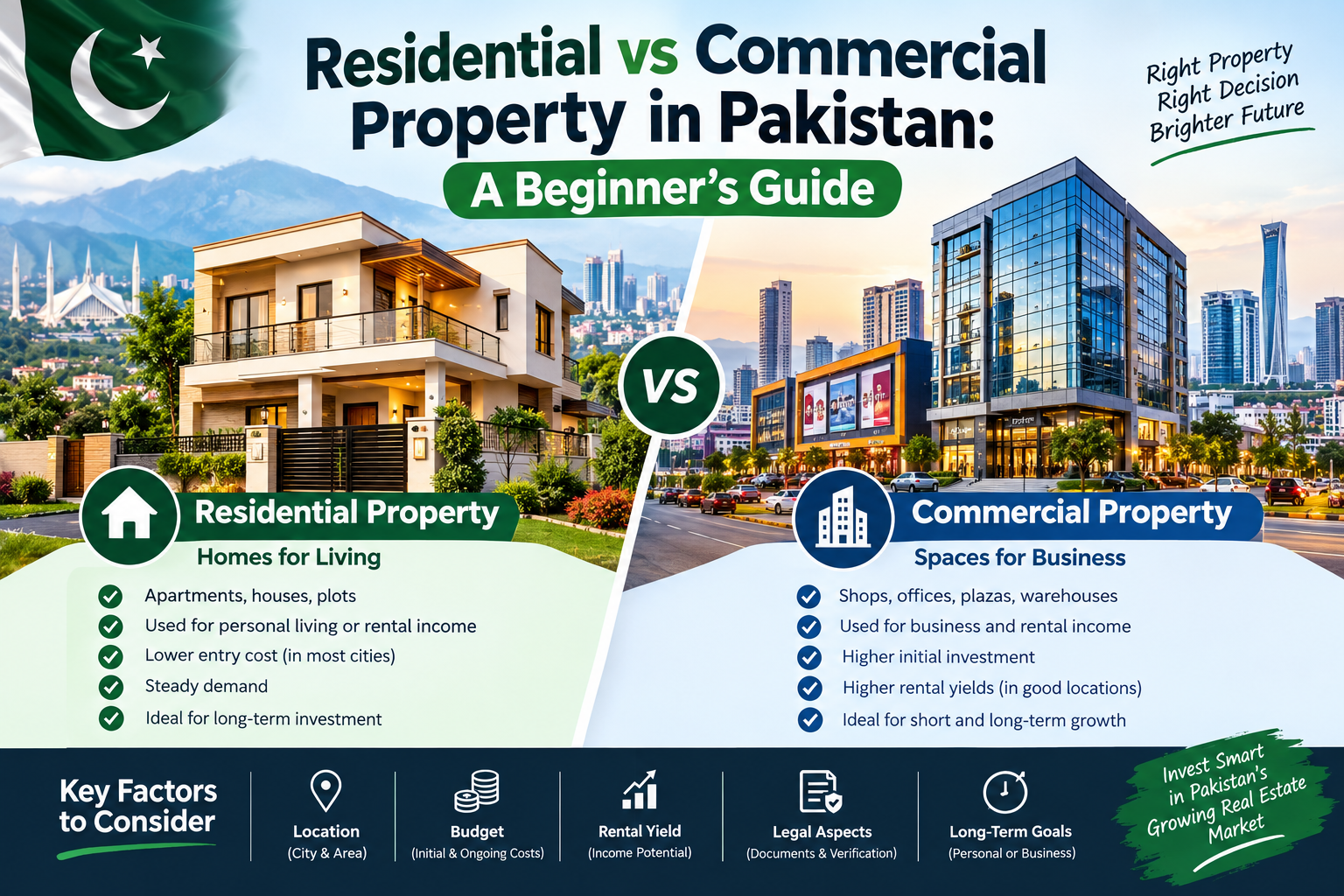
Real estate is an important investment sector in Pakistan, and people choose different types of properties according to their financial goals and personal needs. Among the most common choices are residential and commercial properties. Both can offer opportunities, but they have different purposes, costs, risks, and management requirements.
Residential property generally includes houses, apartments, flats, and residential plots. Commercial property includes shops, offices, commercial plots, plazas, warehouses, and other spaces used for business activities.
For beginners, deciding between residential and commercial property can be difficult. A property may look attractive because of its location or price, but investors should consider several factors before making a decision.
This guide explains the major differences between residential and commercial property in Pakistan and discusses the factors that buyers should consider before investing.
What Is Residential Property?
Residential property is real estate primarily intended for people to live in.
Common examples include:
Houses
Apartments
Flats
Villas
Residential plots
Portions of houses
Residential property can be purchased for personal use, rental income, or long-term investment.
For example, a family may purchase a house to live in, while an investor may purchase an apartment and rent it to a tenant.
What Is Commercial Property?
Commercial property is generally used for business and commercial activities.
Examples include:
Shops
Offices
Commercial plots
Shopping centers
Plazas
Warehouses
Business units
Commercial property can be used directly by the owner or rented to businesses.
A shop in a busy market, for example, may be used by a retailer, while an office building can be occupied by a company or professional service provider.
Main Difference Between Residential and Commercial Property
The biggest difference is their intended use.
Residential property is primarily designed for living, while commercial property is designed for business activities.
Their markets can also behave differently.
Residential demand is often influenced by population, family needs, employment, schools, hospitals, and transportation.
Commercial demand can be influenced by customer traffic, business activity, accessibility, nearby markets, offices, and economic conditions.
This means investors should select a property type according to their investment purpose rather than simply choosing the option that appears more profitable.
Residential Property for Personal Use
One of the main reasons people purchase residential property is to build or buy a home.
Owning a home can provide stability and allow families to select a location according to their needs.
When choosing residential property for personal use, buyers may consider:
Distance from workplace
Schools and colleges
Hospitals
Markets
Public transport
Road access
Neighborhood environment
Electricity and water availability
Security
Future development
The most important factor may be convenience rather than potential resale value.
Residential Property for Rental Income
Residential property can also be purchased for rental purposes.
Apartments and houses may be rented to families, students, professionals, or other tenants depending on the location.
Rental demand can vary significantly from one area to another.
Locations near universities, hospitals, offices, industrial areas, and major commercial centers may have different rental requirements.
Before purchasing a property for rental income, investors should research actual rents in the area.
They should also consider maintenance, vacancy periods, taxes, utility responsibilities, and property management.
Commercial Property for Business
Commercial property is commonly purchased for business use.
A shop can be used for retail, while an office can be used by a company, consultant, clinic, or other professional service.
The success of a commercial property can depend heavily on its location.
Factors such as visibility, customer access, parking, road connectivity, surrounding businesses, and foot traffic may influence commercial demand.
A large shop in a low-traffic area may not necessarily perform better than a smaller shop in a well-established commercial location.
Commercial Property for Rental Income
Some investors purchase commercial property specifically for rental income.
For example, an investor may purchase a shop and rent it to a business.
Commercial leases can have different terms and conditions from residential rental agreements. The lease duration, rent adjustments, maintenance responsibilities, and permitted business activities should be clearly documented.
Investors should also understand that commercial property can remain vacant for periods of time, particularly when business conditions are weak.
Importance of Location
Location is important for both residential and commercial property, but different factors may matter more depending on the property type.
For Residential Property
Important factors may include:
Schools
Hospitals
Markets
Public transportation
Roads
Parks
Neighborhood facilities
Security
For Commercial Property
Important factors may include:
Customer traffic
Visibility
Parking
Main roads
Public transportation
Nearby businesses
Market activity
Accessibility
Therefore, investors should evaluate a location according to the intended use of the property.
Property Prices and Budget
Budget is another major difference between residential and commercial investment.
The price of a property depends on many factors, including location, size, development, construction quality, demand, and surrounding facilities.
Commercial properties in high-demand locations can require substantial capital.
Residential properties also vary widely in price, from smaller apartments and plots to large houses and premium properties.
Beginners should calculate the complete cost rather than looking only at the advertised price.
Additional expenses may include:
Taxes
Transfer charges
Registration expenses
Legal fees
Development charges
Maintenance
Renovation
Construction
Brokerage fees where applicable
Rental Income Comparison
Both residential and commercial property can generate rental income, but the amount and structure can differ.
Residential properties may have a broader tenant base because people need homes in many areas.
Commercial properties can have higher rental values in certain high-demand business locations, but this is not guaranteed.
Commercial property may also involve longer vacancies depending on market conditions.
Investors should therefore calculate realistic income instead of assuming that commercial property will automatically generate more money.
Maintenance Requirements
Maintenance is an important consideration for property owners.
Residential properties may require repairs related to plumbing, electricity, painting, appliances, roofs, and other household components.
Commercial properties can require maintenance of building structures, shop fronts, electrical systems, elevators, security systems, parking areas, and other facilities depending on the property.
The exact responsibilities can depend on the property type and rental agreement.
Legal Verification
Legal verification is essential before purchasing either residential or commercial property.
Buyers should verify:
Ownership
Title documents
Land records
Approval status
Property boundaries
Transfer procedure
Outstanding dues
Possession status
Applicable restrictions
Commercial property may also require checking whether the intended business activity is permitted at that location.
Buyers should not rely solely on verbal statements from sellers or agents.
For significant transactions, consulting a qualified property lawyer can help buyers understand the relevant documents and legal requirements.
Residential vs Commercial Property: Risk Factors
Both property types involve risks.
Residential Risks
Residential property can face risks such as:
Weak rental demand
Maintenance costs
Property damage
Long vacancy periods
Changes in neighborhood demand
Documentation issues
Commercial Risks
Commercial property may involve:
Higher purchase costs
Business-related vacancies
Changes in customer traffic
Economic downturns
Maintenance expenses
Changing commercial demand
Documentation or zoning issues
The level of risk varies according to the specific property and location.
Liquidity Considerations
Real estate is generally less liquid than many financial assets.
This means an owner may not be able to sell a property immediately whenever money is needed.
The time required to sell can depend on:
Location
Price
Market conditions
Property type
Documentation
Buyer demand
Commercial properties can sometimes have a narrower pool of potential buyers than standard residential properties, depending on the location and property type.
Investors should therefore avoid putting all of their available funds into a property without considering their other financial needs.
Established Areas vs Developing Areas
Both residential and commercial properties can exist in established or developing areas.
Established areas may have:
Existing roads
Utilities
Schools
Hospitals
Markets
Established communities
Developing areas may have new roads, housing projects, commercial centers, and other infrastructure under development.
However, buyers should carefully verify development claims.
A project described as "future commercial hub" should not be treated as guaranteed unless relevant development information can be independently verified.
Importance of Property Approval
Approval is another important consideration.
Before purchasing a plot or constructed property, buyers should check whether the relevant development or local authority has approved the project or property where applicable.
An approved project and an unauthorized development can have very different legal and financial implications.
This is particularly important for buyers who are purchasing property based on future development expectations.
Role of Real Estate Agents
Real estate agents can help buyers identify available properties and understand local market conditions.
However, buyers should independently verify important claims.
An agent may provide useful market information, but the buyer should still check:
Ownership
Documents
Approval
Price
Development status
Transfer process
Comparing several properties and speaking to more than one market source can provide a clearer understanding of the local market.
Factors to Consider Before Buying Residential Property
A beginner considering residential property can ask the following questions:
Is the location suitable for my purpose?
Are schools and hospitals nearby?
Is public transportation available?
Are electricity and water available?
Is the property legally documented?
Is the area developed?
What are similar properties selling for?
What are local rental rates?
What additional costs will I have?
How long do I plan to keep the property?
These questions can help create a more structured decision-making process.
Factors to Consider Before Buying Commercial Property
Commercial investors can consider:
How much customer traffic does the location receive?
Is the property visible from the main road?
Is parking available?
What businesses operate nearby?
Is the property approved for commercial use?
What is the local rental demand?
What businesses are suitable for the location?
What are the maintenance costs?
How much capital is required?
What happens if the property remains vacant?
Commercial property requires careful research because business demand can vary significantly between locations.
Common Mistakes to Avoid
Buying Without Verification
Never make a major property purchase based only on advertisements or verbal promises.
Ignoring Total Costs
The purchase price is not always the complete cost.
Expecting Guaranteed Profit
No property investment can guarantee a particular future return.
Choosing Property Only Because It Is Cheap
A low price may have a reason. Buyers should investigate the location, documentation, demand, and development status.
Ignoring the Purpose of the Property
A property suitable for a family home may not be suitable for a commercial investment, and vice versa.
Relying Entirely on One Person's Advice
Buyers should compare information and conduct their own research.
Which Property Type Should Beginners Understand First?
There is no universal answer because the appropriate property type depends on the buyer's purpose and financial situation.
Someone looking for a home has different requirements from someone looking for rental income.
Similarly, someone interested in business property needs to study commercial demand, customer traffic, and business activity.
The most useful approach is to understand both categories and then compare properties within the buyer's specific budget and goals.
Future Trends in Pakistan's Property Market
Pakistan's urban population continues to create demand for housing, commercial facilities, offices, and other forms of real estate.
Modern housing developments, apartments, mixed-use projects, commercial centers, and digital property platforms are changing the way people search for and use property.
At the same time, affordability, infrastructure, urban planning, utilities, and legal transparency remain important issues.
Technology is also making property research easier. Buyers can now compare listings, explore locations digitally, and communicate with agents through online platforms.
However, digital research should complement rather than replace physical inspection and legal verification.
Conclusion
Residential and commercial properties both have an important place in Pakistan's real estate market, but they serve different purposes and involve different considerations.
Residential property is generally associated with homes, apartments, and living spaces, while commercial property is designed for businesses, shops, offices, and other commercial activities.
For beginners, the most important step is to understand their own purpose before choosing a property. Location, budget, legal documentation, development status, rental demand, maintenance costs, and market conditions should all be considered.
A buyer should never assume that a particular property will automatically increase in value or generate a specific amount of income. Real estate markets can change, and every property has its own characteristics.
Careful research, proper documentation, physical inspection, and professional advice when necessary can help buyers understand the risks and responsibilities involved.
Whether someone chooses residential or commercial property, a well-researched decision is more useful than simply following market rumors or promises of quick returns.
FAQs
1. What is the difference between residential and commercial property?
Residential property is mainly used for living, while commercial property is used for business activities such as shops, offices, and other commercial purposes.
2. Can residential property generate rental income?
Yes. Houses and apartments can be rented to tenants and may generate rental income depending on location and local demand.
3. Can commercial property be used for rental purposes?
Yes. Shops, offices, warehouses, and other commercial properties can be rented to businesses according to applicable rules and agreements.
4. What should buyers check before purchasing property in Pakistan?
Buyers should check ownership, legal documents, approval status, location, development status, total costs, possession, and applicable transfer requirements.
5. Is commercial property always more profitable than residential property?
No. Returns and rental income depend on factors such as location, demand, purchase price, expenses, vacancies, and market conditions. There is no guaranteed return for either type.




