Introduction
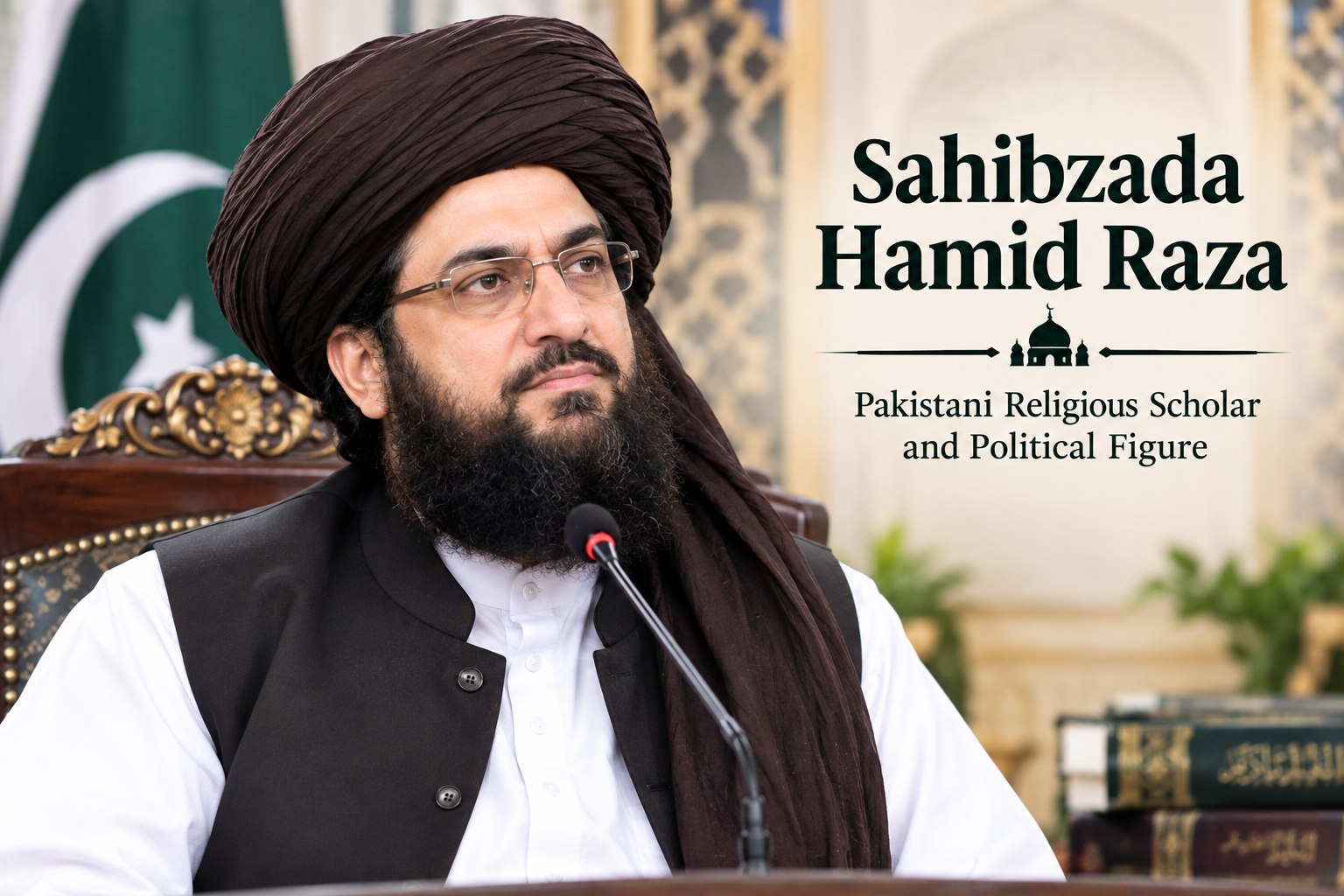
Sahibzada Muhammad Hamid Raza is a Pakistani religious scholar and political figure associated with the Sunni Ittehad Council (SIC). He has been active in religious and political affairs in Pakistan for many years. He became particularly known for his leadership role in the Sunni Ittehad Council and later entered the National Assembly of Pakistan.
Hamid Raza belongs to a family with a strong background in religious scholarship and public life. His father, Sahibzada Fazal Karim, was a well-known religious scholar and politician and was associated with the foundation and leadership of the Sunni Ittehad Council.
Hamid Raza continued his family's involvement in religious and public affairs. His career shows how religious scholarship and politics have sometimes been connected in Pakistan's social and political environment.
He was elected to the National Assembly from Faisalabad in the 2024 general election. According to the National Assembly's official profile, his constituency was NA-104 Faisalabad-X.
His public life has included religious activities, political leadership, parliamentary participation, and public speaking.
Early Life and Family
Sahibzada Hamid Raza was born in Faisalabad, formerly known as Lyallpur, in Punjab, Pakistan. His family had strong religious connections.
His father, Sahibzada Fazal Karim, was an important religious scholar and political personality. Fazal Karim was associated with the Sunni Ittehad Council and served as its chairman.
Growing up in such a family gave Hamid Raza an early connection with religious education and public affairs.
Families connected with religious scholarship often place considerable importance on education, religious knowledge, community service, and moral values.
Hamid Raza later developed his own public career and became involved in religious and political activities.
Religious Background
Hamid Raza is known publicly as a religious scholar. His religious background has been an important part of his public identity.
Religious scholars in Pakistan may participate in teaching, public speaking, community activities, religious discussions, and social affairs.
Hamid Raza became known for his public speeches and religious views. His association with the Sunni Ittehad Council also connected him with a wider network of religious scholars and organizations.
His religious background influenced his public career and helped shape the way he participated in political discussions.
Sunni Ittehad Council
The Sunni Ittehad Council is a Pakistani political and religious organization.
The organization was founded in 2009 and was associated with several Sunni religious scholars. Hamid Raza later became one of its prominent leaders.
The council has participated in religious, political, and social discussions in Pakistan.
Hamid Raza's leadership role brought him into the national political conversation.
Through the council, he became involved in issues concerning religious communities, political representation, and national affairs.
Leadership Role
Leadership requires responsibility and the ability to communicate with different groups.
Hamid Raza's role in the Sunni Ittehad Council placed him in a position where he had to speak publicly on political and religious matters.
As a religious and political leader, he participated in public meetings, discussions, and political activities.
His leadership also made him a recognizable figure in Faisalabad and in national politics.
Political Career
Hamid Raza entered electoral politics and later became a member of the National Assembly.
In the 2024 general election, he contested the National Assembly seat from NA-104 Faisalabad-X. He won the election as an independent candidate supported by the Sunni Ittehad Council.
His election was important because it brought a religious scholar from Faisalabad into Pakistan's national parliament.
The National Assembly provides a platform where elected representatives discuss legislation, public issues, national policies, and matters affecting citizens.
As an MNA, Hamid Raza became part of this parliamentary system.
Representation of Faisalabad
Faisalabad is one of Pakistan's major cities and an important industrial center in Punjab.
Hamid Raza's political career has been closely connected with Faisalabad.
Representing a constituency means that an elected representative is expected to raise issues related to local people and participate in national decision-making.
His election from Faisalabad gave him an opportunity to participate in national politics while remaining connected with his local community.
Parliamentary Role
The National Assembly is one of the most important institutions of Pakistan's democratic system.
Members of the National Assembly participate in debates, legislation, parliamentary discussions, and other official activities.
Hamid Raza served as an MNA during 2024 and 2025. His time in parliament connected his religious and political background with formal parliamentary politics.
His parliamentary career also showed the participation of religious personalities in Pakistan's democratic institutions.
Political Alliance in 2024
The 2024 general election produced a complicated political environment in Pakistan.
Several independent candidates supported by Pakistan Tehreek-e-Insaf (PTI) joined the Sunni Ittehad Council after the election as part of their parliamentary strategy. The National Assembly records and contemporary reporting documented this development.
Hamid Raza's political position therefore became connected with one of the major parliamentary developments following the 2024 election.
This period brought considerable national attention to the Sunni Ittehad Council.
Public Speaking
Public speaking has been an important part of Hamid Raza's career.
Religious scholars often communicate with large audiences through speeches, lectures, meetings, and public gatherings.
Political leaders also need communication skills because they have to explain their views to citizens and supporters.
Hamid Raza has participated in public gatherings and addressed audiences on religious and political issues.
His ability to communicate helped him build a public profile in Pakistan.
Religious and Social Issues
Religious leaders in Pakistan frequently participate in discussions about social values, religious education, community matters, and national issues.
Hamid Raza's public career has included discussion of such matters.
Religious personalities can have an important role in communities because people often seek guidance from them on religious and social questions.
At the same time, public figures need to communicate responsibly because their statements can influence public discussion.
Connection with Faisalabad
Faisalabad has played an important role in Hamid Raza's public life.
His family has long been associated with religious and political activities in the city.
His father, Fazal Karim, was also a prominent figure in Faisalabad.
Hamid Raza's own political career continued this connection. His election to the National Assembly from a Faisalabad constituency made him a nationally recognized representative of the area.
Family Influence
Family background can influence a person's early education and interests.
Hamid Raza grew up in a family connected with religious scholarship and politics. His father was an important religious personality and leader.
This environment exposed him to religious discussions and public affairs from an early age.
However, Hamid Raza developed his own public identity through his leadership activities and political career.
His story demonstrates how family traditions can influence career choices while individuals still develop their own roles.
Religious Leadership and Politics
Pakistan has a long history of religious scholars participating in public and political life.
Some scholars focus mainly on education and religious teaching, while others also participate in political organizations or elections.
Hamid Raza belongs to the group of religious personalities who became directly involved in politics.
His career therefore provides an example of the connection between religion and politics in Pakistan.
Importance of Responsible Leadership
Leadership comes with responsibility.
A public leader has to deal with different opinions and different groups of people.
Religious and political leaders especially need to understand the impact of their public statements.
Responsible leadership includes respect for law, peaceful political participation, and communication based on facts.
These principles are important for every public figure.
Political Challenges
Political careers can involve many challenges.
Pakistan's political environment is often highly competitive. Political leaders may face disagreements, legal disputes, criticism, and changing political alliances.
Hamid Raza's political career has also faced serious challenges.
His political activities and legal cases have received national attention. In November 2025, reports stated that he was sent to jail following a conviction in a May 9 riots case.
Such developments became an important part of his recent public record.
Legal and Political Controversies
Like many public political figures, Hamid Raza has been involved in controversies.
His political career has included legal proceedings connected with the May 9 events.
When discussing political figures, it is important to distinguish between allegations, court proceedings, convictions, and established facts.
News reports in 2025 reported that an anti-terrorism court in Faisalabad sentenced him to a 10-year prison term in connection with the May 9 riots case.
These legal developments affected his political career.
Importance of Law
Public life requires respect for the law and constitutional institutions.
Political disagreements should ideally be handled through peaceful and lawful democratic processes.
Courts, election authorities, and parliament all have different responsibilities within Pakistan's constitutional system.
The experience of political figures can demonstrate why legal procedures and democratic institutions are important.
Young People and Public Life
Young people can learn several general lessons from the public career of Hamid Raza.
The first lesson is the importance of education.
The second lesson is the value of communication skills.
The third lesson is that public leadership requires responsibility.
The fourth lesson is that political participation should remain connected with lawful and peaceful democratic processes.
Young people who are interested in public service can study political systems and understand different viewpoints before forming their own opinions.
Education and Knowledge
Education is important for every public leader.
A person involved in religious or political work needs knowledge about society, law, history, religion, and current affairs.
Religious education can provide an understanding of religious traditions, while general education can help a person understand wider social and political issues.
Hamid Raza's background combines religious scholarship with political activity.
This combination has shaped his public identity.
Community Connection
Public figures often build their careers through connections with local communities.
Faisalabad has remained an important part of Hamid Raza's public identity.
Community connections can help political representatives understand local concerns.
Issues such as education, employment, infrastructure, public services, and social welfare affect ordinary citizens.
Representatives are expected to raise such issues through appropriate political and parliamentary channels.
Role of Religious Scholars in Society
Religious scholars have traditionally played an important role in Pakistani society.
They may teach religious subjects, provide guidance, speak at gatherings, and participate in community activities.
Some also enter politics.
The role of a religious scholar in politics can be complex because religious questions and political questions can overlap.
For this reason, public discussion should remain respectful and should distinguish religious teaching from political campaigning.
Importance of Peaceful Dialogue
Pakistan contains people with many different political, religious, ethnic, and social backgrounds.
Peaceful dialogue can help people understand different opinions.
Public leaders can contribute positively when they encourage respectful discussion rather than hostility.
This is especially important for religious and political personalities because their words can reach large audiences.
Public Responsibility
Being a public figure means that people closely observe one's actions and statements.
Political and religious leaders therefore have a responsibility to communicate carefully.
They also have a responsibility to respect institutions and different opinions.
Hamid Raza's career illustrates the responsibilities and challenges that can come with combining religious leadership and political activity.
Media and Public Image
Modern political leaders are also shaped by media coverage.
Television, newspapers, websites, and social media can quickly spread statements and political developments.
This can increase a leader's influence but can also create challenges.
Public figures need to understand that statements made publicly can reach large audiences.
Responsible use of media is therefore an important part of modern leadership.
Importance of Democratic Institutions
Pakistan's political system includes parliament, elections, courts, political parties, and other institutions.
Elected representatives participate in this system through constitutional and legal procedures.
Hamid Raza's election to the National Assembly demonstrated his participation in parliamentary politics.
His later legal and political difficulties also highlighted the importance of institutions such as courts and election authorities.
A Career of Religious and Political Activity
Sahibzada Hamid Raza's career is different from that of people who work only in religious education or only in politics.
He has been associated with both fields.
His religious background helped shape his public identity, while his political activities brought him into national political affairs.
This combination made him a notable public personality in Pakistan.
Lessons from His Public Career
There are several general lessons that can be taken from his career.
Education matters: Knowledge helps people understand complicated issues.
Communication matters: Leaders need to explain their ideas clearly.
Responsibility matters: Public positions require careful behavior.
Law matters: Political activities should take place within legal and constitutional boundaries.
Respect matters: Society includes people with different opinions and backgrounds.
These lessons are useful for anyone interested in public service.
Conclusion
Sahibzada Muhammad Hamid Raza is a Pakistani religious scholar and political figure associated with the Sunni Ittehad Council.
He comes from a family with a strong religious and political background. His father, Sahibzada Fazal Karim, was an important religious scholar and political leader.
Hamid Raza later became involved in the leadership of the Sunni Ittehad Council and entered electoral politics.
In the 2024 general election, he won the National Assembly seat from NA-104 Faisalabad-X and became a member of Pakistan's parliament.
His public career has included religious activities, political leadership, public speaking, parliamentary participation, and legal challenges.
His story reflects the complex relationship between religious scholarship and politics in Pakistan.
For young people, his career can be studied as an example of public leadership, political participation, communication, and the responsibilities that come with public office.
Most importantly, anyone studying a political personality should look at reliable information, understand different viewpoints, and distinguish confirmed facts from political claims or opinions.
FAQs
1. Who is Sahibzada Hamid Raza?
Sahibzada Hamid Raza is a Pakistani religious scholar and political figure associated with the Sunni Ittehad Council.
2. Which city is Hamid Raza associated with?
He is strongly associated with Faisalabad, Punjab, Pakistan.
3. Was Hamid Raza a member of the National Assembly?
Yes. He was elected from NA-104 Faisalabad-X in the 2024 general election.
4. What is the Sunni Ittehad Council?
The Sunni Ittehad Council is a Pakistani religious and political organization established in 2009.
5. What is Hamid Raza known for?
He is known for his religious background, leadership in the Sunni Ittehad Council, political activities, public speaking, and parliamentary career.




