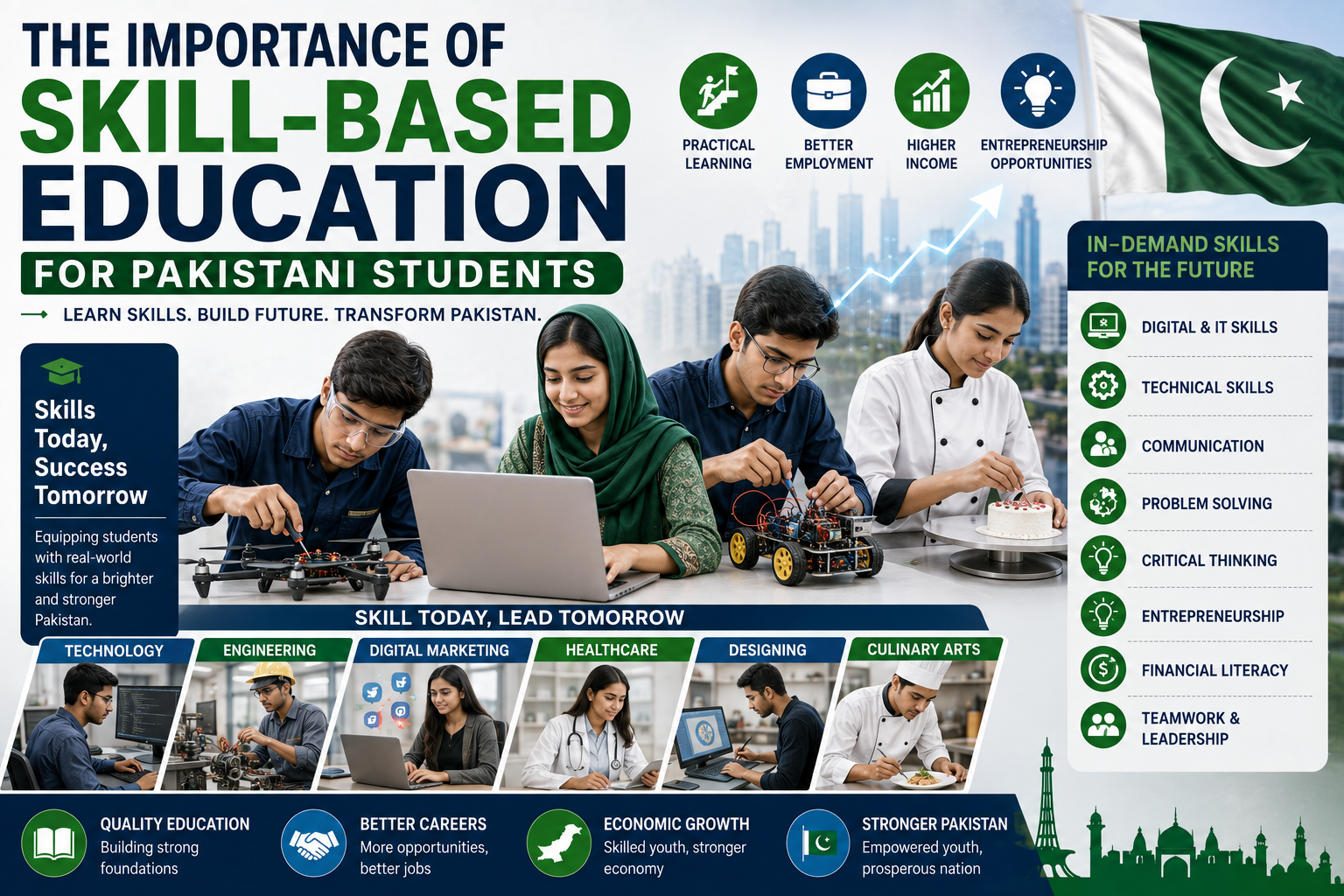
Education is one of the most important factors in the development of a country. In Pakistan, millions of students attend schools, colleges, universities and different educational institutions every year. Traditional education mainly focuses on textbooks, examinations and academic grades. However, in today's rapidly changing world, academic knowledge alone is not always enough to build a successful career.
Students also need practical abilities that can help them solve problems, communicate effectively, use technology, work with others and earn a living. This is where skill-based education becomes important. Skill-based education focuses on developing practical, technical, digital and professional skills alongside traditional academic knowledge.
For Pakistani students, skill-based education can create new opportunities in employment, freelancing, entrepreneurship and higher education. It can also help young people become more confident and independent.
What Is Skill-Based Education?
Skill-based education is an educational approach that focuses on developing practical abilities that students can use in real-life situations. Instead of concentrating only on memorizing information, it encourages students to understand concepts and learn how to apply them.
For example, a computer science student may learn programming concepts from a textbook. Skill-based education would also give that student opportunities to write programs, develop projects, solve coding problems and use modern software.
Similarly, a student studying business can learn about entrepreneurship in class while also learning how to create a business plan, communicate with customers, manage money and promote a product.
Skill-based education can include:
Digital skills
Computer programming
Communication skills
Technical skills
Problem-solving
Critical thinking
Graphic design
Web development
Entrepreneurship
Financial literacy
Leadership
Teamwork
Time management
Vocational and technical skills
Career-related practical training
The main purpose is to prepare students not only for examinations but also for real-life challenges and future careers.
Why Does Pakistan Need Skill-Based Education?
Pakistan has a large and growing young population. Every year, many students complete school, college and university education and enter the job market. However, academic qualifications do not always guarantee employment.
One reason is the gap between education and the skills required by employers. Some graduates may have degrees but limited practical experience. Employers often look for people who can actually perform tasks, use technology, communicate with customers and solve workplace problems.
Skill-based education can help reduce this gap.
Instead of asking only, "What degree does a student have?" the modern job market increasingly asks, "What can this person do?"
This makes practical skills extremely important for Pakistani students.
Skill-Based Education and Employment Opportunities
One of the biggest advantages of skill-based education is its connection with employment.
Students who develop useful skills can have more options when entering the job market. For example, a student with digital marketing skills may explore marketing-related work, while someone with web development skills may work on websites and software projects.
Technical skills can also help students enter industries that require trained workers.
Skill-based education can therefore help students understand what employers expect and prepare them for practical responsibilities.
It can also encourage students to build portfolios and demonstrate their abilities rather than depending only on certificates.
Digital Skills Are Essential
Technology has become an important part of education, business and everyday life. Pakistani students need basic digital literacy regardless of the career they choose.
Digital education can include learning:
Basic computer operation
Microsoft Office and similar productivity tools
Internet research
Online communication
Digital presentations
Programming
Graphic design
Video editing
Web development
Digital marketing
Data analysis
Artificial intelligence tools
Cybersecurity awareness
Not every student needs to become a programmer. However, understanding technology can help students work more effectively in almost every field.
For example, a future teacher may need digital presentation skills, a business owner may need online marketing skills, and a lawyer may need digital research and document-management skills.
Importance of Technical Education
Technical education is another important part of skill-based learning.
Students can learn practical skills related to areas such as:
Electrical work
Electronics
Mechanical technology
Computer technology
Construction
Automotive technology
Agriculture
Renewable energy
Healthcare support
Manufacturing
Technical education should not be considered less important than academic education. Skilled technicians and professionals are essential for the development of industries and communities.
A strong technical education system can also provide young people with alternative career pathways.
Vocational Skills for Students
Vocational education prepares students for specific occupations and practical careers. It can be especially useful for students who prefer hands-on learning.
Vocational training may include cooking, tailoring, electrical work, automotive repair, computer repair, beauty and personal-care services, agriculture-related skills and many other areas.
These skills can help students become employable or even start small businesses.
For example, a student who learns a practical trade can eventually provide services in their local community. With additional business knowledge, that student may develop the skill into a small enterprise.
Freelancing and Skill Development
Freelancing has created new possibilities for people with useful digital skills. Pakistani students who learn appropriate professional skills can explore online work when they reach the appropriate age and meet platform requirements.
Common digital skills associated with freelance work include:
Graphic design
Web development
Content writing
Video editing
Digital marketing
Programming
Data-related services
Translation
UI/UX design
The important point is that freelancing requires genuine skills. Simply creating an online account does not guarantee success.
Students need to learn their chosen field, practise regularly, create quality work and understand professional communication.
Entrepreneurship and Skill-Based Education
Skill-based education can also encourage entrepreneurship.
A student who develops a practical skill may eventually identify a problem and create a product or service to solve it.
For example, a student interested in technology might develop a simple educational application. Another student with graphic design skills might create a small design service. Someone interested in food could learn food production and business management.
Entrepreneurship education can teach students:
How to identify opportunities
How to understand customers
How to create a business plan
Basic financial management
Marketing
Communication
Leadership
Risk awareness
Product development
These skills can help students understand how businesses operate.
Communication Skills Are Important
Technical knowledge is valuable, but students also need communication skills.
A highly skilled person may still struggle professionally if they cannot explain ideas clearly, communicate with colleagues or present their work.
Students should therefore practise:
Speaking clearly
Writing professionally
Giving presentations
Listening carefully
Asking useful questions
Participating in discussions
Communicating through digital platforms
English can be particularly useful because it is widely used in higher education, technology and international business. At the same time, strong Urdu and local-language communication skills are also valuable for communication within Pakistan.
Critical Thinking and Problem-Solving
Skill-based education should not focus only on technical abilities. Thinking skills are equally important.
Students should learn how to analyze information, identify problems and develop possible solutions.
For example, instead of simply memorizing a scientific formula, students can learn where and why that formula is used. Instead of memorizing computer code, they can learn how to solve a programming problem.
Problem-solving prepares students for situations where there is no single answer in a textbook.
Creativity and Innovation
Creativity is another important skill for the modern world.
Students should be encouraged to develop their own ideas instead of always copying existing answers. Project-based assignments, presentations, experiments and creative activities can help develop innovation.
A student may discover a new solution to a local problem through a school project.
Pakistan needs young people who can think creatively and develop useful ideas in areas such as technology, agriculture, education, business and environmental protection.
Time Management and Discipline
Success is not based only on technical knowledge.
Students also need to learn how to manage their time and responsibilities.
Time-management skills can include:
Creating schedules
Setting priorities
Completing assignments on time
Breaking large tasks into smaller steps
Avoiding unnecessary distractions
Balancing study and other responsibilities
These habits can help students both in education and professional life.
Teamwork and Leadership
Most modern workplaces require people to work in teams.
Students should therefore have opportunities to complete group projects and activities. Through teamwork, they can learn how to share responsibilities, listen to others and solve disagreements respectfully.
Leadership is also important. A good leader does not simply give orders. Leadership includes responsibility, decision-making, communication and helping a team achieve a common goal.
Schools and colleges can develop these skills through debates, projects, societies, competitions and community activities.
Role of Teachers in Skill-Based Education
Teachers have a major role in developing practical skills among students.
A teacher can move beyond traditional lectures by using:
Practical activities
Group projects
Presentations
Research assignments
Problem-solving exercises
Technology
Real-world examples
Classroom discussions
Teachers also need professional development so that they can understand modern technologies and teaching methods.
The goal is not to remove textbooks or examinations completely. Instead, academic learning should be connected with practical application.
Project-Based Learning
Project-based learning is one effective way to develop skills.
Instead of completing only written exercises, students can work on projects that require research, planning and practical application.
For example, computer students can develop a small software project. Science students can conduct an experiment. Business students can prepare a business plan. Geography students can study a local environmental issue.
Such activities help students learn by doing.
Importance of Career Guidance
Many students in Pakistan choose educational subjects without having enough information about possible careers.
Career guidance can help students understand:
Different professions
Required qualifications
Required skills
Career pathways
Future opportunities
Personal interests
Strengths and weaknesses
Schools and colleges should provide reliable career information so that students can make informed decisions.
Students should understand that there is no single successful career path. Different people can succeed through different combinations of education and skills.
Skill-Based Education and Higher Education
Skill development should continue after school.
Universities can include practical projects, internships, laboratory work, research and industry collaboration in degree programs.
For example, computer science students should have opportunities to work on real software projects. Engineering students need practical laboratory and design experience. Business students can work on market research and entrepreneurship projects.
This can make university education more connected to the professional world.
Importance of Internships
Internships can provide students with exposure to professional environments.
During an internship, students can observe how organizations operate and learn how theoretical knowledge is applied.
Internships may help students develop:
Professional communication
Workplace discipline
Teamwork
Technical skills
Time management
Problem-solving
Educational institutions can strengthen connections with companies and organizations to provide suitable learning opportunities.
Artificial Intelligence and Future Skills
Artificial intelligence is changing many industries. Pakistani students should therefore develop an understanding of AI and related technologies.
Students do not necessarily need to become AI engineers. Basic AI literacy can still be useful.
They should understand how AI tools work at a general level, how to use them responsibly, how to verify information and why human judgment remains important.
Future education will likely require students to combine traditional knowledge with digital literacy, creativity and critical thinking.
Financial Literacy
Financial literacy is another useful life skill.
Students should understand basic concepts such as:
Saving
Budgeting
Responsible spending
Banking
Financial planning
Understanding income and expenses
Avoiding unnecessary financial risks
These concepts can help young people make better decisions as they become adults.
Benefits for Rural Students
Skill-based education can be particularly valuable for students in rural areas.
Many rural communities have opportunities connected with agriculture, livestock, small businesses, crafts and local services.
Modern agricultural technology, digital skills, entrepreneurship and vocational training can help students explore opportunities within their communities.
Digital connectivity can also expand access to educational resources, although equal access to reliable devices and internet services remains important.
Reducing the Gap Between Education and Industry
One of the major goals of skill-based education should be to create stronger connections between educational institutions and industries.
Employers can help educational institutions understand which skills are needed. Colleges and universities can then update courses and practical training accordingly.
This cooperation can benefit both sides.
Students gain more relevant skills, while employers gain access to better-prepared graduates.
Equal Access to Skill Education
Skill-based education should be available to students from different economic and geographical backgrounds.
If only students in major cities can access modern training, educational inequality may increase.
Pakistan needs affordable training opportunities, well-equipped institutions, qualified teachers and accessible digital resources.
Government institutions, private organizations, educational institutions and communities can all contribute to expanding access.
Challenges in Skill-Based Education
Despite its benefits, skill-based education faces several challenges.
Limited Resources
Some schools and colleges do not have enough laboratories, computers or technical equipment.
Teacher Training
Teachers may need additional training to teach practical and technology-based skills effectively.
Traditional Mindset
Some families consider academic degrees more valuable than technical or vocational skills. Changing this perception requires awareness.
Urban-Rural Divide
Students in rural and remote areas may have fewer opportunities to access modern training.
Curriculum Issues
Educational curricula need regular updates to remain relevant to changing technology and job-market requirements.
Financial Constraints
Practical education may require equipment, laboratories and training facilities, which can be expensive.
Addressing these challenges requires long-term planning and cooperation.
How Pakistan Can Promote Skill-Based Education
Pakistan can strengthen skill-based education through several steps.
First, practical learning should be introduced at appropriate levels of education.
Second, schools and colleges should provide access to basic digital tools.
Third, teachers should receive regular professional development.
Fourth, technical and vocational education should be treated as respected career pathways.
Fifth, educational institutions should collaborate with industries.
Sixth, career counseling should become an important part of student development.
Seventh, students should receive more opportunities to participate in projects, competitions and practical activities.
Finally, educational policies should focus on both access and quality.
Role of Parents
Parents can also support skill development.
They should encourage children to explore their interests instead of assuming that every student must follow exactly the same career path.
Parents can encourage reading, technology learning, communication, creativity and practical activities.
The purpose should not be to pressure students into choosing a particular skill. Instead, students should be guided toward areas that match their interests and abilities.
Role of Students
Students themselves have the biggest role in developing skills.
They should:
Practise regularly
Learn from mistakes
Ask questions
Explore new technologies
Develop communication skills
Work on practical projects
Read beyond textbooks
Build problem-solving abilities
Learn time management
Stay curious
A certificate can show that someone completed a course, but practical ability comes from learning and practice.
The Future of Skill-Based Education in Pakistan
The future of education in Pakistan is likely to involve a stronger combination of academic knowledge and practical skills.
Students will need to understand traditional subjects while also developing digital literacy, communication, critical thinking, creativity and professional abilities.
Schools, colleges and universities can prepare students for this future by making learning more practical and connected to real-life situations.
Technology can also expand access to learning resources. Online courses, digital libraries, educational videos and interactive platforms can supplement classroom education when students have suitable access.
However, technology should support education rather than replace teachers and human interaction.
Conclusion
Skill-based education is highly important for Pakistani students because the modern world requires more than textbook knowledge. Academic education provides a foundation, but practical skills help students apply what they learn in real-life situations.
Digital skills, technical abilities, communication, critical thinking, problem-solving, teamwork, creativity, entrepreneurship and financial literacy can help young people prepare for future opportunities.
Pakistan has a large and talented youth population. Providing students with useful and relevant skills can help them become more confident, employable and innovative.
The goal should not be to replace traditional education with skill-based education. Instead, Pakistan needs a balanced education system in which academic knowledge and practical skills work together.
When students learn both what to know and how to use what they know, education becomes more meaningful and useful. A stronger focus on skill development can therefore play an important role in preparing Pakistani students for higher education, employment, entrepreneurship and the changing demands of the future.
FAQs
1. What is skill-based education?
Skill-based education focuses on practical abilities that students can use in real-life and professional situations.
2. Why is skill-based education important in Pakistan?
It can help students develop practical abilities, improve employability and prepare for changing career opportunities.
3. Which skills should Pakistani students learn?
Digital literacy, communication, problem-solving, critical thinking, technical skills, teamwork and entrepreneurship are useful areas.
4. Is skill-based education better than traditional education?
Both are important. The best approach combines academic knowledge with practical skills.
5. How can students develop practical skills?
Students can develop skills through projects, practice, courses, internships, competitions and hands-on learning.