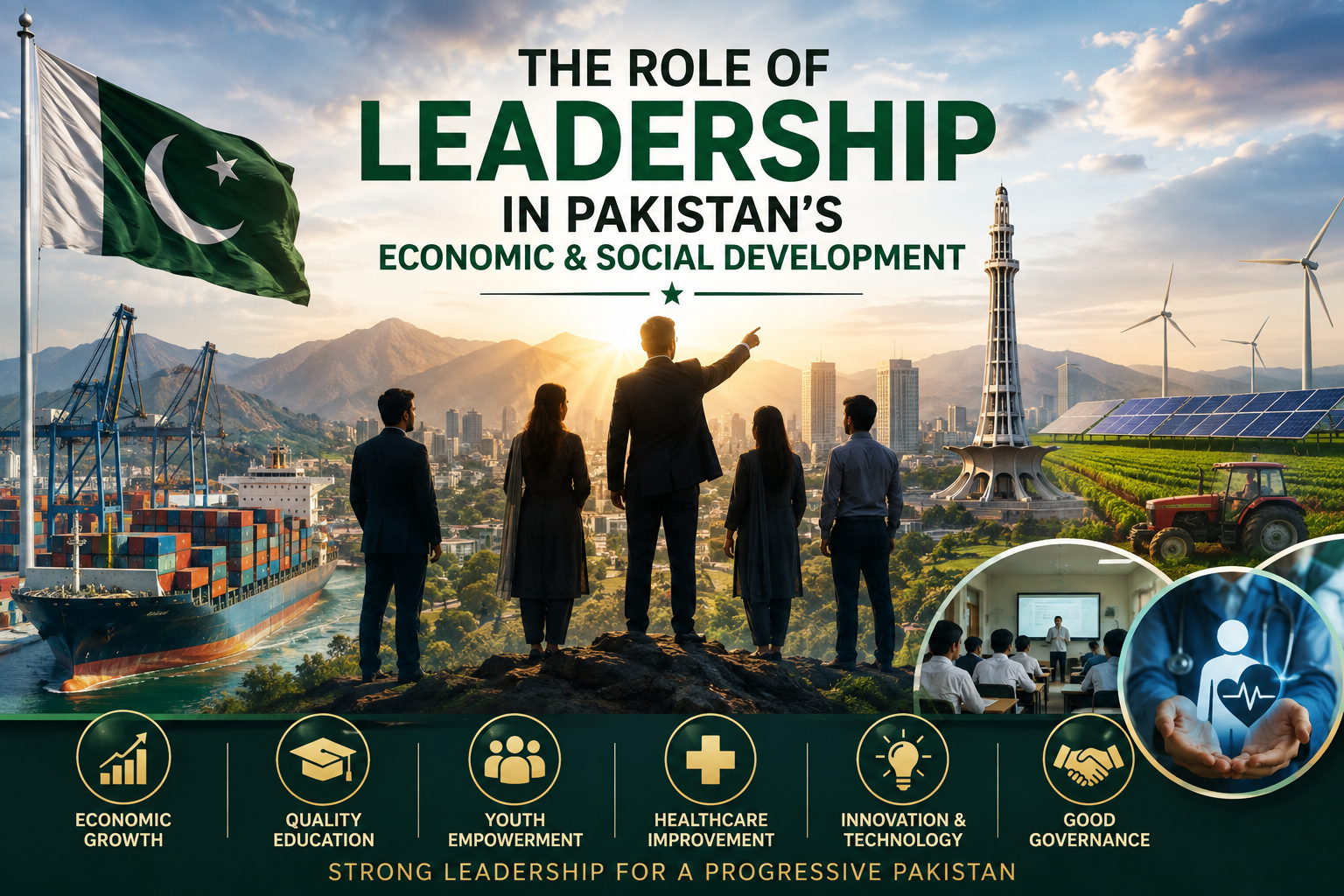
Pakistan is a country with enormous human potential, natural resources, a large young population, and a diverse economy. Since its independence in 1947, the country has made progress in many areas, including education, technology, agriculture, industry, healthcare, infrastructure, and entrepreneurship. At the same time, Pakistan continues to face challenges related to economic stability, employment, education, healthcare, poverty, infrastructure, governance, and social development.
Leadership plays a central role in addressing these challenges. Effective leadership can provide direction, strengthen institutions, encourage innovation, improve public services, and create an environment in which citizens and businesses can contribute to national development. Leadership is not limited to political figures. It can be found in government institutions, businesses, schools, universities, hospitals, communities, and families across Pakistan.
Economic and social development are closely connected. A stronger economy can create employment and improve living standards, while better education, healthcare, and social conditions can produce a healthier and more productive workforce. Good leadership can help connect these areas and create a long-term approach to Pakistan's development.
Understanding Leadership in Pakistan
Leadership means guiding people toward a shared objective while accepting responsibility for decisions and outcomes. In the Pakistani context, effective leadership requires an understanding of the country's unique circumstances.
Pakistan has large metropolitan cities such as Lahore, Karachi, Islamabad, Rawalpindi, and Faisalabad, as well as thousands of rural communities. Different regions have different economic activities, educational needs, infrastructure requirements, and social conditions.
Therefore, successful leadership in Pakistan requires practical knowledge of local realities. Leaders need to listen to communities, understand regional challenges, consult experts, and develop solutions that can work in Pakistan rather than simply adopting approaches without considering local circumstances.
Good leadership also requires integrity. Economic and social development cannot be sustainable if public resources are poorly managed or if institutions lack accountability.
Why Leadership Matters for Pakistan’s Economic Development
Economic development requires long-term planning and consistent implementation. Pakistan has significant opportunities in agriculture, manufacturing, information technology, telecommunications, construction, services, tourism, renewable energy, and entrepreneurship.
Leadership can help transform these opportunities into sustainable economic growth.
A capable leader can identify areas with growth potential, support productive sectors, encourage investment, improve skills, and create policies that help businesses operate more effectively.
Economic leadership should not focus only on increasing short-term economic activity. It should also consider employment, productivity, innovation, education, infrastructure, and the ability of businesses and workers to compete in changing markets.
Pakistan needs an economic environment in which young people can develop useful skills, entrepreneurs can build businesses, farmers can improve productivity, and companies can create employment opportunities.
Leadership and Employment Opportunities
Employment is one of the most important economic and social concerns for Pakistan. A growing population means that millions of young people need opportunities to study, develop skills, and enter the workforce.
Leadership can contribute to employment by supporting industries that create jobs and encouraging entrepreneurship.
Small and medium-sized businesses can play an important role in this area. When businesses receive appropriate support, training, technology, and access to markets, they can grow and employ more people.
Leaders can also encourage vocational and technical education so that young people develop practical skills relevant to the labor market.
Employment is not only an economic issue. Having meaningful work can improve household stability, confidence, independence, and social participation.
The Importance of Education Leadership
Education is one of the strongest foundations of social and economic development. Pakistan needs leaders who understand that education is an investment in the country's future.
Effective educational leadership can improve schools by focusing on teacher development, student learning, curriculum quality, facilities, technology, and accountability.
Teachers themselves are important leaders. A dedicated teacher can influence students' attitudes toward learning, discipline, confidence, and future careers.
Educational leaders should encourage students to develop critical thinking, communication, creativity, problem-solving, teamwork, and digital skills.
Pakistan's future economic growth will depend heavily on the knowledge and abilities of its population. Better education can produce a workforce capable of participating in modern industries and creating new opportunities.
Leadership and Youth Development
Pakistan has a large youth population, making young people one of the country's greatest assets.
Young Pakistanis are active in education, technology, freelancing, entrepreneurship, sports, creative industries, agriculture, and many other fields. However, talent needs opportunities, guidance, and appropriate training.
Strong leadership can help young people develop their abilities through education, internships, vocational programs, entrepreneurship initiatives, sports, community activities, and professional training.
Youth leadership should also encourage responsibility. Young people should be given opportunities to solve problems, manage projects, participate in teams, and contribute to their communities.
A country that invests in its young people is investing in its future workforce, entrepreneurs, professionals, and community leaders.
Leadership and Pakistan’s Technology Sector
Technology is creating new possibilities for Pakistan's economy. Software development, freelancing, e-commerce, digital marketing, online education, artificial intelligence, and other digital fields can provide opportunities for young Pakistanis.
Leadership is important because technological development requires investment in education, internet access, digital infrastructure, innovation, and skills.
Pakistan has already developed a growing community of technology professionals and freelancers. With better training and opportunities, this sector can contribute significantly to economic growth.
Leaders should encourage digital literacy from an early stage. Students should learn not only how to use technology but also how to use it creatively and responsibly.
Technology leadership should also focus on cybersecurity, data protection, ethical innovation, and equal access to digital opportunities.
Leadership in Agriculture
Agriculture remains an important part of Pakistan's economy and supports millions of people directly and indirectly.
Effective leadership in agriculture can help address challenges related to productivity, water management, modern farming techniques, storage, transportation, market access, and agricultural technology.
Farmers need access to knowledge and practical solutions. Agricultural leadership can connect farmers with researchers, agricultural experts, financial services, technology providers, and markets.
Modern agricultural leadership should also encourage efficient use of water and other resources. Pakistan faces significant environmental and water-related challenges, making responsible resource management essential for long-term agricultural development.
Leadership and Industrial Development
Industrial development can create employment, increase production, support exports, and strengthen economic activity.
Pakistan has industries ranging from textiles and sports goods to food processing, pharmaceuticals, engineering, construction materials, and many other sectors.
Strong industrial leadership can encourage modernization, employee training, quality improvement, technological adoption, and innovation.
Business leaders should focus on producing competitive goods and services while maintaining professional standards.
Government and industry leadership can also work together to identify obstacles faced by businesses and develop practical solutions.
Leadership and Small Businesses
Small and medium-sized enterprises are important to Pakistan's economic structure. Many people earn their livelihoods through small shops, workshops, farms, service businesses, online businesses, and family enterprises.
Good leadership can help small businesses become more organized and competitive.
Business owners can improve their leadership skills by learning about financial management, customer service, digital marketing, human resource management, and strategic planning.
A small business does not need to become a large corporation to contribute to the economy. A successful local business can provide employment, support families, and contribute to its community.
Leadership and Social Development
Economic development alone is not enough. A country's progress should also improve people's quality of life.
Social development includes education, healthcare, housing, public services, social inclusion, community development, and opportunities for individuals to participate in society.
Leadership can help ensure that development reaches communities rather than remaining concentrated in a limited number of areas.
Effective social leadership requires listening to citizens and understanding the needs of different communities.
Leadership in Healthcare
Healthcare is an essential part of social development. Healthy people are more capable of studying, working, and contributing to their communities.
Healthcare leadership includes doctors, nurses, hospital administrators, public health professionals, policymakers, and community organizations.
Good healthcare leaders focus on quality, accessibility, professional standards, teamwork, and respectful treatment of patients.
Leadership can also improve healthcare management by encouraging better organization, staff training, efficient use of resources, and public awareness.
Pakistan needs healthcare leadership that considers both urban and rural populations and works toward improving access to essential services.
Leadership and Poverty Reduction
Poverty is a complex issue that cannot be solved through a single program. It involves education, employment, skills, healthcare, housing, infrastructure, and economic opportunities.
Leadership can contribute to poverty reduction by creating conditions in which people can improve their own economic situation.
Instead of focusing only on short-term assistance, development strategies can also emphasize education, vocational skills, entrepreneurship, employment, and access to productive opportunities.
When people gain useful skills and stable employment opportunities, they are better positioned to support themselves and their families.
Leadership and Rural Development
Rural communities are an important part of Pakistan. Many people depend on agriculture, livestock, small businesses, and local employment.
Rural development requires leadership that understands local conditions.
Better roads, schools, healthcare facilities, internet connectivity, agricultural support, clean water, and access to markets can improve rural communities.
Local leaders can play an important role by identifying community needs and communicating them effectively to relevant institutions.
Development should not be viewed only through the lens of large cities. Pakistan's long-term progress requires balanced development across urban and rural areas.
Leadership and Infrastructure
Infrastructure supports economic and social activity. Roads, transport systems, electricity, water supply, communication networks, schools, hospitals, and digital infrastructure all influence people's daily lives.
Strong leadership can help prioritize infrastructure projects according to actual needs and long-term benefits.
Infrastructure planning should consider population growth, economic activity, environmental sustainability, and future requirements.
Good leadership also requires monitoring projects and ensuring that resources are used responsibly.
Leadership and Women’s Economic Participation
Women are an important part of Pakistan's social and economic development. Women contribute to education, healthcare, business, agriculture, technology, public service, and many other areas.
Leadership can help create opportunities for women to develop their education and professional skills.
Supporting women's participation can benefit households and the wider economy. Educated and economically active women can contribute knowledge, income, entrepreneurship, and professional expertise.
Pakistan's development can be stronger when talented individuals have opportunities to contribute based on their abilities.
Leadership and National Unity
Economic and social development require cooperation. Pakistan is a diverse country with different languages, cultures, regions, and communities.
Leadership can promote national unity by encouraging respect, cooperation, and a shared sense of responsibility.
A strong leader should be able to bring people together around common objectives such as education, economic opportunity, public welfare, and national development.
Unity does not require everyone to have identical opinions. It requires people to work together despite differences.
Leadership and Good Governance
Good governance is closely connected with effective leadership.
Governance includes the way institutions make decisions, provide services, manage resources, enforce rules, and respond to citizens.
Strong leadership can help institutions become more efficient and accountable.
Leaders should establish clear responsibilities and performance standards. They should also encourage transparency and professional conduct.
When institutions function effectively, citizens and businesses can plan with greater confidence.
The Importance of Accountability
Accountability is a fundamental quality of effective leadership.
Leaders should be willing to explain decisions, accept responsibility for mistakes, and take corrective action when necessary.
Accountability should apply across organizations. Whether someone works in government, business, education, healthcare, or a community organization, responsibility should accompany authority.
A culture of accountability can improve performance and strengthen trust.
Leadership and Innovation
Innovation is important for Pakistan's future. Countries and organizations that continue to learn and adapt are better prepared for changing economic conditions.
Innovation does not always mean creating completely new technology. It can also mean finding better ways to deliver services, manage resources, educate students, produce goods, or solve local problems.
Pakistani leaders can encourage innovation by supporting research, entrepreneurship, experimentation, and professional development.
Young people in particular should be encouraged to think creatively and develop solutions to problems around them.
Leadership and Environmental Development
Pakistan faces environmental challenges that can affect agriculture, cities, water resources, health, and economic activity.
Leadership can encourage responsible environmental planning and public awareness.
Efforts related to tree planting, water conservation, waste management, clean energy, efficient transportation, and sustainable agriculture can contribute to long-term development.
Environmental leadership should involve government institutions, businesses, educational organizations, communities, and individuals.
Leadership During Difficult Times
Every country experiences difficult periods. Economic pressure, natural disasters, public health challenges, environmental problems, and other crises can test leadership.
During difficult times, people need clear communication, responsible decision-making, coordination, and practical action.
Good leaders do not create unnecessary panic. They provide accurate information, listen to experts, coordinate teams, and focus on solutions.
Crisis leadership can also reveal the importance of preparation. Institutions that plan in advance are often better prepared to respond when unexpected problems arise.
Developing Better Leaders in Pakistan
Pakistan's future leadership should be developed through education and practical experience.
Schools can encourage teamwork, debates, presentations, community service, and problem-solving activities.
Colleges and universities can provide opportunities for students to participate in societies, research, entrepreneurship, volunteer work, and leadership programs.
Businesses can train employees for management positions and encourage professional development.
Communities can give young people opportunities to organize local initiatives.
Leadership development should focus on character as well as skills. Communication, decision-making, time management, teamwork, critical thinking, and responsibility are valuable, but they should be supported by honesty and ethical behavior.
The Role of Teachers as Leaders
Teachers have a unique influence on Pakistan's future because they shape the next generation.
A teacher can inspire students to work hard, develop confidence, respect others, and contribute to society.
Educational leadership should therefore value teachers and provide them with appropriate professional development.
Teachers who continue learning can introduce better teaching methods and help students prepare for a changing world.
The impact of a good teacher can extend far beyond the classroom.
The Role of Entrepreneurs as Leaders
Entrepreneurs are also important economic leaders. They identify opportunities, create businesses, employ people, and introduce new products and services.
Pakistani entrepreneurs can contribute to development by solving local problems through innovative businesses.
Entrepreneurial leadership requires resilience because businesses often face uncertainty.
Successful entrepreneurs learn from mistakes, adapt to market conditions, manage teams, and continue improving their products and services.
The Role of Community Leaders
Community leadership is often overlooked, but it can have a direct impact on people's lives.
A community leader might organize educational support, help improve a neighborhood, encourage cleanliness, support local businesses, promote sports, or assist people during difficult circumstances.
These activities demonstrate that leadership is not defined only by official titles.
A person can be a leader simply by taking responsibility and encouraging others to work toward a positive goal.
Challenges to Effective Leadership in Pakistan
Pakistan's leadership faces several challenges.
One challenge is short-term thinking. Economic and social development often requires long-term planning, while immediate pressures can encourage short-term solutions.
Another challenge is the gap between policy and implementation. A good plan has little value if it is not implemented effectively.
Limited resources can also make development difficult. Leaders therefore need to prioritize projects carefully and use available resources efficiently.
Another challenge is resistance to change. Organizations may sometimes continue using old methods even when better approaches are available.
Effective leadership requires the ability to manage these challenges while remaining focused on long-term goals.
Building a Long-Term Vision for Pakistan
Pakistan needs leadership that looks beyond immediate circumstances and considers the next decade and beyond.
Long-term development requires investment in education, skills, infrastructure, technology, healthcare, agriculture, industry, and environmental sustainability.
A long-term vision should include measurable goals and regular evaluation.
Leaders should ask important questions: Are students receiving quality education? Are young people gaining useful skills? Are businesses becoming more productive? Are healthcare services improving? Are rural communities receiving development opportunities? Are institutions becoming more efficient?
Such questions can help turn broad ambitions into practical objectives.
The Future of Economic and Social Leadership in Pakistan
The future of leadership in Pakistan will increasingly depend on knowledge and adaptability.
Technology will continue changing the economy. New professions will emerge, businesses will become more digital, and education will need to evolve.
Future leaders will need to understand economics, technology, communication, environmental issues, and social development.
However, modern skills alone will not be enough. Leadership will continue to require honesty, responsibility, empathy, courage, and service.
The most successful leaders will be those who can combine modern knowledge with a strong understanding of Pakistan's people and circumstances.
Conclusion
Leadership is one of the most important forces behind Pakistan's economic and social development. Effective leadership can help the country make better use of its human resources, strengthen institutions, improve education and healthcare, encourage entrepreneurship, create employment, support technology, and promote balanced development.
Pakistan has significant potential, but potential must be supported by responsible action. Strong leaders can provide direction, build capable teams, encourage innovation, and create opportunities for people to contribute.
Economic development and social development should not be treated as separate goals. Better education creates a stronger workforce. Better healthcare supports productivity. Better infrastructure supports businesses and communities. Technology creates new opportunities. Employment improves household stability. Together, these areas contribute to a stronger society.
Leadership should therefore focus on people as well as economic numbers.
Pakistan's future depends on developing leaders who understand the country's challenges and are prepared to work toward practical, long-term solutions. These leaders can come from government, education, business, healthcare, technology, agriculture, and local communities.
Ultimately, leadership is not simply about having authority. It is about using responsibility wisely, serving others, solving problems, and creating opportunities for future generations.
Pakistan's economic and social progress will be strongest when leadership is guided by vision, competence, integrity, accountability, innovation, and a genuine commitment to national development.
FAQs
1. Why is leadership important for Pakistan’s economic development?
Strong leadership can support economic growth by encouraging investment, entrepreneurship, employment, innovation, and better resource management.
2. How can leadership improve social development in Pakistan?
Effective leadership can improve education, healthcare, infrastructure, public services, and opportunities for communities.
3. What role does youth play in Pakistan’s development?
Pakistan’s youth can contribute through education, skills, entrepreneurship, technology, and community leadership.
4. How can leadership improve education in Pakistan?
Good educational leadership can support better teaching, student development, skills training, and modern learning opportunities.
5. What qualities are important for leaders in Pakistan?
Integrity, vision, accountability, competence, communication, responsibility, and the ability to make long-term decisions are essential qualities.