Pakistan is a country with a large young population, diverse communities, talented professionals, and enormous potential. Since its creation in 1947, Pakistan has faced many political, economic, social, and administrative challenges. In such circumstances, leadership has always played an important role in determining the direction of the country. Strong leadership is not simply about holding an important position; it is about having a clear vision, making responsible decisions, serving people honestly, and creating opportunities for future generations.
Leadership in Pakistan can be seen at many levels. It exists in government, business, education, healthcare, technology, agriculture, community organizations, and families. A good leader does not necessarily need to be famous or powerful. A teacher who inspires students, an entrepreneur who creates employment, a civil servant who serves citizens honestly, or a community member who helps solve local problems can all demonstrate leadership.
For Pakistan to achieve sustainable progress, it needs leadership based on competence, integrity, responsibility, and a long-term national vision. Strong leaders can help Pakistan make better use of its human and natural resources while encouraging citizens to participate positively in the country's development.
What Does Leadership Mean in the Pakistani Context?
Leadership means guiding people toward a common goal and taking responsibility for the decisions made along the way. In Pakistan, leadership has a particularly important role because the country has a complex social and economic structure. It includes large cities as well as rural communities, different languages and cultures, and people working in many different sectors.
Effective Pakistani leadership should therefore understand the country's actual circumstances rather than simply copying models from other countries. Pakistan needs solutions that consider its own population, economy, education system, institutions, businesses, agriculture, technology, and social realities.
A strong Pakistani leader should be able to listen to people, understand problems at the grassroots level, and develop practical solutions. Leadership should also involve accountability. When leaders accept responsibility for their actions, institutions become stronger and public trust can improve.
Why Strong Leadership Matters for Pakistan
Strong leadership is important because national development requires coordinated efforts. A country cannot progress through the efforts of one individual or one institution alone. Government departments, businesses, educational institutions, professionals, workers, students, and ordinary citizens all contribute to national development.
Leadership provides direction to these efforts.
When leaders have clear goals, institutions can work toward common objectives. When leaders communicate effectively, people understand what is expected from them. When leaders make decisions based on evidence and long-term interests, resources can be used more effectively.
Pakistan has considerable potential in agriculture, information technology, manufacturing, tourism, services, renewable energy, and entrepreneurship. Effective leadership can help transform this potential into sustainable economic opportunities.
Leadership and Pakistan’s Economic Development
Economic development is one of Pakistan's major long-term priorities. Strong leadership can contribute to economic stability by supporting productive industries, encouraging entrepreneurship, improving the business environment, and promoting investment in skills.
Pakistan has millions of young people entering or preparing to enter the workforce. This creates both an opportunity and a responsibility. Leaders need to focus on education and employable skills so that young people can participate meaningfully in the economy.
Entrepreneurial leadership can also play an important role. Pakistani entrepreneurs have demonstrated that businesses can be developed in fields such as technology, retail, agriculture, education, healthcare, manufacturing, and online services.
A strong business leader does not focus only on short-term profit. Good leadership also considers employees, customers, innovation, quality, and the wider community.
Leadership in Education
Education is one of the most important areas where leadership can shape Pakistan's future. Schools, colleges, and universities need leaders who understand that education is more than memorizing information.
Educational leaders can encourage critical thinking, creativity, communication, problem-solving, and responsible citizenship.
Teachers are also leaders in their classrooms. A teacher who encourages students to ask questions and believe in their abilities can influence students for many years. Principals and administrators can create environments where teachers are supported and students are motivated to learn.
Pakistan's future leadership will depend greatly on the quality of its education system. If students receive strong academic foundations along with practical skills and ethical values, they can become more capable contributors to society.
Leadership and Youth in Pakistan
Pakistan has a significant youth population, making young people central to the country's future. Young Pakistanis are studying, working, starting businesses, learning technology, participating in sports, creating digital content, and contributing to communities.
However, young people need opportunities and guidance.
Leadership development should begin early. Schools and colleges can provide students with opportunities to participate in debates, presentations, group projects, societies, volunteer activities, and problem-solving initiatives.
Youth leadership is not about giving young people authority without preparation. It is about teaching them responsibility and allowing them to develop confidence through practical experience.
A young person who learns how to communicate respectfully, manage a team, solve problems, and accept responsibility is already developing important leadership qualities.
Leadership and Technology in Pakistan
Technology is changing the way Pakistanis work, communicate, study, and conduct business. Digital platforms have created opportunities for freelancing, e-commerce, software development, online education, digital marketing, and entrepreneurship.
Leadership in the technology sector requires adaptability. Leaders must understand that technology changes rapidly and that organizations need to continue learning.
Pakistan has a growing pool of young people interested in technology. With appropriate education, training, infrastructure, and opportunities, this talent can contribute significantly to the country's digital economy.
Technology leadership should also focus on responsible innovation. Digital progress should be accompanied by awareness of privacy, cybersecurity, digital literacy, and ethical use of technology.
Leadership in Pakistan’s Agricultural Sector
Agriculture remains an important part of Pakistan's economy and rural life. Leadership in agriculture can help farmers adopt better practices, improve productivity, manage resources efficiently, and connect with markets.
Modern agricultural leadership can involve the use of technology, better irrigation methods, improved information systems, research, storage facilities, and stronger connections between farmers and markets.
Local leadership is particularly important in rural areas. Community leaders who understand local problems can help bring farmers, agricultural experts, financial institutions, and government programs closer together.
Strong leadership can therefore help transform challenges in agriculture into opportunities for innovation and growth.
Leadership in Healthcare
Healthcare leadership is another area that directly affects people's quality of life. Doctors, nurses, hospital administrators, public health professionals, and policymakers all have leadership responsibilities.
A good healthcare leader understands that quality healthcare requires more than medical knowledge. It also requires organization, teamwork, communication, ethical conduct, and effective management.
Healthcare institutions need leaders who can improve services while maintaining professional standards and treating patients with dignity and respect.
Leadership is especially important during public health challenges, when institutions need to coordinate quickly and communicate accurate information to communities.
Leadership and Public Service
Public institutions have a major responsibility because they interact with citizens in areas such as education, healthcare, administration, infrastructure, and public safety.
Effective public leadership should prioritize service rather than personal advantage.
A public-sector leader should understand that authority comes with responsibility. Decisions should be made according to laws, rules, evidence, and public interest.
Transparency and accountability are essential characteristics of effective public leadership. When citizens see institutions functioning fairly and efficiently, confidence in those institutions can increase.
Integrity: A Core Quality of Leadership
Integrity is one of the most important qualities Pakistan needs in its leaders.
A leader may have intelligence, education, communication skills, and experience, but without integrity, these qualities can be misused.
Integrity means being honest, keeping commitments, treating people fairly, and accepting responsibility for mistakes.
For Pakistan's institutions and organizations to become stronger, leadership must promote a culture in which ethical behavior is valued. Young people should also learn that success is not only about position, wealth, or fame. Character matters as well.
Leadership and National Unity
Pakistan is home to people from different provinces, languages, cultures, and backgrounds. Diversity can be a strength when people respect one another and work toward common goals.
Leadership can play an important role in strengthening national unity by promoting respect, inclusion, and cooperation.
National unity does not require everyone to have the same opinions. A healthy society allows people to express different views while maintaining respect for one another.
Strong leaders should focus on common national interests and encourage citizens to cooperate despite their differences.
Leadership and Decision-Making
Every leader eventually faces difficult decisions. Effective decision-making requires knowledge, patience, consultation, and courage.
A good leader does not make every decision based on emotion or pressure. Instead, the leader gathers relevant information, considers possible consequences, listens to qualified people, and chooses the most responsible course of action.
For Pakistan, long-term decision-making is particularly important. Policies related to education, energy, water, infrastructure, employment, technology, and economic development can affect generations.
Leaders should therefore think beyond immediate popularity and consider the long-term interests of the country.
The Importance of Accountability
Accountability is an essential part of leadership. Leaders should be answerable for their decisions, and institutions should have systems that encourage responsible behavior.
Accountability does not mean simply blaming someone when something goes wrong. It means establishing clear responsibilities, evaluating performance, correcting mistakes, and learning from experience.
Organizations in Pakistan—whether public, private, educational, or community-based—can become more effective when responsibilities are clearly defined and performance is evaluated fairly.
Leadership in Pakistani Businesses
Pakistan's private sector has an important role in economic development. Businesses create jobs, provide products and services, pay taxes, develop skills, and contribute to innovation.
Business leaders should therefore think beyond their own organizations.
Responsible business leadership includes providing safe and respectful workplaces, investing in employees, maintaining product quality, serving customers honestly, and supporting innovation.
Small and medium-sized businesses are particularly important because they provide livelihoods to many people. Good leadership can help such businesses improve management, adopt technology, understand markets, and grow sustainably.
Leadership and Women’s Participation
Pakistan's development requires the participation and talents of all sections of society. Women contribute to education, healthcare, business, technology, agriculture, public service, and many other fields.
Strong leadership should create fair opportunities for capable people to contribute.
Encouraging women's education, professional development, entrepreneurship, and leadership can strengthen families, communities, organizations, and the wider economy.
Leadership development should focus on ability, responsibility, education, and character while ensuring that talented individuals have opportunities to use their skills.
Community Leadership in Pakistan
Leadership does not always begin at the national level. Many positive changes begin within local communities.
A community leader may organize educational activities, support a local cleanliness campaign, help people access services, encourage tree planting, arrange community events, or assist students with educational opportunities.
These actions may appear small, but they demonstrate an important principle: leadership begins with responsibility.
If individuals take responsibility for improving their surroundings, communities can gradually become stronger.
What Pakistan Can Learn from Effective Leadership
Pakistan's leadership challenges cannot be solved by slogans alone. The country needs practical, consistent, and long-term efforts.
Several lessons are particularly important.
First, leaders need a clear vision. Without direction, efforts can become fragmented.
Second, leaders need competent teams. No individual can manage every area of a complex country or organization.
Third, leaders need accountability. Authority without responsibility can weaken institutions.
Fourth, leaders need to communicate honestly. People deserve clear information about important decisions.
Finally, leaders need patience. Sustainable development takes time and requires consistency.
Developing Better Leaders in Pakistan
Leadership development should become part of education and professional training.
Schools can introduce teamwork and problem-solving activities. Colleges can encourage debates, societies, research projects, and volunteer work. Universities can provide entrepreneurship and leadership programs.
Businesses can train employees for management positions. Government institutions can develop professional training programs for public servants. Community organizations can give young people opportunities to participate in local initiatives.
The goal should not simply be to produce people who want leadership positions. The goal should be to produce people who are prepared to accept leadership responsibilities.
The Role of Character in Pakistani Leadership
Character often determines how a person uses power and influence.
A knowledgeable person without responsibility may make poor decisions. A talented person without honesty may lose public trust. A confident person without humility may fail to listen to others.
Good leadership therefore requires balance.
A strong Pakistani leader should be confident but willing to listen, ambitious but responsible, decisive but open to evidence, and successful while remaining connected to the people they serve.
Challenges Facing Leadership in Pakistan
Pakistan's leaders operate in a challenging environment. Economic pressures, population growth, educational gaps, environmental concerns, technological changes, unemployment, and administrative challenges require thoughtful solutions.
Another challenge is short-term thinking. Sustainable development often requires decisions whose benefits may become visible years later.
Leadership also faces the challenge of public expectations. Citizens want improvements in their daily lives, while institutions may face limited resources.
Effective leaders need to communicate realistically, set achievable goals, and work consistently toward them.
The Future of Leadership in Pakistan
The future of Pakistani leadership will increasingly depend on knowledge, technology, education, and adaptability.
Future leaders will need to understand both local realities and global developments. They will need digital skills, communication abilities, analytical thinking, and an understanding of economic and social issues.
At the same time, traditional qualities such as honesty, courage, responsibility, respect, and service will remain important.
Technology may change how leaders work, but it cannot replace character.
Pakistan's future leaders may come from government, business, education, science, technology, agriculture, healthcare, sports, or local communities. What matters is whether they are prepared to use their abilities responsibly.
Conclusion
Leadership has always been an important factor in the development of nations, and Pakistan is no exception. The country has talented people, a large young population, natural resources, entrepreneurial potential, and opportunities in many sectors. Turning this potential into sustainable progress requires capable and responsible leadership.
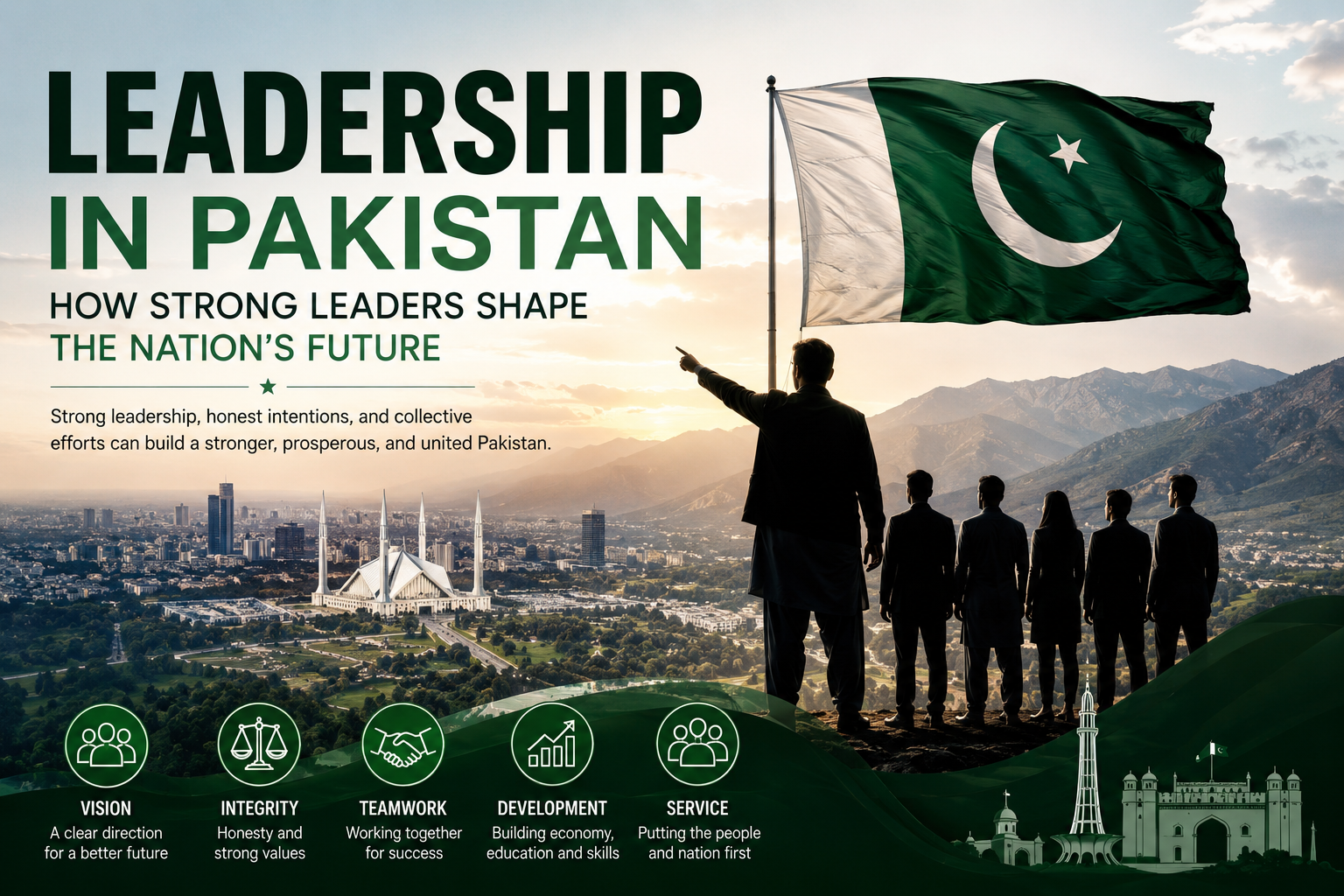
Strong leadership in Pakistan should be based on vision, competence, integrity, accountability, teamwork, and service. It should focus on education, economic development, technology, healthcare, agriculture, employment, national unity, and opportunities for young people.
Most importantly, leadership should not be viewed only as something practiced by politicians or people holding powerful positions. Every Pakistani can demonstrate leadership by taking responsibility, helping others, solving problems, learning continuously, and contributing positively to society.
The Pakistan of the future will be shaped by the choices made today. Developing honest, capable, educated, and responsible leaders is therefore not simply an organizational goal—it is an investment in the country's future.
When leadership is guided by service rather than personal gain, knowledge rather than misinformation, cooperation rather than division, and long-term thinking rather than short-term interests, Pakistan can make better use of its enormous potential.
The strongest future for Pakistan will ultimately depend not only on who leads, but also on how they lead, what values they follow, and what kind of country they work to build for the generations that come after them.
FAQs
1. Why is leadership important for Pakistan?
Strong leadership helps Pakistan improve its economy, education, institutions, and overall national development.
2. What qualities should a good Pakistani leader have?
A good leader should have integrity, vision, responsibility, confidence, competence, and strong decision-making skills.
3. How can leadership improve Pakistan’s economy?
Effective leadership can support businesses, create employment opportunities, encourage innovation, and promote sustainable economic growth.
4. What role does youth play in Pakistan’s future leadership?
Pakistan’s youth can become future leaders by developing education, communication, problem-solving, teamwork, and decision-making skills.
5. How can ordinary Pakistanis demonstrate leadership?
People can demonstrate leadership by taking responsibility, helping their communities, solving local problems, and contributing positively to society.