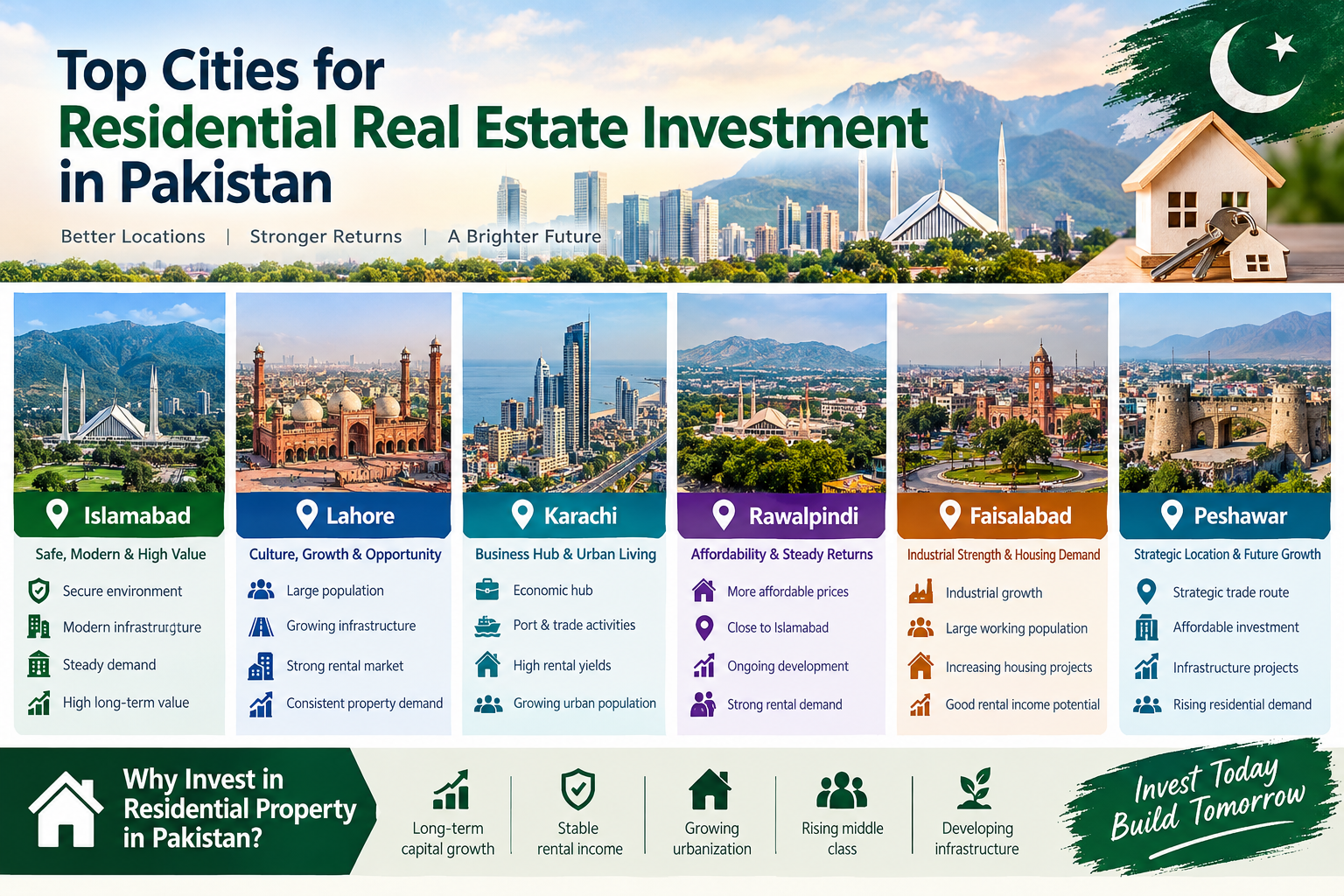
Residential real estate is one of the most important segments of Pakistan's property market. Houses, apartments, residential plots, villas, and housing societies are purchased by families for living purposes and by investors seeking rental income or long-term property opportunities.
Pakistan's major cities have different residential markets. Property prices, rental demand, infrastructure, population growth, employment opportunities, education, healthcare, and development projects can vary significantly from one city to another.
For this reason, choosing a residential property requires more than simply looking at the city name. Investors should examine the specific neighborhood, legal status, development level, accessibility, demand, and price of an individual property.
This guide discusses major Pakistani cities with active residential property markets and explains the factors that buyers and investors should consider when evaluating them.
Why Location Matters in Residential Real Estate
Location has a major influence on residential property demand.
A home located near important facilities may be more convenient for residents and can attract different levels of buyer and tenant interest.
Important location factors include:
Road connectivity
Schools
Universities
Hospitals
Markets
Offices
Public transport
Parks
Commercial areas
Security
Utilities
A property in a major city is not automatically a good investment. The specific location within the city matters greatly.
Lahore Residential Real Estate
Lahore is one of Pakistan's major residential property markets.
The city contains a wide range of residential options, including:
Traditional neighborhoods
Apartments
Private housing societies
Gated communities
Villas
Residential plots
Lahore's large population and extensive business, education, healthcare, and commercial activity create diverse housing requirements.
Residential Demand in Lahore
Different parts of Lahore attract different types of residents.
Some buyers prefer established neighborhoods with developed infrastructure, while others look for newer housing developments with modern planning and community facilities.
Important considerations include:
Distance from workplaces
School access
Road connectivity
Commercial facilities
Property prices
Rental demand
Investors should compare individual areas rather than treating the entire city as one market.
Karachi Residential Real Estate
Karachi is Pakistan's largest city and has a diverse residential property market.
The city includes:
Houses
Apartments
Residential plots
Gated communities
High-rise residential buildings
Established neighborhoods
Karachi's large population and economic activity create demand for different types of housing.
Residential Property in Karachi
Apartment living is an important part of Karachi's residential market, particularly in areas where land prices and population density influence housing choices.
Buyers may consider:
Accessibility
Security
Building maintenance
Parking
Electricity
Water availability
Nearby commercial areas
For houses and plots, location and infrastructure remain particularly important.
Islamabad Residential Real Estate
Islamabad is known for planned sectors, green spaces, roads, and a relatively organized urban structure.
Residential options include:
Houses
Apartments
Villas
Residential plots
Housing developments
The city attracts families, professionals, students, government employees, and businesses.
Factors to Consider in Islamabad
Buyers should examine:
Sector location
Road connectivity
Nearby facilities
Development status
Property documentation
Rental demand
Plot and house prices
Different sectors and surrounding developments can have substantially different market conditions.
Rawalpindi Residential Real Estate
Rawalpindi is closely connected with Islamabad and has its own large residential market.
The city includes:
Established neighborhoods
Housing societies
Apartments
Houses
Residential plots
Its connection with Islamabad creates housing demand from people who work or study across the twin-city area.
Why Rawalpindi Requires Local Research
Property values can differ considerably between neighborhoods.
Investors should examine:
Accessibility
Public transport
Nearby markets
Schools
Hospitals
Road conditions
Development level
The exact location should be evaluated rather than assuming that proximity to Islamabad automatically means high property demand.
Faisalabad Residential Real Estate
Faisalabad is an important industrial and commercial city with a growing residential property market.
The city's economy is strongly connected with manufacturing, textiles, trade, and related businesses.
Residential property options include:
Houses
Residential plots
Apartments
Housing societies
Private residential developments
Residential Demand in Faisalabad
Families may prefer established neighborhoods, while buyers looking for newer construction may consider developing housing areas.
Important factors include:
Road access
Nearby schools
Hospitals
Markets
Employment centers
Utilities
Development status
Investors should study local rental demand and actual transaction prices before purchasing.
Multan Residential Real Estate
Multan is a major city in southern Punjab and has a diverse residential property market.
Residential options include:
Houses
Apartments
Plots
Housing societies
Villas
Multan's role as an important regional center supports demand for residential properties.
Factors Affecting Multan Property Demand
Buyers may consider:
Access to major roads
Educational institutions
Hospitals
Shopping areas
Employment centers
Residential development
Utilities
The development level of individual neighborhoods can vary significantly.
Peshawar Residential Real Estate
Peshawar is an important urban center in Khyber Pakhtunkhwa.
The city has established residential neighborhoods as well as newer housing developments.
Residential properties include:
Houses
Plots
Apartments
Housing societies
Important Factors in Peshawar
Buyers should consider:
Location
Accessibility
Security arrangements
Infrastructure
Schools
Healthcare
Markets
Property documentation
Local market research is particularly important because property demand varies from one area to another.
Gujranwala Residential Real Estate
Gujranwala is an important commercial and industrial city in Punjab.
The city's residential market includes:
Houses
Residential plots
Apartments
Housing societies
Population growth and economic activity can influence housing demand.
Investors should examine the development of individual areas and compare property prices with rental demand.
Sialkot Residential Real Estate
Sialkot is known for its export-oriented economy and industrial activity.
Its residential market includes:
Houses
Plots
Apartments
Housing developments
Employment and business activity can influence residential demand.
Buyers should examine location, accessibility, infrastructure, and the relationship between property prices and local rental demand.
Why Major Cities Attract Residential Investors
Large urban centers can attract residential investment because they often contain:
Large populations
Employment opportunities
Educational institutions
Healthcare facilities
Commercial areas
Transportation networks
However, larger cities can also have higher property prices.
Therefore, investors should consider affordability and actual rental demand rather than assuming that the biggest city always provides the strongest investment opportunity.
Established Areas vs New Housing Societies
Investors often have to choose between established neighborhoods and new housing developments.
Established Areas
Advantages may include:
Existing infrastructure
Developed markets
Schools and hospitals
Established communities
Existing rental demand
Possible disadvantages include:
Older buildings
Limited parking
Higher property prices
Less modern planning
New Housing Developments
Potential advantages may include:
Modern planning
New infrastructure
Wider roads
New houses
Community facilities
Possible risks include:
Development delays
Limited current population
Uncertain rental demand
Infrastructure gaps
Both types require careful research.
Importance of Housing Society Approval
Before purchasing a plot or house in a housing society, buyers should verify the project's legal and approval status.
Important checks may include:
Ownership
Development authority approval
Relevant NOCs
Land status
Transfer process
Development progress
Requirements can differ depending on the city and relevant authority.
Rental Demand
Rental demand is an important factor for residential investors.
A property may attract tenants because it is near:
Universities
Offices
Hospitals
Industrial areas
Commercial centers
Transport routes
Investors should research actual rental rates rather than relying only on advertised figures.
Rental Yield
A basic rental yield calculation is:
Rental Yield = Annual Rent ÷ Property Price × 100
For example, if a property costs Rs. 15 million and generates Rs. 900,000 in annual rent:
Rs. 900,000 ÷ Rs. 15 million × 100 = 6%
This is a simplified calculation.
Actual returns can be lower after considering:
Repairs
Maintenance
Taxes
Vacancy
Management expenses
Property Prices and Affordability
Affordability is an important consideration.
A buyer should calculate not only the purchase price but also:
Transfer costs
Taxes
Renovation
Maintenance
Utility expenses
Financing costs
A property should fit within a realistic budget.
Importance of Infrastructure
Infrastructure can strongly affect residential property demand.
Important infrastructure includes:
Roads
Electricity
Water
Sewerage
Gas where available
Internet
Public transport
Street lighting
Before purchasing in a developing area, buyers should confirm which facilities are already available and which are only planned.
Schools and Universities
Educational facilities can influence residential demand.
Properties near schools, colleges, and universities may attract:
Families
Students
Teachers
University employees
However, buyers should also consider traffic, noise, and neighborhood conditions.
Healthcare Facilities
Hospitals, clinics, pharmacies, and diagnostic centers can make an area more convenient for residents.
Families often consider healthcare access when choosing a home.
Commercial Facilities
Residential communities require nearby commercial facilities.
Residents may need:
Grocery stores
Pharmacies
Restaurants
Banks
Salons
Markets
Repair services
A residential area with convenient commercial facilities may be more practical for everyday living.
Transportation and Connectivity
Good road and transport connections can increase the convenience of a residential location.
Buyers should consider:
Main roads
Public transport
Motorways
Bus routes
Nearby employment areas
However, properties directly next to extremely busy roads may also experience traffic and noise, so the exact location matters.
Residential Apartments
Apartments are increasingly important in urban residential markets.
They can be suitable for:
Small families
Young professionals
Students
Investors
People seeking central locations
When buying an apartment, investors should check:
Building management
Maintenance charges
Parking
Security
Elevator condition
Utility systems
Ownership documents
Residential Plots
Plots can be attractive to buyers who want to construct homes later.
Before purchasing a plot, check:
Development status
Possession
Road access
Utilities
Plot dimensions
Building restrictions
Legal documentation
The price of an undeveloped plot should not be compared directly with a fully developed residential property without considering these differences.
Factors That Affect Residential Property Value
Several factors can influence residential property prices:
Location
Properties in accessible and desirable areas may have stronger demand.
Size
Larger houses and plots generally require higher investment, although location can be more important than size.
Construction Quality
Well-maintained homes may attract stronger buyer interest.
Infrastructure
Reliable utilities and developed roads can increase convenience.
Nearby Facilities
Schools, hospitals, markets, and transport can influence demand.
Development
Growing areas may experience changes in property demand as infrastructure and population increase.
Legal Status
Clear documentation is essential for a property transaction.
Common Mistakes Investors Should Avoid
Buying Based Only on Future Promises
Future development is not guaranteed.
Ignoring Legal Verification
Property documents should always be checked.
Focusing Only on Price Appreciation
Rental demand and actual usability are also important.
Ignoring Vacancy
Rental properties may remain vacant for periods of time.
Not Visiting the Area
Physical inspection can reveal problems that advertisements do not show.
Ignoring Additional Costs
Taxes, transfer charges, repairs, and maintenance can affect the actual investment cost.
How to Compare Residential Markets
Investors can create a simple comparison based on:
Purchase price
Rental rate
Rental yield
Population
Infrastructure
Employment
Education
Healthcare
Development
Legal status
Resale demand
This approach provides a more complete picture than looking at property prices alone.
Residential Real Estate in Pakistan's Future
Pakistan's residential property market is likely to continue changing as cities expand and housing requirements evolve.
Future residential development may include:
Apartment projects
Gated communities
Mixed-use developments
Planned housing societies
Smaller neighborhood developments
Modern residential buildings
Technology, changing family structures, transportation, and affordability may also influence future housing preferences.
Developers may increasingly focus on complete communities that combine homes with schools, parks, commercial areas, healthcare, and other facilities.
Practical Tips for Residential Property Buyers
Before buying residential property in Pakistan:
Define your budget.
Decide whether the property is for living or investment.
Select suitable locations.
Compare multiple properties.
Visit the area personally.
Check infrastructure.
Research rental demand.
Verify ownership documents.
Check approvals.
Calculate all additional costs.
Avoid unrealistic investment promises.
Complete the transaction through proper legal procedures.
Conclusion
Pakistan has diverse residential real estate markets across major cities including Lahore, Karachi, Islamabad, Rawalpindi, Faisalabad, Multan, Peshawar, Gujranwala, and Sialkot. Each city contains different neighborhoods and property types, so residential investment decisions should be based on specific local conditions rather than city names alone.
Location, infrastructure, rental demand, property prices, legal status, nearby facilities, development, and resale demand are important factors for both home buyers and investors.
Established areas may provide developed infrastructure and existing communities, while newer housing developments can offer modern planning and future growth opportunities but may also involve development-related risks.
The most important step is research. Buyers should compare properties, inspect locations, verify documents, understand costs, and evaluate actual demand before making a purchase.
Residential real estate can serve both an important housing need and a potential investment purpose. A careful, research-based approach can help buyers understand different residential markets in Pakistan and select properties according to their individual financial and practical requirements.
FAQs
1. Which cities have major residential real estate markets in Pakistan?
Major residential markets include Lahore, Karachi, Islamabad, Rawalpindi, Faisalabad, Multan, Peshawar, Gujranwala, and Sialkot.
2. What should I consider when choosing a city for residential property?
Consider property prices, rental demand, employment, infrastructure, schools, healthcare, transportation, legal status, and future development.
3. Are new housing societies suitable for residential investment?
New housing societies can offer opportunities, but buyers should verify approvals, development progress, infrastructure, possession, and actual housing demand.
4. Is rental income important for residential property investors?
Yes. Rental demand and rental yield can help investors evaluate the income potential of a residential property.
5. Should I choose an established area or a new development?
Both have different characteristics. Established areas may offer developed infrastructure and existing demand, while new developments may provide newer facilities but can involve development and demand-related uncertainty.




