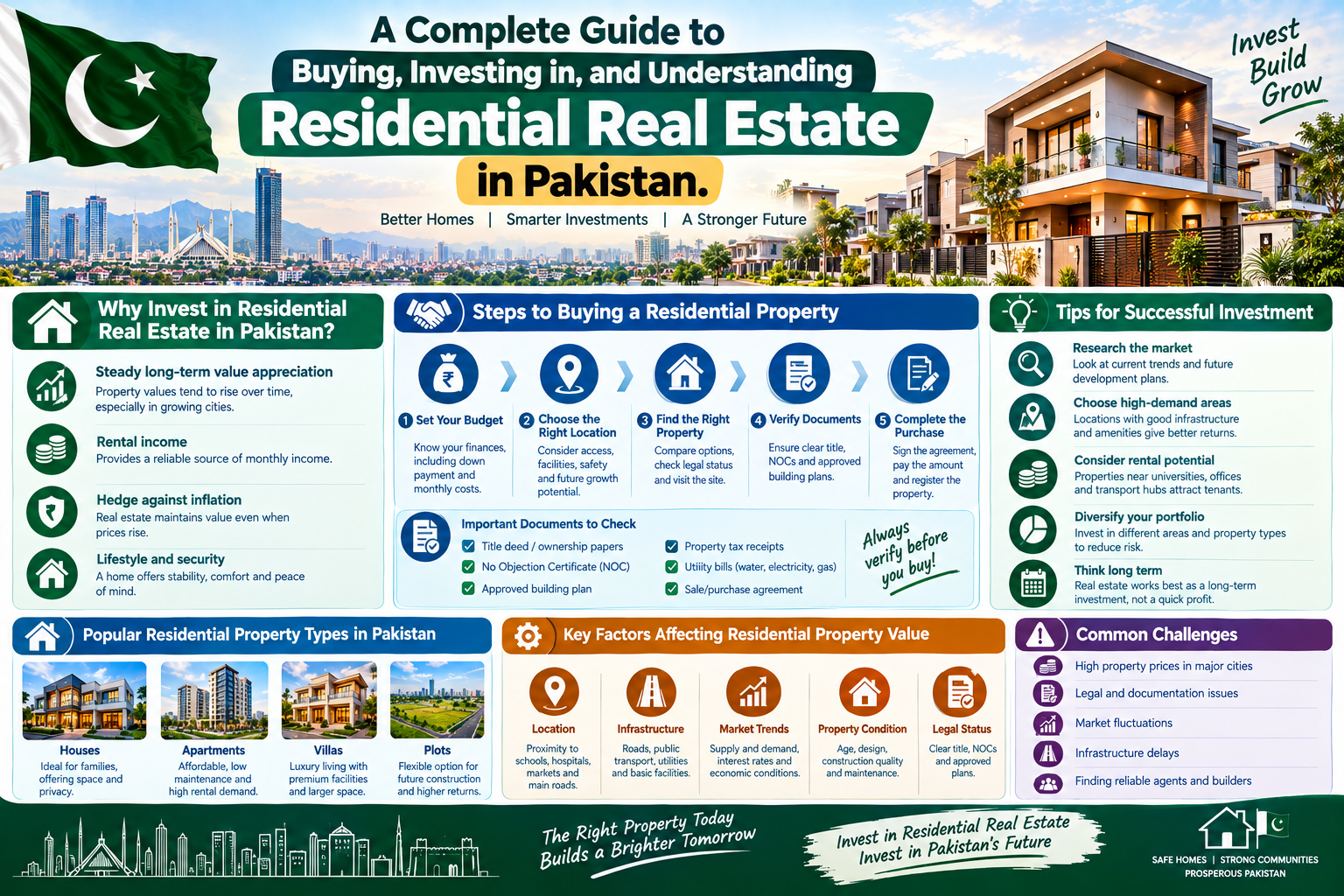
Residential real estate is one of the most important parts of Pakistan’s property market. Houses, apartments, residential plots, villas, and housing communities are purchased by families for living purposes as well as by investors looking for long-term opportunities.
For many Pakistani families, buying a home is an important financial goal. At the same time, residential property can be considered for rental income or long-term investment. However, purchasing residential real estate requires careful planning because property transactions involve significant amounts of money and can include legal, financial, and practical considerations.
The residential property market in Pakistan includes traditional neighborhoods, private housing societies, apartment projects, gated communities, and newly developing residential areas. Prices can vary greatly depending on the city, location, property size, infrastructure, development level, and demand.
This guide explains the basics of residential real estate in Pakistan and covers important factors that home buyers and investors should understand before purchasing a house, apartment, or residential plot.
What Is Residential Real Estate?
Residential real estate refers to property primarily designed for people to live in.
Common examples include:
Houses
Apartments
Flats
Villas
Residential plots
Farmhouses
Townhouses
Residential units in gated communities
Residential property can be purchased for personal use, rental purposes, or long-term investment.
Why Residential Real Estate Is Important in Pakistan
Pakistan has a large and growing population, creating continuous demand for housing.
Families need homes in areas that provide access to:
Schools
Hospitals
Markets
Public transport
Roads
Employment opportunities
Parks
Utilities
As cities expand, new residential communities and apartment projects are developed to meet different housing needs.
Residential real estate therefore remains an important part of the country's overall property sector.
House vs Apartment
One of the first decisions for a buyer is whether to purchase a house or an apartment.
Houses
A house generally provides:
More privacy
Private outdoor space
Greater control over renovations
Parking options
More independent use of the property
However, houses can require higher maintenance costs.
Apartments
Apartments may offer:
Lower entry costs in some locations
Security
Shared facilities
Central locations
Lower exterior maintenance responsibilities
However, apartment owners may have to pay service or maintenance charges.
The right option depends on the buyer's budget, lifestyle, family size, and preferred location.
Buying a Residential Plot
Some buyers prefer purchasing a plot and constructing a house later.
This approach allows the owner to design the house according to personal requirements.
Advantages can include:
Customized construction
Choice of design
Flexible construction timeline
Potential long-term land appreciation
However, plot buyers must consider:
Development status
Construction costs
Approval requirements
Utility availability
Building regulations
Future expenses
A plot that appears inexpensive may require significant additional spending before it becomes suitable for construction.
Buying a Ready-Built House
A ready-built house allows a buyer to move in after completing the transaction and necessary arrangements.
Before purchasing, buyers should inspect:
Structure
Roof
Walls
Flooring
Electrical wiring
Plumbing
Doors and windows
Water supply
Gas availability where applicable
Sewerage
Parking
General maintenance
A professional inspection can help identify problems that may not be obvious during a quick visit.
Location and Residential Property
Location is one of the most important factors affecting residential property value.
A house in a well-connected area may have stronger demand than a similar house in a less accessible location.
Important location factors include:
Road access
Nearby schools
Hospitals
Markets
Public transport
Employment centers
Parks
Mosques
Shopping areas
Security
Infrastructure
Buyers should consider both current facilities and realistic future development.
Major Cities and Residential Markets
Pakistan's major cities have different residential property markets.
Important residential markets exist in cities such as:
Karachi
Lahore
Islamabad
Rawalpindi
Faisalabad
Multan
Peshawar
Gujranwala
Each city contains different neighborhoods and housing developments with different prices and facilities.
Therefore, buyers should compare specific locations rather than assuming that property prices are the same throughout a city.
Established Neighborhoods
Established neighborhoods often have existing infrastructure and services.
They may provide:
Developed roads
Electricity
Water
Sewerage
Schools
Markets
Healthcare
Public transport
These areas may be convenient for families who want immediate access to everyday facilities.
New Housing Developments
New housing developments can provide modern planning and newer infrastructure.
They may include:
Gated entrances
Parks
Wider roads
Commercial areas
Community facilities
New houses
However, buyers should carefully verify the development status and legal approvals.
A newly advertised project may take time to become fully developed.
Housing Societies
Housing societies are a major part of Pakistan's residential property market.
They can offer:
Residential plots
Houses
Apartments
Parks
Commercial areas
Security
Community facilities
Before purchasing property in a housing society, buyers should verify its legal status and relevant approvals through the appropriate authority.
Importance of Legal Verification
Legal verification is one of the most important steps in purchasing residential property.
Before buying, a buyer should verify:
Ownership
Title documents
Sale deed
Transfer records
Property tax status
Outstanding dues
Development approval
Relevant NOCs where applicable
Requirements can vary according to the location and type of property.
Professional legal assistance can be useful when dealing with complicated property transactions.
Verify the Seller
Buyers should confirm that the person selling the property has the legal authority to sell it.
Important questions include:
Is the seller the actual owner?
Is the property jointly owned?
Is there a mortgage?
Are there inheritance issues?
Is there a court dispute?
Are there unpaid taxes or society charges?
Proper verification can reduce the risk of future disputes.
Property Documents
Different properties can involve different documents.
Depending on the transaction, buyers may encounter:
Sale deed
Registry
Allotment letter
Transfer letter
Ownership documents
Possession documents
Approved building plans
Tax records
The buyer should confirm that the documents are genuine and consistent with official records.
Residential Property Prices
Residential property prices in Pakistan vary according to several factors.
These include:
City
Neighborhood
Location
Property size
Construction quality
Road width
Property age
Facilities
Development level
Demand
Legal status
For example, a house located near major facilities may have a different value from a similar-sized house in a less developed location.
House Size and Property Value
Property size is an important factor in pricing.
Common residential property categories can include different plot and house sizes depending on the local market.
However, buyers should not evaluate a property only by size.
A smaller house in a highly accessible location may be more attractive to some buyers than a larger house in a remote area.
Construction Quality
Construction quality affects both comfort and long-term maintenance.
Buyers should inspect:
Foundation
Walls
Roof
Flooring
Plumbing
Electrical wiring
Doors
Windows
Kitchen
Bathrooms
For older properties, additional attention should be given to repairs and structural condition.
Property Age
The age of a house can influence its price.
Older houses may have:
Established locations
Larger rooms
Mature neighborhoods
But they may also require:
Renovation
Plumbing repairs
Electrical upgrades
Roof maintenance
Painting
New houses may have modern designs and newer systems but can be more expensive.
Rental Residential Property
Some investors purchase houses or apartments for rental income.
Rental demand depends on factors such as:
Location
Property condition
Size
Nearby employment
Schools
Universities
Transport
Security
Local demand
A property located near educational institutions or employment centers may attract different types of tenants.
Rental Yield
Rental yield provides a simple way to compare annual rental income with the property's purchase price.
The basic formula is:
Rental Yield = Annual Rent ÷ Property Price × 100
For example, if a property costs Rs. 10 million and generates Rs. 600,000 in annual rent:
Rs. 600,000 ÷ Rs. 10 million × 100 = 6%
This is only a basic calculation.
Actual returns may be lower after considering:
Maintenance
Repairs
Taxes
Vacancy
Property management
Other expenses
Vacancy Risk
A rental property may not remain occupied throughout the year.
When a property is vacant, the owner may lose rental income while still paying certain expenses.
Before purchasing for rental purposes, investors should investigate:
Local rental demand
Average vacancy periods
Typical rent
Tenant preferences
Competition from other properties
Buying Property for Your Own Family
For personal use, financial return is not the only consideration.
Families should also consider:
School distance
Workplace access
Healthcare
Neighborhood environment
Security
Transport
Shopping
Parks
Family requirements
A slightly more expensive property may sometimes provide better convenience if it meets the family's needs.
Residential Property as a Long-Term Investment
Some investors purchase residential property with the expectation that its value may increase over time.
Potential factors include:
Population growth
Infrastructure development
Urban expansion
New roads
Nearby commercial activity
Improved public facilities
However, property appreciation is not guaranteed.
Investors should avoid making decisions based solely on claims that a property will automatically double or triple in value.
Infrastructure and Residential Property
Infrastructure has a strong relationship with residential demand.
Important infrastructure includes:
Roads
Electricity
Water
Gas where available
Sewerage
Internet
Street lighting
Public transport
A residential area with reliable infrastructure can be more convenient for families.
Schools and Educational Facilities
Families with children often consider education when selecting a residential location.
Nearby schools, colleges, and universities can increase the practical attractiveness of some neighborhoods.
However, buyers should also consider:
School quality
Travel time
Transport availability
Traffic
Future educational development
Healthcare Facilities
Access to healthcare can also influence residential decisions.
Nearby:
Hospitals
Clinics
Pharmacies
Diagnostic centers
can provide convenience, particularly for families with children or older family members.
Security and Community Environment
Security is another consideration for residential buyers.
Buyers may examine:
Street activity
Security arrangements
Gated access
Street lighting
Community management
However, security arrangements can vary over time, so buyers should investigate the current situation rather than relying only on advertisements.
Parks and Green Spaces
Parks and open spaces can improve the residential environment.
Families may value areas that provide:
Walking spaces
Playgrounds
Green areas
Community parks
Housing developments with planned green spaces can be attractive to families looking for recreational facilities.
Parking
Parking is an important consideration for many households.
Buyers should check:
Garage size
Street parking
Visitor parking
Road width
Parking restrictions
A house with insufficient parking can create daily inconvenience.
Utilities
Before purchasing a home, buyers should confirm the availability and condition of essential utilities.
These may include:
Electricity
Water
Gas where available
Sewerage
Internet
Waste collection
Buyers should also investigate whether utility connections are individual or shared.
Buying Through a Real Estate Agent
Real estate agents can help buyers find properties and understand local market conditions.
However, buyers should independently verify:
Property ownership
Price
Legal status
Documents
Taxes
Development approvals
The buyer should not rely only on verbal statements.
Property Inspection
A physical inspection is important before buying a house.
During the inspection, check:
Walls
Roof
Floors
Plumbing
Electrical systems
Water pressure
Doors
Windows
Kitchen
Bathrooms
Parking
Boundary walls
For expensive purchases, professional inspection can provide additional information.
Negotiating the Property Price
Residential property prices may sometimes be negotiable.
A buyer can research similar properties before making an offer.
Factors that may influence negotiations include:
Property condition
Location
Seller's circumstances
Market demand
Property age
Required repairs
Comparable properties
Good negotiation should be based on actual market information rather than guesses.
Additional Costs of Buying Residential Property
The purchase price is not always the only expense.
Potential costs may include:
Taxes
Transfer charges
Registration expenses
Legal fees
Agent commission
Society charges
Renovation
Repairs
Utility transfers
Applicable charges can vary depending on the location, transaction, property value, and current rules.
Buyers should confirm the latest applicable costs before completing a transaction.
Common Mistakes Home Buyers Make
Buying Without Checking Documents
Legal verification should come before major financial commitment.
Choosing Only Based on Price
The cheapest property may have problems related to location, construction, access, or legal status.
Ignoring Future Expenses
Buyers should consider renovation, maintenance, taxes, and other costs.
Not Visiting the Property
Online photographs may not show the actual condition.
Ignoring the Neighborhood
The surrounding area can be just as important as the house itself.
Trusting Unrealistic Investment Promises
No one can guarantee future property appreciation.
Forgetting Resale Demand
Even if you plan to live in a property, future resale can be relevant.
How Beginners Can Buy Residential Property
A simple buying process can help beginners stay organized.
Step 1: Set Your Budget
Determine how much you can realistically spend.
Step 2: Decide Your Purpose
Decide whether the property is for:
Personal residence
Rental income
Long-term investment
Step 3: Select the City and Area
Compare different neighborhoods according to your requirements.
Step 4: Research Prices
Study multiple properties rather than relying on one advertisement.
Step 5: Visit Properties
Inspect the actual property and surrounding area.
Step 6: Verify Documents
Confirm ownership, approvals, taxes, and other relevant records.
Step 7: Calculate Additional Costs
Include taxes, transfer fees, legal expenses, repairs, and other charges.
Step 8: Negotiate
Use comparable properties to understand whether the asking price is reasonable.
Step 9: Complete the Legal Process
Use proper documentation and official procedures for the transaction.
Residential Real Estate and Technology
Technology has changed the way people search for residential property.
Buyers can now use online platforms to:
Compare properties
View photographs
Check locations
Compare asking prices
Contact agents
Research neighborhoods
However, online information should be treated as an initial research tool.
Physical inspection and document verification remain important.
Future of Residential Real Estate in Pakistan
Pakistan's residential property sector will continue to be influenced by population growth, urban expansion, changing family needs, construction costs, infrastructure development, and economic conditions.
New housing communities, apartment buildings, and mixed-use developments are likely to remain part of expanding urban areas.
At the same time, buyers are becoming more interested in factors beyond the house itself, including:
Location
Security
Utilities
Parking
Schools
Healthcare
Parks
Commercial facilities
Connectivity
This means residential developers and property sellers need to consider the complete living environment.
Tips for Residential Property Investors
Investors can consider the following principles:
Research the local market.
Compare several properties.
Verify legal documents.
Study rental demand.
Calculate potential rental yield.
Consider vacancy risk.
Check infrastructure.
Visit the property personally.
Calculate all additional costs.
Avoid making decisions based only on future-price promises.
Conclusion
Residential real estate in Pakistan provides housing options for families and opportunities for property investors. Houses, apartments, villas, and residential plots can serve different purposes depending on a buyer's budget, location preferences, family needs, and investment objectives.
Location, legal status, infrastructure, construction quality, property size, rental demand, and surrounding facilities are some of the most important factors to consider before purchasing residential property.
For home buyers, the ideal property is not necessarily the cheapest or largest one. It should meet practical needs while remaining financially manageable. Investors should similarly examine rental income, vacancy risk, expenses, market demand, and potential resale demand.
Most importantly, buyers should conduct proper due diligence. Ownership documents, approvals, taxes, utility connections, property condition, and other relevant information should be verified before completing a transaction.
With careful research and realistic financial planning, buyers and investors can better understand Pakistan's residential real estate market and make informed property decisions.
FAQs
1. What is residential real estate in Pakistan?
Residential real estate includes houses, apartments, flats, villas, residential plots, and other properties primarily designed for living.
2. What should I check before buying a house in Pakistan?
Check ownership documents, legal approvals, property condition, location, utilities, taxes, outstanding dues, access, parking, and surrounding facilities.
3. Is buying a residential property a good long-term investment?
Residential property can provide long-term investment opportunities, but returns are not guaranteed and depend on location, demand, market conditions, expenses, and other factors.
4. Is a house better than an apartment?
It depends on the buyer's budget, family requirements, location, maintenance preferences, and desired facilities. Both houses and apartments have different advantages.
5. How can I calculate residential property rental yield?
Divide the annual rental income by the property's purchase price and multiply by 100. For a more realistic calculation, also consider maintenance, vacancy, taxes, and other expenses.