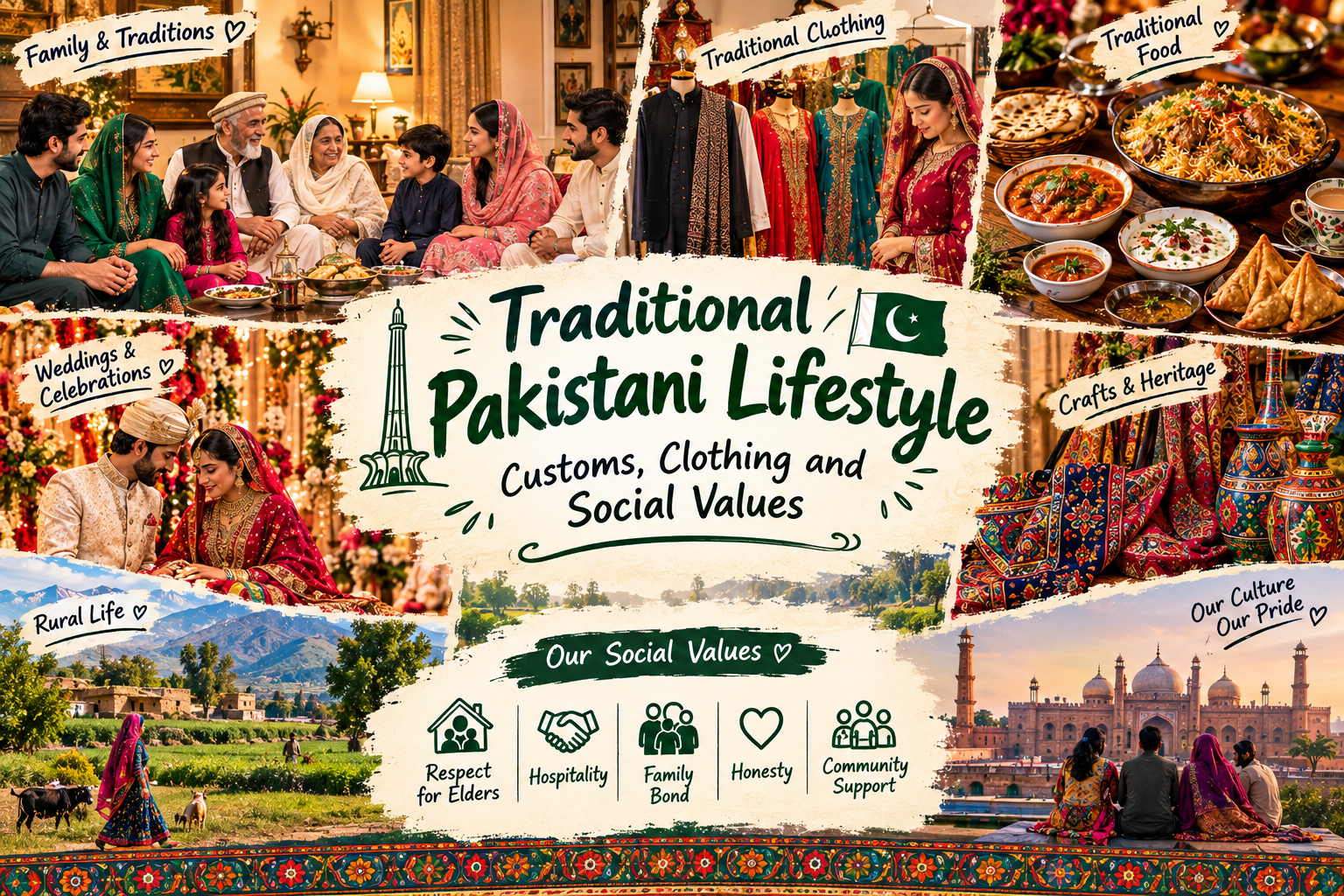
Pakistan is a country with a rich cultural heritage, diverse traditions, colorful clothing, traditional foods, religious celebrations, and strong social values. The traditional lifestyle of Pakistan has developed through centuries of history and has been influenced by different regions, languages, communities, and historical civilizations.
Although modern technology and urban lifestyles are changing the way people live, traditional Pakistani customs remain an important part of everyday life. Family gatherings, hospitality, traditional clothing, local food, weddings, religious celebrations, respect for elders, and community relationships continue to shape Pakistani society.
Traditional Pakistani lifestyle is not exactly the same everywhere. Punjab, Sindh, Khyber Pakhtunkhwa, Balochistan, Gilgit-Baltistan, and other regions have their own languages, clothing, foods, music, crafts, festivals, and social customs. This cultural diversity makes Pakistan's traditional lifestyle unique.
What Is Traditional Pakistani Lifestyle?
Traditional Pakistani lifestyle refers to the customs, habits, values, clothing, food, celebrations, family structures, and social practices that have developed across generations.
Many traditional practices are connected with family and community life. People often celebrate important occasions together, welcome guests warmly, respect elders, and participate in weddings and religious events as families.
Traditional lifestyle can be seen in both rural and urban areas, although its expression may differ.
For example, a rural family may maintain traditional agricultural practices and local customs, while an urban family may live in a modern house but continue wearing traditional clothes during Eid and attending large family gatherings.
This combination allows cultural traditions to remain relevant even as lifestyles change.
Cultural Diversity of Pakistan
Pakistan is home to several major cultural regions.
Punjab has a rich tradition of colorful clothing, folk music, agricultural communities, traditional foods, and lively celebrations.
Sindh is known for its distinctive Ajrak, Sindhi embroidery, handicrafts, folk traditions, and historical heritage.
Khyber Pakhtunkhwa has its own traditional clothing, hospitality practices, Pashtun cultural customs, music, and community traditions.
Balochistan has distinctive embroidery, clothing, handicrafts, tribal traditions, and cultural expressions.
Gilgit-Baltistan contains diverse mountain communities with their own languages, clothing, foods, music, and customs.
This regional diversity means that traditional Pakistani lifestyle cannot be described through one single cultural pattern.
Importance of Family
Family is one of the strongest elements of traditional Pakistani society.
Parents, grandparents, children, cousins, uncles, aunts, and other relatives may maintain close relationships.
In traditional joint-family households, several generations may live together or remain closely connected.
Family members often support one another during important occasions and difficult times.
Children are generally taught to respect their parents and elders from an early age.
Family relationships are also strengthened through shared meals, religious occasions, weddings, visits, and gatherings.
Even families that live separately may maintain strong connections through regular visits and communication.
Respect for Elders
Respect for elders is an important social value in Pakistani culture.
Children are traditionally taught to speak politely with older people and listen to their advice.
Grandparents often hold an important position within families.
They may share stories about family history, traditions, and their experiences with younger generations.
During family gatherings, younger people commonly greet elders and spend time with them.
Modern lifestyles may have changed some family routines, but respect for elders remains an important cultural value.
Pakistani Hospitality
Hospitality is one of the widely recognized features of Pakistani social life.
Guests are often welcomed warmly and offered tea, food, snacks, or refreshments.
In many households, people prepare special food when relatives or friends visit from another city.
Hospitality is also visible during weddings, Eid celebrations, religious events, and community gatherings.
Traditional hospitality is not limited to wealthy households. Even families with modest resources may make an effort to offer something to their guests.
This practice reflects the importance placed on relationships and generosity.
Traditional Pakistani Clothing
Clothing is an important part of Pakistani cultural identity.
The shalwar kameez is one of the most recognizable traditional outfits in Pakistan.
Men commonly wear shalwar kameez, sometimes combined with waistcoats, shawls, turbans, or other regional accessories.
Women wear a wide variety of shalwar kameez designs, dupattas, embroidered suits, and regional clothing.
Traditional clothing varies according to region, climate, occasion, and cultural background.
For example, Sindhi Ajrak is a well-known traditional textile associated with Sindh. Balochi dresses are recognized for detailed embroidery, while different communities in northern Pakistan have their own traditional clothing.
Traditional Clothing for Special Occasions
Traditional clothing becomes especially important during weddings, Eid, religious events, and cultural celebrations.
Women may wear embroidered dresses, formal suits, lehengas, ghararas, or other traditional outfits.
Men may choose sherwanis, waistcoats, kurta shalwar, or formal eastern clothing.
Traditional jewelry, shoes, dupattas, shawls, and other accessories may complete the look.
Clothing also provides an opportunity for families to express regional identity.
Pakistani Food Traditions
Food is one of the most important parts of Pakistani lifestyle.
Traditional Pakistani cuisine includes rice dishes, breads, meat, vegetables, lentils, dairy products, sweets, and many regional specialties.
Popular foods include biryani, pulao, nihari, haleem, karahi, kebabs, daal, saag, chana, naan, roti, and a wide range of desserts.
Different regions have their own specialties.
Food is often connected with family gatherings and celebrations. Weddings, Eid, religious occasions, and visits from relatives may involve special meals.
Traditional recipes are frequently passed from parents and grandparents to younger generations.
Importance of Tea
Tea has a special place in Pakistani social life.
Chai is commonly served to guests and enjoyed by family members.
People may sit together in the evening for tea and conversation.
Tea can also be part of meetings between relatives, friends, neighbors, and business associates.
Different regions and households have their own preferences regarding tea preparation.
This simple beverage has become closely connected with social interaction.
Traditional Pakistani Weddings
Weddings are among the most important social events in Pakistan.
Traditional weddings can involve several ceremonies and gatherings.
Events such as mehndi, dholki, baraat, and walima are common in many families, although customs differ according to region and family traditions.
Music, traditional clothing, decorations, food, jewelry, and family gatherings are important parts of many weddings.
Relatives often travel from other cities to participate.
Weddings can also strengthen relationships between extended families.
Although modern event planning and digital photography have changed the appearance of weddings, many traditional customs continue.
Mehndi and Dholki Traditions
Mehndi celebrations are often associated with colorful clothing, music, decorations, and family gatherings.
Women and girls may apply henna designs on their hands during wedding celebrations.
Dholki gatherings can involve traditional songs, drums, dancing, and informal family celebrations.
These traditions vary from family to family and from region to region.
Modern weddings may combine these traditions with contemporary decorations and professional event services.
Religious Traditions
Religion plays an important role in Pakistani social and cultural life.
Ramadan, Eid-ul-Fitr, and Eid-ul-Adha influence family routines and community activities.
During Ramadan, families often gather for sehri and iftar.
Mosques become important centers of prayer and community activity.
Eid-ul-Fitr is celebrated with prayers, family visits, special food, new clothes, and greetings.
Eid-ul-Adha includes the tradition of animal sacrifice and distribution of meat among family members, relatives, neighbors, and people in need.
These occasions bring communities and families together.
Traditional Family Meals
Family meals have traditionally been an important part of Pakistani life.
People may sit together for lunch or dinner, especially during weekends and special occasions.
Traditional meals often include roti or naan, rice, vegetables, meat dishes, lentils, yogurt, and salads.
Large family gatherings may include several dishes prepared by different members of the household.
Food can therefore be more than a basic necessity. It can be a way of expressing hospitality, affection, and cultural identity.
Rural Traditional Lifestyle
Rural Pakistan has traditionally been closely connected with agriculture.
Farming, livestock, local markets, handicrafts, and community activities have played important roles in many rural communities.
People may grow crops, raise animals, work in agricultural businesses, or participate in local trades.
Village communities can have strong social relationships. Neighbors and relatives often participate together in weddings, religious celebrations, and community activities.
Traditional lifestyles in rural areas are also changing because of education, technology, transportation, and modern agricultural methods.
Traditional Lifestyle in Cities
Traditional culture is not limited to villages.
Urban Pakistanis also maintain many cultural practices.
People living in cities may wear western or modern clothing during ordinary days but choose traditional outfits for Eid, weddings, religious events, and family gatherings.
Urban families may live in apartments or modern houses but continue traditional food and celebration practices.
Restaurants and food businesses also preserve traditional dishes while presenting them in modern settings.
This shows how traditional culture can adapt to urban environments.
Traditional Music and Folk Culture
Music is an important part of Pakistani cultural heritage.
Different regions have their own folk music traditions.
Punjabi folk music, Sindhi music, Pashtun musical traditions, Balochi music, and northern regional music contribute to Pakistan's cultural diversity.
Traditional instruments can include drums, flutes, string instruments, and other regional instruments.
Folk songs are often associated with weddings, festivals, historical stories, love, nature, and community life.
Modern Pakistani music sometimes combines traditional sounds with contemporary musical styles.
Pakistani Handicrafts
Traditional handicrafts represent another important part of Pakistani culture.
Different regions are known for embroidery, textiles, pottery, woodwork, carpets, jewelry, leather products, and decorative items.
Sindhi Ajrak is one example of a traditional textile with a distinctive design.
Balochi embroidery is another important form of regional craftsmanship.
Handicrafts can provide income for artisans while also preserving cultural traditions.
Tourists and collectors often purchase handmade products as cultural souvenirs.
Traditional Markets and Bazaars
Traditional markets remain an important part of Pakistani life.
Local bazaars sell clothing, spices, fruits, vegetables, jewelry, footwear, household items, handicrafts, and food.
Markets can also serve as social spaces where people meet neighbors and relatives.
Although shopping malls and online stores have become popular, traditional bazaars continue to attract customers.
Many visitors enjoy traditional markets because they provide an experience connected with local culture.
Traditional Games and Sports
Pakistan has a history of traditional games and physical activities.
Children traditionally played outdoor games in streets, school grounds, parks, and open spaces.
Cricket has become extremely popular throughout the country, while hockey, squash, football, wrestling, and other sports also have cultural importance.
Traditional rural communities have also maintained regional games and competitions.
Sports provide entertainment while encouraging teamwork and community interaction.
Traditional Greetings and Manners
Manners are an important part of Pakistani social culture.
People commonly greet one another politely and ask about each other's well-being.
Respectful language is often used when speaking with elders.
Guests may be invited to sit comfortably and offered refreshments.
Children are traditionally taught to greet relatives and visitors properly.
These small social practices help maintain respectful relationships.
Role of Neighbors
Neighborhood relationships can be important in traditional Pakistani communities.
Neighbors may help each other during weddings, religious events, emergencies, or other important situations.
In villages and smaller towns, neighbors may know each other closely.
Urbanization has changed neighborhood interaction in some areas, but community relationships continue through local gatherings, religious activities, schools, and social events.
Traditional Celebrations
Pakistan has many cultural and religious celebrations.
Eid celebrations are among the most widespread.
Weddings and family events are also important social occasions.
Regional cultural festivals may celebrate local music, food, crafts, literature, history, and traditions.
Such celebrations provide opportunities for younger generations to learn about their cultural heritage.
Role of Storytelling
Before modern digital entertainment became widespread, storytelling was an important form of family entertainment.
Grandparents and elders often shared stories with children.
Stories could include family history, folk tales, moral lessons, historical events, and personal experiences.
Although children today have access to television, smartphones, games, and online videos, storytelling can still help preserve family memories and cultural knowledge.
Traditional Values and Honesty
Traditional Pakistani society places importance on values such as honesty, respect, responsibility, generosity, and loyalty to family.
Parents often teach children to be truthful, respectful, helpful, and responsible.
Religious and cultural teachings also influence these values.
Different families may emphasize different qualities, but moral education remains an important part of childhood.
Traditional Role of Community
Community relationships have historically played a strong role in Pakistani life.
People may come together during weddings, funerals, religious events, festivals, and local activities.
Community support can be particularly important during difficult circumstances.
Modern urban lifestyles may reduce daily interaction between neighbors, but community networks continue through mosques, schools, local organizations, family relationships, and social groups.
Changing Traditional Lifestyle
Traditional Pakistani lifestyle is not completely unchanged.
Technology, education, urbanization, globalization, and international media have introduced new ideas.
Young people may have different preferences regarding fashion, careers, entertainment, travel, and communication.
Families may live in smaller households and use digital communication instead of visiting relatives as frequently.
Online shopping has changed traditional market habits.
Western and international food options are increasingly available alongside traditional cuisine.
These changes do not necessarily remove traditional culture. Instead, many people combine old customs with modern lifestyles.
Traditional and Modern Clothing Together
Modern Pakistani fashion is an excellent example of cultural adaptation.
Designers often use traditional embroidery, fabrics, and eastern clothing styles while introducing modern cuts and designs.
Young people may choose traditional clothing for family events and modern clothing for casual activities.
This combination allows cultural identity to remain visible while fashion continues to evolve.
Preserving Pakistani Traditions
Preserving cultural traditions requires participation from different generations.
Parents and grandparents can teach children traditional recipes, stories, languages, crafts, and customs.
Schools can introduce students to cultural history and local heritage.
Museums, cultural organizations, artists, and artisans also contribute to preservation.
Digital platforms can provide another way to document and share Pakistani traditions with younger audiences.
Traditional culture can therefore be preserved while using modern technology.
Importance of Regional Languages
Language is a major part of cultural identity.
Pakistan is home to many languages, including Urdu, Punjabi, Sindhi, Pashto, Balochi, Saraiki, Hindko, Brahui, and several languages spoken in northern regions.
Regional languages are often passed from parents to children.
They are used in family conversations, folk songs, poetry, storytelling, and cultural events.
Preserving regional languages helps protect cultural diversity.
Traditional Values in Modern Families
Modern Pakistani families often combine traditional values with contemporary lifestyles.
A family may use smartphones and online banking while maintaining traditional Eid celebrations.
Parents may encourage children to pursue modern careers while continuing to teach respect for elders.
Families may live in separate homes but gather for weddings and religious occasions.
This balance demonstrates that culture can adapt without completely disappearing.
Challenges to Traditional Culture
Traditional culture faces several challenges.
Globalization and international media can influence clothing, food, entertainment, language, and social habits.
Young people may become less familiar with traditional crafts, folk songs, local languages, or historical customs.
Urbanization can also reduce connections with traditional rural practices.
However, cultural education, family participation, schools, tourism, local businesses, and digital platforms can help preserve traditions.
Future of Traditional Pakistani Lifestyle
The future of traditional Pakistani lifestyle will likely involve a combination of preservation and change.
Some customs may become less common, while others may remain strong.
Traditional clothing, food, weddings, Eid celebrations, hospitality, family relationships, and regional crafts are likely to continue playing important roles.
At the same time, technology will provide new ways to promote and document culture.
Young people can use social media, websites, photography, video, and digital storytelling to introduce Pakistani traditions to wider audiences.
Conclusion
Traditional Pakistani lifestyle reflects the country's rich cultural history, regional diversity, family relationships, hospitality, clothing, food, religious traditions, music, crafts, and social values.
Family remains one of the strongest foundations of traditional life. Respect for parents and elders, hospitality toward guests, shared meals, weddings, Eid celebrations, and community relationships continue to influence everyday life.
Pakistan's cultural diversity makes its traditional lifestyle especially rich. Each region contributes its own clothing, language, food, music, crafts, and customs.
Modernization is changing the way people live, but traditional culture continues to adapt. People can use smartphones, shop online, study through digital platforms, and work remotely while still celebrating Eid, wearing traditional clothing, preparing local food, attending weddings, and maintaining family relationships.
The future of Pakistani culture will depend partly on how successfully younger generations learn, appreciate, and preserve their heritage while adapting to modern life. Tradition and modernity do not have to exist separately. They can develop together and create a lifestyle that respects the past while making room for the future.
FAQs
1. What are the main features of traditional Pakistani lifestyle?
Family values, respect for elders, hospitality, traditional clothing, local food, religious celebrations, weddings, regional languages, music, and community relationships are important features.
2. What is traditional Pakistani clothing?
Shalwar kameez is one of the most common traditional outfits. Regional clothing, embroidery, Ajrak, shawls, waistcoats, and other traditional garments are also important.
3. Why is family important in Pakistani culture?
Family provides emotional and practical support and helps pass cultural values, traditions, language, and social practices from one generation to another.
4. What foods are part of traditional Pakistani culture?
Traditional foods include biryani, nihari, haleem, karahi, pulao, kebabs, daal, saag, naan, roti, chana, and various regional dishes and sweets.
5. How is traditional Pakistani culture changing?
Technology, urbanization, education, globalization, social media, and modern employment are changing everyday lifestyles, while many traditional customs continue to be practiced and adapted.