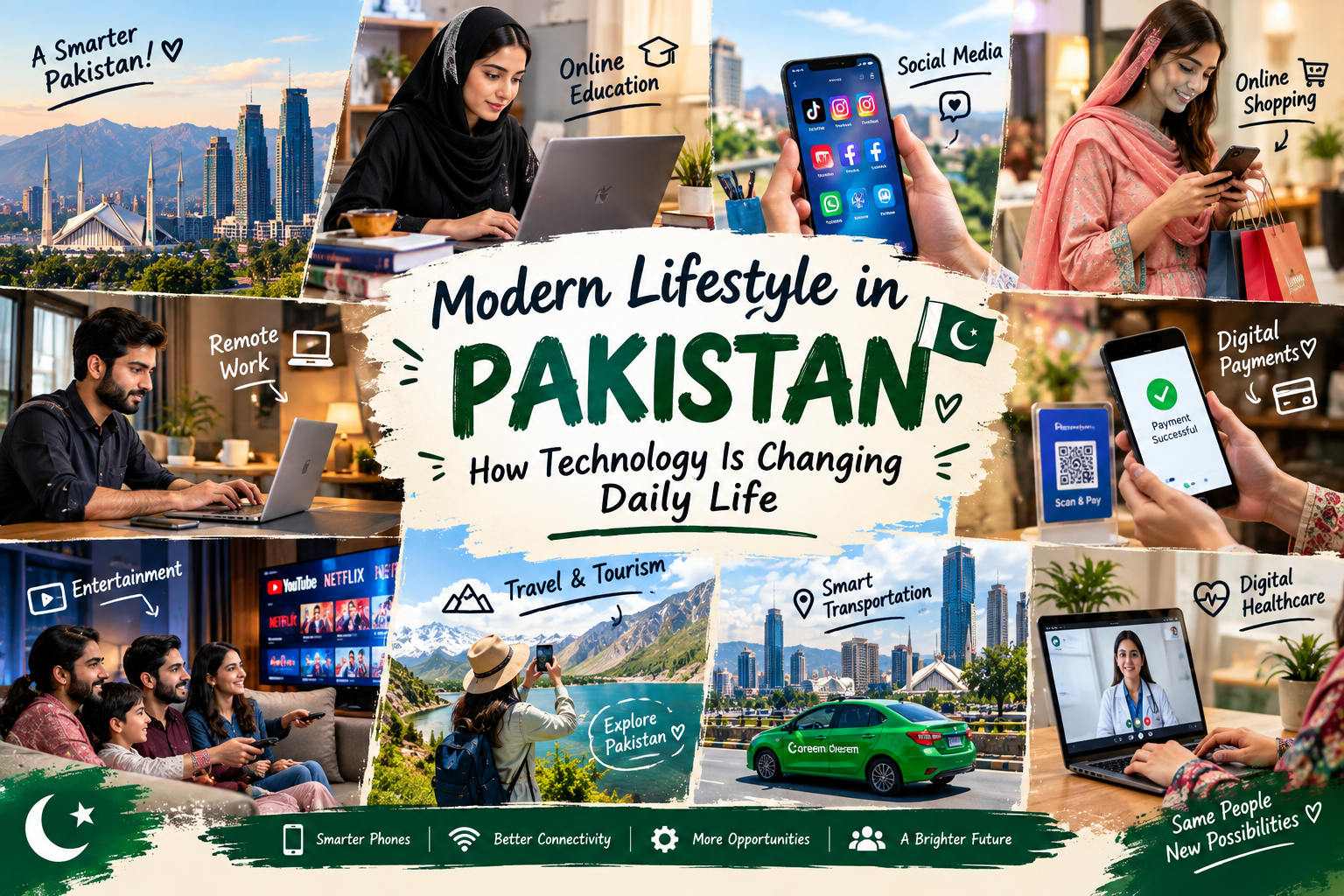
Technology has become an important part of modern life in Pakistan. Over the past few years, smartphones, internet services, social media, online shopping, digital payments, remote work, and online education have changed the way people communicate, study, work, shop, travel, and spend their free time.
Pakistan still has strong cultural and family traditions, but modern technology has introduced new ways of living. A person can now attend an online class, communicate with relatives in another country, order food from home, pay a bill through a mobile application, or work with an international client without leaving the house.
The impact of technology is visible in both large cities and smaller towns. Although access and usage vary between different communities, digital services are becoming increasingly connected with everyday activities.
What Is Modern Lifestyle in Pakistan?
Modern lifestyle in Pakistan refers to the changing ways people live, work, communicate, shop, study, and entertain themselves.
Traditional Pakistani lifestyle remains important, but technology has added new choices and opportunities. People can combine traditional customs with modern digital services.
For example, a family may celebrate Eid according to traditional customs while using smartphones to contact relatives abroad. A student may wear traditional clothes during a family event but use an online platform for education. A small business owner may operate a physical shop while also selling products through social media.
This combination of traditional culture and modern technology is an important feature of contemporary Pakistani life.
Smartphones and Daily Life
Smartphones are among the most influential technologies in modern Pakistani society.
People use smartphones for communication, education, entertainment, photography, navigation, banking, shopping, and business.
Messaging applications allow families and friends to communicate instantly. Voice and video calls make it possible to stay connected with relatives living in different cities or countries.
Smartphones have also changed the way people access information. Instead of waiting for newspapers or television programs, people can find information online within seconds.
Students use smartphones for educational videos, digital notes, dictionaries, research, and communication with classmates.
Small businesses also use smartphones to communicate with customers, manage orders, advertise products, and maintain social media pages.
Internet and Pakistani Society
Internet access has created new opportunities for Pakistani citizens.
Students can access online courses and educational resources. Professionals can communicate with clients and colleagues. Businesses can reach customers outside their local areas.
The internet has also changed entertainment. People can watch videos, listen to music, follow sports, read articles, and communicate with friends through digital platforms.
For many people, the internet is no longer simply a source of entertainment. It has become part of education, employment, business, communication, and everyday activities.
However, access to reliable and affordable internet is not equal everywhere. Urban areas generally have more digital facilities, while some rural and remote communities may face connectivity limitations.
Social Media in Pakistan
Social media has become an important part of modern Pakistani lifestyle.
Platforms such as Facebook, Instagram, TikTok, YouTube, and other digital services are used for communication, entertainment, education, marketing, and business.
Young people especially use social media to share photographs, videos, opinions, creative work, and educational content.
Businesses use social media to introduce new products, communicate with customers, and advertise their services.
A small clothing business, for example, can display its products online and receive orders from customers in different cities.
Social media has therefore created new opportunities for communication and entrepreneurship.
Digital Education
Technology has changed education in Pakistan.
Students can access lectures, tutorials, digital books, educational websites, and learning applications through smartphones and computers.
Online education can be particularly useful for students who cannot easily travel to educational institutions or who want additional learning resources.
Teachers can use presentations, videos, digital assignments, and online communication tools to support classroom learning.
Many students also use educational videos to understand difficult subjects.
Online learning has therefore become an additional option alongside traditional schools, colleges, universities, and academies.
Online Learning for Skills
Modern technology has also made skill development easier.
Young Pakistanis can learn programming, graphic design, video editing, digital marketing, writing, communication, photography, and other skills through online courses and tutorials.
These skills can be useful for employment, freelancing, entrepreneurship, and personal development.
A student does not always need to depend entirely on traditional classroom education to learn a new digital skill.
However, learners need to select reliable educational resources and develop practical skills rather than simply collecting certificates.
Remote Work in Pakistan
Remote work is another major change in modern Pakistani lifestyle.
Some professionals can work from home using laptops, smartphones, internet connections, and online communication tools.
Remote work can reduce daily commuting for people whose jobs allow them to work digitally.
It can also create opportunities for people living outside major cities.
Freelancing has become particularly relevant to Pakistan's digital economy. People with skills such as programming, writing, graphic design, digital marketing, and video editing can work with clients from different locations.
The availability of remote work depends on skills, internet access, employment opportunities, and the nature of the profession.
Freelancing and Young Pakistanis
Freelancing has become an attractive option for many young people.
A freelancer can offer services to clients through online platforms or direct professional networks.
Common freelance services include:
Graphic design
Content writing
Web development
Software development
Digital marketing
Video editing
Virtual assistance
Data-related services
Translation
Search engine optimization
Technology allows these services to be delivered digitally.
For students, freelancing can also provide an opportunity to develop practical skills while continuing their education. However, building a successful freelance career generally requires patience, communication skills, quality work, and professional consistency.
E-Commerce in Pakistan
Online shopping has changed consumer habits.
People can browse products, compare prices, read descriptions, place orders, and receive deliveries at home.
Clothing, electronics, cosmetics, household products, accessories, groceries, and many other items are sold online.
Social media has also become an important channel for small businesses. Many sellers use social media pages to display products and communicate directly with customers.
E-commerce provides convenience, but consumers should also pay attention to product descriptions, seller reputation, payment security, and return policies.
Digital Payments
Digital payment services have become increasingly visible in Pakistan.
Mobile wallets, banking applications, online transfers, QR-based payments, and other digital methods allow people to conduct financial transactions electronically.
People can use digital services to pay bills, transfer money, purchase products, and manage certain banking activities.
Digital payments can save time and reduce the need to visit physical branches for some transactions.
However, users should protect their passwords, PINs, verification codes, and account information.
Online Banking
Banking applications have changed the relationship between customers and banks.
People can check account balances, transfer money, pay bills, and perform other services through digital banking applications where available.
This has made banking more convenient for many users.
At the same time, digital banking requires awareness of online security. Users should avoid sharing passwords or verification codes and should be careful when clicking unfamiliar links.
Technology and Pakistani Businesses
Technology has changed how businesses operate.
Large companies may use sophisticated digital systems, while small businesses can use affordable tools for marketing, communication, accounting, customer service, and sales.
A local restaurant can create an online presence, display its menu, communicate with customers, and receive orders digitally.
A clothing business can promote new collections through social media.
A tutor can advertise online classes.
A home-based food business can accept orders through messaging applications.
These examples show how technology has expanded business opportunities beyond traditional physical locations.
Online Food Delivery
Food delivery applications have changed how people order meals.
Instead of visiting a restaurant, customers can browse menus, select meals, place orders, and have food delivered to their homes.
This is especially popular in major urban areas.
Online food services have also provided restaurants with another way to reach customers.
Home-based food businesses can sometimes use digital platforms and social media to promote their products.
The growth of food delivery reflects the broader trend toward convenience in modern Pakistani life.
Technology and Transportation
Technology has also influenced transportation.
Digital maps and navigation applications help people find routes and locations.
Ride-hailing services have provided another option for transportation in cities where such services operate.
People can use mobile applications to request rides, view estimated routes, and make certain types of digital payments.
Technology has therefore made some transportation services more organized and accessible.
Modern Pakistani Travel Lifestyle
Travel has become increasingly connected with technology.
People can research destinations online, compare hotels, view photographs, read reviews, plan routes, and share travel experiences on social media.
Young people often discover tourist destinations through videos and photographs posted online.
Technology has also helped travelers stay connected while visiting different parts of Pakistan.
Northern areas such as Hunza, Skardu, Swat, and other destinations have gained significant attention through digital travel content.
Technology and Fashion
Technology has influenced Pakistani fashion as well.
People discover new clothing designs through social media, online stores, fashion pages, and digital advertisements.
Traditional clothing remains popular, but modern designs and online trends can influence how people choose colors, fabrics, embroidery, and styles.
Many Pakistani clothing businesses now use websites and social media platforms to showcase collections.
Customers can sometimes order traditional and modern clothing from home.
Digital Entertainment
Entertainment habits have changed considerably.
Television remains important, but many people now watch videos through digital platforms.
YouTube and other online services provide access to entertainment, educational videos, documentaries, comedy, music, sports content, and lifestyle material.
Young people may also spend time playing online games or creating their own digital content.
The availability of digital entertainment means that people can choose content according to their interests rather than relying only on scheduled television programs.
Gaming in Pakistan
Gaming has become another part of modern digital life.
Young people play games on smartphones, computers, and gaming consoles.
Online games can connect players from different cities and countries.
Gaming can be a form of entertainment, although maintaining a balanced routine is important. Excessive gaming may interfere with study, sleep, physical activity, and family responsibilities.
Parents and young people can work together to establish healthy technology habits.
Technology and Communication Between Families
Technology has transformed family communication.
Pakistani families often have relatives living in different cities or countries. In the past, maintaining frequent contact across long distances could be difficult.
Today, messaging applications and video calls allow families to communicate almost instantly.
Grandparents can speak to grandchildren living abroad. Parents can communicate with children studying in another city. Cousins can remain connected through family groups.
Technology has therefore helped maintain relationships across geographical distances.
Changing Workplace Culture
Modern technology has changed workplaces as well.
Many offices use computers, digital communication, cloud-based tools, online meetings, electronic documents, and digital record systems.
Employees may communicate through email and professional messaging platforms instead of relying entirely on face-to-face meetings.
Some organizations allow flexible or remote work depending on the nature of their operations.
These changes can save time and improve communication, although they also require employees to develop digital skills.
Digital Entrepreneurship
Technology has lowered some barriers to starting small businesses.
A person can promote a product through social media without opening a large physical store.
Home-based businesses can sell food, clothing, handmade products, accessories, artwork, and other items online.
Young entrepreneurs can use digital marketing to reach customers beyond their local communities.
This does not guarantee business success, but digital platforms have created additional opportunities for people interested in entrepreneurship.
Technology and Women in Pakistan
Technology has also created opportunities for Pakistani women.
Women can access online education, develop digital skills, work remotely, operate online businesses, and communicate with customers through digital platforms.
Home-based entrepreneurship has become easier for some women because social media and online marketplaces can provide access to customers.
Women can also offer services such as tutoring, writing, graphic design, digital marketing, and other digital work from home.
The opportunities available to women vary according to internet access, education, family circumstances, location, and skills.
Digital Health Services
Technology is also influencing healthcare.
People can search for general health information online, communicate with healthcare providers through digital channels where available, and use applications for appointments or reminders.
Some healthcare facilities have introduced digital records and online appointment systems.
However, online information should not automatically replace professional medical advice. Reliable healthcare sources and qualified professionals remain important when dealing with health concerns.
Smart Homes and Modern Living
Modern Pakistani homes are increasingly using digital appliances and devices.
Smart televisions, internet-connected devices, security cameras, automated appliances, and digital entertainment systems are becoming more visible in some households.
Even traditional appliances have become more technologically advanced.
People can use smartphones to control certain devices, monitor security systems, or manage household activities when compatible technology is available.
Such technology is more common among households that can afford these products and have suitable internet infrastructure.
Technology and Language
Digital communication has also influenced language.
Pakistanis frequently use Urdu, English, regional languages, and combinations of languages in online communication.
Roman Urdu is commonly used in informal digital conversations.
Young people may switch between Urdu and English depending on the platform and situation.
This reflects the flexible nature of digital communication.
Challenges of a Digital Lifestyle
Modern technology provides many benefits, but it also creates challenges.
One major concern is excessive screen time. Spending too many hours on phones or computers can affect daily routines and reduce time available for physical activity and face-to-face communication.
Privacy is another important issue.
People share photographs, locations, personal information, and financial details online. Careless sharing can create security risks.
Cybersecurity awareness is therefore becoming increasingly important.
Digital Privacy and Security
As more activities move online, protecting personal information becomes essential.
Users should create strong passwords and avoid sharing passwords, PINs, or verification codes.
People should also be careful with suspicious messages, fake websites, phishing attempts, and unknown links.
Young users especially benefit from learning basic online safety practices.
Families can discuss privacy and responsible technology use with children and teenagers.
Digital Divide in Pakistan
Not everyone in Pakistan has equal access to technology.
People living in major cities may have better access to high-speed internet, computers, digital services, and technology-related education.
Some rural and remote communities may face limitations related to connectivity, electricity, affordability, or availability of digital resources.
This difference is known as the digital divide.
Improving digital access and digital literacy can help more people benefit from modern technology.
Balancing Tradition and Modern Technology
One of the most interesting features of modern Pakistani lifestyle is the combination of tradition and technology.
Families continue to celebrate Eid, weddings, religious occasions, and cultural events while using modern communication tools.
Traditional Pakistani food remains popular alongside international cuisines.
Shalwar kameez continues to be widely worn while modern fashion trends influence designs.
Family gatherings continue while relatives use smartphones to stay connected with people living abroad.
This combination shows that modernization does not necessarily mean abandoning cultural traditions.
Future of Technology in Pakistan
Technology is likely to become even more important in Pakistan.
Artificial intelligence, digital commerce, online education, remote work, financial technology, and smart devices may influence everyday life further.
Young people are likely to play an important role in adopting and developing new technologies.
Businesses may continue to move toward digital marketing and online services.
Educational institutions may also use more digital tools to support students.
The future will depend not only on technology itself but also on digital education, affordable access, cybersecurity, infrastructure, and responsible use.
Conclusion
Modern lifestyle in Pakistan is changing as technology becomes increasingly connected with everyday life. Smartphones, internet services, social media, digital education, online shopping, digital payments, remote work, and online entertainment have created new ways of living.
Technology has provided opportunities for students, professionals, businesses, freelancers, entrepreneurs, and families. It has made communication faster and allowed people to access services without always visiting physical locations.
At the same time, modern technology brings challenges such as privacy concerns, excessive screen time, cybersecurity risks, and unequal access to digital resources.
The future of Pakistani lifestyle will likely involve an even stronger connection between traditional culture and modern technology. Pakistani families can continue celebrating their traditions while using digital tools for education, work, communication, business, and entertainment.
The most important part of this transformation is maintaining balance. Technology can make life more convenient and create new opportunities, but cultural values, family relationships, education, responsible communication, and healthy daily routines remain important parts of a meaningful lifestyle.
FAQs
1. How is technology changing lifestyle in Pakistan?
Technology is changing communication, education, shopping, banking, transportation, entertainment, employment, and business activities across Pakistan.
2. How do smartphones affect Pakistani daily life?
Smartphones are used for communication, education, entertainment, online shopping, banking, navigation, social media, and business activities.
3. Is online shopping popular in Pakistan?
Online shopping has become increasingly common, allowing consumers to purchase clothing, electronics, food, household products, and other items through digital platforms.
4. How has technology helped Pakistani students?
Students can use online lectures, educational videos, digital notes, learning applications, online courses, and other resources to support their studies and develop new skills.
5. What are the challenges of modern digital lifestyle in Pakistan?
Major challenges include privacy risks, cybersecurity threats, excessive screen time, misinformation, and unequal access to reliable internet and digital resources.