Introduction
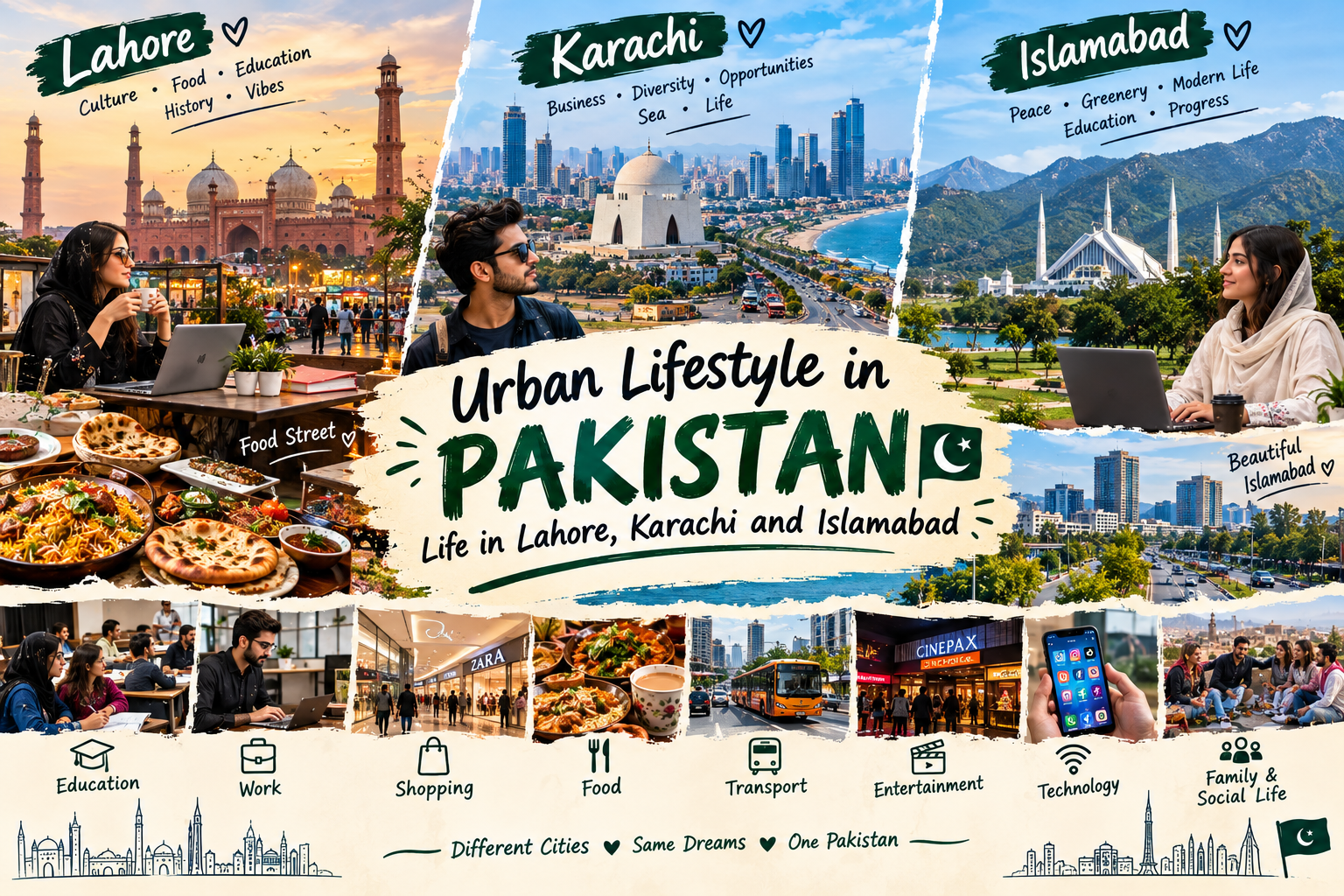
Urban lifestyle in Pakistan has changed significantly over the years. As cities have grown, people’s daily routines, work patterns, education, transportation, shopping habits, entertainment choices, and social relationships have also evolved. Pakistan’s major cities provide a combination of traditional culture and modern urban living. Among the most important urban centers are Lahore, Karachi, and Islamabad, each offering a distinct lifestyle shaped by its history, geography, economy, and population.
Lahore is widely known for its historical heritage, food culture, educational institutions, shopping areas, and lively social environment. Karachi is Pakistan’s largest metropolitan city and an important center of business, trade, finance, media, and industry. Islamabad, the capital city, is known for its organized sectors, greenery, government institutions, educational facilities, and relatively calm environment.
Urban life in these cities provides many opportunities, but it also comes with challenges. People living in urban areas often have better access to universities, hospitals, offices, markets, technology, transportation, and entertainment. At the same time, traffic, rising living costs, pollution, housing pressures, and busy routines can affect everyday life.
This article explores urban lifestyle in Pakistan by looking at Lahore, Karachi, and Islamabad, their daily routines, family life, education, employment, food, shopping, transportation, entertainment, housing, technology, and the changing habits of urban residents.
Understanding Urban Lifestyle in Pakistan
Urban lifestyle refers to the way people live in cities and towns where population density, employment opportunities, businesses, educational institutions, transportation systems, and modern services are more concentrated.
In Pakistan, urban lifestyles are influenced by both traditional values and modern trends. Families may continue to celebrate cultural festivals, weddings, religious occasions, and traditional events while also using smartphones, online shopping platforms, digital payments, food delivery services, and social media.
Young people especially experience a mixture of traditional and modern lifestyles. They may attend universities, work in offices, use online learning platforms, spend time in cafés, and communicate through social media while remaining connected to their families and cultural traditions.
The urban lifestyle is therefore not simply about modern buildings or technology. It is a combination of changing routines, social relationships, economic activities, cultural practices, and modern facilities.
Urban Lifestyle in Lahore
Lahore as a Major Pakistani City
Lahore is one of Pakistan’s most important cities and the capital of Punjab. It has a long history and is famous for its cultural heritage, historical buildings, educational institutions, food, literature, arts, and lively social atmosphere.
Life in Lahore combines old and new. Historic areas represent the city’s traditional character, while modern commercial areas contain shopping centers, restaurants, offices, universities, and entertainment facilities.
People from different backgrounds live, study, work, and do business in Lahore, making it an important center of urban activity.
Daily Life in Lahore
Daily life in Lahore can be busy, particularly in major commercial and educational areas. Students travel to schools, colleges, and universities, while employees commute to offices and businesses.
Morning routines often involve getting ready for work or education, arranging transportation, and managing household responsibilities. During the afternoon and evening, markets, restaurants, shopping areas, parks, and cafés become active.
Family remains an important part of life for many residents. Even people with busy professional schedules often make time for family meals, gatherings, weddings, religious occasions, and visits to relatives.
Education in Lahore
Lahore is an important educational center in Pakistan. It has schools, colleges, universities, academies, libraries, and professional institutions.
Students from different parts of Punjab and other regions may move to Lahore for higher education. This creates a diverse student population and contributes to the city’s energetic environment.
Modern education has also become connected with technology. Students increasingly use laptops, smartphones, online lectures, educational websites, digital notes, and online communication tools.
Food Culture in Lahore
Food is a major part of Lahore’s urban lifestyle. Traditional Pakistani dishes remain popular, including biryani, nihari, karahi, kebabs, haleem, naan, pulao, and various sweets.
At the same time, urban residents have access to international-style food, cafés, bakeries, fast-food restaurants, and modern dining spaces.
Eating outside the home is often part of social life. Families may visit restaurants during weekends, while friends and students may meet at cafés or food streets.
Lahore’s food culture demonstrates how traditional Pakistani cuisine can exist alongside modern dining trends.
Shopping and Entertainment in Lahore
Shopping is another important part of urban life. Residents can find traditional markets, local shops, shopping centers, supermarkets, and modern malls.
People shop for clothing, shoes, electronics, household items, cosmetics, groceries, gifts, and other products.
Entertainment also includes cinemas, parks, restaurants, cafés, cultural events, sports activities, and family outings.
The city’s historic locations also attract people interested in architecture and cultural heritage.
Urban Lifestyle in Karachi
Karachi as a Metropolitan City
Karachi is Pakistan’s largest metropolitan city and one of the country’s most important economic centers. It is a major hub for business, trade, finance, industry, media, education, and transportation.
Because of its economic importance, people from different parts of Pakistan live and work in Karachi. This has created a highly diverse urban environment.
Karachi’s lifestyle is generally fast-paced. Business activities, offices, markets, educational institutions, transport networks, and commercial areas remain active throughout the day.
Daily Routine in Karachi
Daily life in Karachi can involve long travel distances. Many residents commute between residential areas, workplaces, educational institutions, and commercial centers.
Traffic is an important part of the urban experience. People often plan their daily schedules around travel time.
Despite the busy routine, Karachi has a strong social and family culture. Residents celebrate weddings, Eid, religious occasions, birthdays, and family events.
The city also offers a wide range of activities for people with different interests.
Employment and Business
Karachi provides employment opportunities in numerous sectors. These include finance, banking, manufacturing, retail, media, information technology, education, healthcare, logistics, and other businesses.
Small businesses and entrepreneurship are also important parts of the city's economy.
Modern technology has created additional opportunities for freelancers, online sellers, digital marketers, content creators, and remote workers.
This has changed the traditional concept of employment. Some people can now work with clients and companies without physically traveling to an office every day.
Food Lifestyle in Karachi
Karachi has a diverse food culture influenced by its multicultural population.
Traditional Pakistani foods are widely available, while restaurants also offer a variety of regional and international dishes.
Street food is an important part of Karachi's food culture. Residents may enjoy snacks, kebabs, rolls, biryani, seafood, desserts, and many other foods.
Restaurants and cafés also serve as social spaces where families and friends meet.
Shopping in Karachi
Karachi offers a wide range of shopping opportunities, from traditional markets to modern shopping centers.
Residents can shop for clothing, electronics, groceries, furniture, accessories, and household products.
Online shopping has also become an important part of urban life. People can compare products, read reviews, place orders, and receive items at home.
This combination of physical markets and online shopping provides consumers with more choices.
Urban Lifestyle in Islamabad
Islamabad as the Capital City
Islamabad is the capital of Pakistan and has a different urban character from Lahore and Karachi.
The city is known for its planned sectors, wide roads, green spaces, hills, government institutions, educational organizations, offices, and residential areas.
Islamabad’s urban lifestyle is often associated with organized neighborhoods and access to natural surroundings.
Daily Life in Islamabad
Life in Islamabad can be relatively structured because of the city’s planned layout.
Residential sectors are connected to commercial areas, schools, offices, parks, and other facilities.
Many residents enjoy visiting parks, walking areas, restaurants, cafés, and recreational locations.
The city’s natural environment also influences its lifestyle. Green spaces and views of the Margalla Hills provide opportunities for outdoor activities.
Education in Islamabad
Islamabad has many educational institutions and attracts students from different parts of Pakistan.
Students can find schools, colleges, universities, training centers, libraries, and professional education opportunities.
The presence of educational and research institutions contributes to the city’s intellectual environment.
Technology is also increasingly important in education. Students use online resources, digital classrooms, educational applications, and electronic communication.
Food and Café Culture
Islamabad has developed a strong café and restaurant culture.
Residents can find traditional Pakistani food as well as continental, Asian, Middle Eastern, and other cuisines.
Cafés have become popular meeting places for students, professionals, families, and friends.
At the same time, traditional food remains an important part of family gatherings and celebrations.
Comparison of Urban Life in Lahore, Karachi and Islamabad
Lahore, Karachi, and Islamabad all offer urban lifestyles, but each has its own character.
Lahore is strongly associated with culture, history, education, food, and social activities.
Karachi is strongly connected with business, trade, industry, finance, media, and a highly diverse population.
Islamabad is known for its planned environment, government institutions, greenery, education, and relatively organized residential areas.
These differences mean that people may experience city life differently depending on where they live, study, or work.
Housing and Residential Life
Housing is an important part of urban lifestyle in Pakistan.
Cities contain different types of residential areas, including apartments, houses, rented properties, residential societies, and older neighborhoods.
Families often consider factors such as location, security, schools, transportation, nearby markets, healthcare facilities, and affordability when selecting a home.
Apartments have become increasingly relevant in large cities because population growth and limited land can make traditional housing more difficult to access in some areas.
Young professionals and students may also prefer rented accommodation close to educational institutions or workplaces.
Changing Family Structures
Urbanization can influence family structures.
Traditional joint families remain common in Pakistan, but some urban families prefer nuclear households because of employment, education, housing, and lifestyle considerations.
Even when families live separately, relatives may remain closely connected through regular visits, phone calls, messaging applications, and family gatherings.
Technology has therefore helped maintain family connections despite geographical distance.
Transportation and Urban Mobility
Transportation is one of the most important aspects of city life.
Residents use cars, motorcycles, buses, ride-hailing services, bicycles, and other forms of transportation.
Public transportation systems and mass-transit projects have changed commuting options in major cities.
Motorcycles are widely used because they can provide an economical option for daily travel.
Ride-hailing applications have also changed transportation habits. People can use smartphones to request rides, estimate fares, and track journeys.
However, traffic congestion remains a challenge in many urban areas. Increasing numbers of vehicles can contribute to longer travel times and environmental concerns.
Technology and Digital Urban Life
Technology has become a central part of urban life in Pakistan.
Smartphones are used for communication, education, entertainment, banking, shopping, navigation, and work.
Social media platforms allow people to communicate with friends and relatives, follow news and trends, share content, and promote businesses.
Digital payments are also becoming increasingly common in urban areas.
Online banking and mobile financial services allow users to perform many transactions without visiting a physical bank branch.
Remote Work and Freelancing
Remote work and freelancing have created new possibilities for urban residents.
A person with suitable skills can potentially work with clients outside their city or country through online platforms.
Popular areas include graphic design, writing, programming, digital marketing, video editing, customer support, and other digital services.
This has also created new career possibilities for young people.
Shopping and Consumer Habits
Urban consumers have access to traditional markets, supermarkets, malls, and online stores.
Shopping habits are changing because of technology.
People can now search for products online, compare prices, check specifications, read customer feedback, and order products from home.
However, traditional markets remain important because many consumers prefer to physically inspect products and negotiate prices.
The combination of online and physical shopping has created a flexible retail environment.
Social Life in Pakistani Cities
Despite modernization, social relationships remain an important part of Pakistani urban life.
Family gatherings, weddings, Eid celebrations, religious events, birthday celebrations, and visits to relatives continue to bring people together.
Friends also meet in restaurants, cafés, parks, universities, workplaces, and recreational spaces.
Social media has added another layer to these relationships. People can stay connected through messaging groups, video calls, and social platforms.
However, digital communication does not completely replace face-to-face interaction. Physical gatherings remain an important part of Pakistani culture.
Fashion and Urban Lifestyle
Fashion is another visible part of urban life.
Traditional clothing such as shalwar kameez remains widely worn, while modern clothing styles are also common, especially among young people.
Women may choose from traditional dresses, modern outfits, modest fashion, embroidered clothing, and seasonal styles.
Men also combine traditional and modern clothing according to their workplace, education, social events, and personal preferences.
Urban fashion is influenced by local culture, social media, television, international trends, and Pakistani designers.
Parks and Recreation
Urban residents need spaces for relaxation and recreation.
Parks, walking tracks, sports facilities, cafés, cinemas, shopping centers, and family entertainment locations provide opportunities to take breaks from busy routines.
In Islamabad, green spaces and natural surroundings are particularly important parts of city life.
Lahore and Karachi also have parks and recreational spaces where families and young people can spend time together.
Recreation can contribute to a balanced urban lifestyle when people manage their time between work, education, family, and personal activities.
Challenges of Urban Lifestyle in Pakistan
Urban living provides many opportunities, but it also creates challenges.
Traffic Congestion
Large populations and increasing numbers of vehicles can lead to traffic congestion.
Long commutes may consume significant amounts of time and can make daily routines stressful.
Rising Living Costs
Housing, transportation, education, food, healthcare, and other expenses can place pressure on urban households.
Families often need to carefully manage budgets.
Pollution
Air pollution, waste management issues, traffic emissions, and other environmental concerns can affect urban areas.
Improving public transportation, waste management, green spaces, and environmental awareness can help cities become healthier places to live.
Population Growth
Rapid urban population growth increases demand for housing, transportation, healthcare, education, water, electricity, and other services.
Urban planning therefore remains an important issue for Pakistan’s growing cities.
Work-Life Balance
Busy urban routines can make it difficult for some people to balance employment, education, family responsibilities, social activities, and personal time.
Technology can make work more flexible, but it can also make it harder for people to disconnect from work or social media.
Positive Features of Urban Life
Urban life also offers many advantages.
Residents can often access a wider range of educational institutions, healthcare facilities, employment opportunities, markets, technology, entertainment, and professional services.
Cities also provide opportunities for networking and entrepreneurship.
A young person interested in technology, business, education, fashion, media, or other fields may find more opportunities in large urban centers.
Urban areas can also bring people from different regions and backgrounds together, creating cultural exchange and new ideas.
The Role of Women in Urban Pakistan
Women are increasingly visible in education, professional work, entrepreneurship, healthcare, technology, media, education, and other sectors.
Urban areas can provide women with access to universities, training programs, workplaces, business networks, and digital opportunities.
Many women also run small businesses from home or use online platforms to sell products and services.
Technology has further expanded opportunities by allowing people to learn skills and connect with customers online.
Family support, education, safe transportation, suitable workplaces, and access to opportunities can all influence women's participation in urban economic and social life.
Young People and Modern City Life
Young people are an important part of Pakistan’s urban population.
Students and young professionals are increasingly interested in technology, entrepreneurship, freelancing, social media, fashion, entertainment, travel, and higher education.
They may combine traditional family values with modern ambitions.
For example, a young person may study at a university, work online, participate in a family gathering, wear traditional clothing at cultural events, and use digital technology throughout the day.
This combination demonstrates how Pakistani urban culture continues to evolve without completely abandoning traditional identity.
Future of Urban Lifestyle in Pakistan
The future of urban lifestyle in Pakistan will likely be influenced by population growth, technology, education, transportation, housing, environmental concerns, and economic development.
Smartphone usage and digital services are expected to remain important.
Online education, remote work, digital businesses, e-commerce, and electronic payments may continue changing daily routines.
Urban planning will also become increasingly important as cities grow.
Better transportation systems, improved public spaces, efficient waste management, affordable housing, environmental protection, and accessible public services can contribute to more sustainable urban communities.
Technology can support these changes, but successful urban development also depends on planning, infrastructure, responsible resource use, and community participation.
Conclusion
Urban lifestyle in Pakistan represents a combination of tradition, modernization, technology, family values, education, business, and changing social habits. Lahore, Karachi, and Islamabad demonstrate different forms of Pakistani urban life.
Lahore combines history, culture, food, education, and social activity. Karachi represents a highly diverse metropolitan environment with strong connections to business, trade, industry, and employment. Islamabad offers a planned urban environment with greenery, educational institutions, government offices, and recreational opportunities.
Urban residents benefit from access to education, healthcare, employment, shopping, technology, entertainment, and professional opportunities. At the same time, they face challenges such as traffic, rising expenses, pollution, housing pressures, and busy lifestyles.
The future of Pakistani cities will depend on how effectively urban growth is managed. With better planning, modern infrastructure, digital innovation, environmental awareness, and accessible public services, cities can provide better opportunities for their growing populations.
Urban Pakistan is continuously changing, but its traditional identity remains an important part of everyday life. The most interesting feature of Pakistani urban lifestyle is this balance between the old and the new: historic traditions continue to exist alongside modern technology, businesses, education, fashion, and digital communication.
FAQs
1. What is urban lifestyle in Pakistan?
Urban lifestyle in Pakistan refers to the way people live in cities, including their work, education, transportation, shopping, social activities, housing, food habits, and use of technology.
2. What are the major cities associated with urban lifestyle in Pakistan?
Lahore, Karachi, and Islamabad are three major cities with distinct urban lifestyles. Karachi is a major business center, Lahore is known for culture and education, while Islamabad is known for its planned environment and greenery.
3. How has technology changed urban life in Pakistan?
Technology has changed communication, education, shopping, banking, transportation, entertainment, freelancing, and remote work. Smartphones and internet services are now important parts of everyday urban life.
4. What are some challenges of urban life in Pakistan?
Major challenges can include traffic congestion, rising living costs, pollution, housing pressures, population growth, and maintaining a healthy balance between work, education, family, and personal time.
5. How is Pakistani urban lifestyle changing?
Pakistani urban lifestyle is changing through digital technology, online shopping, modern education, remote work, new transportation options, changing housing patterns, and evolving social and fashion trends while traditional family and cultural values continue to remain important.




