Introduction
Balochistan, Pakistan’s largest province by land area, has significant natural resources, a rich cultural heritage and considerable potential for economic growth. However, the province continues to face challenges involving education, healthcare access, employment opportunities, infrastructure and the delivery of public services.
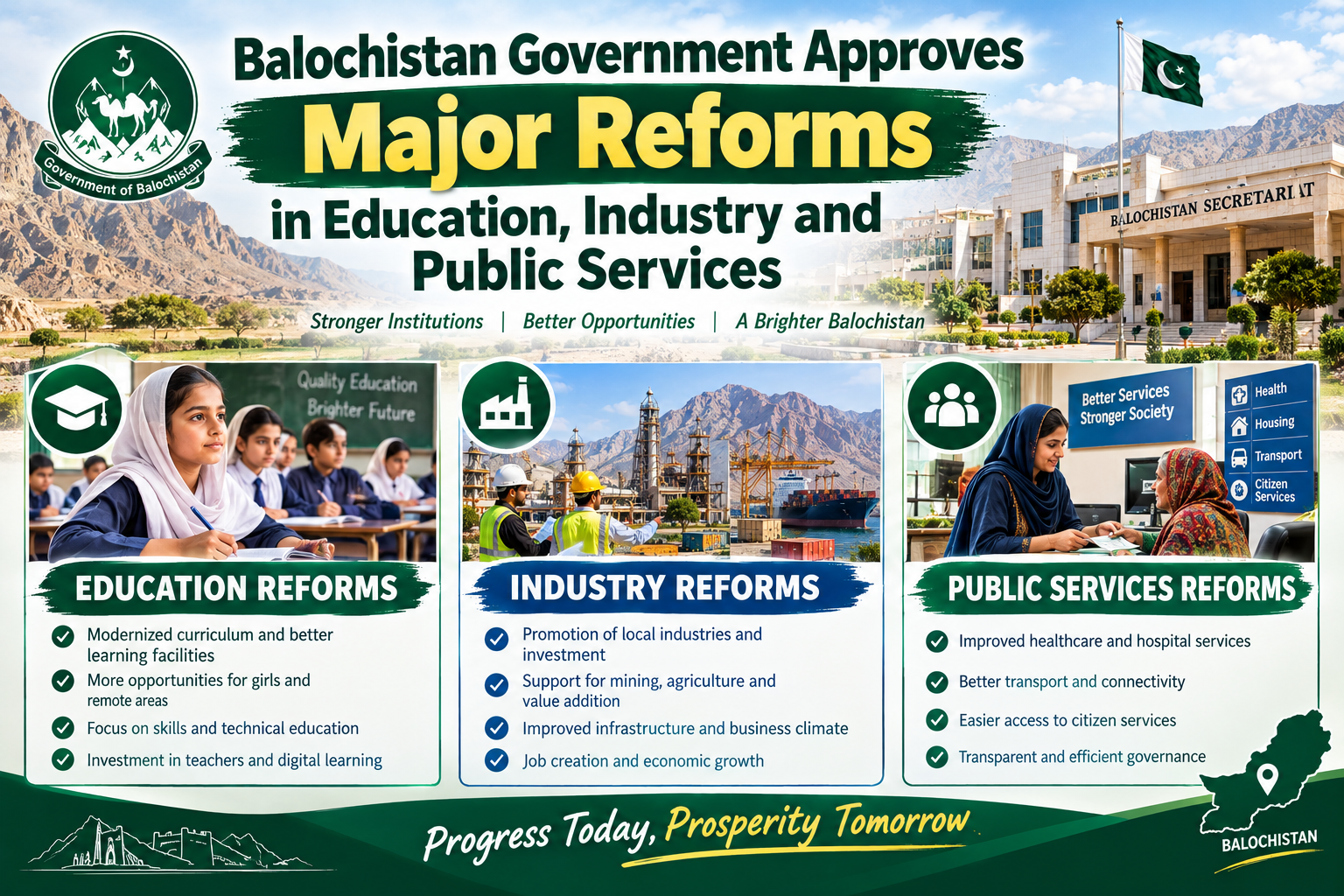
In an important administrative development, the Balochistan provincial cabinet has approved a series of reforms intended to support economic development, improve public services and strengthen governance. The meeting was chaired by Chief Minister Mir Sarfraz Bugti, and the decisions cover several important sectors, including education, mining, tourism, industrial development and public procurement.
Among the major decisions are a policy for using the Balochistan Mineral Development Fund, the approval of the Balochistan Non-Formal Education Act, 2025, plans for double-shift schooling in government schools and incentives intended to help reopen closed industrial units. The cabinet also approved measures designed to improve transparency in government purchasing and encourage investment in tourism and cultural activities.
These decisions are significant because the province’s long-term development depends not only on its natural resources but also on how effectively public funds, institutions and opportunities are managed.
Balochistan Cabinet Approves Reforms Across Key Sectors
The provincial cabinet’s latest decisions reflect an effort to address several development priorities through administrative and policy changes. Instead of focusing on a single department, the approved measures cover different areas of public life.
Education remains one of the central priorities, particularly because a large number of children are reported to be outside the formal education system. Industrial development is another important area, as reopening inactive businesses could help create jobs and encourage economic activity.
The cabinet also endorsed draft tourism and cultural policies, with the objective of attracting investment, supporting employment and protecting the province’s historical heritage.
Meanwhile, changes to public procurement rules are intended to expand electronic bidding and encourage greater transparency and competition in government contracts.
Although cabinet approval is an important step, the practical results will depend on implementation. Departments will need to translate policy decisions into functioning programmes, provide appropriate oversight and ensure that the benefits reach communities across the province.
Balochistan Mineral Development Fund Policy
One of the important decisions concerns the utilisation of the Balochistan Mineral Development Fund.
Balochistan possesses valuable mineral resources, making the mining sector an important part of its economic potential. However, the contribution of natural resources to public welfare depends on how revenues are managed and how development priorities are identified.
The cabinet approved a policy intended to ensure that financial benefits generated from mineral resources contribute to provincial development and public welfare.
Why the mineral development fund matters
A well-managed development fund can help governments plan how resources are used for long-term public benefit. Depending on the applicable policy and approved projects, resource-related funding can support development priorities rather than being treated only as a source of short-term income.
For Balochistan, the central issue is how economic activity linked to natural resources can contribute to broader provincial progress.
The effectiveness of the fund will depend on transparent financial management, clear eligibility criteria, proper project selection and regular monitoring. Public reporting can also help residents understand how funds are allocated and what results have been achieved.
Connecting natural resources with local development
Mining can create opportunities for investment, employment, transportation services and supporting businesses. However, these opportunities do not automatically improve living standards in nearby communities.
For local people to benefit, development planning needs to consider infrastructure, skills, environmental protection and access to essential services.
A transparent approach to mineral revenue management could strengthen public confidence and help establish a clearer connection between the province’s natural wealth and the needs of its population.
The approved policy provides a framework for pursuing this objective, while its long-term success will depend on the details of implementation.
Education Reform Targets Approximately 1.6 Million Children
Education is another major focus of the cabinet’s decisions.
The government approved the Balochistan Non-Formal Education Act, 2025, which targets approximately 1.6 million children aged 10 to 16 who are outside the formal education system.
The scale of this target highlights the importance of creating educational opportunities for children who have not enrolled in school or who have been unable to continue their studies through conventional schooling.
The importance of non-formal education
Traditional schools may not be accessible to every child. Distance, family circumstances, financial difficulties and limited educational facilities can create barriers to regular attendance.
Non-formal education programmes can provide alternative routes for learning. Their effectiveness depends on suitable teaching arrangements, qualified educators, appropriate learning materials and clear pathways for students to continue their education.
For older children who have missed several years of schooling, flexible learning arrangements may help them acquire essential reading, writing, mathematics and other practical skills.
The approved legislation represents a policy step towards addressing educational exclusion. Its impact will depend on the availability of learning centres, the recruitment and preparation of teachers, student enrolment and the quality of instruction.
Why the 1.6 million target matters
The target draws attention to the number of children who need educational opportunities beyond the conventional school system.
Bringing more children into education can have benefits that extend beyond individual students. Education supports literacy, practical skills, informed decision-making and future employment opportunities.
However, enrolment alone is not enough. Students also need to attend regularly, receive effective teaching and have opportunities to complete appropriate learning programmes.
Authorities will need reliable information to identify eligible children, understand local barriers and monitor progress.
Double-Shift Schooling in Government Schools
The cabinet also approved double-shift teaching in government schools.
Under a double-shift arrangement, a school building can be used for separate groups of students at different times of the day. This approach can increase the use of existing facilities and provide additional learning capacity without necessarily requiring a completely new school building for every additional group.
Making better use of existing facilities
Where school buildings are available but cannot accommodate all students during a single shift, a second shift may help expand access.
This can be particularly useful in areas where enrolment demand is greater than the capacity of existing classrooms.
However, the success of double-shift schooling depends on careful planning. Schools need sufficient teachers, workable timetables, appropriate classroom conditions and access to essential facilities.
Authorities must also ensure that teachers are not placed under unreasonable workloads and that students in both shifts receive a comparable quality of education.
Maintaining educational quality
Expanding the number of available places is only one part of improving education. Students also need effective teaching, regular assessments, suitable learning materials and a supportive environment.
If the second shift is poorly organised, additional classroom time may not translate into better learning outcomes.
For this reason, the implementation of double-shift schooling should be evaluated through measures such as student attendance, classroom capacity, teaching quality and progress in learning.
Combined with non-formal education initiatives, the policy could contribute to a broader effort to make education more accessible across the province.
Incentives to Reopen Closed Industrial Units
Industrial development is another important component of the approved reforms.
The cabinet approved incentives intended to encourage the reopening of closed and non-functional industrial units. The objective is to revive economic activity, attract investment and create employment opportunities.
Inactive industrial facilities can represent unused productive capacity. When businesses stop operating, workers may lose employment opportunities, suppliers may lose customers and surrounding communities can experience reduced economic activity.
Why industrial revival is important
Reopening existing industrial units may offer an opportunity to restore economic activity using facilities that are already in place.
Depending on the condition of a business and the nature of the support provided, industrial revival may involve financial assistance, operational improvements, investment or other incentives.
However, every inactive industrial unit has its own circumstances. Some may have financial difficulties, while others may face problems involving machinery, energy costs, demand or management.
A successful policy needs to identify the reasons businesses stopped operating before deciding which support measures are appropriate.
Potential employment benefits
Operating industries can create direct employment for workers and additional opportunities for transport operators, suppliers, maintenance providers and other service businesses.
Industrial activity can also encourage the development of practical skills and support small businesses that serve larger companies.
For Balochistan, the wider objective is to create conditions in which businesses can operate sustainably and contribute to local economic activity.
The government will need to monitor whether supported units actually reopen, remain operational and provide the intended economic benefits.
Tourism and Cultural Policies
The provincial cabinet endorsed draft Balochistan Tourism Policy and Cultural Policy documents.
These policies are intended to promote investment, create employment opportunities and protect historical and cultural heritage.
Balochistan has a distinctive landscape and cultural identity. Its potential tourism assets include coastal areas, mountains, historical locations and cultural traditions. Developing tourism responsibly could create opportunities for local communities and small businesses.
Tourism as an economic opportunity
Tourism can support hotels, restaurants, transport services, guides, local markets and businesses selling locally produced goods.
Visitors may also create demand for cultural experiences and services provided by residents.
However, tourism development requires more than attracting visitors. Travel infrastructure, visitor safety, accommodation, sanitation, environmental management and reliable local services are also important.
Without suitable planning, tourism can place pressure on local resources or provide limited benefits to the communities where visitors spend their time.
Protecting cultural heritage
Cultural heritage contributes to a region’s identity and helps preserve knowledge about its history and traditions.
A cultural policy can provide a framework for protecting historical places and supporting cultural activities. Its implementation should consider local communities, researchers, cultural organisations and people who maintain traditional practices.
Conservation and economic development do not have to conflict. When managed carefully, cultural preservation can create educational opportunities and support responsible tourism.
The practical success of the draft policies will depend on the projects, regulations and partnerships introduced following their approval.
Electronic Bidding and Transparent Public Procurement
The cabinet also approved amendments to public procurement rules to expand electronic bidding.
According to the reported decision, electronic bidding will be mandatory for tenders exceeding Rs500,000 across the relevant procurement categories.
Public procurement involves the purchase of goods, services and works by government departments. It can cover items ranging from office supplies and equipment to construction and other public projects.
Because procurement uses public money, transparent procedures are important for accountability and value for money.
How electronic bidding can help
Electronic bidding allows relevant parts of a procurement process to be handled through digital systems rather than relying entirely on traditional paper-based procedures.
When appropriately designed and implemented, these systems can make it easier to publish tender information, receive bids and maintain records.
Digital processes may also reduce some administrative barriers and help eligible suppliers access procurement opportunities.
However, technology alone cannot guarantee transparency. Clear rules, effective oversight, secure systems and consistent enforcement remain essential.
Encouraging competition
Competitive bidding can help government departments compare offers and assess which proposals meet their requirements.
The objective should not be to select a supplier based only on the lowest price. Quality, technical suitability, delivery schedules and compliance with tender requirements also matter.
Procurement officials must apply the rules fairly and document their decisions.
The introduction of mandatory electronic bidding for specified tenders is a notable administrative measure. Its results will depend on whether departments and suppliers can use the system effectively and whether the process is properly monitored.
Improving Governance and Public Services
The cabinet’s decisions also highlight the broader importance of administrative governance.
Public policies produce meaningful results when government departments can implement them efficiently, coordinate their activities and respond to the needs of residents.
A development programme may have clear objectives, but delays can occur if responsibilities are unclear, information is incomplete or agencies lack the resources needed to carry out their duties.
For this reason, governance reforms should focus on practical implementation as well as policy approval.
The role of accountability
Accountability involves making responsibilities clear and checking whether public institutions are meeting their commitments.
For development programmes, useful monitoring may include progress reports, expenditure records, service-delivery indicators and assessments of whether intended beneficiaries are being reached.
Public access to reliable information can also help residents understand the purpose of government initiatives.
In procurement, accountability means applying tender rules consistently. In education, it involves checking whether children are enrolling and learning. In industrial development, it includes assessing whether supported businesses become operational.
Different sectors require different indicators, but the underlying principle remains the same: government decisions should produce measurable public benefits.
Challenges in Implementing the Reforms
Although the cabinet has approved several important measures, implementation will be a major test.
Financial and administrative capacity
Education programmes, industrial revival initiatives and digital procurement systems require planning and resources.
Departments must identify the costs involved, establish responsibilities and make sure that the necessary staff and facilities are available.
Where resources are limited, projects should be prioritised according to need, feasibility and expected public benefit.
Reaching remote communities
Balochistan covers a large geographical area, and communities may face different challenges depending on their location.
A policy that works in one district may need adjustments elsewhere. Education initiatives, for example, must consider travel distances, available facilities and the needs of students.
Effective implementation requires local information and coordination between provincial authorities and relevant district-level institutions.
Monitoring results
Governments need to measure whether approved policies are meeting their objectives.
For non-formal education, this could include enrolment, attendance and learning progress. For industrial revival, relevant measures could include the number of units that reopen and remain active.
For electronic procurement, monitoring could examine compliance, competition and the timely completion of contracts.
Publishing accurate results can help policymakers identify problems and improve programmes over time.
Maintaining public trust
Public confidence grows when policies are implemented fairly and their results can be assessed.
Clear eligibility criteria, transparent financial decisions and accessible complaint procedures can help reduce uncertainty.
Consultation with relevant communities and businesses may also reveal practical obstacles before they become larger problems.
What the Reforms Could Mean for Balochistan’s Future
The approved decisions address several areas that influence long-term development.
Education can help young people gain knowledge and skills. Industrial revival can support employment and business activity. Better management of mineral-related revenue can help connect natural resources with public priorities. Tourism policies can create opportunities for local businesses while supporting cultural preservation.
Meanwhile, transparent procurement procedures can help improve the management of public spending.
These areas are interconnected. Education can prepare people for employment, while a stronger business environment can create opportunities for people with relevant skills. Responsible management of natural resources can support development priorities, and better governance can help ensure that public programmes operate effectively.
Nevertheless, the results will not appear automatically. They will depend on the quality of implementation, adequate resources, effective oversight and the ability of institutions to respond to local needs.
The cabinet’s decisions should therefore be viewed as steps in a broader development process rather than as evidence that the underlying challenges have already been resolved.
Conclusion
The Balochistan cabinet’s latest decisions represent a broad policy effort covering education, natural resources, industry, tourism and public administration.
The approval of the Balochistan Mineral Development Fund Policy aims to direct the financial benefits of natural resources towards provincial development and public welfare. The Balochistan Non-Formal Education Act, 2025, targets approximately 1.6 million children aged 10 to 16 who are outside the formal education system, while double-shift schooling is intended to make better use of existing government school facilities.
In addition, incentives for reopening closed industrial units could help restore economic activity, while draft tourism and cultural policies aim to encourage investment, employment and heritage protection. Changes to public procurement rules are intended to expand electronic bidding and improve transparency for specified tenders.
The long-term importance of these decisions will depend on what happens next. Transparent implementation, responsible financial management, effective monitoring and a focus on measurable results will be essential.
If the approved measures are carried out effectively, they could contribute to improved public services and broader economic opportunities in Balochistan. The next stage will be to turn cabinet decisions into practical improvements that people across the province can see and experience.
Frequently Asked Questions (FAQs)
1. What reforms has the Balochistan cabinet approved?
The cabinet approved measures covering mineral fund utilisation, non-formal education, double-shift schooling, industrial revival, tourism, cultural heritage and electronic public procurement.
2. How many children are targeted by the non-formal education initiative?
The initiative targets approximately 1.6 million children aged 10 to 16 who are outside the formal education system.
3. What is the purpose of the Balochistan Mineral Development Fund Policy?
The policy aims to ensure that financial benefits from the province’s natural resources contribute to public welfare and provincial development.
4. How could industrial revival benefit Balochistan?
Reopening closed industrial units could restore economic activity, create employment opportunities and support businesses that provide goods and services to industries.
5. Why is electronic bidding important for government procurement?
Electronic bidding can improve access to tender information, support competition and strengthen record-keeping when combined with clear rules and effective oversight.