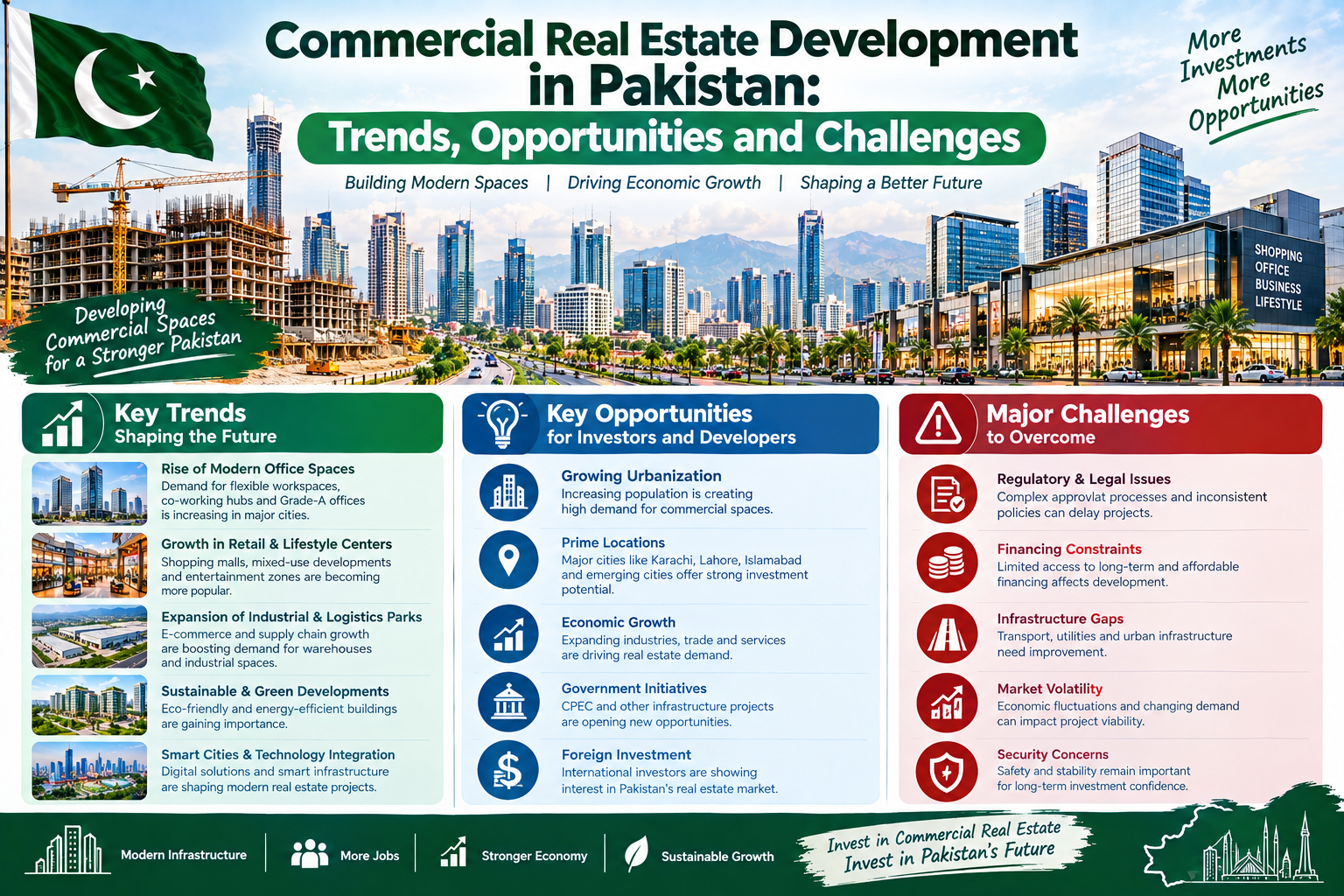
Commercial real estate development is an important part of Pakistan’s growing property sector. As cities expand, populations increase, businesses grow, and new residential communities develop, the demand for commercial spaces also changes.
Commercial real estate development includes the planning, construction, and management of properties such as shopping plazas, office buildings, retail centers, showrooms, business centers, warehouses, mixed-use buildings, and other commercial projects.
Pakistan’s commercial property sector includes both traditional markets and modern developments. Large cities have established business districts, while expanding urban areas are seeing new commercial centers and mixed-use projects.
For investors, developers, business owners, and property buyers, understanding commercial real estate development is important. A successful commercial project requires more than constructing a building. Location, planning, infrastructure, legal approvals, financing, tenant demand, construction quality, and long-term management all play important roles.
This article explains commercial real estate development in Pakistan, its major trends, opportunities, challenges, and important considerations for investors and developers.
What Is Commercial Real Estate Development?
Commercial real estate development is the process of converting land or existing property into buildings and spaces designed for business activities.
The process can involve:
Land acquisition
Market research
Project planning
Architectural design
Approval processes
Construction
Infrastructure development
Marketing
Leasing
Property management
Examples of commercial developments include:
Shopping plazas
Office buildings
Retail centers
Showrooms
Business centers
Hotels
Warehouses
Restaurants
Mixed-use developments
The objective is generally to create usable commercial space that can attract businesses, customers, tenants, or investors.
Why Commercial Real Estate Development Matters in Pakistan
Commercial development supports economic activity by creating locations where businesses can operate.
A commercial project can provide space for:
Retailers
Offices
Restaurants
Clinics
Banks
Educational services
Technology companies
Professional services
Wholesale businesses
Commercial development can also create employment during construction and after businesses begin operating.
When properly planned, commercial areas can become important parts of growing communities.
Major Commercial Real Estate Markets in Pakistan
Commercial property development exists across Pakistan, but activity varies between cities and areas.
Major urban centers such as:
Karachi
Lahore
Islamabad
Rawalpindi
Faisalabad
Multan
Peshawar
contain established commercial markets and developing business districts.
Smaller cities and expanding suburban areas are also developing new commercial spaces as population and business activity grow.
The investment potential of a project depends on its specific location rather than simply the name of the city.
Urbanization and Commercial Development
Urbanization is one of the important factors influencing commercial property development.
As populations move toward urban areas and cities expand, residents require more:
Shops
Restaurants
Offices
Schools
Clinics
Pharmacies
Supermarkets
Service businesses
New residential developments can therefore create demand for nearby commercial facilities.
However, developers need to study actual population growth rather than assuming that every new project will automatically become commercially successful.
Mixed-Use Developments
Mixed-use development combines different property uses within one project.
For example, a building may contain:
Retail shops on lower floors
Offices on middle floors
Apartments or other uses on upper floors
Mixed-use projects can provide convenience because different activities are located within the same development.
They can also create regular movement of residents, employees, customers, and visitors.
Modern Shopping Centers
Traditional markets remain important in Pakistan, but modern shopping centers have also become part of the commercial property landscape.
Modern retail developments may provide:
Organized shops
Food courts
Parking
Security
Entertainment areas
Air-conditioned spaces
Brand outlets
The success of such projects depends on location, customer demand, tenant mix, management, and accessibility.
Growth of Office Spaces
Business activities require suitable office spaces.
Demand can come from:
IT companies
Software businesses
Call centers
Consultants
Lawyers
Accountants
Real estate companies
Educational businesses
Healthcare professionals
Office requirements can vary significantly depending on the type and size of the business.
Flexible office layouts and reliable internet connectivity have become increasingly important for many modern businesses.
Retail Development
Retail is one of the most visible areas of commercial real estate.
Retail developments include:
Shops
Supermarkets
Shopping centers
Showrooms
Department stores
Neighborhood markets
Retail success depends heavily on customer traffic and purchasing demand.
A beautifully designed retail project may still struggle if it is difficult to reach or located far from its target customers.
E-Commerce and Physical Retail
Online shopping has changed the retail environment.
Customers can now purchase many products through digital platforms without visiting physical stores.
This has created new challenges for traditional retailers but has also created opportunities for businesses that combine online and physical operations.
Some businesses use physical shops as:
Showrooms
Pickup locations
Service centers
Experience centers
Storage locations
Commercial developers therefore need to consider how changing consumer behavior may affect future tenant demand.
Warehouses and Logistics Properties
The growth of online commerce and distribution networks can increase demand for storage and logistics facilities.
Warehouses may be needed by:
Retailers
Manufacturers
Distributors
E-commerce companies
Importers
Wholesalers
Location is particularly important for warehouses.
Properties near major roads, transport routes, industrial areas, and urban markets may have advantages depending on the business requirements.
Importance of Location for Developers
Location is one of the most important decisions in commercial real estate development.
Developers should evaluate:
Population
Income levels
Road access
Traffic
Nearby businesses
Residential communities
Public transport
Parking
Utilities
Future development
A project should be designed according to the actual needs of its target market.
Market Research Before Development
Developers should conduct market research before purchasing land or beginning construction.
Research can include:
Local property prices
Rental rates
Tenant demand
Competition
Population
Customer behavior
Business categories
Existing commercial supply
This can help developers understand what type of project the market actually needs.
Understanding the Target Market
A commercial project should have a clearly defined target market.
For example, a developer may target:
Small retailers
Large brands
Offices
Restaurants
Medical businesses
Technology companies
Local service providers
The building design, unit sizes, parking, facilities, and pricing should be planned around the target users.
Legal Approvals
Legal and regulatory compliance is an essential part of commercial development.
Depending on the location and project, developers may need approvals relating to:
Land use
Building plans
Construction
Commercial activity
Environmental requirements
Utilities
Fire safety
Other local regulations
Requirements vary between cities and relevant authorities.
Developers and investors should verify the applicable requirements before starting a project.
Land Ownership
Clear land ownership is fundamental to development.
Before purchasing land, developers should investigate:
Ownership records
Title documents
Existing claims
Mortgages
Disputes
Land-use restrictions
Relevant approvals
Legal due diligence can help identify problems before major funds are invested.
Financing Commercial Developments
Commercial development can require substantial capital.
Funding may come from:
Developer's own capital
Business partners
Investors
Financial institutions
Other lawful financing arrangements
Developers need to estimate:
Land cost
Construction cost
Approval expenses
Labor
Materials
Marketing
Utilities
Financing costs
Maintenance
Contingency funds
A realistic budget is important because construction costs can change during a project.
Construction Costs
Construction costs are affected by prices of:
Cement
Steel
Bricks
Electrical materials
Plumbing materials
Glass
Wood
Tiles
Labor
Changes in construction costs can influence the final selling price or rental structure of a commercial project.
Developers should maintain financial flexibility for unexpected expenses.
Infrastructure Development
Commercial projects require reliable infrastructure.
Important facilities include:
Roads
Electricity
Water
Sewerage
Drainage
Internet
Street lighting
Waste management
A commercial building without reliable infrastructure may struggle to attract tenants.
Parking Requirements
Parking can have a major impact on commercial project success.
Retail centers and shopping plazas may need significant parking because customers often arrive by car or motorcycle.
Developers should consider:
Parking capacity
Entry and exit points
Parking management
Accessibility
Emergency access
Loading areas
Poor parking planning can create operational problems even when the building itself is attractive.
Building Design
Commercial buildings should be designed according to their intended purpose.
Important considerations include:
Unit sizes
Floor plans
Entrances
Elevators
Staircases
Emergency exits
Lighting
Ventilation
Signage
Accessibility
A flexible design may allow different businesses to use the property over time.
Technology in Commercial Buildings
Modern commercial buildings increasingly require technology infrastructure.
Examples include:
High-speed internet
Security cameras
Digital access systems
Backup power
Smart building systems
Modern communication infrastructure
Businesses often consider connectivity an important requirement.
Energy Efficiency
Energy efficiency can reduce operating expenses and improve building performance.
Developers may consider:
Energy-efficient lighting
Better insulation
Efficient cooling systems
Natural lighting
Solar energy solutions
Efficient electrical equipment
The exact approach depends on the project's design and budget.
Green Building Concepts
Environmental considerations are becoming more relevant to property development.
Commercial developers may explore:
Solar power
Water-saving systems
Waste management
Energy-efficient equipment
Natural ventilation
Green spaces
These features can also reduce some long-term operating costs.
Role of Property Management
Construction is only one stage of commercial real estate development.
After completion, effective property management is important.
Management may involve:
Security
Cleaning
Maintenance
Parking
Tenant coordination
Repairs
Utility management
Common-area management
A well-managed commercial property may provide a better experience for tenants and visitors.
Tenant Mix
Tenant mix refers to the combination of businesses operating within a commercial project.
For example, a shopping center may include:
Clothing stores
Restaurants
Cafés
Pharmacies
Electronics shops
Beauty businesses
A balanced tenant mix can make a commercial center more attractive to visitors.
Too many similar businesses may create excessive competition.
Rental Strategy
Developers may sell commercial units, rent them, or use a combination of both approaches.
Rental strategy can depend on:
Location
Building type
Target tenants
Market conditions
Project financing
Before setting rents, developers should research comparable properties.
Sales Strategy
Commercial projects may also sell individual shops or offices.
Potential buyers may include:
Business owners
Investors
Companies
Entrepreneurs
Property investors
Clear documentation and transparent pricing can help establish buyer confidence.
Commercial Real Estate Investment Opportunities
Commercial development can create opportunities in different areas.
Retail
Retail spaces can serve local and regional customers.
Offices
Office buildings can serve professional and corporate businesses.
Warehouses
Warehouses can support distribution and logistics activities.
Mixed-Use Buildings
Mixed-use projects can combine residential, retail, and office uses.
Neighborhood Commercial Centers
Smaller commercial centers can serve nearby residential communities.
Challenges Facing Commercial Real Estate Development
Commercial development also involves several challenges.
High Construction Costs
Rising material and labor expenses can affect project budgets.
Financing Challenges
Large developments may require significant capital.
Regulatory Delays
Approval processes can affect project timelines.
Weak Demand
A poorly researched project may struggle to attract buyers or tenants.
Competition
New projects may compete with existing commercial areas.
Economic Uncertainty
Changes in economic conditions can influence business activity and property demand.
Infrastructure Problems
Poor roads, electricity, water, or parking can reduce commercial attractiveness.
Risk of Overdevelopment
Developers need to consider how much commercial space the market can actually absorb.
If many similar projects are developed in one area, supply may exceed demand.
This can result in:
Vacant shops
Lower rents
Slow sales
Increased competition
Market research is therefore essential before development.
Importance of Tenant Demand
A commercial project should not be based only on land availability.
Developers should ask:
Who will rent these units?
What businesses need space?
How much rent can they afford?
Are customers available?
What competitors already exist?
Understanding tenant demand can improve project planning.
Role of Small Businesses
Small businesses are important users of commercial property in Pakistan.
They may include:
Family-owned shops
Restaurants
Boutiques
Salons
Repair businesses
Clinics
Offices
Local retailers
Commercial developments that offer appropriately sized units can attract smaller businesses.
Commercial Development in Secondary Cities
Commercial development is not limited to the largest cities.
Secondary cities can also experience growth due to:
Population increases
New housing projects
Industrial activity
Education
Healthcare
Transportation
Local business expansion
Developers should study the specific economic characteristics of each city before selecting a project.
Importance of Local Economic Activity
Commercial real estate works closely with the local economy.
Areas with active:
Manufacturing
Agriculture-related trade
Education
Healthcare
Services
Retail
may create different types of commercial demand.
For example, an industrial city may have stronger demand for warehouses, offices, and supplier businesses, while a tourism-oriented location may have different commercial requirements.
Future Trends in Commercial Real Estate
Several trends may influence commercial development in Pakistan.
Mixed-Use Projects
Developers may continue combining different property uses within larger projects.
Neighborhood Retail
Smaller commercial centers can serve nearby residential communities.
Logistics and Warehousing
Changing distribution models may create demand for storage and logistics properties.
Flexible Offices
Some businesses may prefer flexible office arrangements rather than traditional large offices.
Technology Integration
Digital security, connectivity, and smart building features may become increasingly important.
Energy-Efficient Buildings
Energy-saving systems can help control operating costs.
How Developers Can Improve Project Success
Developers can follow several practical principles.
Conduct Proper Market Research
Understand customer and tenant demand before purchasing land.
Choose the Location Carefully
Accessibility and surrounding development matter greatly.
Verify Legal Requirements
Complete necessary approvals and documentation.
Maintain Construction Quality
Poor construction can damage long-term property value.
Plan Parking Properly
Parking should be considered from the beginning rather than added later.
Control Costs
Maintain realistic budgets and contingency funds.
Focus on Tenant Needs
Design commercial units around actual businesses.
Plan Long-Term Management
A commercial building needs proper management after construction.
What Investors Should Check Before Buying in a New Commercial Project
Investors should investigate:
Developer background
Land ownership
Project approvals
Building plans
Location
Development progress
Infrastructure
Payment schedule
Transfer process
Maintenance charges
Expected rental demand
Existing commercial competition
Investors should independently verify important claims rather than relying only on marketing material.
Conclusion
Commercial real estate development in Pakistan offers opportunities across retail, offices, warehouses, shopping centers, mixed-use buildings, and neighborhood commercial projects. Urban growth, business expansion, residential development, technology, and changing consumer behavior can all influence the demand for commercial space.
However, commercial development also involves significant challenges. Construction costs, financing, legal approvals, infrastructure, competition, vacancy, and changing market conditions can affect the success of a project.
Successful development requires careful planning from the beginning. Developers need to study the market, understand their target customers and tenants, select suitable locations, verify legal requirements, control construction costs, and provide reliable infrastructure.
For investors, due diligence is equally important. A commercial project should be evaluated based on its location, legal status, development progress, demand, pricing, rental potential, and long-term management rather than marketing promises alone.
As Pakistan's cities and business communities continue to evolve, commercial real estate is likely to remain an important part of the country's property sector. Projects that respond to genuine market needs, provide useful facilities, and maintain proper legal and operational standards can play an important role in supporting future commercial activity.
FAQs
1. What is commercial real estate development?
Commercial real estate development involves planning, constructing, and managing properties designed for business activities, such as shops, offices, plazas, warehouses, and shopping centers.
2. What factors are important for a commercial development project?
Location, market demand, legal approvals, infrastructure, construction costs, financing, parking, tenant demand, and property management are important factors.
3. What are the major challenges in commercial real estate development?
Common challenges include high construction costs, financing requirements, regulatory processes, weak tenant demand, competition, infrastructure problems, and economic uncertainty.
4. Is commercial real estate development limited to major Pakistani cities?
No. Commercial development also occurs in secondary cities and expanding urban areas where population, businesses, housing, and infrastructure are growing.
5. What should investors check before buying in a new commercial project?
Investors should check ownership, approvals, location, development progress, infrastructure, payment terms, transfer procedures, maintenance costs, tenant demand, and the project's overall market potential.