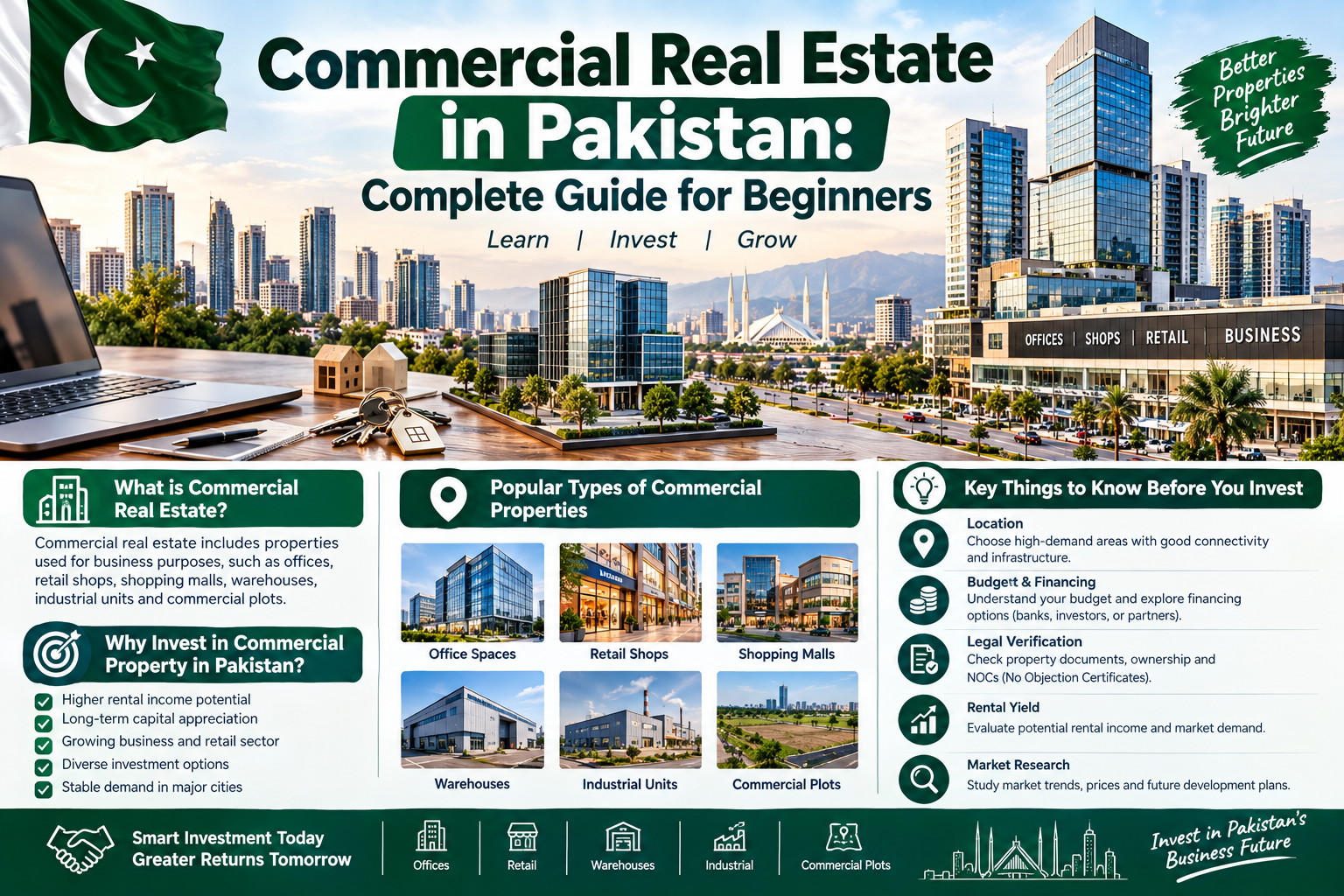
Commercial real estate is an important part of Pakistan's property market. Shops, offices, plazas, warehouses, commercial plots, business centers, and other commercial properties support businesses and provide opportunities for property owners and investors.
Many people in Pakistan consider commercial property because of its potential for rental income, business use, and long-term investment. However, commercial real estate is different from residential property. Location, customer traffic, accessibility, business activity, property approval, rental demand, and operating costs can all influence a commercial property's performance.
For beginners, entering the commercial real estate market can seem complicated. There are different types of commercial properties, various legal requirements, and several costs that need to be considered before making a purchase.
This guide explains commercial real estate in Pakistan in simple terms and covers property types, location, investment considerations, rental income, legal verification, risks, and common mistakes.
What Is Commercial Real Estate?
Commercial real estate refers to property that is primarily used for business or commercial purposes.
Common examples include:
Shops
Offices
Commercial plots
Shopping plazas
Warehouses
Business centers
Commercial buildings
Showrooms
Industrial-related commercial spaces
The purpose of commercial property is generally different from residential property, which is mainly used for living.
Commercial property can be owned by an individual, company, partnership, or other legal entity and may be used by the owner or rented to another business.
Why Is Commercial Real Estate Important in Pakistan?
Commercial properties support a wide range of economic activities.
Retail stores need shops, companies need offices, manufacturers and traders need warehouses, and service providers need suitable business locations.
As cities grow, demand for commercial spaces can change according to population, business activity, infrastructure, and urban development.
Major Pakistani cities such as Lahore, Karachi, Islamabad, Rawalpindi, Faisalabad, Multan, Peshawar, Gujranwala, and Sialkot have different commercial property markets.
However, commercial demand can vary greatly between localities within the same city.
Types of Commercial Property in Pakistan
Understanding different property types is an important first step for beginners.
1. Commercial Shops
Shops are among the most common commercial properties.
They may be located in:
Main markets
Shopping centers
Commercial streets
Housing societies
Plazas
Business districts
The potential of a shop can depend on customer traffic, visibility, parking, nearby businesses, accessibility, and the type of products or services offered.
2. Offices
Office properties are used by businesses, companies, consultants, software firms, clinics, agencies, and other professional organizations.
Office demand can be influenced by the city's business activity and the location's accessibility.
A modern office in a well-connected business area may attract different tenants from an office in a less-developed location.
3. Commercial Plots
Commercial plots are purchased for constructing shops, offices, plazas, or other approved commercial structures.
Before purchasing a commercial plot, buyers should verify:
Ownership
Plot category
Commercial approval
Development status
Building regulations
Road access
Utility availability
4. Warehouses
Warehouses provide storage space for businesses.
They can be particularly relevant to trading, manufacturing, distribution, and e-commerce businesses.
Important factors include road connectivity, loading facilities, building condition, security, and proximity to markets or industrial areas.
5. Showrooms
Showrooms are used by businesses that need visible spaces to display products.
Automobile businesses, furniture stores, electronics retailers, fashion businesses, and other companies may use showroom spaces.
Location and visibility can be especially important for this type of property.
Importance of Location in Commercial Real Estate
Location is one of the most important factors in commercial property.
A commercial property may have excellent construction, but weak customer access can affect its business potential.
When evaluating a location, investors can consider:
Main road access
Customer traffic
Visibility
Parking
Public transportation
Nearby residential areas
Nearby businesses
Population density
Road conditions
Security
Utilities
Different businesses have different location requirements.
A small convenience store may depend heavily on nearby residents, while a warehouse may prioritize road connectivity and loading access.
Foot Traffic and Customer Demand
Foot traffic refers to the number of people passing through an area.
For many retail businesses, customer movement can be an important factor.
However, high foot traffic does not automatically guarantee business success.
The type of customers, nearby businesses, product demand, competition, parking, and rent can also affect a business.
Therefore, commercial property buyers should examine the complete business environment.
Accessibility and Transportation
Easy accessibility can make a commercial property more convenient for customers and employees.
Properties near major roads, public transportation routes, markets, and important business areas may attract different types of commercial users.
For warehouses and distribution facilities, access for larger vehicles may be particularly important.
Before buying, investors should physically visit the location at different times to understand traffic and accessibility.
Commercial Property for Rental Income
Many investors purchase commercial property with the goal of earning rent.
A shop, office, warehouse, or other commercial space may be rented to a business.
Rental income can depend on:
Location
Property size
Property condition
Customer traffic
Local business activity
Tenant demand
Competition
Accessibility
Rental income should be estimated using realistic local market information rather than assumptions.
Understanding Commercial Leases
A commercial rental agreement can contain important terms for both landlord and tenant.
These may include:
Monthly rent
Security deposit
Lease duration
Rent increase terms
Maintenance responsibilities
Utility responsibilities
Permitted business activity
Renewal conditions
Termination conditions
Both parties should clearly understand the agreement before signing.
For complicated or high-value leases, professional legal advice may be useful.
Buying Commercial Property for Your Own Business
Not every commercial property buyer is an investor.
Many people purchase property for their own businesses.
For example, an entrepreneur may purchase a shop rather than renting one.
Owning the property can provide control over the business location, but it also requires significant capital.
A business owner should compare the financial implications of buying versus renting.
Important considerations include:
Purchase price
Financing cost
Maintenance
Taxes
Business cash flow
Expected period of use
Future flexibility
Commercial Property Investment and Capital Growth
Some investors purchase commercial property intending to hold it for several years.
They may expect the property's market value to increase over time.
However, future price increases are not guaranteed.
Property values can be affected by:
Economic conditions
Interest rates
Business activity
Infrastructure
Population growth
Local development
Property supply
Demand
Investors should avoid assuming that every commercial property will automatically appreciate.
Commercial Real Estate in Major Pakistani Cities
Lahore
Lahore has a large commercial property market covering traditional markets, shopping areas, offices, plazas, and newer commercial developments.
Commercial demand can vary significantly between localities.
Investors should examine customer traffic, business activity, accessibility, and nearby residential populations.
Karachi
Karachi has one of Pakistan's largest and most diverse commercial property markets.
The city includes retail areas, offices, warehouses, industrial-related property, shopping centers, and business districts.
Because of the city's size, location-specific research is particularly important.
Islamabad
Islamabad has commercial centers, offices, shops, and mixed-use developments.
Accessibility, planned sectors, nearby residential populations, and business activity can influence commercial demand.
Rawalpindi
Rawalpindi has a diverse commercial market including traditional markets, shops, offices, plazas, and business areas.
Its connection with Islamabad also creates movement between the two cities.
Faisalabad
Faisalabad's industrial and trading activities support demand for shops, offices, warehouses, and other commercial spaces.
Businesses related to manufacturing, textiles, trade, and services can influence commercial property demand.
Multan
Multan is an important commercial center in southern Punjab.
The city has markets, shopping areas, offices, and commercial developments serving both local and regional customers.
Legal Verification of Commercial Property
Legal verification is essential before buying commercial real estate.
Buyers should verify:
Ownership
Title documents
Land records
Property boundaries
Approval status
Commercial classification
Transfer requirements
Outstanding dues
Possession status
Applicable restrictions
If the property is part of a housing society or private development, the relevant approval and transfer records should also be checked.
Commercial Approval and Land Use
One important issue is whether a property is legally approved for commercial use.
A property should not be assumed to be commercial simply because businesses are operating nearby.
Buyers should verify the property's approved use with the relevant authority.
This can help prevent problems related to unauthorized commercial activity or changes in land use.
Taxes and Additional Costs
Commercial property transactions can involve various taxes, fees, and expenses.
The applicable charges can depend on the property, location, transaction value, taxpayer status, and current laws.
Potential costs may include:
Property taxes
Transfer charges
Registration-related expenses
Legal fees
Development charges
Maintenance
Renovation
Utility expenses
Brokerage fees where applicable
Because tax rules can change, buyers should verify current requirements before completing a transaction.
Financing Commercial Property
Some buyers may use financing to purchase commercial property.
Before taking financing, investors should understand:
Total amount borrowed
Interest or financing cost
Repayment schedule
Additional charges
Security requirements
Effect on business cash flow
The financing cost should be included when calculating the overall cost of the investment.
Common Risks in Commercial Real Estate
Commercial property can involve several risks.
Vacancy Risk
A commercial property may remain empty if there are not enough suitable tenants.
Business Risk
A tenant's business may struggle, affecting their ability to pay rent.
Market Risk
Property prices and rental demand can change.
Location Risk
A location that performs well today may face changes in traffic, competition, or development.
Legal Risk
Unclear ownership, unauthorized construction, or incorrect land-use classification can create problems.
Maintenance Risk
Commercial buildings may require significant maintenance depending on their age and facilities.
How Beginners Can Research Commercial Property
Beginners can follow a structured process.
Step 1: Define the Purpose
Decide whether the property is for:
Your own business
Rental income
Long-term investment
Future development
Step 2: Set a Budget
Calculate the maximum amount you can realistically invest.
Step 3: Choose a Location
Research several commercial areas instead of focusing on one property.
Step 4: Compare Prices
Compare similar properties in the same locality.
Step 5: Study Rental Demand
Check realistic rental rates and vacancy conditions.
Step 6: Verify Documents
Confirm ownership, approval, classification, and transfer requirements.
Step 7: Inspect the Property
Visit the property and surrounding area.
Step 8: Calculate Total Costs
Include taxes, fees, maintenance, renovation, and other expenses.
Step 9: Seek Professional Advice
For significant transactions, consult qualified legal and financial professionals where necessary.
Common Mistakes Beginners Should Avoid
Buying Based on Promises
Statements about guaranteed profits or future price increases should not replace proper research.
Ignoring Customer Traffic
For retail property, customer access can be very important.
Not Checking Commercial Approval
Always verify that the property is legally approved for the intended use.
Ignoring Parking
Parking can influence customer convenience and business activity.
Forgetting Maintenance Costs
Building maintenance can affect rental income and overall returns.
Paying Before Verification
Buyers should verify ownership and documents before making significant payments.
Ignoring the Local Market
National property trends do not necessarily represent every locality.
Role of Real Estate Agents
Real estate agents can provide useful information about available commercial properties and local market conditions.
However, buyers should independently verify important claims.
A buyer should check property documents, ownership, approval, price, and other important information rather than relying entirely on an agent.
Comparing multiple properties can also help buyers understand the market better.
Technology and Commercial Real Estate
Technology has changed the way people search for commercial property in Pakistan.
Online property listings allow buyers to:
Compare asking prices
View property photographs
Explore locations
Contact agents
Research different areas
Digital maps can also help buyers understand nearby roads, markets, businesses, and facilities.
However, online research should not replace physical inspection and legal verification.
Future of Commercial Real Estate in Pakistan
Pakistan's expanding cities and changing business environment continue to create demand for different types of commercial spaces.
Retail, offices, warehouses, logistics facilities, and mixed-use developments are all part of the broader commercial real estate sector.
The growth of e-commerce may also influence demand for warehouses and distribution facilities.
At the same time, commercial property markets can be affected by economic conditions, business activity, construction costs, financing conditions, and government policies.
Therefore, investors should regularly research the specific market in which they plan to invest.
Conclusion
Commercial real estate plays an important role in Pakistan's economy by providing spaces for shops, offices, warehouses, businesses, and other commercial activities.
For beginners, investing in commercial property requires careful research. Location, customer traffic, accessibility, rental demand, property approval, legal documentation, taxes, maintenance, and overall costs should all be considered.
A commercial property should not be purchased simply because it is advertised as a high-return opportunity. Future income and price appreciation are never guaranteed.
The most practical approach is to define the investment purpose, set a realistic budget, compare properties, verify legal documents, inspect the location, and understand the total financial commitment.
With proper research and professional guidance when needed, beginners can develop a clearer understanding of Pakistan's commercial real estate market and make decisions based on reliable information rather than market rumors.
FAQs
1. What is commercial real estate in Pakistan?
Commercial real estate includes properties used for business activities, such as shops, offices, warehouses, plazas, showrooms, and commercial plots.
2. What factors are important when buying commercial property?
Location, customer traffic, accessibility, parking, rental demand, legal approval, property condition, and total costs are important factors.
3. Can commercial property generate rental income?
Yes. Shops, offices, warehouses, and other commercial spaces can be rented to businesses, although rental income and occupancy are not guaranteed.
4. What should I verify before buying commercial property?
Buyers should verify ownership, title documents, commercial approval, land records, outstanding dues, possession, transfer requirements, and applicable taxes.
5. Is commercial real estate risk-free?
No. Commercial property can involve vacancy, market, business, legal, maintenance, and location-related risks. Proper research can help identify and manage these risks.