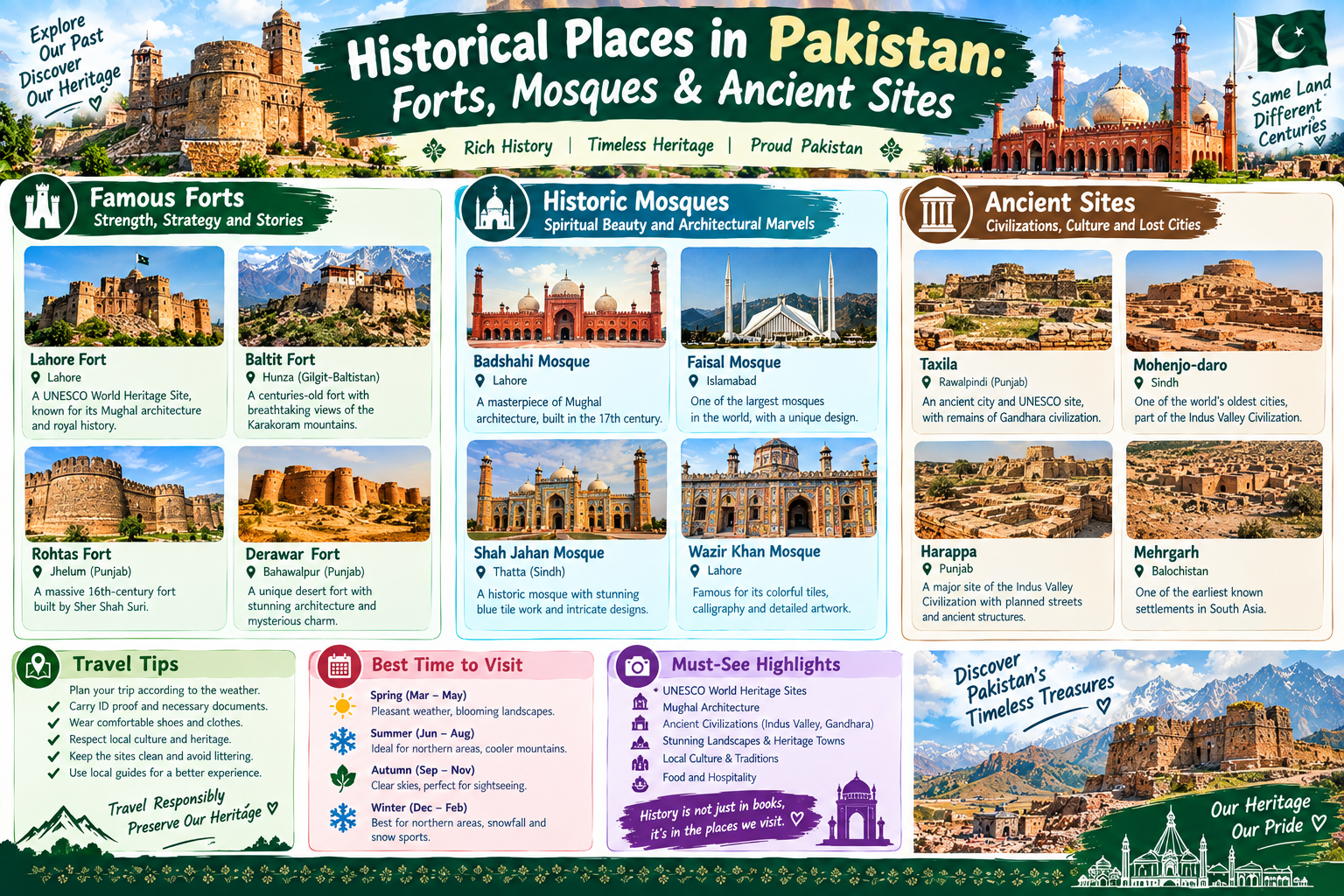
Pakistan is a country with a rich and diverse history. The land that makes up modern Pakistan has been home to ancient civilizations, powerful kingdoms, cultural centers, religious communities, and important historical events for thousands of years. As a result, Pakistan has many historical places that attract students, researchers, tourists, photographers, and families.
Historical places in Pakistan can be found in almost every province and region. Punjab has famous Mughal buildings, forts, mosques, and old cities. Sindh is home to important archaeological sites connected with the Indus Valley Civilization. Khyber Pakhtunkhwa has ancient Buddhist heritage and historic towns. Balochistan has archaeological and cultural sites that show the long history of the region. Islamabad and other modern cities also contain museums and monuments that help preserve national heritage.
Visiting these places is not only a form of tourism. Historical tourism can help people understand how communities lived, built cities, developed art and architecture, traded goods, practiced religions, and interacted with one another over time.
Why Are Historical Places Important?
Historical places provide a connection between the present and the past. Books can describe ancient civilizations and historic events, but visiting a historical site allows people to see architecture, objects, streets, walls, and structures connected with earlier periods.
Historical sites also help preserve cultural identity. Buildings such as forts, mosques, palaces, museums, and archaeological ruins represent different periods of the region's development.
These places can also support tourism and local economies. Visitors need transportation, accommodation, food, guides, and other services, creating opportunities for local businesses.
For students, historical tourism can make learning more interesting. A visit to an archaeological site or museum can provide a practical connection to topics studied in school.
Lahore Fort
Lahore Fort is one of the most important historical landmarks in Pakistan. It is located in the historic Walled City of Lahore and represents centuries of architectural development.
The fort contains several important structures, including palaces, halls, gardens, gateways, and decorative buildings.
Its architecture reflects different periods of the region's history, particularly the Mughal period and later developments.
The fort is especially valuable for people interested in architecture, history, art, and heritage conservation.
Visitors can explore the different sections of the complex and observe decorative details that demonstrate the artistic traditions of earlier periods.
Badshahi Mosque
Badshahi Mosque is located near Lahore Fort and is one of the most recognizable historical mosques in Pakistan.
The mosque is known for its large courtyard, impressive domes, minarets, and Mughal architectural style.
Its scale and architectural design make it an important part of Lahore's historical landscape.
Visitors should remember that it remains a religious place, so respectful behavior and appropriate dress are important.
The mosque is often included in historical tours of Lahore because of its location near several other important heritage sites.
Walled City of Lahore
The Walled City of Lahore is an important historical area containing old streets, markets, mosques, havelis, gates, and traditional architecture.
The area developed over many centuries and contains evidence of different periods of Lahore's history.
Walking through the old city can provide visitors with an opportunity to see traditional buildings and experience historic neighborhoods.
The Walled City is also known for traditional food, handicrafts, markets, and cultural activity.
Visitors should be respectful of residents because the area is not simply a tourist attraction; it is also a living community.
Minar-e-Pakistan
Minar-e-Pakistan is one of the most important national monuments in Lahore.
It stands in Iqbal Park and is associated with the Lahore Resolution of 1940.
The monument's architecture combines elements of different architectural traditions.
It has become an important landmark for visitors interested in Pakistan's political and national history.
The surrounding park also provides a large public space for visitors.
Shalimar Gardens
The Shalimar Gardens in Lahore are another major example of Mughal-era landscape architecture.
The gardens were designed with terraces, water channels, fountains, trees, and decorative structures.
The planning of the gardens reflects the importance of landscape design during the Mughal period.
Today, the site provides visitors with an opportunity to appreciate historical architecture and garden design.
Jahangir's Tomb
The Tomb of Jahangir is located near Lahore and is an important Mughal-era monument.
The tomb complex contains decorative architecture, gardens, and artistic details.
It provides an opportunity to learn about Mughal funerary architecture and the artistic traditions of the period.
The surrounding garden layout also demonstrates the historical importance of planned landscapes.
Tomb of Asif Khan
The Tomb of Asif Khan is another historic Mughal-era monument in Lahore.
Its architectural details reflect the artistic style associated with Mughal buildings.
Although it receives less attention than some of Lahore's most famous attractions, it remains an important part of the city's historical heritage.
Visitors interested in architecture can include it in a wider heritage tour.
Rohtas Fort
Rohtas Fort is one of the most important historic forts in Pakistan. It is located near Jhelum in Punjab.
The fort was constructed during the 16th century and is known for its massive walls, gates, towers, and defensive design.
Its location and architecture demonstrate the military importance of forts during the period in which it was built.
The fort is particularly interesting for students of history and architecture.
Visitors can explore the large complex and observe its defensive features.
Derawar Fort
Derawar Fort is located in the Cholistan Desert of Punjab.
The fort is famous for its large square structure and tall circular bastions.
Its location in the desert creates a dramatic landscape that attracts photographers and travelers.
Derawar Fort is associated with the history of the Cholistan region and the former princely state of Bahawalpur.
Because the fort is located in a relatively remote area, travelers should plan transportation and local arrangements before visiting.
Noor Mahal
Noor Mahal is located in Bahawalpur and is one of the city's most recognizable historic buildings.
The palace reflects the architectural traditions associated with the former princely state of Bahawalpur.
Its exterior and interior design make it a popular destination for visitors interested in architecture and heritage.
Noor Mahal also demonstrates the royal history of Bahawalpur and the region's cultural development.
Darawar and Cholistan Heritage
The Cholistan Desert contains more than just Derawar Fort. The wider region has a history connected with trade routes, settlements, desert communities, and traditional lifestyles.
Visitors can explore the desert landscape while learning about the cultural heritage of southern Punjab.
Traditional crafts, camel culture, local clothing, and desert festivals can also provide insight into the region's traditions.
Multan's Historic Shrines
Multan is often associated with its many historic shrines and religious monuments.
The city has been an important center of religious and cultural activity for centuries.
The shrines contain distinctive architectural features, including decorated domes, tile work, calligraphy, and traditional designs.
Multan's blue pottery and other handicrafts also reflect the city's artistic traditions.
Visitors should show respect when visiting religious sites and follow local rules.
Shah Rukn-e-Alam Shrine
The Shrine of Shah Rukn-e-Alam is one of Multan's most famous historic monuments.
The shrine is known for its distinctive architecture and large dome.
Its design reflects the architectural traditions of the region.
The monument is important both as a religious site and as an example of historic architecture.
It attracts visitors interested in history, architecture, culture, and religious heritage.
Uch Sharif
Uch Sharif is a historic town in Punjab known for its religious monuments and shrines.
The area has an important place in the history of Islamic culture in the region.
Its historic tombs and buildings contain architectural details that demonstrate the artistic traditions of earlier centuries.
Uch Sharif can be particularly interesting for travelers who want to explore less commercialized historical destinations.
Taxila
Taxila is one of Pakistan's most important archaeological destinations.
The ancient region of Taxila was an important center of learning, trade, and culture.
Archaeological remains in the area show the development of ancient settlements and religious institutions.
Taxila is particularly significant for the study of Gandhara civilization and Buddhist heritage.
Students can learn about ancient urban planning, architecture, art, and religious history through the archaeological sites.
Taxila Museum
Taxila Museum contains a collection of archaeological objects associated with the region.
The museum helps visitors understand the cultural history of ancient Taxila.
Sculptures, coins, pottery, and other artifacts provide information about past communities.
A museum visit can be especially useful for students because objects provide a direct connection to archaeological history.
Mohenjo-daro
Mohenjo-daro is one of the world's most important archaeological sites.
Located in Sindh, it is associated with the Indus Valley Civilization, one of the world's earliest urban civilizations.
The ruins demonstrate sophisticated urban planning, streets, drainage systems, buildings, and public structures.
Mohenjo-daro provides important information about the organization of ancient cities.
Visitors can walk through the archaeological remains and learn about life thousands of years ago.
Harappa
Harappa is another major archaeological site associated with the Indus Valley Civilization.
It is located in Punjab and provides evidence of ancient urban life.
The archaeological remains include structures, streets, artifacts, and other features that help researchers understand the civilization.
Harappa is an important destination for students and people interested in archaeology.
A visit can help explain how ancient communities organized their cities and economic activities.
Makli Necropolis
Makli Necropolis is located near Thatta in Sindh.
It is one of the largest historical funerary sites in the world and contains numerous tombs and monuments.
The site represents several centuries of architectural development.
Its tombs contain decorative elements, stone carvings, tile work, and other artistic features.
Makli is important for understanding the cultural and architectural history of Sindh.
Shah Jahan Mosque, Thatta
The Shah Jahan Mosque in Thatta is an important example of Mughal-era architecture in Sindh.
The mosque is particularly known for its brickwork, decorative tile designs, domes, and acoustic features.
Its architecture is different from many famous Mughal buildings in Lahore, making it an interesting destination for people studying regional architectural traditions.
Ranikot Fort
Ranikot Fort is located in Sindh and is famous for its enormous defensive walls.
The fort extends across a large mountainous landscape and is sometimes described as one of the world's largest forts by perimeter.
Its exact historical development is complex, and different historical interpretations exist.
The site provides an interesting combination of natural scenery and historic architecture.
Mohatta Palace
Mohatta Palace is located in Karachi and is an important heritage building.
The palace was constructed in the early twentieth century and reflects architectural influences associated with the period.
Today, it is used for cultural and heritage activities and exhibitions.
Its architecture makes it a popular destination for visitors interested in history and art.
Quaid-e-Azam House
Quaid-e-Azam House, also known as Flagstaff House, is a historic building in Karachi associated with Muhammad Ali Jinnah.
The building is preserved as a museum and contains objects connected with the country's founding history.
It provides visitors with an opportunity to learn about the historical period surrounding the creation of Pakistan.
National Museum of Pakistan
The National Museum of Pakistan is located in Karachi.
It contains collections related to archaeology, art, Islamic heritage, coins, manuscripts, and cultural history.
Museums such as this are important because they preserve objects that may otherwise be difficult for the public to see.
Students can use museums to learn about different periods of Pakistan's history.
Peshawar Museum
Peshawar Museum is an important cultural institution in Khyber Pakhtunkhwa.
It is particularly known for its collection of Gandhara art.
The museum contains sculptures and archaeological objects that help explain the Buddhist heritage of the region.
The museum is valuable for students, researchers, and visitors interested in archaeology and ancient art.
Bala Hisar Fort
Bala Hisar Fort is a historic fort in Peshawar.
The fort has played an important role in the city's military and political history.
Its strategic location reflects the historical importance of Peshawar as a gateway between different regions.
The fort is an important part of the city's heritage.
Jamrud Fort
Jamrud Fort is located near the Khyber Pass.
The area has historically been important because of its location along routes connecting South Asia with Central Asia and Afghanistan.
The fort reflects the military importance of the region.
Because the wider area can have specific access requirements, visitors should check current local arrangements before planning a visit.
Khyber Pass
The Khyber Pass is one of the most historically significant mountain passes in the region.
It has served as an important route between Central and South Asia for centuries.
The pass has been associated with trade, travel, military campaigns, and cultural exchange.
Its geographical location gives it major historical importance.
Rohtas and Other Historic Forts
Pakistan has many forts beyond the most famous examples.
Some were built for military defense, while others were associated with rulers, local chiefs, or princely states.
Forts often contain massive walls, gates, towers, courtyards, and residential areas.
Studying these structures helps visitors understand how security, administration, and royal life worked in earlier periods.
Historical Mosques in Pakistan
Pakistan has many historic mosques representing different architectural traditions.
Some famous examples include Badshahi Mosque in Lahore, Wazir Khan Mosque in Lahore, Shah Jahan Mosque in Thatta, and historic mosques in Multan and other cities.
These buildings demonstrate different approaches to domes, minarets, tile work, brickwork, calligraphy, and decorative design.
Historic mosques are also active religious places in many cases, so visitors should follow appropriate rules.
Wazir Khan Mosque
Wazir Khan Mosque is located in Lahore's historic Walled City.
It is famous for its colorful tile work, calligraphy, frescoes, and architectural details.
The mosque provides an excellent example of Mughal-era decorative art.
Visitors interested in architecture and Islamic art can learn a great deal by observing its detailed decoration.
Historical Museums in Pakistan
Museums are an important part of heritage tourism.
They preserve archaeological objects, manuscripts, coins, weapons, artwork, clothing, pottery, and other cultural materials.
Important museums are located in cities such as Karachi, Lahore, Peshawar, Taxila, and Islamabad.
A museum visit can complement a visit to a historical monument because it can provide additional information and artifacts related to the same period.
Importance of Heritage Conservation
Historical buildings and archaeological sites can be damaged by weather, pollution, overcrowding, poor maintenance, and human activity.
Preserving these places requires careful conservation.
Visitors also have an important role. They should not write on walls, remove objects, damage structures, or leave waste at historical sites.
Following visitor rules helps protect heritage for future generations.
Historical Tourism for Students
Historical tourism can be an excellent learning experience for students.
Instead of studying only from textbooks, students can see real buildings and archaeological remains.
A school or family trip to Taxila can introduce students to ancient civilizations. Lahore can provide lessons about Mughal architecture and the history of the independence movement. Mohenjo-daro and Harappa can help students understand ancient urban civilization.
Museums can further support classroom learning by providing access to original artifacts.
Best Time to Visit Historical Places
The best season depends on the location.
Historical cities such as Lahore, Multan, and Karachi can generally be visited throughout the year, although summer temperatures can be uncomfortable in some areas.
Outdoor archaeological sites may be easier to explore during cooler months.
Visitors should check local weather conditions before planning long outdoor visits.
Tips for Visiting Historical Sites
Travelers should research the history of a site before visiting. Knowing basic information can make the experience more meaningful.
Comfortable shoes are useful because some archaeological sites require considerable walking.
Visitors should carry water, especially when exploring outdoor ruins.
Appropriate clothing is important at religious sites.
Photography rules should be followed, especially inside museums and religious buildings.
Visitors should also avoid touching fragile historical objects unless permission is given.
Responsible Heritage Tourism
Responsible tourism helps protect Pakistan's historical heritage.
Visitors should keep sites clean and avoid damaging walls, carvings, tiles, and other structures.
They should respect religious places and local communities.
Using authorized guides can also provide better historical information while supporting local employment.
Buying locally made handicrafts can support traditional craftspeople and local businesses.
Conclusion
Pakistan's historical places represent thousands of years of human civilization, cultural development, religious traditions, architecture, trade, and political history.
From Mohenjo-daro and Harappa to Taxila, from Lahore Fort and Badshahi Mosque to Derawar Fort and Makli, the country has an impressive range of historical destinations.
Punjab offers many Mughal monuments, forts, shrines, and archaeological sites. Sindh provides ancient civilization sites, historic mosques, tombs, and coastal heritage. Khyber Pakhtunkhwa contains important Gandhara heritage and historic routes. Balochistan also contains archaeological and cultural sites that demonstrate the long history of the region.
Historical tourism can be valuable for everyone. Families can enjoy educational trips, students can connect classroom lessons with real locations, and travelers can discover the cultural diversity of Pakistan.
Protecting these places is equally important. Historical buildings and archaeological remains cannot simply be replaced once they are damaged. Responsible visitors, proper conservation, museums, researchers, and heritage organizations all contribute to preserving the country's past.
Exploring historical places in Pakistan is therefore more than sightseeing. It is a way to understand the people, civilizations, cultures, architecture, and traditions that have shaped the region over centuries.
Pakistan heritage tourism
FAQs
1. What are the most famous historical places in Pakistan?
Some famous historical places include Lahore Fort, Badshahi Mosque, Taxila, Mohenjo-daro, Harappa, Rohtas Fort, Derawar Fort, Makli and Wazir Khan Mosque.
2. Which ancient civilization is associated with Mohenjo-daro?
Mohenjo-daro is associated with the ancient Indus Valley Civilization.
3. Which city of Pakistan is famous for Mughal historical buildings?
Lahore is particularly famous for Mughal-era buildings such as Lahore Fort, Badshahi Mosque, Shalimar Gardens and Wazir Khan Mosque.
4. Why is Taxila historically important?
Taxila was an important ancient center of learning, trade and culture and is especially significant for Gandhara and Buddhist heritage.
5. How can tourists protect historical places in Pakistan?
Visitors can protect heritage sites by avoiding littering, not damaging structures, following site rules, respecting religious places and avoiding the removal of historical objects.