Introduction
Energy is an essential part of modern life. Homes need electricity for lighting, cooling, refrigeration, communication, entertainment, and household appliances. Businesses need power for computers, machines, shops, offices, and other activities. Schools, hospitals, farms, and industries also depend on a reliable energy supply.
Pakistan has abundant sunlight for much of the year, which makes solar energy an important area of interest. Solar technology has developed considerably, and it is no longer limited to large power projects. Today, solar systems can be used in homes, shops, farms, schools, offices, factories, and many other locations.
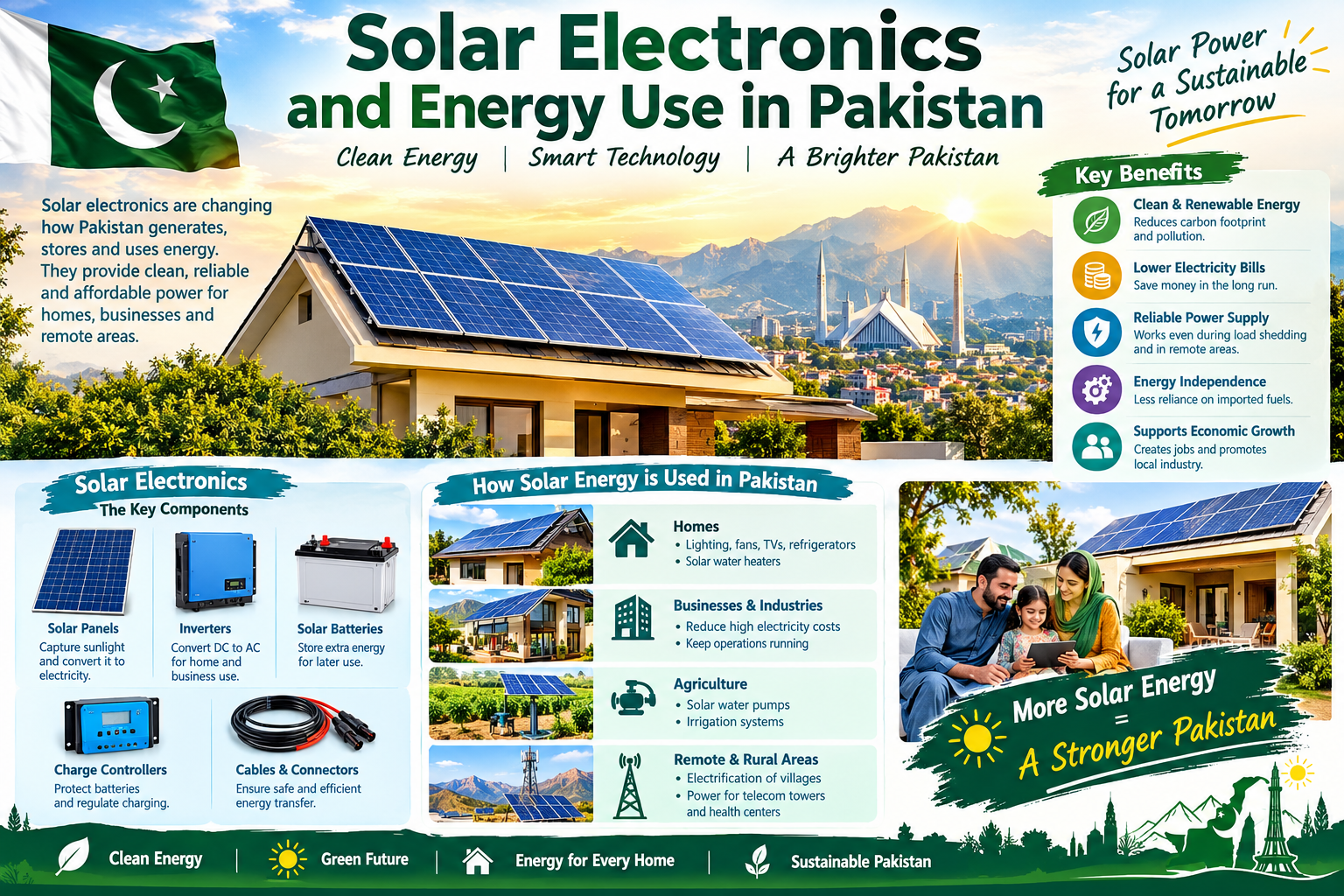
Solar electronics are an important part of these systems. A solar panel produces electrical energy from sunlight, but electronic components are needed to control, convert, store, and distribute that energy. Inverters, charge controllers, batteries, monitoring systems, and other components help turn solar generation into usable electricity.
The growing use of solar electronics is changing the way many people think about electricity. Instead of depending entirely on conventional electricity sources, consumers can consider generating some or much of their electricity from sunlight.
This development is important not only because of energy production but also because it is creating new technical skills, businesses, career opportunities, and awareness about renewable energy.
What Are Solar Electronics?
Solar electronics refers to electronic equipment used in solar-energy systems to control, convert, monitor, or use electricity generated from sunlight.
Solar panels are the most visible part of a solar system. They contain photovoltaic cells that convert sunlight into electrical energy. However, a complete solar installation usually requires additional equipment.
An inverter can convert electricity from the solar panels or batteries into a form suitable for household and other electrical loads. Charge controllers can regulate battery charging in systems that use batteries. Monitoring devices can provide information about energy generation and system performance.
Other solar-powered electronic products include solar lights, solar fans, solar water pumps, solar chargers, and various small devices.
Together, these technologies form a growing part of Pakistan's renewable-energy ecosystem.
How Solar Energy Works
The basic idea behind solar electricity is relatively simple.
Solar panels receive sunlight and generate direct-current electricity. Depending on the system design, this electricity can be used by compatible equipment, stored in batteries, or passed through an inverter.
An inverter converts DC electricity into alternating-current electricity for many common household and commercial loads.
A battery-based system can store electricity for later use. This can be useful when solar generation is lower, such as during the evening or periods of limited sunlight.
A charge controller may manage the flow of electricity between solar panels and batteries in appropriate system configurations.
The exact design of a solar system depends on its size, purpose, available sunlight, electrical loads, battery requirements, and other technical factors.
Why Solar Electronics Are Important in Pakistan
Solar technology has attracted attention in Pakistan for several reasons. Electricity costs, energy reliability, environmental concerns, and interest in energy independence all contribute to consumer interest.
Many households want to reduce their dependence on conventional electricity. Businesses may also consider solar systems as part of their long-term energy planning.
Solar electronics provide a way to convert renewable energy into practical electricity for daily activities.
For example, a household can use solar-generated electricity for lights, fans, refrigerators, computers, and other compatible appliances. A farm can use solar-powered pumps to support irrigation. A shop can use solar power for lighting, refrigeration, security cameras, and other equipment.
The usefulness of solar technology therefore extends beyond a single type of consumer.
Solar Panels for Homes
Residential solar systems are becoming increasingly familiar to Pakistani consumers. A home solar system can be designed according to the family's electricity requirements.
Before installing a system, households need to understand their electricity consumption. Large appliances such as air conditioners, refrigerators, water pumps, and electric heaters can require significant power.
A properly designed system considers the total load as well as how long different appliances operate.
The roof or installation area is another important factor. Solar panels need suitable space and appropriate exposure to sunlight.
Professional assessment is useful because panel placement, wiring, inverter selection, structural support, and electrical protection all affect system performance.
Solar Inverters
The inverter is one of the most important electronic components in a solar system.
Solar panels produce DC electricity, while many household appliances operate using AC electricity. The inverter performs the necessary conversion for compatible loads.
Different types of solar inverters are designed for different system configurations. Some systems are connected to the electricity grid, while others use batteries or operate independently.
Consumers should not select an inverter only by looking at its price. Capacity, compatibility, efficiency, safety features, monitoring functions, warranty, and installation requirements are all important.
A correctly matched inverter can help a solar system operate efficiently and safely.
Battery Storage
Batteries allow solar-generated electricity to be stored for later use.
This can be useful when electricity is needed after sunset or when solar generation temporarily decreases.
Battery technology has developed over time. Different battery types have different characteristics, costs, maintenance requirements, lifespans, and performance levels.
Consumers should consider the expected energy demand and backup requirements before choosing a battery system.
Battery installation also requires appropriate safety measures. Batteries should be installed according to manufacturer instructions and kept in suitable conditions.
Solar Lights
Solar lighting is one of the simplest applications of solar electronics.
A solar light generally includes a small solar panel, battery, LED light, and electronic control system. During daylight, the solar panel can charge the battery. The stored energy can then power the light when needed.
Solar lights can be useful for outdoor areas, gardens, pathways, streets, farms, and locations where connecting to conventional electricity is difficult.
LED technology makes solar lighting particularly practical because LEDs can provide useful illumination with relatively low electrical power requirements.
Solar Fans
Fans are especially important in Pakistan because of the country's hot summers.
Solar-powered fans can operate using electricity generated by solar panels or through a battery-supported system. They can be useful in locations where electricity access is limited or where users want an alternative energy source.
Solar fans may be particularly useful in rural areas, workshops, agricultural locations, and outdoor environments.
As with other solar devices, performance depends on system capacity, sunlight conditions, battery storage, and the electrical requirements of the fan.
Solar Water Pumps
Agriculture is an important sector in Pakistan, making water pumping a significant application of solar technology.
Solar water pumps use electricity generated from solar panels to operate water-pumping equipment. They can be used for irrigation, livestock water supply, and other agricultural purposes.
One benefit is that solar generation occurs during daylight hours, which can match many agricultural pumping needs.
The design of a solar pumping system depends on factors such as water depth, required flow rate, pump capacity, solar availability, and irrigation requirements.
Professional system design is important because selecting an unsuitable pump or solar array can lead to poor performance.
Solar Electronics in Agriculture
Solar technology can support agricultural activities in several ways.
Besides water pumps, farms can use solar-powered lighting, electric fencing systems, monitoring equipment, ventilation systems, sensors, and communication devices.
Solar-powered sensors can potentially collect information about soil moisture, temperature, humidity, or other environmental conditions.
Connected agricultural equipment can help farmers monitor operations and make decisions using digital information.
The combination of solar energy, electronics, sensors, and communication technology may become increasingly important in modern agriculture.
Solar Power for Small Businesses
Small businesses such as shops, workshops, offices, restaurants, and service centers depend on electricity for many daily activities.
Solar systems can be used to support lighting, fans, computers, refrigerators, security cameras, networking equipment, and other loads.
For a business, electricity is often part of operating costs. Therefore, energy management can be an important business consideration.
Before investing in solar equipment, a business should examine its actual electricity consumption and determine which loads need solar support.
A properly planned system can be more useful than simply installing the largest possible number of panels.
Solar Electronics in Schools
Schools can also benefit from solar technology.
Solar systems can provide electricity for lighting, fans, computers, projectors, networking equipment, and other educational devices.
Reliable power can support digital learning and computer-based education.
Schools can also use solar installations as practical educational tools. Students can learn about renewable energy, photovoltaic systems, circuits, electricity, batteries, energy efficiency, and environmental responsibility.
This can connect classroom concepts with real-world technology.
Solar Technology and Rural Pakistan
Solar electronics can have particular importance in rural areas.
Some rural locations may have different energy requirements and infrastructure challenges compared with major urban centers. Solar systems can provide electricity for lighting, water pumping, communication, refrigeration, and other activities.
Small solar systems can also power devices such as mobile chargers and LED lights.
For rural communities, appropriate solar technology can support education, communication, agriculture, and small businesses.
However, successful adoption depends on affordability, quality equipment, proper installation, maintenance, and access to trained technicians.
Solar Electronics and Electricity Bills
One reason consumers consider solar technology is the possibility of reducing electricity purchased from the conventional grid.
The amount of electricity a solar system can offset depends on system size, sunlight availability, household consumption, battery use, equipment efficiency, and other factors.
Consumers should avoid assuming that every solar system will eliminate an electricity bill. Actual results depend on how the system is designed and operated.
A household that uses substantial electricity during daylight hours may be able to directly use a significant portion of its solar generation. Battery storage can provide additional flexibility but adds to the cost and technical complexity of the system.
Energy Efficiency and Solar Systems
Solar panels are only one part of energy management.
Energy-efficient appliances can reduce the amount of electricity required by a household. LED bulbs, efficient fans, appropriately sized refrigerators, and energy-conscious cooling practices can reduce demand.
Lower electricity demand means that a solar system may need less generation capacity to support the same household.
Therefore, solar adoption can work well alongside energy efficiency.
Consumers should first understand their electricity usage and then consider which appliances or habits are contributing most to consumption.
Smart Monitoring of Solar Systems
Modern solar electronics can include digital monitoring systems.
These systems may provide information about solar generation, energy consumption, battery status, and system performance.
Some equipment can display information through a screen, while connected systems may provide information through smartphone applications.
Monitoring can help users understand how their solar system is performing and identify unusual changes.
For example, a significant reduction in expected generation may indicate shading, equipment problems, dirt accumulation, or other issues.
Maintenance of Solar Electronics
Solar systems require maintenance even though solar panels have no moving parts.
Panels can accumulate dust and other material, which may reduce the amount of sunlight reaching their surface. The appropriate cleaning schedule depends on local conditions.
Electrical connections, cables, inverters, batteries, and protective equipment should also be inspected as recommended by the manufacturer or qualified technician.
Maintenance requirements vary according to the system design and components used.
Using quality components and professional installation can help reduce avoidable problems.
Importance of Quality Equipment
The growing solar market creates choices for consumers, but quality remains important.
Solar panels, inverters, batteries, cables, mounting structures, and protective devices should be selected according to appropriate technical specifications.
Very low-cost equipment may not always provide the expected performance or durability.
Consumers should examine product specifications, warranty terms, supplier reputation, and service support before purchasing.
A solar system is a long-term investment, so the quality of its components can affect its overall performance.
Solar Electronics and Employment Opportunities
The growth of solar technology is creating demand for technical skills.
Installation technicians, electricians, engineers, sales professionals, maintenance workers, system designers, and customer-support staff can all contribute to the solar sector.
Students interested in electronics and renewable energy can develop skills in electrical circuits, photovoltaic systems, batteries, inverters, wiring, safety procedures, and system troubleshooting.
Technical and vocational education can help prepare young people for opportunities in this growing field.
Opportunities for Pakistani Entrepreneurs
Solar technology also provides opportunities for entrepreneurship.
Businesses can provide solar installation services, maintenance, equipment sales, system design, energy audits, and technical training.
Entrepreneurs can also develop specialized products for agricultural, residential, commercial, and educational applications.
Small solar products such as lights and charging systems can serve consumers who do not need large installations.
The success of a solar business depends on product quality, technical knowledge, customer service, honest system sizing, and responsible installation.
Environmental Benefits
Solar energy is renewable because sunlight is naturally replenished.
Generating electricity from sunlight can reduce dependence on fossil-fuel-based electricity generation. This can contribute to broader efforts to reduce emissions associated with energy production.
Solar electronics can therefore support environmental awareness while also serving practical energy needs.
However, solar systems themselves also contain materials that eventually require responsible disposal or recycling. Batteries in particular require appropriate handling.
Sustainable energy therefore involves not only clean generation but also responsible manufacturing, maintenance, reuse, and disposal.
Challenges of Solar Electronics in Pakistan
Despite their benefits, solar systems also have challenges.
The initial installation cost can be significant for many households and businesses. Consumers also need suitable roof or land space for panels.
Dust, shading, extreme weather, and poor installation can affect performance.
Battery-based systems can add considerable cost and require additional maintenance and replacement planning.
There can also be differences in product quality and service availability. Consumers should therefore research suppliers carefully and use qualified professionals for installation.
These challenges do not make solar technology unsuitable; rather, they show why proper planning is important.
Solar Electronics and Smart Homes
Solar technology can work together with smart-home systems.
A home can potentially combine solar panels, batteries, smart meters, energy-monitoring systems, smart plugs, and connected appliances.
Such systems can help households understand when electricity is being generated and consumed.
Smart controls may also allow users to manage certain loads according to energy availability.
For example, some electricity-intensive activities can be scheduled during periods when solar generation is high.
This combination of renewable energy and smart electronics represents an important direction for future homes.
The Future of Solar Electronics in Pakistan
The future of solar electronics in Pakistan is likely to involve greater integration between renewable energy, batteries, smart controls, and digital monitoring.
Solar panels are expected to remain the foundation of many systems, while improvements in batteries and electronic controls can provide greater flexibility.
Electric vehicles may also become connected with home energy systems in the future. A sufficiently developed system could potentially coordinate solar generation, energy storage, home electricity use, and vehicle charging.
Agriculture may also benefit from improved solar pumps, sensors, automation, and monitoring systems.
Education will be another important factor. As more students learn about renewable energy and electronics, Pakistan can develop a larger pool of skilled workers and entrepreneurs.
Tips for People Considering Solar Technology
Anyone considering solar electronics should begin with an assessment of actual electricity usage.
The consumer should identify major appliances and determine when they are used. Daytime and nighttime electricity consumption can be especially important when deciding whether battery storage is required.
Available installation space should also be examined.
Consumers should compare equipment specifications rather than relying only on marketing claims. Warranty and after-sales support should be considered as well.
Installation should be performed by qualified professionals, and electrical safety requirements should be followed.
Most importantly, system capacity should be based on actual energy needs rather than simply choosing the largest system available.
Solar Electronics as a Technology Education Opportunity
Solar energy provides an excellent practical learning area for students.
Students can learn how photovoltaic cells generate electricity and how electronic components control electrical energy.
Small educational projects can demonstrate concepts such as voltage, current, circuits, batteries, sensors, and energy conversion.
Students interested in computer science can combine electronics with programming by creating monitoring systems using sensors and microcontrollers.
This combination can introduce learners to renewable energy, electronics, automation, robotics, and embedded systems.
Conclusion
Solar electronics are becoming an important part of Pakistan's changing energy environment. Solar panels, inverters, batteries, charge controllers, solar lights, fans, pumps, and monitoring systems provide practical ways to use energy from sunlight.
Homes can use solar technology to support everyday electricity needs. Businesses can explore renewable energy as part of their energy planning. Farmers can use solar pumps and electronic systems for agricultural activities. Schools can use solar installations for electricity and practical education.
The development of solar electronics is also creating opportunities for technicians, engineers, students, entrepreneurs, and technology professionals.
At the same time, successful solar adoption requires careful planning. Consumers need to consider electricity consumption, system size, equipment quality, installation, maintenance, safety, and long-term costs.
As Pakistan's interest in renewable energy continues to grow, solar electronics can remain an important area of technological development. The combination of solar power, modern electronics, batteries, smart monitoring, and energy-efficient appliances can help create more flexible and technology-driven energy systems for homes, businesses, farms, and institutions.
FAQs
1. What are solar electronics?
Solar electronics are electronic components and devices used to generate, control, convert, store, monitor, or use electricity produced from solar energy. Examples include inverters, charge controllers, batteries, solar lights, and monitoring systems.
2. Can solar systems be used in Pakistani homes?
Yes. Solar systems can be designed for residential use and can support different household loads, depending on system capacity, electricity consumption, available sunlight, and whether battery storage is included.
3. What is the purpose of a solar inverter?
A solar inverter converts electricity between forms required by different parts of the system. In many household systems, it converts DC electricity from solar panels into AC electricity suitable for compatible household loads.
4. Can solar energy help Pakistani farmers?
Yes. Solar-powered water pumps can be used for irrigation and livestock water supply, while other solar electronic devices can support lighting, monitoring, communication, and agricultural operations.
5. What should consumers consider before installing a solar system?
Consumers should consider their electricity consumption, required system capacity, available installation space, solar exposure, inverter and battery requirements, equipment quality, warranty, maintenance, safety, and professional installation.