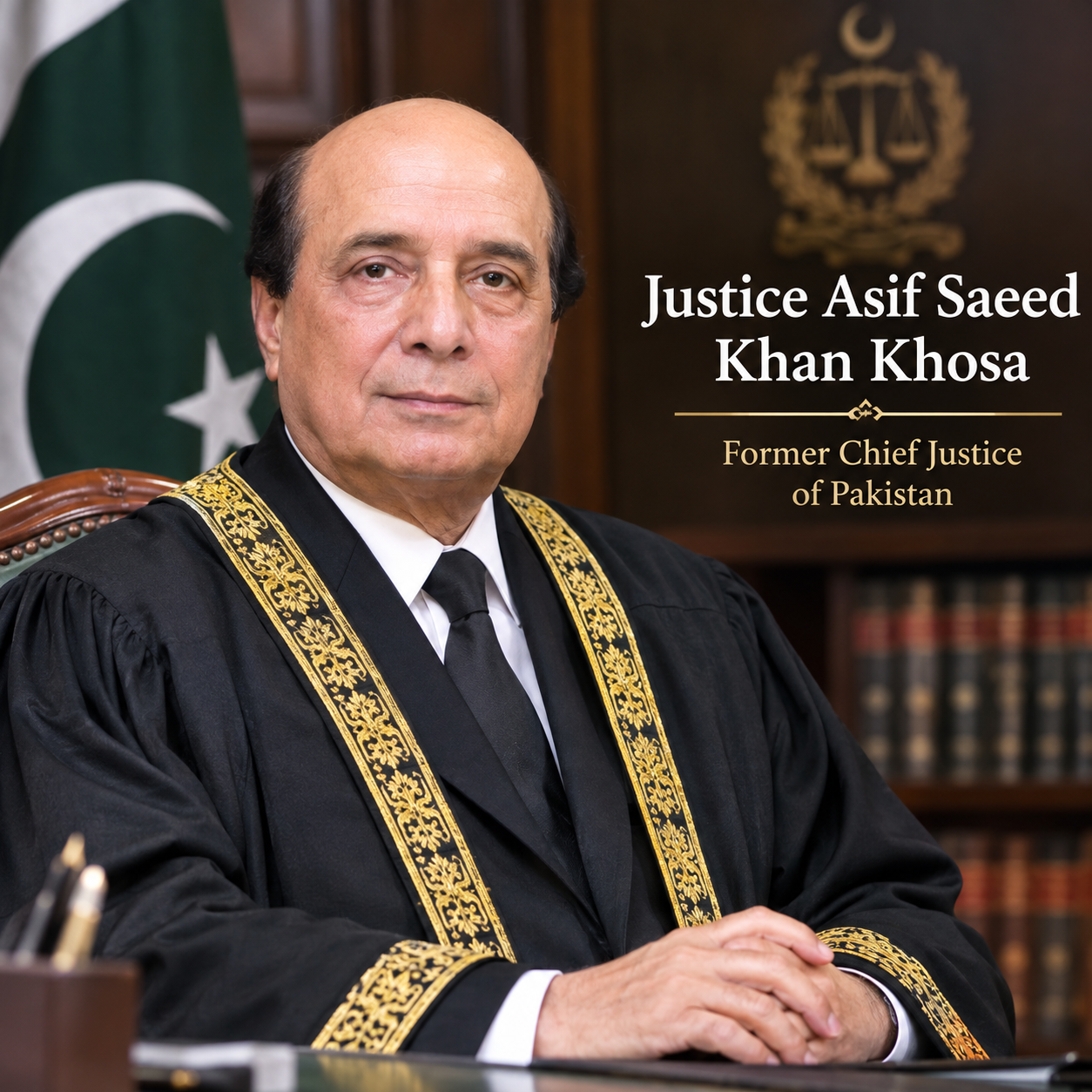
Justice Asif Saeed Khan Khosa is an important name in the judicial history of Pakistan. He served as a judge of the Lahore High Court, later became a judge of the Supreme Court of Pakistan, and eventually served as Chief Justice of Pakistan. His professional career covered several decades and included legal practice, judicial service, legal education, and work on important constitutional and legal questions.
Justice Asif Saeed Khan Khosa was born on 21 December 1954 in Dera Ghazi Khan, Pakistan. He received his early education in Pakistan and achieved strong academic results. According to the official profile of the Supreme Court of Pakistan, he received national talent scholarships during several stages of his education.
His academic journey later took him to the United Kingdom, where he studied law at the University of Cambridge. He obtained an LL.M. and was called to the Bar at Lincoln's Inn in London. He then returned to Pakistan and developed a long career in legal practice before entering the judiciary.
Early Life and Education
Justice Asif Saeed Khan Khosa was born in Dera Ghazi Khan on 21 December 1954.
His academic career began with his schooling in Pakistan. He obtained the fifth position in the Board of Intermediate and Secondary Education, Multan, in 1969 and received a National Talent Scholarship.
He later completed his Intermediate education through the Board of Intermediate and Secondary Education, Lahore, securing the first position in 1971. He studied at Government College, Lahore, and again received a National Talent Scholarship.
His undergraduate studies were also highly successful. He obtained a Bachelor of Arts degree from the University of the Punjab in 1973, securing the first position in the university.
He continued his studies in English language and literature and completed a Master of Arts degree from the University of the Punjab in 1975.
His education was therefore not limited to law. His academic background also included English language and literature, which became an important part of his broader educational profile.
Legal Education in Cambridge
After completing his education in Pakistan, Justice Khosa travelled to the United Kingdom for further studies.
He studied the Law Tripos, Part I, at Queens' College, University of Cambridge, in 1977.
In 1978, he completed an LL.M. from Queens' College, University of Cambridge. His specialization included public international law, with subjects such as the law of peace, law of war and armed conflict, international institutions, and civil liberties.
This international legal education gave him an academic background in areas that are important to constitutional and public law.
He was later called to the Bar on 26 July 1979 at the Honourable Society of Lincoln's Inn in London.
Beginning of Legal Practice
After completing his studies abroad, Justice Khosa returned to Pakistan and entered the legal profession.
He was enrolled as an Advocate of the Lahore High Court on 13 November 1979.
He later became an Advocate of the Supreme Court of Pakistan on 12 September 1985.
During his legal career, he handled a large number of cases involving different branches of law.
The official Supreme Court profile records that he handled thousands of cases involving constitutional, criminal, civil, service, revenue, and election laws.
This broad legal experience became an important part of his professional background before he entered judicial service.
Experience as a Lawyer
Legal practice provides advocates with practical experience of courts and legal procedures.
As a lawyer, Justice Khosa worked on cases involving constitutional questions as well as ordinary civil and criminal disputes.
Constitutional law deals with the interpretation and application of the Constitution. Civil law deals with disputes between individuals and organizations, while criminal law concerns offences and the legal process relating to them.
Service law can involve disputes concerning public employees, while revenue law may involve taxation, land, and government revenue matters. Election law concerns legal questions related to elections and electoral processes.
His experience across these areas gave him exposure to a wide range of legal questions.
Appointment to the Lahore High Court
Justice Asif Saeed Khan Khosa was elevated to the Lahore High Court as a judge.
The High Court is an important level of Pakistan's judicial system. High Courts deal with a broad range of civil, criminal, constitutional, and administrative matters.
As a High Court judge, Justice Khosa became responsible for hearing cases and applying laws and constitutional principles to the disputes before the court.
His experience at the Lahore High Court later became part of the foundation for his elevation to the Supreme Court.
Elevation to the Supreme Court
Justice Asif Saeed Khan Khosa was elevated as a judge of the Supreme Court of Pakistan on 18 February 2010. The official Supreme Court record lists this as his date of elevation.
The Supreme Court is the highest court in Pakistan.
A Supreme Court judge deals with appeals and important legal questions that can have significance beyond individual cases.
The court also interprets constitutional provisions and decides matters involving fundamental rights, government institutions, and different branches of law.
Justice Khosa served on the Supreme Court for almost a decade before becoming Chief Justice.
Work as a Supreme Court Judge
During his service at the Supreme Court, Justice Khosa participated in numerous cases.
His professional background in constitutional, criminal, civil, service, revenue, and election law was relevant to the wide range of matters heard by the Supreme Court.
Supreme Court judgments form an important part of Pakistan's legal record. They are studied by lawyers, judges, law students, researchers, and academics.
A judgment generally explains the legal questions before the court, the relevant law, the arguments considered, and the reasoning behind the court's decision.
Justice Khosa's judgments are therefore part of the material that can be studied to understand legal reasoning in Pakistan.
Appointment as Chief Justice
Justice Asif Saeed Khan Khosa became Chief Justice of Pakistan on 18 January 2019.
The official Supreme Court annual report lists 18 January 2019 as the date on which he became Chief Justice. It also records his retirement date as 20 December 2019.
His tenure as Chief Justice was therefore relatively short, lasting approximately eleven months.
He succeeded Justice Mian Saqib Nisar as Chief Justice and was later succeeded by Justice Gulzar Ahmed.
Responsibilities of the Chief Justice
The Chief Justice of Pakistan is the head of the Supreme Court.
The position includes judicial responsibilities as well as administrative responsibilities concerning the functioning of the court.
The Chief Justice works with other judges and court officials to manage the business of the Supreme Court.
Cases may involve constitutional questions, civil disputes, criminal appeals, government matters, fundamental rights, and other legal issues.
The Chief Justice also plays an important role in the administration of the judicial institution.
His Tenure in 2019
Justice Khosa's tenure as Chief Justice began in January 2019 and ended in December 2019.
Although the period was short, it formed part of a long judicial career that had already included service in the High Court and nearly nine years on the Supreme Court.
The official Supreme Court record confirms his date of appointment as Chief Justice and his retirement date.
Studying his tenure is therefore best understood within the context of his broader career.
Interest in Legal Reasoning
Justice Khosa's academic and professional background included strong emphasis on law and legal reasoning.
His studies at Cambridge included public international law and civil liberties.
His legal practice involved constitutional and other areas of law.
Later, as a Supreme Court judge, he participated in cases requiring interpretation of legislation and constitutional provisions.
Legal reasoning is an essential part of judicial work because courts must connect the facts of a case with the applicable law.
Criminal Law Experience
One part of Justice Khosa's legal background was criminal law.
Criminal cases involve allegations that a person has committed an offence. Courts examine evidence, legal provisions, procedural requirements, and arguments from the parties before reaching a decision.
His experience with criminal cases was part of the broader legal practice recorded in his official profile.
His judicial work later included consideration of criminal appeals and other criminal-law matters before the Supreme Court.
Constitutional Law
Constitutional law was another important part of Justice Khosa's professional background.
The Constitution establishes the structure of the state and defines powers and responsibilities of public institutions. It also provides protections relating to fundamental rights.
Constitutional cases can involve questions about the powers of government institutions, interpretation of constitutional provisions, and the rights of citizens.
Because Justice Khosa had handled constitutional cases as an advocate, this area was already part of his professional experience before he joined the judiciary.
Civil and Service Law
Justice Khosa also handled civil and service matters during his career as a lawyer.
Civil law covers many types of disputes, including matters involving contracts, property, compensation, and other private legal relationships.
Service law deals with employment-related legal questions involving public servants and government institutions.
The combination of civil, criminal, constitutional, service, revenue, and election law experience gave him a broad professional background.
Revenue and Election Law
Revenue law and election law were also included among the areas of legal practice listed in Justice Khosa's official Supreme Court profile.
Revenue matters can involve taxation, government dues, land, and related legal issues.
Election law involves legal questions concerning elections, electoral processes, eligibility, and related disputes.
Both areas can involve constitutional and administrative questions and can reach the higher courts.
International Legal Education
Justice Khosa's education in the United Kingdom was an important part of his academic career.
His LL.M. specialization included public international law.
Public international law deals with legal relationships between states and international institutions.
The subjects he studied included the law of peace, the law of war and armed conflict, international institutions, and civil liberties.
This educational background provided him with exposure to international legal concepts before his long career in Pakistan's legal system.
Academic Background in English Literature
One distinctive part of Justice Khosa's education was his Master's degree in English Language and Literature from the University of the Punjab.
He completed the degree in 1975 after earning his B.A. in 1973.
This combination of humanities and legal education gave his academic background a broad character.
English language skills are also useful in the legal profession because many legal documents, judgments, statutes, and legal arguments in Pakistan are written in English.
Importance for Law Students
Justice Khosa's career can be useful for students who are considering a future in law.
His journey shows that legal careers can include different stages.
A person may begin with an undergraduate education, study law, practice as an advocate, become a High Court judge, and later serve at the Supreme Court.
His career also demonstrates the value of continuing education.
He studied law in Pakistan and later completed advanced legal education in the United Kingdom.
For students, his academic journey shows the importance of developing strong reading, writing, reasoning, and communication skills.
The Role of a Supreme Court Judge
A Supreme Court judge has responsibilities that go beyond simply deciding individual disputes.
Judges must study legal material carefully, listen to arguments, consider evidence and applicable law, and prepare decisions.
Supreme Court decisions can also become important precedents for later cases.
This means that judicial reasoning can influence how lawyers and lower courts understand legal principles.
Justice Khosa's years at the Supreme Court therefore formed an important part of his professional contribution to Pakistan's judiciary.
The Role of Judicial Precedent
Judicial precedent refers to earlier court decisions that may guide courts when dealing with similar legal questions.
Higher-court decisions can be particularly important because lower courts may rely on principles established by higher courts.
For law students, studying judgments helps explain how legal principles develop over time.
Justice Khosa's judgments, like those of other Supreme Court judges, form part of Pakistan's body of judicial decisions.
Chief Justice and Judicial Administration
The position of Chief Justice also involves administrative work.
Courts need systems for managing cases, assigning judicial work, maintaining records, and supporting judges and court staff.
The Chief Justice is therefore involved in the broader functioning of the Supreme Court in addition to hearing cases.
Justice Khosa served as Chief Justice during 2019 after almost nine years as a Supreme Court judge.
His previous experience gave him extensive familiarity with the court before he assumed the leadership position.
Retirement
Justice Asif Saeed Khan Khosa retired on 20 December 2019.
The official Supreme Court annual report lists his date of birth as 21 December 1954, his elevation as a Supreme Court judge on 18 February 2010, his appointment as Chief Justice on 18 January 2019, and his retirement on 20 December 2019.
His retirement marked the end of his formal service on the Supreme Court.
By that point, he had spent decades in the legal profession and nearly ten years as a member of the Supreme Court.
Professional Legacy
Justice Asif Saeed Khan Khosa's professional legacy is connected with his long service in Pakistan's legal and judicial institutions.
He worked as an advocate for many years before becoming a judge.
He served at the High Court level and later spent almost a decade on the Supreme Court.
His academic career also included education at Government College Lahore, the University of the Punjab, and the University of Cambridge.
These different stages make his career relevant to the study of Pakistan's legal profession and judiciary.
Contribution to Pakistan's Judiciary
Justice Khosa's career represents several important aspects of Pakistan's judicial system.
He worked as a lawyer before joining the bench.
He served in a High Court before moving to the Supreme Court.
He then became Chief Justice of Pakistan.
His career also demonstrates the importance of legal education and professional experience in the development of a judicial career.
His judgments remain part of the official judicial record and can be studied as part of Pakistan's legal history.
Conclusion
Justice Asif Saeed Khan Khosa was an important Pakistani jurist and former Chief Justice of Pakistan.
Born on 21 December 1954 in Dera Ghazi Khan, he developed a strong academic background in Pakistan before studying law at Cambridge University. He completed an LL.M. specializing in public international law and was called to the Bar at Lincoln's Inn in London.
He began practicing law in Pakistan in 1979 and was later enrolled as an Advocate of the Supreme Court in 1985. During his legal career, he handled cases involving constitutional, criminal, civil, service, revenue, and election laws.
He later entered the judiciary and eventually became a judge of the Supreme Court on 18 February 2010. After years of service on the Supreme Court, he became Chief Justice of Pakistan on 18 January 2019.
He served as Chief Justice until 20 December 2019, when he retired from the Supreme Court.
His career is notable for its combination of legal practice, academic study, judicial service, and leadership of the Supreme Court. For students interested in law, his journey provides an example of how a legal career can develop through education, advocacy, judicial service, and experience.
Frequently Asked Questions
1. Who was Justice Asif Saeed Khan Khosa?
Justice Asif Saeed Khan Khosa was a Pakistani jurist who served as a judge of the Supreme Court and later became Chief Justice of Pakistan.
2. When did Asif Saeed Khan Khosa become Chief Justice of Pakistan?
He became Chief Justice of Pakistan on 18 January 2019.
3. When did Justice Asif Saeed Khan Khosa retire?
He retired from the Supreme Court on 20 December 2019.
4. Where was Justice Asif Saeed Khan Khosa born?
He was born in Dera Ghazi Khan, Pakistan, on 21 December 1954.
5. When did he become a Supreme Court judge?
He was elevated as a judge of the Supreme Court of Pakistan on 18 February 2010.