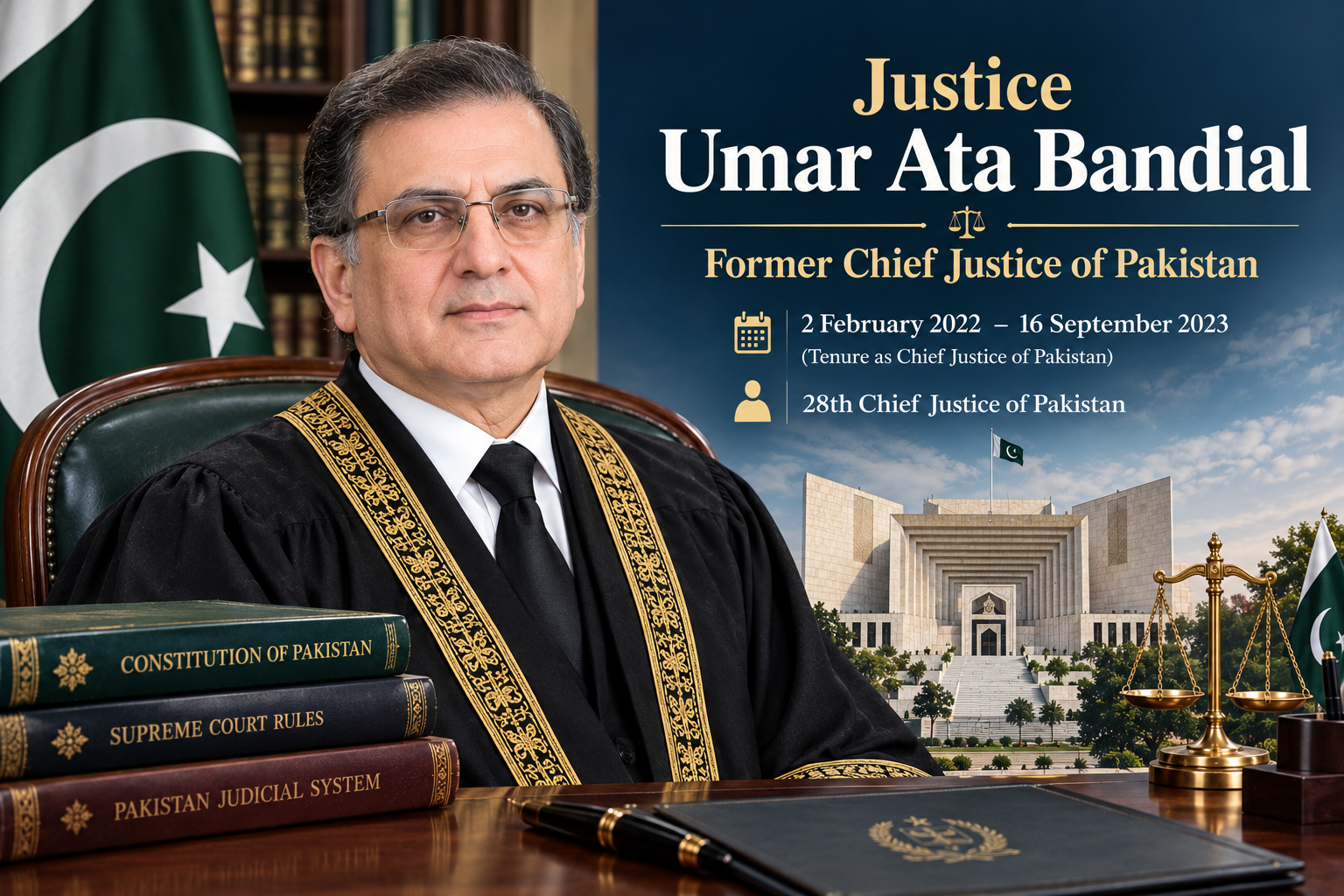
Justice Umar Ata Bandial was an important figure in Pakistan’s modern judicial history. He served as a lawyer, judge of the Lahore High Court, Chief Justice of the Lahore High Court, judge of the Supreme Court of Pakistan, and finally Chief Justice of Pakistan.
He became Chief Justice of Pakistan on 2 February 2022 and served until 16 September 2023, when he retired from the Supreme Court. The official Supreme Court record gives his date of birth as 17 September 1958, his elevation to the Supreme Court as 17 June 2014, and his retirement as 16 September 2023.
His career is notable for its combination of legal practice, academic work, High Court experience, and service at the country's highest court.
Early Life of Justice Umar Ata Bandial
Justice Umar Ata Bandial was born on 17 September 1958 in Lahore.
According to the official Supreme Court biography, he received his early education at different schools in Kohat, Rawalpindi, Peshawar, and Lahore. He completed his Senior Cambridge certificate from St. Mary's Academy, Rawalpindi, in 1973 and his Higher Senior Cambridge certificate from Aitchison College in 1975.
His early education in different cities exposed him to different educational environments in Pakistan.
From an early stage, education played an important role in his professional development. He later continued his studies abroad and pursued both economics and law.
Higher Education
Justice Umar Ata Bandial studied Economics at Columbia University in the United States. He obtained his B.A. in Economics in 1979.
After that, he studied law at the University of Cambridge in the United Kingdom, where he completed a Law Tripos degree in 1981.
In 1982, he qualified as a Barrister-at-Law from Lincoln's Inn, London.
His educational background therefore combined economics with law.
This combination gave him academic exposure to two different but connected fields. Economics deals with markets, resources, and financial systems, while law provides the framework through which rights, contracts, property, business, and government responsibilities are regulated.
Beginning of His Legal Career
After completing his legal education, Justice Umar Ata Bandial returned to Pakistan and began his legal career.
He was enrolled as an Advocate of the Lahore High Court in 1982. Later, he became an Advocate of the Supreme Court of Pakistan.
He established his legal practice in Lahore.
During his years as a lawyer, he mainly dealt with areas such as commercial law, banking law, tax law, and property law.
These areas required knowledge of business transactions, financial institutions, taxation, contracts, and property rights.
International Commercial Disputes
Justice Umar Ata Bandial also gained experience in international commercial disputes.
The Supreme Court's official biography records that after 1993, he handled international commercial disputes and appeared in arbitration matters before the Supreme Court of Pakistan and foreign arbitral tribunals in London and Paris.
This part of his legal career gave him exposure to disputes involving businesses and institutions operating across national boundaries.
His professional experience included matters such as the Hitachi-Rupali dispute, the Hubco-Government of Pakistan dispute, the Ghazi Barotha Contractors-WAPDA dispute, and the Bayindir-NHA dispute.
Teaching Law
Justice Umar Ata Bandial also had experience as a teacher.
While practicing as an advocate, he taught Contract Law at Punjab University Law College for four years until 1987. He later remained associated with the institution's Graduate Studies Committee while serving as a judge of the Lahore High Court.
Teaching law requires the ability to understand legal principles and explain them clearly to students.
His experience as a teacher therefore became another important part of his professional background.
It also connected his legal career with legal education in Pakistan.
Appointment as a Lahore High Court Judge
Justice Umar Ata Bandial was elevated as a judge of the Lahore High Court on 4 December 2004.
His appointment to the High Court marked a major change in his professional career. After years of legal practice, he moved into judicial service.
As a High Court judge, his responsibilities included hearing cases, considering arguments from lawyers, examining legal material, and applying the Constitution and laws to disputes before the court.
The official Supreme Court biography states that during his time at the Lahore High Court, he delivered judgments on important public-law and private-law issues.
The 2007 Judicial Crisis
Justice Umar Ata Bandial's judicial career also passed through Pakistan's 2007 judicial crisis.
The official Supreme Court biography records that he declined to take oath under the Provisional Constitutional Order (PCO) in November 2007. He was later restored to his position as a Lahore High Court judge following the lawyers' and civil society movement for restoration of the judiciary and constitutional rule.
This period was an important chapter in Pakistan's judicial history.
The lawyers' movement became a major national movement concerning the judiciary and constitutional governance.
Chief Justice of the Lahore High Court
Justice Umar Ata Bandial was appointed Chief Justice of the Lahore High Court on 1 June 2012.
He served in this position until his elevation to the Supreme Court in June 2014.
As Chief Justice, he had both judicial and administrative responsibilities.
The Chief Justice of a High Court is responsible not only for participating in judicial proceedings but also for matters connected with the administration and functioning of the court.
His time at the Lahore High Court therefore provided important leadership experience before he joined the Supreme Court.
Elevation to the Supreme Court
Justice Umar Ata Bandial was elevated to the Supreme Court of Pakistan on 17 June 2014.
The Supreme Court is Pakistan's highest court.
As a Supreme Court judge, he heard cases involving different areas of law, including constitutional, civil, commercial, and other legal questions.
His earlier experience in commercial and banking law also provided a background for dealing with complex legal disputes.
Work as a Supreme Court Judge
A Supreme Court judge has to examine legal arguments, constitutional provisions, legislation, previous judgments, and relevant evidence before reaching a decision.
Justice Umar Ata Bandial served on the Supreme Court for several years before becoming Chief Justice.
During this period, his judgments and judicial opinions became part of Pakistan's legal record.
Law students, lawyers, researchers, and other readers can study Supreme Court judgments to understand how legal principles are applied to particular cases.
Becoming Chief Justice of Pakistan
Justice Umar Ata Bandial became Chief Justice of Pakistan on 2 February 2022.
He succeeded Justice Gulzar Ahmed as Chief Justice.
His tenure continued until 16 September 2023, when he retired from the Supreme Court. The Supreme Court's official records list these dates.
As Chief Justice, he was responsible for judicial and administrative duties associated with Pakistan's highest court.
Responsibilities of the Chief Justice
The Chief Justice of Pakistan is the head of the Supreme Court.
The office includes participation in important judicial proceedings as well as responsibilities related to the administration of the court.
The Supreme Court hears cases involving constitutional interpretation, fundamental rights, disputes between institutions, and many other areas of law.
The Chief Justice works alongside other Supreme Court judges in performing the court's judicial functions.
Constitutional Cases During His Tenure
Justice Umar Ata Bandial's tenure as Chief Justice coincided with several important constitutional developments in Pakistan.
The Supreme Court heard cases involving questions concerning the Constitution, Parliament, provincial assemblies, elections, and other public-law matters.
One notable example was the Supreme Court's proceedings in 2022 concerning the National Assembly and the no-confidence vote.
The official Supreme Court judgment in the case records Justice Umar Ata Bandial as Chief Justice and explains that the proceedings were initiated after events concerning the National Assembly on 3 April 2022.
Because these matters involved constitutional questions, they became part of Pakistan's legal and constitutional record.
Judicial Work and Constitutional Interpretation
Constitutional interpretation is an important part of the Supreme Court's work.
When a case involves the Constitution, judges may have to interpret constitutional provisions and consider how different institutions exercise their powers.
During his time on the Supreme Court, Justice Umar Ata Bandial participated in cases involving such questions.
His judgments and opinions can be studied as part of Pakistan's constitutional jurisprudence.
Election-Related Constitutional Case
During Justice Umar Ata Bandial's tenure as Chief Justice, the Supreme Court also heard constitutional litigation related to elections.
For example, an April 2023 Supreme Court judgment in a constitutional petition concerning the Election Commission records Justice Umar Ata Bandial as Chief Justice on the bench.
This illustrates the type of constitutional and public-law questions that came before the Supreme Court during his tenure.
Judicial Record
A judge's judicial record consists largely of judgments, opinions, orders, and participation in court proceedings.
Justice Umar Ata Bandial's judicial record covers his years at the Lahore High Court and Supreme Court.
His cases and judgments remain part of the official court record and can be consulted for legal research.
For law students, studying judgments can help explain how courts interpret statutes and constitutional provisions.
Experience in Commercial Law
One distinctive part of Justice Umar Ata Bandial's earlier career was his experience in commercial and financial law.
Before joining the judiciary, he practiced in areas including:
Commercial law
Banking law
Tax law
Property law
International commercial disputes
The official Supreme Court biography also records his involvement in arbitration matters in Pakistan and abroad.
This professional background gave him experience with legal disputes involving businesses, financial institutions, contracts, and property.
Experience in Arbitration
Arbitration is a method of resolving disputes outside the ordinary court process, usually through an agreed tribunal.
Justice Umar Ata Bandial appeared in arbitration matters before the Supreme Court and foreign arbitral tribunals in London and Paris during his legal career.
International arbitration can involve complicated contracts and commercial relationships.
His experience in this area formed an important part of his legal practice before he became a judge.
Contribution to Legal Education
Justice Umar Ata Bandial's work as a law teacher also forms part of his professional history.
His teaching of Contract Law at Punjab University Law College connected him with future members of the legal profession.
Legal education is important because lawyers and judges depend on strong understanding of legal concepts.
His combination of teaching and legal practice therefore gave him experience both in learning and explaining legal principles.
Importance of His Lahore High Court Career
His years at the Lahore High Court were a major stage of his judicial development.
He served as a judge for several years and later became Chief Justice.
This allowed him to gain experience in both judicial decision-making and court administration.
The Lahore High Court is one of Pakistan's major constitutional courts and hears a wide range of cases.
His service there prepared him for his later responsibilities at the Supreme Court.
Role in Pakistan's Judiciary
Justice Umar Ata Bandial's career covered more than three decades of legal and judicial service.
He began as an advocate, later became a High Court judge, served as Chief Justice of the Lahore High Court, became a Supreme Court judge, and eventually served as Chief Justice of Pakistan.
This progression provides an example of a long professional career within Pakistan's judicial system.
Professional Development
His career also demonstrates the importance of continued professional development.
He studied economics, law, and professional legal practice.
He worked as a lawyer and teacher before becoming a judge.
Each stage provided different forms of experience.
For students interested in law, his career illustrates that legal professionals can develop expertise through education, practice, teaching, and judicial service.
Importance for Law Students
Law students can learn several things from Justice Umar Ata Bandial's career.
First, his education demonstrates the value of strong academic preparation.
Second, his legal practice shows the importance of practical experience.
Third, his teaching career demonstrates the value of understanding and explaining legal principles.
Fourth, his judicial career shows how lawyers can move into judicial service.
Finally, his service as Chief Justice demonstrates the responsibilities associated with leadership of the Supreme Court.
His Approach to Judicial Work
Judicial decisions are based on legal materials, including the Constitution, legislation, precedents, and arguments presented before the court.
Justice Umar Ata Bandial's judgments form part of the official record through which his judicial approach can be studied.
Rather than relying only on summaries, law students and researchers can examine the original judgments to understand the reasoning used by the court.
This is particularly important when studying constitutional cases.
Retirement
Justice Umar Ata Bandial retired from the Supreme Court on 16 September 2023.
The official Supreme Court record lists his date of birth as 17 September 1958 and his retirement date as 16 September 2023.
His retirement marked the end of his formal judicial service.
However, the judgments issued during his time on the Lahore High Court and Supreme Court remain part of Pakistan's legal record.
Legacy in Pakistan's Legal History
Justice Umar Ata Bandial's legacy is connected with his long career in Pakistan's legal system.
He practiced law, taught Contract Law, served as a judge of the Lahore High Court, became Chief Justice of the Lahore High Court, joined the Supreme Court, and finally served as Chief Justice of Pakistan.
His career therefore provides a broad view of the different stages of legal and judicial service.
His judgments and participation in constitutional cases remain relevant to researchers studying Pakistan's recent judicial history.
Conclusion
Justice Umar Ata Bandial was a Pakistani jurist whose career included legal practice, teaching, High Court service, Supreme Court service, and leadership as Chief Justice of Pakistan.
Born in Lahore in 1958, he received education in Pakistan and abroad. He earned a degree in Economics from Columbia University, studied law at Cambridge University, and qualified as a Barrister-at-Law from Lincoln's Inn.
He began practicing law in Lahore and developed experience in commercial, banking, tax, property, and international commercial disputes. He also taught Contract Law at Punjab University Law College.
He became a judge of the Lahore High Court in 2004 and later served as Chief Justice of that court from 2012 until his elevation to the Supreme Court in 2014.
He became Chief Justice of Pakistan in February 2022 and served until his retirement in September 2023.
His tenure included Supreme Court proceedings involving significant constitutional questions, including cases concerning the National Assembly and election-related constitutional matters.
For students of law and Pakistan's judicial history, Justice Umar Ata Bandial's career offers an example of a legal professional progressing through different stages of the country's justice system.
His educational background, legal practice, teaching experience, judicial service, and leadership of the Supreme Court all form important parts of his professional history.
Frequently Asked Questions
1. Who was Justice Umar Ata Bandial?
Justice Umar Ata Bandial was a Pakistani jurist who served as a judge of the Supreme Court and later as Chief Justice of Pakistan.
2. When did Umar Ata Bandial become Chief Justice of Pakistan?
He became Chief Justice of Pakistan on 2 February 2022 and served until 16 September 2023.
3. Where was Justice Umar Ata Bandial born?
He was born in Lahore on 17 September 1958.
4. Where did Umar Ata Bandial study law?
He studied law at the University of Cambridge and later qualified as a Barrister-at-Law from Lincoln's Inn, London.
5. When did Justice Umar Ata Bandial retire?
He retired from the Supreme Court on 16 September 2023.