Introduction
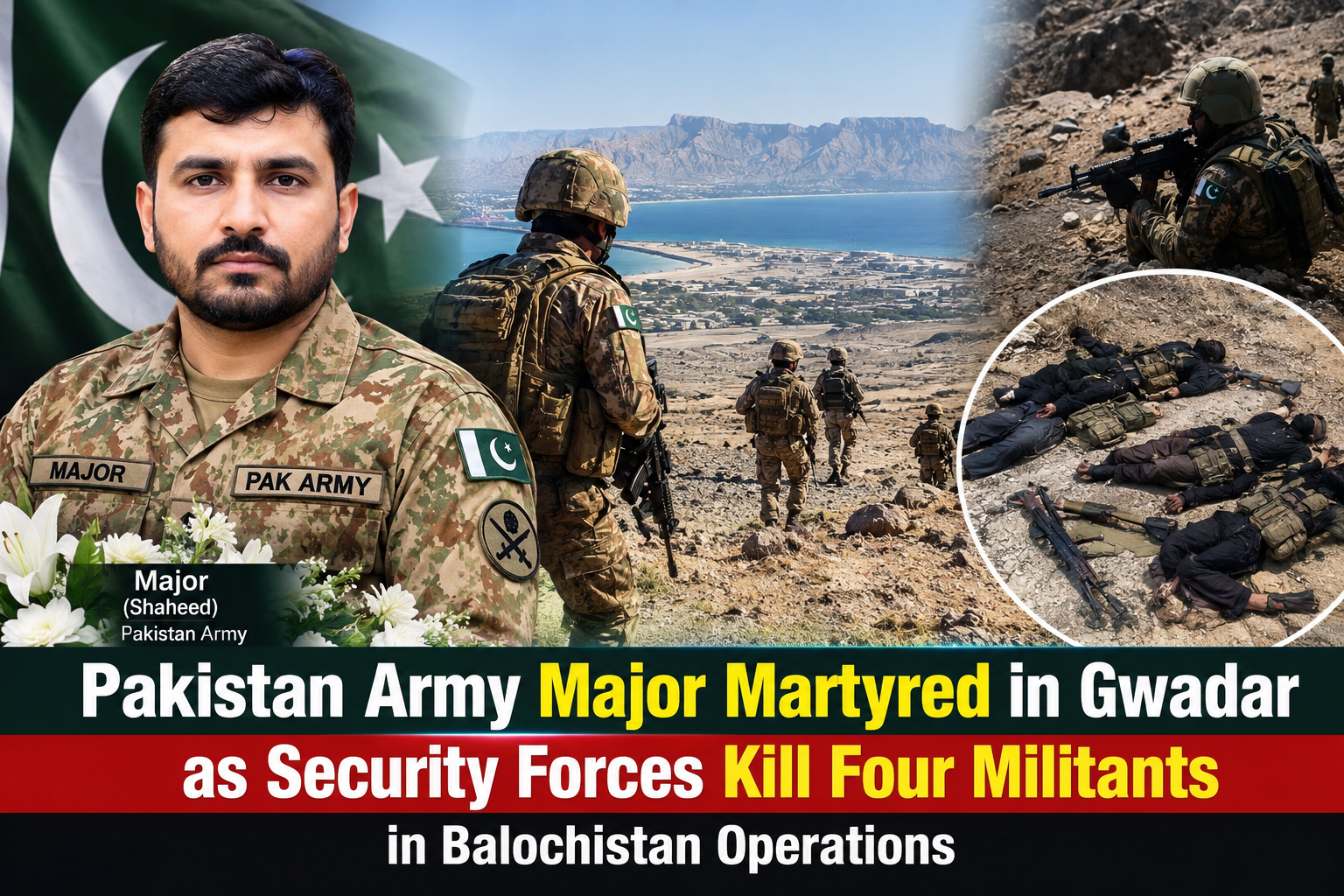
Security developments in Balochistan remained in the national spotlight on Monday after Pakistan’s military announced that an army major had been martyred during a security operation in Gwadar district, while four militants were killed in a separate intelligence-based operation in Kalat district. The incidents highlight the continuing security challenges faced by authorities in the province and the importance of protecting local communities, maintaining public safety, and supporting long-term stability.
According to the Inter-Services Public Relations (ISPR), the military’s media wing, security forces carried out operations in the Jattakabad area of Kalat and the Shadi Kaur area of Pasni tehsil in Gwadar district. Four militants were reported killed during the Kalat operation, while Major Wajahat Waheed lost his life when a security forces contingent was targeted by an improvised explosive device during clearance activities in Gwadar. The military also reported recovering a substantial quantity of arms and ammunition in Kalat. <Cite refs={["turn643937search1","turn643937search11"]}/>
The announcement prompted expressions of condolence from Pakistan’s senior leadership. President Asif Ali Zardari and Prime Minister Shehbaz Sharif paid tribute to the martyred officer and commended the security forces for their operations. Authorities also stated that clearance activities would continue in the affected areas.
The latest developments have renewed attention on Balochistan’s security situation, the challenges facing law enforcement agencies, and the broader need for peace, stability, and economic progress across the province.
Major Wajahat Waheed Martyred During Gwadar Operation
One of the most significant developments reported on October 19 was the death of Major Wajahat Waheed during a security operation in the Shadi Kaur area of Pasni tehsil, Gwadar district.
According to the ISPR statement, security forces were conducting clearance operations in the area when a contingent led by Major Waheed was targeted by an improvised explosive device. The explosion resulted in the officer’s death while he was performing his official duties.
The military identified Major Wajahat Waheed as a 34-year-old resident of Lahore. His death was announced alongside details of other counterterrorism operations in Balochistan. <Cite refs={["turn643937search1","turn643937search8"]}/>
The loss of a serving officer is a reminder of the risks faced by security personnel working in areas affected by violence and instability. Such incidents also bring grief to the families of those who lose their lives while carrying out public duties.
Following the announcement, the president and prime minister expressed condolences to Major Waheed’s family. Their statements reflected the government’s recognition of the sacrifices made by security personnel during operations intended to improve safety and security.
For residents of Balochistan, incidents involving security forces can also raise concerns about everyday life, travel, business activities, and access to essential services. Ensuring that affected communities receive timely information and appropriate assistance remains an important responsibility for the relevant authorities.
Four Militants Reported Killed in Kalat District
In a separate incident, security forces conducted an intelligence-based operation in the Jattakabad area of Kalat district on October 18, according to the military’s account released the following day.
The ISPR stated that the operation targeted a location where intelligence agencies had reported the presence of a militant hideout. An exchange of fire followed, and four militants were reported killed.
The military also said that a large quantity of arms and ammunition was recovered during the operation. The announcement did not provide a complete public inventory of the recovered material in the initial report. <Cite refs={["turn643937search0","turn643937search1"]}/>
Intelligence-based operations are generally intended to act on information gathered by security and intelligence agencies about suspected threats. Their stated objectives may include locating suspected militant networks, preventing planned attacks, and reducing risks to nearby communities.
However, the effectiveness of such operations cannot be measured by a single announcement alone. A fuller assessment requires reliable information about subsequent security conditions, investigations, the protection of civilians, and whether violence declines over time.
The reported operation in Kalat forms part of a wider security effort in Balochistan, where authorities continue to address threats posed by militant groups. The government and military have repeatedly described counterterrorism as a priority, while the long-term security situation also depends on effective governance, public confidence, and opportunities for local development.
Security Operations in Gwadar and Kalat
The two incidents occurred in different districts but were included in the same military announcement because both formed part of security activities in Balochistan.
In Gwadar, forces were conducting clearance operations in the Shadi Kaur area of Pasni tehsil. These activities were reportedly aimed at securing the area and addressing suspected militant presence. It was during this operation that Major Waheed was killed in the explosive-device attack.
In Kalat, the operation focused on a reported militant hideout in Jattakabad. The military said four militants were killed and weapons and ammunition were recovered.
The ISPR stated that further sanitisation operations would continue to identify and address any remaining threats in the affected locations. <Cite refs={["turn643937search1","turn643937search5"]}/>
Clearance activities can involve checking areas after an operation to assess whether further security concerns remain. The duration and scope of such activities depend on local conditions and information available to the authorities.
For communities living near affected locations, clear communication is particularly important. Residents need dependable guidance about road access, movement restrictions, and any official safety instructions. Timely information can help reduce confusion and prevent rumours from spreading.
Authorities also face the responsibility of balancing security measures with the everyday needs of residents. Local businesses, transport services, students, workers, and families may all be affected when security operations take place near populated areas.
A sustainable approach to security therefore requires not only operations against immediate threats but also coordination with local administration, emergency services, and community representatives.
Why Balochistan Remains Strategically Important
Balochistan is Pakistan’s largest province by land area and occupies an important position in the country’s geography and economy. It borders Iran and Afghanistan and has a long coastline along the Arabian Sea.
Gwadar, in particular, has received considerable attention because of its deep-sea port, coastal location, and connection to wider regional trade and infrastructure plans. The port is associated with Pakistan’s efforts to improve transport links, attract investment, and expand economic cooperation.
Kalat also forms part of Balochistan’s wider network of towns and districts, where local livelihoods depend on a mixture of public services, trade, agriculture, transport, and other economic activities.
Because of the province’s size and geographic diversity, security conditions can vary significantly between districts. A reported incident in one area does not automatically mean that the entire province is unsafe. Assessments should be based on verified local information rather than broad assumptions.
At the same time, repeated incidents of violence can create serious difficulties for residents and businesses. They may affect investor confidence, raise transport costs, disrupt education, and make it harder for communities to plan for the future.
Improving security is therefore closely connected with the province’s wider development needs. Better infrastructure, dependable public services, employment opportunities, and accessible education can all contribute to stronger communities. These measures are not substitutes for law enforcement, but they can support broader efforts to build lasting stability.
Government Leadership Pays Tribute to the Martyred Officer
Following the announcement, President Asif Ali Zardari and Prime Minister Shehbaz Sharif separately expressed grief over Major Wajahat Waheed’s death and paid tribute to the security forces.
According to Radio Pakistan, both leaders offered condolences to the officer’s family and acknowledged the sacrifices made during the operations in Kalat and Gwadar. The prime minister also reiterated the government’s stated commitment to continuing counterterrorism efforts. <Cite refs={["turn643937search10","turn643937search8"]}/>
Such statements are a regular part of the official response when members of the security forces are killed in the line of duty. They communicate the government’s position, recognise the loss suffered by the family, and signal that the incident is being treated as a matter of national concern.
For the family of a serving officer, however, public tributes cannot remove the personal impact of a death. Condolences, practical assistance, and appropriate support for family members are important parts of the response to such losses.
More broadly, public statements from senior officials are most useful when accompanied by clear information about security measures, investigations, and steps being taken to protect civilians.
The public also benefits from reporting that distinguishes confirmed facts from allegations or claims that have not been independently verified. This distinction helps readers understand what happened without confusing official statements with independently established findings.
The Role of Intelligence in Counterterrorism
Intelligence gathering is an important component of modern security operations. It can help authorities identify potential threats, understand patterns of activity, and decide where additional attention may be needed.
In the Kalat incident, the ISPR said the operation followed intelligence reports about a suspected militant hideout. In Gwadar, security forces were conducting clearance activities when the explosive-device attack occurred.
These accounts illustrate two different aspects of the security challenge: efforts to locate suspected militant positions and the dangers that personnel may encounter while carrying out operations.
Reliable intelligence can help authorities focus resources more effectively. Nevertheless, information must be assessed carefully, and allegations concerning individuals or organisations should be handled through appropriate legal and investigative processes.
Security operations also require coordination among relevant agencies, medical and emergency services, and civilian authorities. Such coordination can improve the response to incidents, support affected people, and help local communities receive accurate information.
Another important consideration is accountability. Clear public communication about the purpose and outcomes of security operations can help build confidence, provided that sensitive information is protected and investigations are not compromised.
For lasting improvements, security efforts need to be evaluated over time. Relevant indicators include the frequency of attacks, the safety of civilians, the ability of schools and businesses to operate, and whether communities can access services without unreasonable disruption.
How Security Incidents Affect Local Communities
Security incidents can affect people far beyond the immediate location where an operation takes place. Even when violence is geographically limited, uncertainty can influence travel, commercial activity, family decisions, and access to public services.
For residents near Gwadar and Kalat, the immediate concerns may include whether roads remain accessible, whether normal transport services are operating, and whether authorities have issued any local safety instructions.
Small businesses can be particularly vulnerable to disruptions. Shops, markets, transport operators, and service providers depend on customers being able to travel and work safely. Uncertainty can discourage visitors and delay commercial activity.
Education can also be affected when families become concerned about travel or when local arrangements need to change. Schools and educational authorities may need to communicate clearly with parents if any temporary changes to schedules or access are required.
Healthcare access is another priority. In areas experiencing security operations, emergency response arrangements and communication between local authorities and healthcare providers can help ensure that people continue receiving necessary assistance.
It is important not to assume that every service has been disrupted simply because an operation has taken place. Reliable local updates are needed to determine the actual impact.
Community resilience depends partly on access to trustworthy information. Residents should be able to distinguish official announcements from unverified messages circulating on social media. Sharing rumours or graphic material can increase anxiety and may expose private information about affected people.
Responsible reporting should prioritise confirmed details, respect the privacy of families, and avoid presenting speculation as fact.
The Connection Between Security and Economic Development
Balochistan’s economic potential is frequently discussed in relation to its coastline, natural resources, transport routes, and strategic position. Yet economic opportunities can only benefit communities fully when people and businesses have a dependable environment in which to operate.
Gwadar is an important example. Its location gives it potential for port-related services, logistics, trade, construction, and other economic activities. Realising that potential requires more than infrastructure projects. Businesses also need reliable transport, utilities, trained workers, predictable regulations, and confidence in public safety.
Security incidents can complicate these objectives by increasing uncertainty. Investors may delay decisions, while local entrepreneurs may struggle to maintain regular operations when movement or business activity is affected.
However, the relationship between security and development works in both directions. Stronger economic opportunities can help communities improve living standards, while responsive public institutions can strengthen trust and support stability.
Long-term progress requires attention to local priorities. Employment programmes, vocational training, healthcare, education, water access, and infrastructure maintenance can all influence how residents experience development.
It is also important that local people have meaningful opportunities to participate in economic activity. Projects are more likely to deliver broad benefits when communities can access jobs, training, contracts, and public services associated with investment.
The latest operations in Gwadar and Kalat do not, by themselves, determine the province’s economic outlook. They do, however, underline why public safety and development planning remain important issues for policymakers.
The Importance of Accurate and Responsible News Reporting
News about terrorism and security operations requires particular care because incomplete or inaccurate information can have serious consequences.
The initial report concerning the October 18 and 19 incidents came from the military’s media wing. News organisations reported the official account, including the death of Major Waheed, the four reported militant fatalities, and the recovery of weapons and ammunition in Kalat.
When reporting these developments, journalists should identify the source of information and avoid adding unsupported details about the identities, motives, or affiliations of people involved.
Claims about responsibility for attacks, foreign involvement, and links between individuals or groups should be attributed to the officials making those claims. Where independent verification is unavailable, that limitation should be made clear.
Responsible reporting also means respecting the dignity of those who have died and the privacy of their families. Photographs and personal information should be used carefully, while unnecessary descriptions of violent incidents should be avoided.
For readers, checking more than one reputable news organisation can help provide context. Official statements are useful for understanding the government’s position, while independent reporting may add background, local perspectives, and further details as they become available.
The facts can also change as investigations progress. Early reports should therefore be understood as accounts based on information available at the time, rather than as a complete record of every aspect of an incident.
What Happens Next?
According to the military’s announcement, sanitisation operations were to continue in the affected areas to address any remaining threats. The authorities also reiterated their commitment to counterterrorism operations under the stated framework of Azm-e-Istehkam. <Cite refs={["turn643937search1","turn643937search11"]}/>
The next steps will depend on the results of continuing operations, assessments by relevant agencies, and any further information released by authorities.
For the public, several issues will remain important: whether local security conditions improve, whether affected communities can continue their daily activities, and whether official updates provide clear information about any necessary precautions.
The authorities will also need to maintain coordination with local administrations and emergency services. Where communities face disruption, timely communication and practical support can help limit the effects on ordinary life.
In the longer term, progress should be assessed through evidence of improved public safety and stronger civilian life, rather than through individual operational announcements alone. Fewer attacks, better protection for residents, accessible public services, and increased confidence in local institutions would all be meaningful signs of progress.
It is too early to draw broad conclusions about the future security situation from these two incidents alone. Further verified information will be needed to assess their wider consequences.
Conclusion
The security operations reported in Balochistan on October 19, 2026, brought renewed attention to the challenges facing Gwadar and Kalat. According to the ISPR, four militants were killed during an intelligence-based operation in Jattakabad, Kalat, while Major Wajahat Waheed was martyred in an explosive-device attack during clearance activities in the Shadi Kaur area of Gwadar.
President Asif Ali Zardari and Prime Minister Shehbaz Sharif expressed condolences to the officer’s family and paid tribute to the security forces. Authorities also said that further clearance activities would continue in the affected areas.
The incidents underline the risks faced by security personnel and the importance of protecting civilians in regions affected by violence. They also highlight the need for accurate information, effective public services, and long-term efforts to support stability.
Balochistan’s future depends on the ability to improve public safety while expanding opportunities for education, employment, investment, and community development. Security operations remain one part of that effort, alongside accountable governance and practical measures that help residents lead safer and more productive lives.
As more information becomes available, developments in Gwadar and Kalat will remain important to understanding Pakistan’s continuing counterterrorism efforts and the broader challenges of achieving lasting peace in Balochistan.
Frequently Asked Questions (FAQs)
1. What happened in Balochistan on October 19, 2026?
Pakistan’s military reported that an army major was martyred during a security operation in Gwadar, while four militants were killed in a separate operation in Kalat district.
2. Who was Major Wajahat Waheed?
Major Wajahat Waheed was a Pakistan Army officer from Lahore who was martyred during a clearance operation in the Shadi Kaur area of Pasni tehsil, Gwadar district.
3. Where were the four militants killed?
According to the ISPR, four militants were killed during an intelligence-based operation in the Jattakabad area of Kalat district.
4. What did the government say about the incidents?
President Asif Ali Zardari and Prime Minister Shehbaz Sharif expressed condolences over Major Waheed’s death and paid tribute to the security forces.
5. Why is security important for Balochistan’s development?
Improved security can help communities access education and healthcare, support local businesses, strengthen investor confidence, and create better conditions for long-term economic development.