Introduction
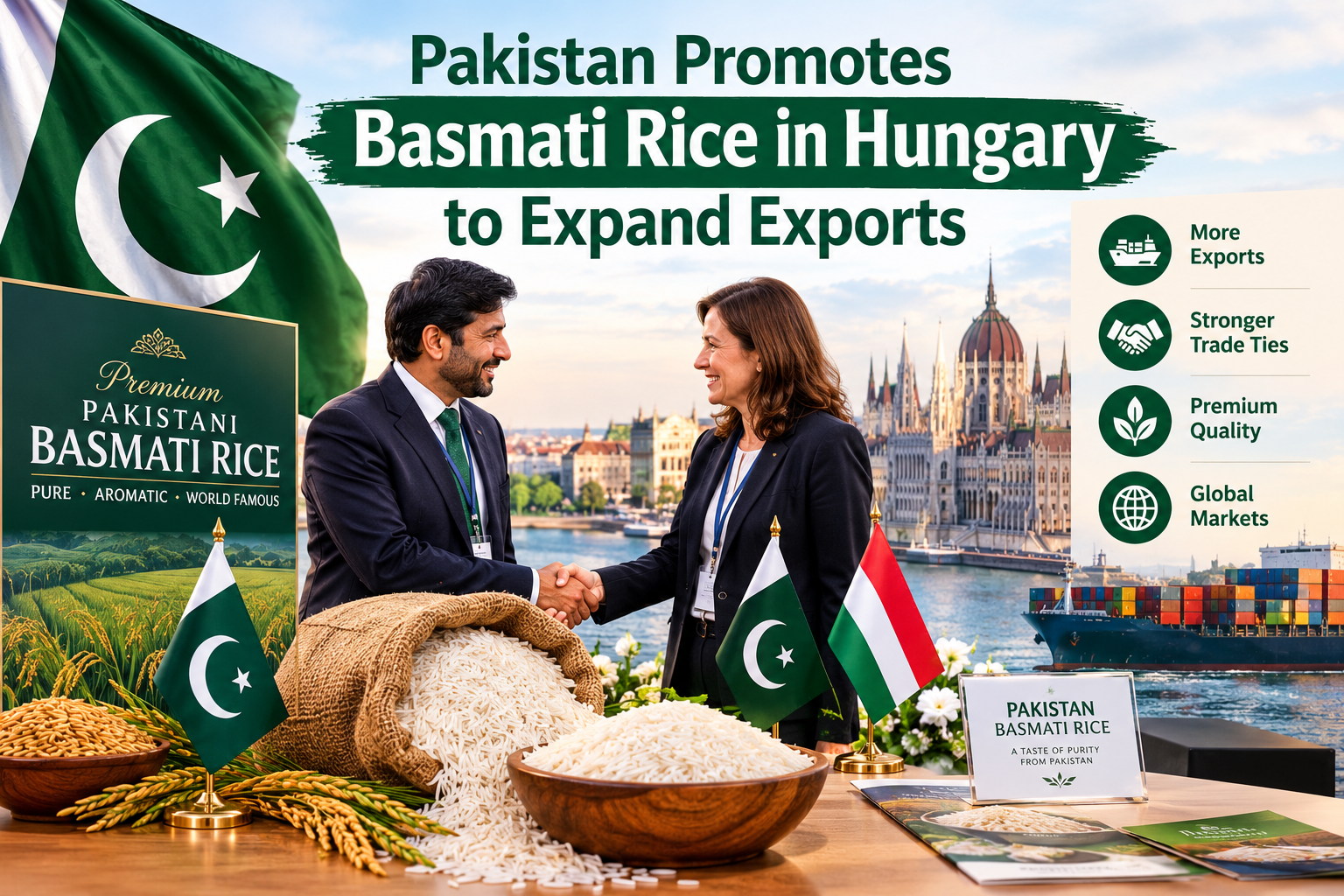
Pakistan is taking new steps to promote its agricultural products in international markets, with basmati rice receiving particular attention as an important export commodity. On October 17, 2026, the Embassy of Pakistan in Hungary hosted the first Pakistan Rice Festival in Budapest to introduce Pakistani basmati rice to Hungarian importers, chefs, food industry professionals, and business representatives.
The festival was organized in collaboration with Pakistan's Ministry of Commerce and the Trade Development Authority of Pakistan. Its primary objective was to introduce Pakistani rice to potential buyers, highlight its distinctive qualities, and explore opportunities to strengthen agricultural trade between Pakistan and Hungary.
Federal Minister for Commerce Jam Kamal Khan welcomed the initiative and emphasized the importance of presenting Pakistani agricultural products directly to international buyers. The event also featured a live biryani cooking demonstration, samples of Pakistani rice, a Hungarian-language recipe booklet, and other Pakistani products, including Himalayan pink salt.
The initiative reflects Pakistan's broader efforts to expand agricultural and food exports, attract investment, and develop commercial relationships in markets beyond its traditional trading partners.
For Pakistan, rice exports are important because they connect farmers, mill owners, exporters, transportation companies, packaging businesses, and international distributors. Expanding access to new markets could create additional opportunities throughout this supply chain.
However, long-term success will depend on more than promotional events. Pakistani exporters must also maintain product quality, offer competitive prices, meet international food safety requirements, and establish reliable relationships with overseas buyers.
The Budapest festival represents an opportunity to introduce Pakistani food products to a new audience and explore whether that interest can develop into sustainable commercial partnerships.
1. Pakistan Organizes Its First Rice Festival in Hungary
The first Pakistan Rice Festival in Hungary was held in Budapest, bringing Pakistani basmati rice directly to representatives of the European food industry.
The event brought together importers, food and agriculture business leaders, Hungarian master chefs, public-sector representatives, and members of the diplomatic community. This combination of participants created an opportunity to introduce Pakistani rice to people involved in purchasing, preparing, distributing, and promoting food products.
The festival was organized through cooperation between the Embassy of Pakistan in Hungary, the Ministry of Commerce, and the Trade Development Authority of Pakistan.
Rather than relying exclusively on conventional advertising, the event allowed participants to experience Pakistani rice through product samples and a live cooking demonstration. This approach can be useful because food buyers often want to understand a product's characteristics before deciding whether to consider it for commercial distribution.
The festival also highlighted the importance of direct communication between exporters and potential customers. Business discussions can help suppliers understand what buyers need, including product specifications, packaging preferences, delivery schedules, and pricing expectations.
Although a promotional event does not automatically guarantee export orders, it can provide a starting point for negotiations and future business relationships.
The next step will be to determine whether interested buyers are willing to place orders and establish regular commercial relationships with Pakistani suppliers.
2. Why Pakistani Basmati Rice Is Important
Basmati rice is one of Pakistan's best-known agricultural export products. It is valued for its distinctive aroma, characteristic long grains, and suitability for a variety of traditional and international dishes.
Rice is also an important part of Pakistan's agricultural economy. Its production supports farmers, agricultural workers, rice mills, traders, exporters, and businesses involved in storage and transportation.
Pakistani basmati rice has an established identity in international food markets. Its reputation provides exporters with an opportunity to promote the product to customers who value quality, consistency, and culinary characteristics.
However, international markets are competitive. Buyers compare products according to price, grain quality, aroma, packaging, availability, and delivery reliability.
For Pakistani exporters, maintaining these characteristics consistently is essential. A product may attract attention during a festival, but repeat orders usually depend on whether the supplier can deliver the expected quality at an acceptable price.
The Budapest festival offered an opportunity to communicate the distinctive qualities of Pakistani basmati rice directly to potential customers.
By presenting the product in a professional setting, Pakistani representatives could encourage buyers to consider its suitability for restaurants, specialty food stores, wholesalers, and other distribution channels.
3. Showcasing the Heritage of Pakistani Basmati Rice
Pakistan's basmati rice has a strong agricultural and culinary identity. Its reputation is connected to the regions in which it is cultivated, traditional farming practices, and the characteristics that distinguish it from other varieties of rice.
At the Budapest event, Pakistan's Ambassador to Hungary, Asif Hussain Memon, discussed the heritage and export potential of Pakistani basmati rice.
The ambassador also highlighted its Geographical Indication protection, which helps distinguish products associated with a particular geographical origin.
Geographical indications can be important in international trade because they help communicate a product's identity and origin. Such recognition may also support efforts to protect its reputation against misleading descriptions and unauthorized use of protected names.
For exporters, a clearly established product identity can become part of a broader marketing strategy. Buyers need to know what they are purchasing, where it comes from, and whether its quality matches the description provided by the supplier.
Nevertheless, product recognition must be supported by effective quality control and accurate documentation. Origin-related protections do not eliminate the need to comply with food safety standards, import regulations, or commercial requirements.
Promoting the heritage of Pakistani basmati rice alongside reliable product information can help exporters build credibility in international markets.
4. Introducing Pakistani Rice to Hungarian Chefs
One of the notable features of the festival was its focus on culinary experience.
Hungarian chefs and food industry professionals were introduced to Pakistani rice through a live cooking demonstration called "The Art of Biryani."
The demonstration was conducted by Pakistan's Trade and Investment Attaché, Shehryar Amjad Qaisrani. It provided participants with an introduction to Pakistani rice and the dishes traditionally prepared with it.
Food demonstrations can help international audiences understand how an unfamiliar ingredient can be incorporated into their own cooking practices.
For chefs, the performance of rice during preparation is important. Grain separation, aroma, texture, cooking time, and consistency can influence whether a particular variety is suitable for a restaurant's menu.
A cooking demonstration allows these characteristics to be experienced more directly than a written product description alone.
Pakistani biryani also provides a way to introduce the country's culinary traditions. Its combination of rice, spices, herbs, and other ingredients can help visitors understand the versatility of Pakistani rice.
However, Hungarian consumers may have different tastes and food preferences. Exporters and distributors would need to understand local demand before deciding which varieties, package sizes, and marketing approaches are most appropriate.
Introducing the product through familiar culinary settings could help make Pakistani rice more accessible to potential buyers.
5. Himalayan Pink Salt Also Receives Attention
The festival was not limited to basmati rice. Other Pakistani products, including Himalayan pink salt, were also displayed for participants.
Himalayan pink salt is associated with Pakistan's mineral resources and is sold in several international markets for culinary and other commercial uses.
Displaying complementary products alongside rice allowed participants to learn about more than one category of Pakistani goods during the same event.
This approach can be valuable because importers and distributors may be interested in developing relationships with suppliers offering several products that fit their business needs.
For example, a specialty food distributor may evaluate rice alongside salt and other packaged food products. A wider selection can create opportunities for additional commercial discussions, although each product must be assessed independently.
Exporters must also recognize that different products have different requirements. Food products may require specific labeling, packaging, testing, and documentation depending on the destination market and their intended use.
The inclusion of Himalayan pink salt helped present a broader picture of Pakistan's food-related export potential.
6. Hungarian-Language Recipe Book Promotes Pakistani Cuisine
Another feature of the event was the distribution of a short recipe booklet written in Hungarian.
The booklet contained a selection of rice-based dishes and was designed to encourage participants to try preparing Pakistani rice in their own kitchens.
Language can play an important role in international product promotion. Information presented in a buyer's local language is often easier to understand and share with colleagues, customers, and other interested consumers.
A recipe booklet also serves a practical purpose. It gives potential customers ideas for using a product instead of simply describing its general characteristics.
For Pakistani rice exporters, recipes can help demonstrate that basmati rice is suitable for different culinary applications. Although biryani is an important example, rice can also be used in pilafs, side dishes, rice bowls, and other preparations.
The booklet could therefore support product awareness beyond the event itself.
Nevertheless, marketing materials are most effective when accompanied by accessible product information, consistent supply, and competitive commercial terms.
The distribution of samples and recipes created an opportunity for participants to evaluate Pakistani rice after returning to their businesses or homes.
7. Opportunities for Pakistan's Agricultural Exporters
The Budapest festival reflects an effort to connect Pakistani agricultural products with buyers in markets that may offer opportunities for future growth.
Pakistan's agricultural sector includes rice, fruits, vegetables, processed foods, and other products that may appeal to international consumers.
However, different products face different market conditions. Exporters need to identify products for which they can meet buyer expectations regarding quality, price, delivery, and regulatory compliance.
Expanding Rice Exports
Rice exporters can use trade events to introduce products, arrange meetings, and identify potential distributors.
If discussions lead to commercial orders, businesses may have opportunities to expand production, improve packaging, and develop additional customer relationships.
However, increased export activity depends on actual demand rather than promotional visibility alone.
Exporters must calculate production and transportation costs carefully to ensure that international orders remain commercially viable.
Developing Value-Added Products
Pakistan may also explore opportunities in processed and packaged food products.
Value-added products can include carefully packaged rice, ready-to-cook ingredients, and other foods designed for particular customer groups.
Such products may require additional investment in processing, packaging, testing, and marketing. Companies should evaluate consumer demand before making major investments.
Supporting Smaller Exporters
Smaller agricultural businesses may have strong products but limited experience with international buyers.
Business associations and government-supported trade initiatives can help these companies understand market requirements and develop professional networks.
Practical assistance with export documentation, pricing, packaging, and buyer communication can be particularly valuable.
The long-term objective should be to help businesses develop dependable export relationships rather than relying on occasional promotional events.
8. Benefits for Pakistani Farmers and Rural Communities
Agricultural exports connect international markets with rural communities across Pakistan.
Farmers produce the crops that enter the supply chain, while rice mills, traders, storage facilities, transport operators, and exporters help prepare and deliver products to customers.
If demand for Pakistani rice grows and exporters secure sustainable orders, the resulting activity could create opportunities across these different stages.
Higher and more dependable demand may encourage some businesses to invest in better storage, processing, and quality-control systems.
However, the benefits for farmers depend on several factors, including production costs, crop yields, purchasing arrangements, market prices, and the distribution of profits throughout the supply chain.
Export growth does not automatically guarantee higher incomes for every farmer.
For agricultural trade to support rural development effectively, businesses need transparent purchasing arrangements and reliable payment practices. Farmers also benefit from access to suitable seeds, technical advice, storage facilities, and accurate market information.
A stronger export sector could provide additional opportunities, but sustainable agricultural development requires attention to the entire production and distribution system.
9. Challenges in Entering European Food Markets
European markets can offer opportunities for food exporters, but entering them requires careful preparation.
Businesses must understand the relevant import regulations, food safety requirements, labeling rules, and documentation procedures.
Food Safety and Quality
Food products must meet the applicable standards of their destination markets.
Exporters should maintain suitable hygiene practices, quality-control procedures, and traceability systems. Buyers may also request information about production methods, testing, packaging, and product consistency.
Failure to meet the required standards can result in delays, additional expenses, or rejected shipments.
Competitive Pricing
Pakistani exporters must compete with suppliers from other countries.
Buyers generally consider the total cost of obtaining a product, including its purchase price, transportation, insurance, handling, and other relevant expenses.
A high-quality product may still struggle to attract orders if its final cost is significantly above that of comparable alternatives.
Exporters therefore need to understand both their own costs and the prices offered by competing suppliers.
Transportation and Delivery
International food shipments require dependable logistics.
Rice is less perishable than many fresh agricultural products, but exporters still need appropriate storage, moisture control, packaging, and protection against contamination.
Reliable transportation and accurate delivery schedules help businesses build trust with importers.
Building Consumer Awareness
A product's reputation in one country does not necessarily mean that consumers in another country already recognize it.
Promotional campaigns, cooking demonstrations, product samples, and cooperation with local distributors can help introduce Pakistani rice to new audiences.
However, building brand recognition takes time and requires consistent communication.
10. Hungary as a Potential Market for Pakistani Food Products
Hungary's participation in the festival provided Pakistani representatives with an opportunity to introduce basmati rice to a European business audience.
Potential customers may include food importers, wholesalers, specialty retailers, restaurants, and businesses supplying ingredients to the hospitality sector.
Each category has different requirements.
Restaurants may prioritize cooking performance and dependable supply. Retailers may focus on packaging, shelf presentation, product labeling, and customer demand. Wholesalers may place greater emphasis on pricing, order quantities, and delivery schedules.
Understanding these differences would help Pakistani exporters tailor their commercial proposals to specific buyers.
Hungary could also serve as a market in which Pakistani businesses learn more about European customer expectations and distribution practices.
However, it would be premature to assume that the festival has already produced substantial sales or established a long-term market for Pakistani rice.
Commercial success would need to be demonstrated through actual orders, repeat purchases, and sustained relationships between suppliers and buyers.
11. The Role of Government and Trade Organizations
Government institutions and trade organizations can help exporters identify opportunities and overcome barriers to international business.
The Ministry of Commerce and the Trade Development Authority of Pakistan have roles in supporting export promotion and developing commercial relationships with international markets.
Pakistan's diplomatic missions can also help introduce local businesses to Pakistani products, organize promotional events, and facilitate communication between companies.
Trade Promotion
Trade festivals and exhibitions allow exporters to present their products directly to potential buyers.
They also provide an opportunity to gather feedback about product quality, packaging, prices, and consumer preferences.
This information can help businesses make better decisions about market entry.
Business Networking
Business meetings can connect exporters with importers, distributors, retailers, and other commercial partners.
For these connections to become valuable, companies need to follow up after events, provide requested information, and negotiate clear commercial terms.
Practical Support
Exporters may need guidance on documentation, regulatory requirements, product testing, shipping, and payment arrangements.
Accessible and accurate information can reduce uncertainty, particularly for small and medium-sized businesses entering a new market for the first time.
Government support is most effective when it helps companies overcome practical barriers and measure commercial results.
12. FoodAg 2026 Could Provide Further Opportunities
Participants at the Budapest festival were invited to attend FoodAg 2026, Pakistan's international food and agriculture exhibition scheduled to take place at the Expo Centre in Karachi from November 23 to 26, 2026.
The exhibition offers a potential opportunity for international buyers to meet Pakistani suppliers and learn more about the country's agricultural and food industries.
For foreign importers, such events can make it easier to compare products, discuss commercial requirements, and establish direct relationships with manufacturers and exporters.
For Pakistani businesses, international participation can provide exposure to new markets and help them understand the needs of potential customers.
Companies interested in attracting overseas buyers should prepare product specifications, samples where appropriate, pricing information, production details, and clear export terms.
The value of an exhibition depends not only on attendance but also on the quality of the business connections it generates.
Follow-up negotiations, product assessments, and reliable delivery arrangements are necessary to turn initial interest into commercial transactions.
13. How Pakistani Exporters Can Strengthen Their International Position
The Budapest festival demonstrates one approach to promoting Pakistani agricultural products. Continued progress will require businesses to combine marketing with strong operational performance.
Maintain Consistent Quality
Buyers need products that meet agreed specifications from one shipment to the next.
Exporters should maintain appropriate quality-control systems and communicate clearly about product varieties, packaging, and handling.
Research Target Markets
Businesses should study consumer preferences, competing products, import regulations, and distribution costs before entering a new market.
Careful research can help companies identify customers whose requirements match their products.
Build Reliable Partnerships
Long-term commercial relationships depend on trust, timely communication, accurate documentation, and dependable delivery.
Exporters should evaluate potential partners and establish clear contracts before accepting significant orders.
Invest in Packaging and Presentation
Packaging can influence product protection, storage, transport, and consumer understanding.
Exporters should ensure that packaging meets relevant legal requirements and communicates accurate product information.
Measure Commercial Results
The success of an export initiative should be evaluated through concrete outcomes.
Useful indicators include inquiries from qualified buyers, trial orders, completed shipments, repeat purchases, and the development of sustainable distribution relationships.
These measures can help businesses identify which promotional activities generate real economic value.
14. What the Festival Means for Pakistan's Economy
Agricultural exports can contribute to economic activity by generating business for farmers, processors, manufacturers, transport companies, and exporters.
When companies successfully sell products abroad, they may generate additional revenue and create opportunities to invest in production capacity and improved technology.
Diversifying export markets can also reduce dependence on a limited number of customers or destinations.
However, the benefits depend on profitability, stable demand, and the ability to deliver products consistently.
Exporters must account for production expenses, transportation, exchange-rate movements, payment risks, and changing international market conditions.
The government and business community can support exporters by improving access to market information, encouraging quality improvements, and promoting transparent commercial practices.
The Budapest festival is a promotional initiative, not proof of a particular increase in export revenue. Its longer-term economic significance will depend on whether it leads to commercial agreements and sustained demand.
15. The Future of Pakistani Basmati Rice in Europe
The future of Pakistani basmati rice in European markets will depend on product quality, consumer awareness, competitive pricing, regulatory compliance, and dependable supply chains.
The Budapest festival created an opportunity to introduce the product to Hungarian importers, chefs, and food industry professionals.
The cooking demonstration, rice samples, recipe booklet, and presentation of other Pakistani products helped participants learn about the country's agricultural and culinary offerings.
To build on this initial exposure, exporters will need to maintain contact with potential buyers and respond to their commercial requirements.
Some buyers may seek trial shipments before placing larger orders. Others may need additional information about product specifications, packaging, delivery schedules, and pricing.
Exporters should treat these discussions as opportunities to understand demand rather than assume that every interested participant will become a customer.
If the initiative leads to repeat orders and dependable business relationships, it could contribute to a stronger presence for Pakistani rice in the Hungarian market.
Success in one market may also provide useful lessons for promoting Pakistani agricultural products in other countries.
Conclusion
Pakistan's first Rice Festival in Hungary represents an effort to introduce Pakistani basmati rice to European buyers and explore opportunities for expanding agricultural exports.
The event brought together food importers, business leaders, chefs, and representatives of public institutions in Budapest. Through a live biryani demonstration, product samples, and a Hungarian-language recipe booklet, participants were introduced to the characteristics and culinary uses of Pakistani rice.
The presentation of Himalayan pink salt also highlighted the wider range of Pakistani food products that could interest international buyers.
For Pakistan, the initiative offers an opportunity to promote its agricultural strengths, support exporters, and develop relationships in markets beyond its traditional destinations.
Nevertheless, long-term success will depend on practical commercial results. Competitive pricing, consistent quality, reliable transportation, compliance with food safety rules, and dependable payment arrangements will remain essential.
Farmers, rice processors, exporters, and related businesses could benefit if promotional efforts lead to sustainable demand and profitable trade.
FoodAg 2026 may provide another opportunity to connect international buyers with Pakistani suppliers and continue these discussions.
Ultimately, the festival's significance will be measured by its ability to generate lasting business relationships and help Pakistani agricultural products reach more consumers around the world.
FAQs
1. What was the Pakistan Rice Festival in Hungary?
It was an event held in Budapest on October 17, 2026, to introduce Pakistani basmati rice to Hungarian importers, chefs, and food industry professionals.
2. Who organized the festival?
The Embassy of Pakistan in Hungary organized the event in collaboration with the Ministry of Commerce and the Trade Development Authority of Pakistan.
3. What activities took place at the festival?
The event featured a live biryani cooking demonstration, samples of Pakistani rice, a Hungarian-language recipe booklet, and the presentation of other Pakistani products, including Himalayan pink salt.
4. How could the festival benefit Pakistani farmers and exporters?
If the event leads to sustained demand and commercial orders, it could create opportunities for farmers, rice mills, exporters, packaging businesses, and transportation providers.
5. What challenges must Pakistani rice exporters overcome?
Exporters must address competitive pricing, international food safety requirements, transportation costs, product quality, market awareness, and reliable relationships with foreign buyers.
Fix the missing section numberReduce repeated export explanations