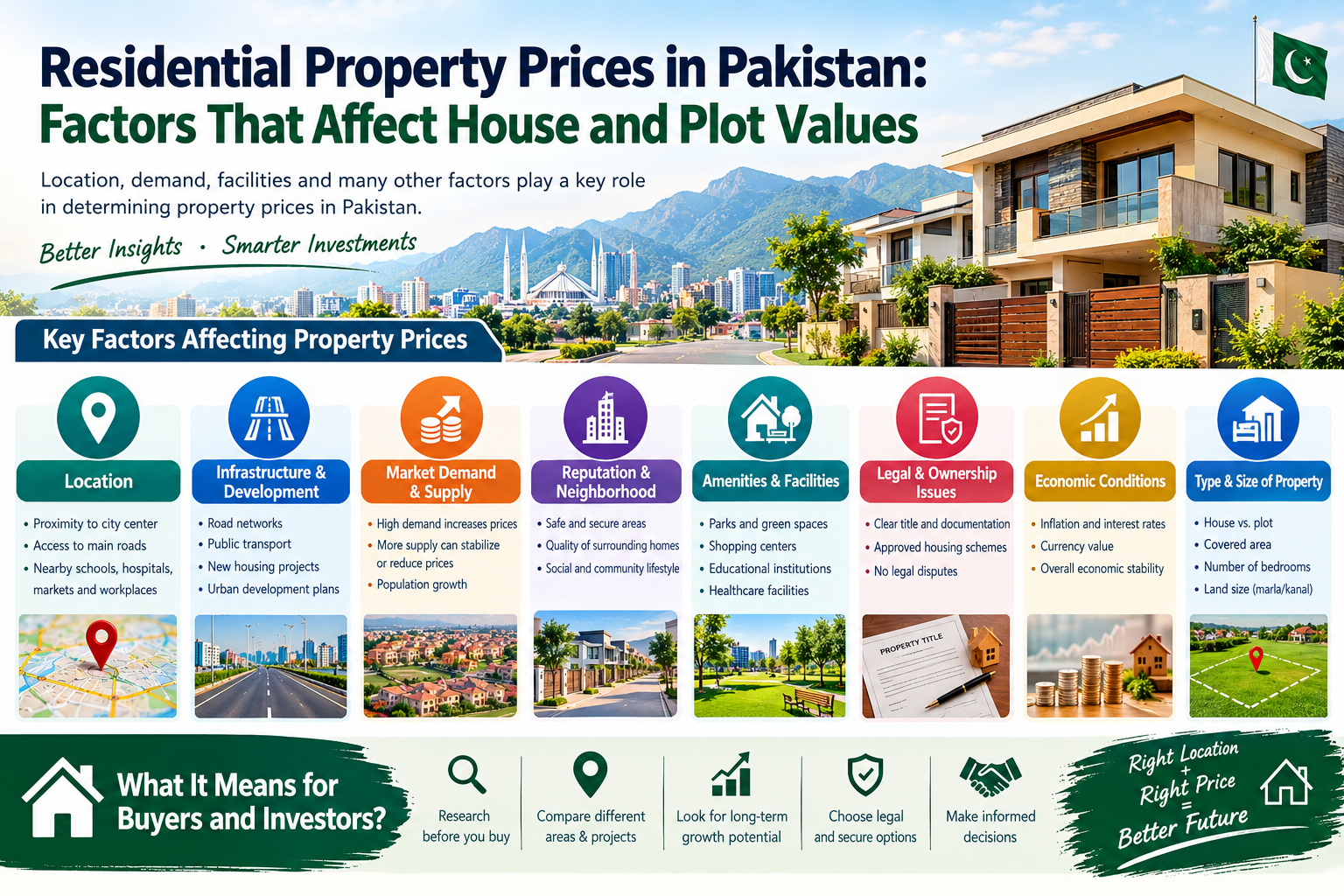
Residential property is one of the most important parts of Pakistan's real estate market. People buy houses and plots for different reasons, including personal living, family needs, rental income, and long-term investment. However, residential property prices in Pakistan are not the same everywhere. Prices can change significantly from one city, neighborhood, housing society, or street to another.
A house in a developed urban area may have a very different price from a similar-sized house in a developing locality. Likewise, two plots with the same dimensions may have different values because of their location, road access, development status, and surrounding facilities.
Understanding the factors that affect residential property prices can help buyers, sellers, and investors make better-informed decisions. This guide explains the major elements that influence house and plot values in Pakistan.
Understanding Residential Property Prices in Pakistan
Residential property prices are influenced by a combination of economic, geographical, social, and property-specific factors.
The major factors include:
Location
Plot size
Covered area
Construction quality
Road access
Development level
Availability of utilities
Nearby facilities
Demand and supply
Population growth
Infrastructure development
Property documentation
Market conditions
Rental demand
Future development potential
No single factor determines the value of every property.
1. Location Is a Major Price Factor
Location is one of the most important factors affecting residential property prices.
A property located in a well-developed and accessible neighborhood can have a higher market value than a similar property in a less developed area.
Important location factors include:
Distance from major roads
Accessibility
Nearby markets
Schools
Hospitals
Public transport
Parks
Commercial areas
Employment centers
Overall neighborhood development
For many buyers, convenience is an important part of property value.
2. City-Wise Differences in Property Prices
Residential property markets differ between Pakistani cities.
Lahore
Lahore has a large residential property market containing traditional neighborhoods, private housing societies, apartments, and newly developing areas.
Prices can vary considerably depending on location, accessibility, development, and property type.
Karachi
Karachi has a diverse residential market ranging from apartments to houses in different parts of the city. Population size, employment opportunities, commercial activity, and accessibility influence residential demand.
Islamabad
Islamabad's residential market includes houses, apartments, plots, and planned sectors. Location, sector development, road access, and proximity to important facilities can influence property values.
Rawalpindi
Rawalpindi has a wide range of residential properties. Its connection with Islamabad and established urban areas can influence demand in different localities.
Faisalabad
Faisalabad has an important residential market supported by its population, industrial activity, commercial areas, and expanding urban development.
Multan
Multan's residential property market includes established neighborhoods and developing housing areas. Infrastructure and urban expansion can influence values.
Peshawar
Peshawar has a diverse housing market where location, accessibility, security considerations, infrastructure, and local demand can affect property prices.
Gujranwala and Sialkot
Both cities have active residential markets influenced by population growth, business activity, local employment, and expanding housing developments.
The important point is that city-level comparisons alone are not enough. Property prices can vary significantly within the same city.
3. Plot Size Affects Value
Plot size is another major factor.
Common residential plot categories can include different sizes depending on the area and housing scheme.
Generally, a larger plot requires a larger investment, but size alone does not determine its market value.
For example, a smaller plot in a highly desirable location may have greater market demand than a larger plot in a less developed area.
Therefore, buyers should consider both:
Plot size + Location
rather than focusing on size alone.
4. Covered Area and House Size
For constructed houses, covered area is an important consideration.
A house with a larger covered area may have a different value from another house on the same plot size.
Covered area can include:
Bedrooms
Bathrooms
Kitchen
Living rooms
Dining area
Garage
Store rooms
Other constructed spaces
However, the quality and condition of the construction also matter.
5. Construction Quality
Construction quality can significantly affect the value of a house.
Buyers often consider:
Building structure
Flooring
Doors
Windows
Electrical wiring
Plumbing
Kitchen fittings
Bathroom fittings
Ceiling condition
Roof condition
Finishing quality
A well-maintained house may attract more buyers than a property requiring extensive repairs.
6. Age of the Property
The age of a house can affect its market value.
Newer houses may have modern layouts, updated fittings, and newer infrastructure.
Older houses may require:
Renovation
Repainting
Plumbing work
Electrical upgrades
Roof repairs
Bathroom renovation
Kitchen renovation
However, an older house in a highly desirable location can still have strong market value.
Therefore, age should always be considered together with location and condition.
7. Road Width and Accessibility
Road access can influence residential property prices.
A property located on a wider and easily accessible road may attract more interest than a similar property on a narrow or difficult-to-access street.
Important factors include:
Street width
Main road access
Traffic conditions
Parking availability
Public transport
Distance from major routes
Corner properties and properties with better access may also have different market values.
8. Corner Location
A corner plot or corner house can have characteristics that make it attractive to certain buyers.
Possible advantages include:
More visibility
Additional access
Better ventilation
Multiple road-facing sides
Different design possibilities
However, the value of a corner property depends on the location and local market.
9. Availability of Utilities
Utilities are essential for residential living.
Property prices can be affected by the availability and reliability of:
Electricity
Water
Gas where available
Sewerage
Drainage
Internet services
A developed property without reliable basic services may face weaker demand compared with a property offering better infrastructure.
10. Development Level of the Area
Development status is particularly important in new housing societies.
Buyers often consider whether an area has:
Developed roads
Street lighting
Water supply
Sewerage
Electricity
Parks
Schools
Commercial areas
Security
Public transport
A developing area may have lower prices than an established area, although future development can influence demand.
11. Housing Society Reputation
Housing societies can have different levels of demand.
Factors that may influence buyer interest include:
Management
Infrastructure
Security
Maintenance
Development
Community facilities
Accessibility
Legal and approval status
Before purchasing a property in a housing society, buyers should verify the relevant legal and regulatory status.
12. Legal and Documentation Status
Clear documentation is an important part of property value.
Buyers generally prefer properties with properly documented ownership.
Potential concerns include:
Ownership disputes
Unclear ownership history
Missing documents
Unauthorized construction
Transfer problems
Court disputes
Unresolved claims
A property with unclear legal status may create difficulties during resale.
13. Demand and Supply
Like many markets, residential property values are influenced by demand and supply.
When many buyers are interested in a limited number of properties, sellers may have greater negotiating power.
When available properties exceed buyer demand, sellers may face more competition.
Demand can be affected by:
Population growth
Employment opportunities
New infrastructure
Migration
Education facilities
Business activity
Rental demand
14. Population Growth
Population growth can increase demand for residential properties.
As cities expand, more people need:
Houses
Apartments
Plots
Rental accommodation
This can contribute to increased demand in areas where residential development is expanding.
However, population growth does not automatically guarantee that every property will increase in value. Location, infrastructure, affordability, and demand quality remain important.
15. Infrastructure Development
Infrastructure can have a strong influence on residential property markets.
Examples include:
New roads
Road widening
Bridges
Public transport
Schools
Hospitals
Commercial centers
Industrial developments
Improved connectivity can make previously less accessible areas more attractive to residents and businesses.
16. Nearby Schools and Universities
Families often consider education facilities when choosing a home.
A property located near schools, colleges, or universities may attract buyers who want convenient access to education.
This can also influence rental demand among families and students, depending on the location and type of property.
17. Healthcare Facilities
Hospitals, clinics, pharmacies, and other healthcare facilities can also influence residential demand.
Families often prefer neighborhoods where healthcare services are reasonably accessible.
18. Shopping and Commercial Facilities
Access to markets and commercial areas can increase convenience.
Residents generally need access to:
Grocery stores
Pharmacies
Banks
Restaurants
Clothing shops
Supermarkets
Repair services
Other daily necessities
However, buyers may also prefer some distance from extremely crowded commercial areas because of noise and traffic.
19. Parks and Green Spaces
Parks and open spaces can make residential neighborhoods more attractive.
Families with children may particularly value access to safe recreational areas.
Housing developments with properly maintained parks and community spaces may attract greater interest from some buyers.
20. Security and Neighborhood Environment
Security is an important consideration for many Pakistani families.
Buyers may consider:
Gated entry
Street lighting
Security arrangements
Neighborhood activity
Traffic
General environment
A property's surrounding environment can affect both demand and buyer preferences.
21. Rental Demand
Rental demand can influence residential property values.
Properties near:
Universities
Business districts
Industrial areas
Hospitals
Major employment centers
Commercial markets
may attract tenants depending on local conditions.
A property with good rental demand can be attractive to buyers interested in rental income.
22. Rental Income and Property Value
Investors sometimes compare the expected rental income of a property with its purchase price.
A simple rental yield calculation is:
Rental Yield = Annual Rent ÷ Property Value × 100
For example, if a property generates Rs. 600,000 in annual rent and its value is Rs. 10,000,000:
Rental Yield = 600,000 ÷ 10,000,000 × 100 = 6%
This calculation provides a basic way to compare rental performance.
However, investors should also consider maintenance, vacancies, taxes, repairs, and other expenses.
23. Economic Conditions
Broader economic conditions can influence property markets.
Factors can include:
Inflation
Interest rates
Construction costs
Employment
Household income
Financing availability
Consumer confidence
When construction materials become more expensive, the cost of building houses can increase.
24. Construction Material Costs
The cost of construction can influence house prices.
Important materials include:
Cement
Steel
Bricks
Sand
Tiles
Wood
Paint
Electrical equipment
Plumbing materials
Labor costs also contribute to construction expenses.
When construction costs rise, the replacement or construction cost of residential properties can also change.
25. Interest Rates and Financing
Some buyers purchase property using financing or housing loans.
Changes in financing costs can influence affordability.
When borrowing becomes more expensive, some buyers may postpone purchases or choose less expensive properties.
When financing becomes more accessible, demand can change.
26. Inflation
Inflation affects both household purchasing power and construction costs.
When prices of goods and services rise, construction and maintenance can become more expensive.
However, property prices do not necessarily move at the same rate as inflation in every location.
27. Overseas Pakistani Demand
Overseas Pakistanis are an important part of the property market.
Some overseas buyers purchase:
Houses
Apartments
Plots
Rental properties
Family homes
Demand from overseas buyers can be particularly relevant in cities and housing developments with strong connections to expatriate communities.
28. Commercial Activity Near Residential Areas
Business activity can influence residential property demand.
Employment centers and commercial areas can attract people who prefer living nearby to reduce travel time.
However, extremely busy commercial activity can also create:
Traffic
Noise
Parking problems
Congestion
Therefore, the exact location matters.
29. Future Development Potential
Some buyers consider the future development of an area.
Potential indicators can include:
Planned roads
New commercial areas
Educational institutions
Healthcare facilities
Industrial projects
Transport improvements
Population growth
However, buyers should distinguish between officially planned projects and unverified claims.
30. Property Taxes and Government Policies
Government policies related to property transactions, taxes, documentation, and development can influence the market.
Tax rules may change over time, so buyers and investors should verify current requirements before completing a transaction.
House Prices vs Plot Prices
House and plot prices are influenced by some common factors but also have important differences.
Plot Prices
Plot values are often influenced by:
Location
Size
Development
Road position
Society status
Infrastructure
Future potential
House Prices
House values depend on:
Plot size
Covered area
Construction quality
Age
Condition
Location
Layout
Facilities
A buyer should therefore compare similar properties rather than simply comparing a house with a plot.
How Buyers Can Compare Property Prices
A buyer can create a simple comparison list.
Factor | Property A | Property B | Property C |
|---|---|---|---|
Location | |||
Plot size | |||
Covered area | |||
Asking price | |||
Construction | |||
Road access | |||
Utilities | |||
Documentation | |||
Nearby facilities | |||
Rental demand |
This can help buyers identify important differences between properties.
How Sellers Can Estimate a Reasonable Asking Price
Sellers should avoid setting a price based only on personal expectations.
They can research:
Similar properties
Recent local listings
Property size
Construction condition
Location
Road position
Facilities
Demand
Market activity
A professional valuation may also be useful for certain transactions.
Common Mistakes When Evaluating Property Prices
Focusing Only on Price
A cheaper property is not necessarily better if it has poor documentation or location.
Comparing Different Locations
A property should preferably be compared with similar properties in the same or comparable areas.
Ignoring Construction Condition
Repair and renovation costs can change the actual cost of a house.
Believing Every Future Development Claim
Buyers should verify development claims rather than relying only on advertisements.
Ignoring Legal Status
Documentation problems can affect both current ownership and future resale.
Forgetting Additional Costs
Taxes, transfer charges, repairs, and renovation can increase the total cost.
Tips for Buyers
Before purchasing residential property in Pakistan:
Research the area carefully.
Compare several properties.
Visit the property personally.
Check construction quality.
Verify ownership.
Review property documents.
Check development status.
Consider nearby facilities.
Estimate all additional expenses.
Consider future resale needs.
Avoid rushing because of seller pressure.
Seek professional advice for complicated transactions.
Tips for Investors
Property investors should consider more than expected price growth.
Evaluate:
Rental demand
Purchase price
Rental income
Maintenance expenses
Vacancy risk
Legal documentation
Location
Development
Resale market
Investment timeframe
An investment decision should be based on the investor's own financial circumstances and objectives.
The Importance of Long-Term Planning
Residential property is generally a significant financial commitment.
Before purchasing, buyers should think about their future needs.
For a family, this could include:
Children's education
Workplace distance
Family expansion
Healthcare access
Transportation
Neighborhood facilities
For investors, long-term considerations can include:
Rental demand
Property maintenance
Resale possibilities
Future development
Holding period
Conclusion
Residential property prices in Pakistan are influenced by many factors, and no single factor can explain the value of every house or plot. Location, size, construction quality, development, accessibility, utilities, nearby facilities, demand, documentation, and economic conditions all play a role.
Buyers should compare similar properties, inspect houses carefully, verify ownership documents, and research the surrounding area before making a decision. Investors should also consider rental demand, maintenance costs, resale possibilities, and their own financial objectives.
Understanding these factors can help buyers and investors evaluate residential properties more carefully and avoid making decisions based only on advertisements or asking prices.
FAQs
1. What is the biggest factor affecting residential property prices in Pakistan?
Location is one of the most important factors, but property value also depends on size, development, construction quality, accessibility, and demand.
2. Does plot size determine property value?
Plot size is important, but location and development can have a major effect on the overall value of a plot.
3. Do nearby schools and hospitals affect property prices?
Yes. Easy access to schools, hospitals, markets, transportation, and other facilities can increase the attractiveness of a residential area.
4. How does construction quality affect house prices?
Good construction, modern facilities, proper maintenance, and fewer repair requirements can make a house more attractive to buyers.
5. Can future development increase property value?
Future development can influence demand, but buyers should verify whether proposed projects are officially planned rather than relying only on advertisements or informal claims.