Introduction
Electronics are now a major part of modern life in Pakistan. People use electronic devices at home, in schools, offices, hospitals, shops, factories, and businesses. Many activities that once required significant time and physical effort can now be completed quickly with the help of electronic technology.
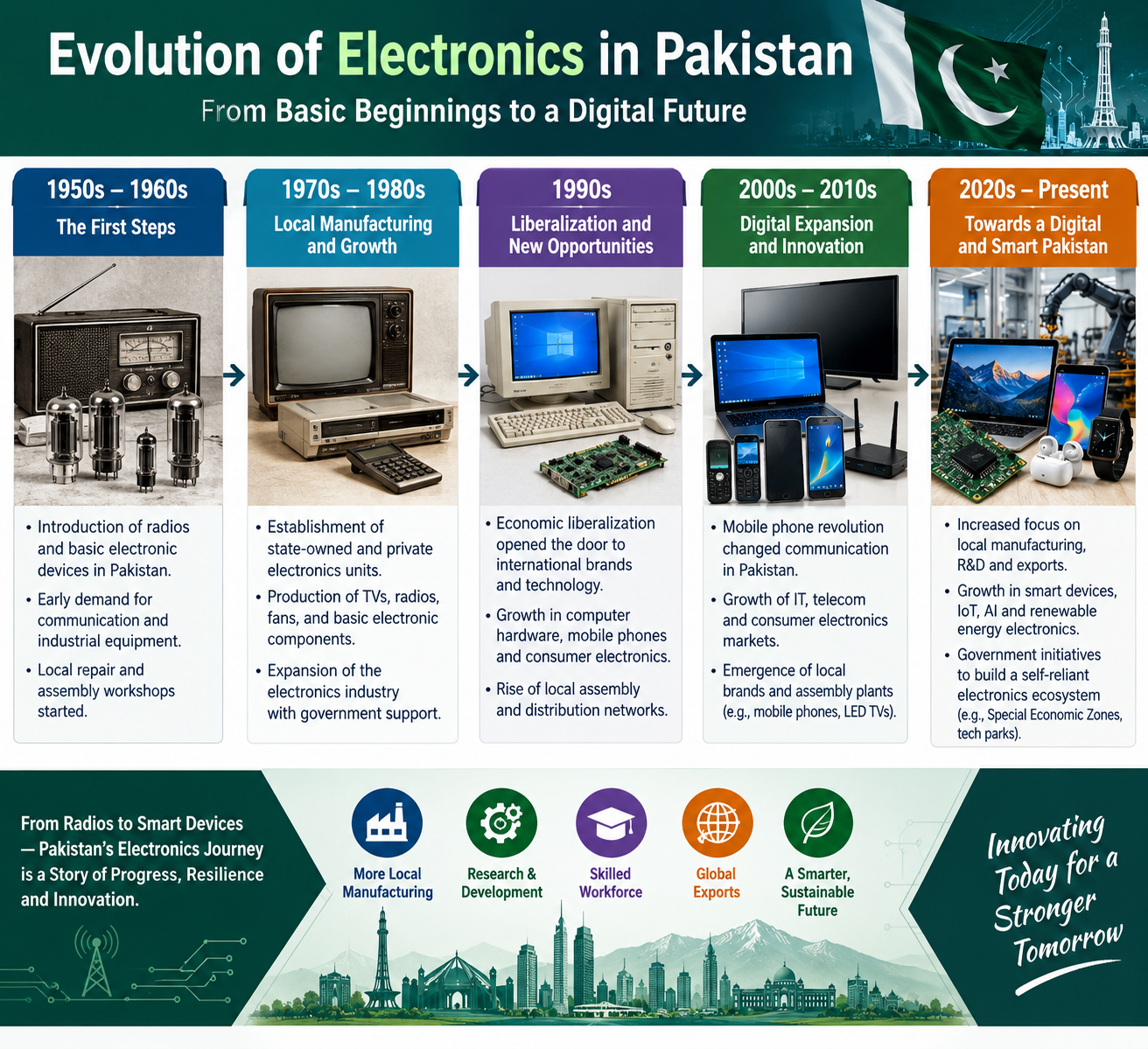
The journey of electronics in Pakistan has developed over many decades. In earlier times, electronic devices were limited and were mainly used for communication and entertainment. Radios, black-and-white televisions, tape recorders, and basic telephones were common examples. These devices were valuable because they connected people with information and entertainment.
With the development of technology, electronic devices became smaller, faster, more powerful, and easier to use. Color televisions replaced older television sets, cassette players developed into CDs and digital music players, and traditional telephones gradually gave way to mobile phones. Today, smartphones can perform many functions that once required several separate devices.
The evolution of electronics is not only about new products. It is also about changes in the way people live and work. Internet-connected devices have made communication faster, digital education more accessible, and many business activities easier. In Pakistan, this transformation continues as more people adopt smart and connected technologies.
Early Electronics in Pakistan
The early development of electronics in Pakistan was strongly connected with communication and entertainment. Radio was one of the most important electronic devices for households. It allowed people to listen to news, educational programs, music, and other broadcasts.
Television later became an important source of information and entertainment. In many Pakistani homes, television became a central household device. Families gathered to watch news, dramas, sports, educational programs, and other broadcasts.
During this period, electronic devices were generally larger than today's products. They could also be expensive to purchase and maintain. Repairs were often carried out by local technicians who developed practical skills in electronics.
Tape recorders and cassette players were also popular. People used them to listen to music, speeches, educational recordings, and religious content. These devices represent an important stage in the development of consumer electronics in Pakistan.
The Growth of Telecommunication
Telecommunication played a major role in changing the electronics landscape of Pakistan. Traditional landline telephones provided voice communication between homes, offices, and businesses. However, mobile communication eventually transformed the way people communicated.
Mobile phones became increasingly common because they offered greater convenience. People no longer needed to remain at a fixed location to communicate with others. As mobile technology developed, phones gained cameras, internet access, messaging applications, GPS, music players, and many other features.
The smartphone created an even bigger change. A modern smartphone can function as a telephone, camera, video player, calculator, map, digital wallet, learning tool, and communication device. This development shows how several separate technologies can become integrated into one small electronic product.
For Pakistani consumers, smartphones have become important for both personal and professional activities. Students can use them for online learning, while businesses can use them for communication, marketing, customer service, and digital payments.
The Rise of Computers in Pakistan
Computers are another major part of the evolution of electronics in Pakistan. Earlier computers were large, expensive, and mainly used by organizations with specialized needs. Over time, computers became smaller, more affordable, and more powerful.
Desktop computers became common in educational institutions, offices, businesses, and homes. Later, laptops provided greater mobility and convenience. People could carry their computers to schools, universities, workplaces, and other locations.
The spread of computers also contributed to the growth of information technology in Pakistan. Students began learning programming, graphic design, database management, web development, and other computer-related skills.
Businesses also adopted computers for accounting, record keeping, communication, inventory management, and office work. This created demand for computer operators, software developers, technicians, IT professionals, and other skilled workers.
Electronics and Education
Electronics have significantly changed education in Pakistan. Traditional classrooms mainly depended on textbooks, blackboards, notebooks, and face-to-face teaching. Today, teachers and students can also use computers, projectors, tablets, smartphones, digital boards, and online educational platforms.
Digital resources can make learning more flexible. Students can watch educational videos, access online books, search for information, and communicate with teachers through digital platforms.
Electronic calculators and computers are particularly useful for subjects such as mathematics, physics, computer science, engineering, and accounting. Students can use specialized software to understand difficult concepts and practice different types of problems.
During periods when physical access to educational institutions is difficult, electronic devices can also support remote learning. This has increased awareness of the importance of internet connectivity and digital devices in education.
However, technology works best when it supports good teaching rather than completely replacing teachers. Students still need guidance, critical thinking, discipline, and interaction with educators.
The Development of Home Appliances
Electronics have also transformed Pakistani homes. Traditional household activities increasingly use electrical and electronic appliances that save time and provide convenience.
Refrigerators, washing machines, microwave ovens, air conditioners, televisions, electric ovens, water dispensers, and vacuum cleaners are examples of household technology.
Modern appliances increasingly include digital controls and automatic functions. For example, washing machines can offer different washing programs, while air conditioners can use electronic sensors and digital temperature controls.
The introduction of smart appliances is another step in this development. Some modern appliances can connect to smartphones or home networks, allowing users to monitor or control certain functions digitally.
This transformation has made electronic knowledge more relevant to ordinary households. Consumers increasingly need to understand features, energy use, maintenance requirements, warranties, and safe operation before purchasing appliances.
Smart TVs and Digital Entertainment
Entertainment technology has changed dramatically in Pakistan. Traditional television broadcasting has expanded into digital television, streaming services, internet-based entertainment, and smart TVs.
A smart TV can connect to the internet and provide access to applications and online content. Instead of depending only on scheduled television programs, users can select content according to their interests.
Smartphones, tablets, laptops, and gaming devices have also become important entertainment technologies. Digital music, online videos, games, and social media can all be accessed through electronic devices.
This has created new opportunities for Pakistani content creators. People can produce educational videos, entertainment programs, tutorials, reviews, and other digital content using relatively affordable electronic equipment.
Electronics and Internet Connectivity
The internet has made electronic devices much more powerful. A computer without internet access can still perform many functions, but internet connectivity opens access to a much wider range of information and services.
In Pakistan, internet-connected smartphones have become important tools for communication and business. People can send messages, participate in video calls, access websites, use online banking services, order products, and communicate with customers.
Wi-Fi routers and mobile internet devices help connect electronic products to the internet. Homes and offices may have multiple connected devices, including smartphones, laptops, televisions, printers, and security systems.
This development has also increased the importance of cybersecurity. Users need to protect passwords, avoid suspicious links, update software, and use secure networks.
The Expansion of Solar Electronics
Energy-related technology is another important part of Pakistan's electronics landscape. Solar power systems have become increasingly relevant to households, businesses, agricultural users, and other consumers.
Solar panels generate electricity from sunlight, while electronic components such as inverters and charge controllers help manage the electrical system. Batteries may also be used to store energy for later use.
The growing interest in solar technology has created opportunities for technicians, installers, engineers, retailers, and businesses. It has also increased public awareness about energy efficiency and alternative sources of electricity.
Solar-powered lights, fans, chargers, water pumps, and other electronic systems can provide useful solutions in different environments. As technology continues to improve, solar electronics are likely to remain an important area of interest in Pakistan.
Electronics in Healthcare
Electronic technology has also changed healthcare. Hospitals and clinics use electronic equipment for diagnosis, monitoring, communication, record management, and treatment.
Devices such as digital thermometers, blood pressure monitors, patient monitors, imaging systems, and laboratory equipment help healthcare professionals perform different tasks.
Electronic records and computer systems can also help organizations manage patient information and administrative activities.
Telemedicine and digital communication have created additional possibilities for connecting patients and healthcare professionals. These technologies can be particularly useful when distance makes physical visits difficult.
At the same time, healthcare electronics require proper maintenance, trained professionals, and appropriate safety standards because inaccurate or poorly maintained equipment can create serious problems.
Electronics in Agriculture
Agriculture remains an important part of Pakistan's economy, and electronics are increasingly being used in agricultural activities.
Electronic water pumps, irrigation controllers, sensors, weather-monitoring equipment, and automated systems can help farmers manage agricultural resources.
Modern technologies can provide information about soil conditions, temperature, humidity, and water requirements. Such information can support better decision-making.
Mobile phones also help farmers communicate with markets, suppliers, customers, and agricultural experts. Access to weather information and agricultural knowledge can support planning.
The future of agricultural electronics may include greater use of automation, sensors, data analysis, and connected devices.
Electronics and Business
Businesses in Pakistan rely heavily on electronics. Computers, printers, barcode scanners, point-of-sale systems, security cameras, routers, smartphones, and other devices are common in modern commercial environments.
Small businesses can use smartphones for customer communication and social media marketing. Larger organizations may use advanced computer networks and specialized electronic systems.
Digital payment technologies have also changed commercial transactions. Electronic systems allow businesses to receive payments, maintain records, and communicate with customers more efficiently.
The growth of e-commerce has increased the importance of computers and smartphones. Customers can search for products, compare prices, place orders, and communicate with sellers using digital devices.
The Electronics Manufacturing and Repair Sector
Pakistan's electronics market includes imported products as well as locally assembled and manufactured equipment. Retailers, distributors, repair shops, and technical service providers form an important part of the electronics ecosystem.
Repair technicians remain valuable because electronic devices can develop faults or require maintenance. Skills in circuit testing, soldering, component identification, troubleshooting, and device repair can provide employment and business opportunities.
Technical education can help young people develop practical skills in electronics. Training in electrical and electronic systems can support careers in repair, installation, maintenance, manufacturing, telecommunications, and related industries.
The Importance of Electronic Skills
As electronic devices become more common, basic electronic knowledge is useful for consumers. People should understand how to operate devices safely and responsibly.
Students interested in technology can learn basic concepts such as voltage, current, resistance, circuits, semiconductors, sensors, and digital systems. These concepts provide a foundation for more advanced studies.
Programming and electronics can also work together. Microcontrollers and development boards allow learners to create projects involving sensors, lights, motors, displays, and automated systems.
Such projects can help students develop problem-solving and practical skills. They can also introduce young learners to fields such as robotics, automation, embedded systems, and the Internet of Things.
Smart Home Technology in Pakistan
Smart home technology represents the next stage of electronic development. Smart bulbs, smart plugs, security cameras, sensors, smart speakers, and other connected devices can communicate through home networks.
Some systems allow users to control devices through smartphones or voice commands. For example, a user may be able to turn a compatible light on or off remotely.
Security is another area where smart electronics can be useful. Connected cameras, sensors, and alarms can provide homeowners with additional monitoring options.
However, smart home technology also requires reliable internet connectivity, appropriate installation, regular software updates, and attention to privacy and cybersecurity.
Electronic Waste in Pakistan
The growth of electronics also creates an important environmental challenge: electronic waste, commonly called e-waste.
Old mobile phones, computers, televisions, batteries, chargers, circuit boards, and other discarded electronic products can contain materials that require careful handling.
Improper disposal can create environmental and health concerns. Recycling and responsible disposal can help recover useful materials and reduce unnecessary waste.
Consumers can contribute by using devices responsibly, repairing products when practical, and disposing of unwanted electronics through appropriate recycling or collection systems.
Manufacturers, businesses, educational institutions, and government organizations can also contribute to better e-waste management.
The Future of Electronics in Pakistan
The future of electronics in Pakistan is likely to involve greater connectivity, automation, energy efficiency, and digital integration.
Artificial intelligence, robotics, smart sensors, Internet of Things devices, electric transportation, renewable-energy systems, and advanced communication technologies are developing rapidly around the world.
Pakistan's young population and growing interest in technology provide opportunities for students and entrepreneurs to participate in these fields.
Educational institutions can support this development by providing practical technology education. Businesses can invest in modern equipment and skilled workers. Consumers can benefit by learning how to choose, operate, maintain, and recycle electronic devices responsibly.
The future will not simply be about owning more electronic devices. It will also be about using technology effectively, safely, and responsibly.
Conclusion
The evolution of electronics in Pakistan has transformed everyday life. Radios and traditional televisions represented earlier stages of electronic development, while smartphones, laptops, smart TVs, solar systems, and connected devices represent the modern era.
Electronics now support communication, education, healthcare, agriculture, business, entertainment, and household activities. They have also created new career opportunities in technology, repair, manufacturing, programming, telecommunications, and digital services.
As electronic technology continues to develop, Pakistan has opportunities to expand technical education, encourage innovation, improve digital skills, and promote responsible e-waste management.
The most important part of this evolution is not simply the technology itself. It is how people use that technology to solve problems, improve productivity, learn new skills, communicate with others, and create opportunities. With responsible use and better technical education, electronics can continue to play an important role in Pakistan's technological and economic development.
FAQs
1. How have electronics changed life in Pakistan?
Electronics have made communication, education, entertainment, business, healthcare, and household activities faster and more convenient. Smartphones and internet-connected devices have especially changed everyday communication and access to information.
2. What are some common electronic devices used in Pakistan?
Common devices include smartphones, laptops, televisions, refrigerators, washing machines, air conditioners, microwave ovens, routers, cameras, computers, and various solar-powered systems.
3. Why are electronics important for education in Pakistan?
Electronic devices provide students with access to digital books, educational videos, online courses, learning applications, research materials, and communication tools. They can complement traditional classroom learning.
4. What is the role of solar electronics in Pakistan?
Solar electronic systems can convert and manage solar energy for different uses. They are used in homes, businesses, agriculture, lighting, water pumping, and other applications.
5. Why is electronic waste a concern in Pakistan?
Discarded electronic products can contain materials that require responsible handling. Proper collection, recycling, repair, and disposal can help reduce environmental problems and recover useful materials.