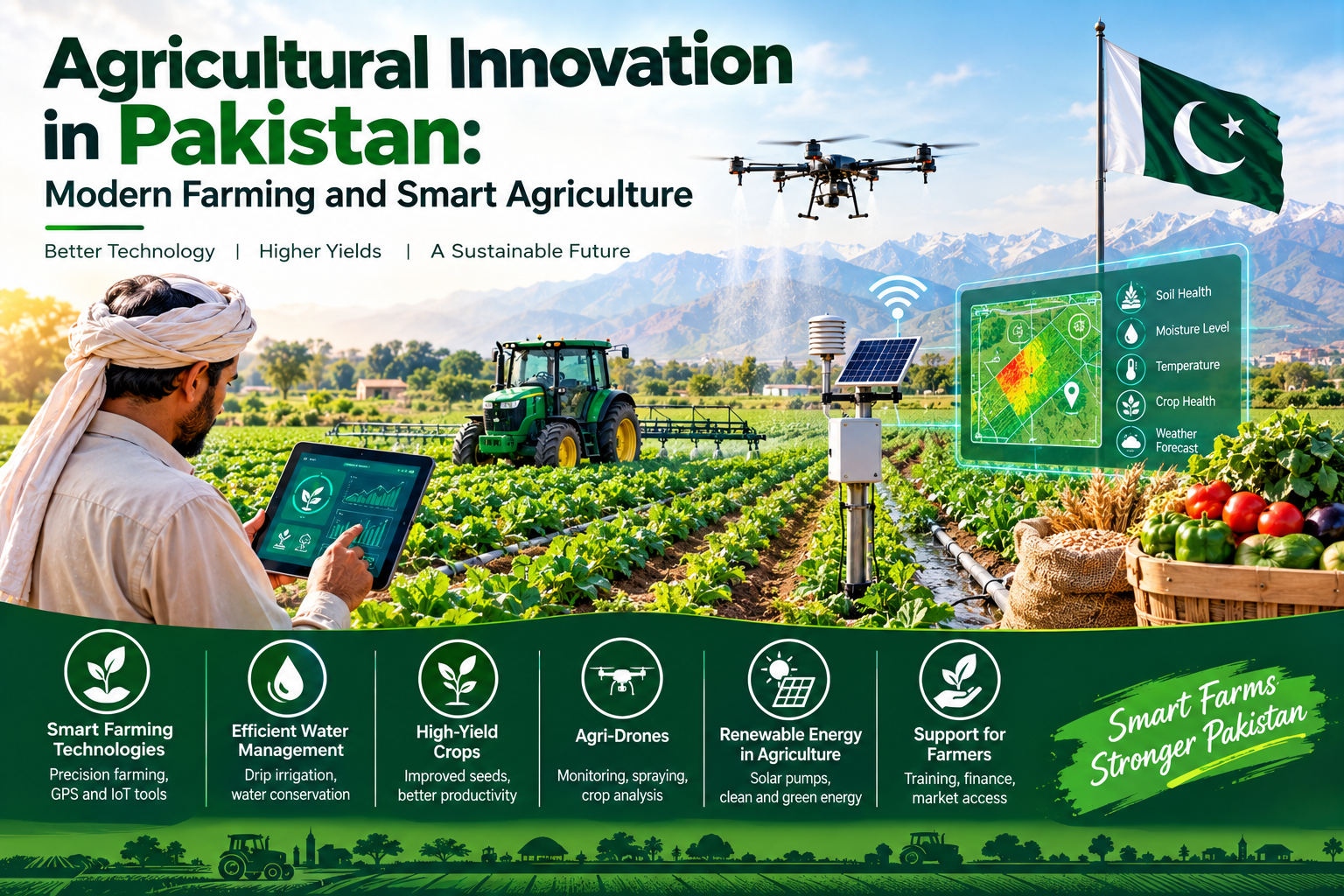
Agriculture has always been an important part of Pakistan's economy, society, and rural life. Millions of people are connected directly or indirectly with farming, livestock, food production, agricultural trade, and related industries. As the country's population grows and environmental conditions change, agricultural innovation has become increasingly important.
Agricultural innovation means using new ideas, technologies, farming methods, equipment, and management practices to improve agricultural production and resource use. It can include modern irrigation systems, improved seeds, agricultural machinery, digital farming platforms, weather information, soil monitoring, greenhouse farming, precision agriculture, and improved supply-chain systems.
Pakistan has significant agricultural potential, but farmers also face challenges such as water shortages, changing weather conditions, soil degradation, pests, rising input costs, post-harvest losses, and limited access to timely information. Innovation can help address some of these challenges and create more productive and sustainable farming systems.
Modern agriculture is not only about large machines or advanced technology. Even a simple improvement in irrigation, crop planning, storage, or market access can make a meaningful difference.
What Is Agricultural Innovation?
Agricultural innovation refers to the introduction or adoption of new methods, technologies, products, or practices that improve farming and related activities.
It can include:
Smart irrigation
Modern farm machinery
Improved seeds
Soil testing
Weather monitoring
Digital agriculture
Greenhouse farming
Precision agriculture
Drones and satellite technology
Livestock technology
Modern storage systems
Digital marketplaces
The goal is generally to increase productivity, improve efficiency, reduce waste, protect resources, and improve farmers' access to information and markets.
Why Agricultural Innovation Matters in Pakistan
Agricultural innovation is important because Pakistan has a large agricultural sector and a growing population.
Farmers need to produce sufficient food while dealing with limited resources.
Water is particularly important. Efficient irrigation can help farmers use available water more effectively.
Technology can also help farmers make better decisions. Weather information, soil analysis, crop monitoring, and market information can support planning.
Innovation can also reduce dependence on inefficient processes and help farmers manage rising production costs.
The benefits of agricultural innovation can extend beyond farms because better agricultural productivity can influence food supply, rural employment, processing industries, transportation, and exports.
Modern Farming in Pakistan
Modern farming combines traditional agricultural knowledge with improved technology and scientific methods.
Farmers can use machinery for land preparation, planting, harvesting, and other activities.
Modern crop-management practices can help improve productivity.
Farmers can also use soil testing to understand the condition of their land and make more informed decisions about fertilizers and other inputs.
Technology can help farmers monitor crops throughout the growing season.
The objective is not necessarily to replace traditional knowledge but to combine useful traditional experience with modern information and tools.
Smart Agriculture
Smart agriculture uses technology and data to improve farming decisions.
A smart agriculture system may combine information from:
Weather stations
Soil sensors
Satellite imagery
Mobile applications
Farm equipment
Drones
GPS systems
Market information
Farmers can use this information to understand crop conditions and make decisions about irrigation, planting, fertilization, and harvesting.
Smart agriculture is particularly useful when resources are limited and farmers need to use them efficiently.
Precision Agriculture
Precision agriculture focuses on applying the right amount of resources at the right place and time.
For example, instead of treating an entire field in exactly the same way, farmers can use information about different parts of the field.
Soil conditions may vary across a farm. Some areas may require more water, while others may require less.
Technology can help identify these differences.
Precision agriculture can therefore contribute to efficient use of water, fertilizer, seeds, and other inputs.
Smart Irrigation
Water management is one of the most important areas of agricultural innovation in Pakistan.
Traditional irrigation methods can sometimes result in unnecessary water loss.
Modern irrigation systems can improve water distribution and efficiency.
Drip irrigation delivers water directly near plant roots. Sprinkler systems distribute water in controlled ways.
Soil-moisture sensors can provide information about how much water is available in the soil.
Farmers can use such information to make irrigation decisions rather than relying only on fixed schedules.
Efficient irrigation can be especially valuable in areas where water availability is limited.
Weather Technology for Farmers
Weather conditions strongly influence agriculture.
Heavy rainfall, drought, heat, frost, storms, and other weather events can affect crops.
Digital weather services can provide farmers with information about temperature, rainfall, humidity, and other conditions.
This information can help farmers plan planting, irrigation, harvesting, and other activities.
Weather alerts can also help farmers prepare for potentially damaging conditions.
Better access to timely weather information can therefore improve agricultural decision-making.
Soil Testing and Monitoring
Healthy soil is essential for productive agriculture.
Soil testing can provide information about nutrients, pH, salinity, and other characteristics.
Farmers can use this information to understand what their land needs.
Digital soil-monitoring technologies can also collect information from different parts of a field.
Better soil management can help reduce unnecessary use of fertilizers and support long-term agricultural productivity.
Improved Seeds
Seeds are another important area of agricultural innovation.
Improved crop varieties can be developed for characteristics such as productivity, disease resistance, drought tolerance, or suitability to particular growing conditions.
Farmers need access to suitable and quality planting material.
Research institutions and agricultural scientists play an important role in developing and testing improved varieties.
The adoption of suitable varieties can contribute to better crop performance when combined with appropriate farming practices.
Agricultural Machinery
Modern machinery can reduce the physical effort and time required for many farming activities.
Tractors, planters, harvesters, threshers, and other equipment can improve efficiency.
Mechanization can be particularly useful for large-scale farming and time-sensitive agricultural activities.
However, machinery needs to be appropriate for local conditions and economically practical for farmers.
Shared machinery services can potentially help smaller farmers access equipment without purchasing every machine themselves.
Drones in Agriculture
Drones are an emerging agricultural technology.
Equipped with cameras and sensors, drones can collect aerial information about crops.
They may help identify areas affected by pests, disease, water stress, or other problems.
Farmers and agricultural professionals can use aerial imagery to observe large areas more efficiently.
Drone technology requires appropriate training and regulation, but it has potential applications in modern farm management.
Satellite Technology
Satellite imagery can provide information about large agricultural areas.
Researchers and agricultural organizations can use satellite data to monitor vegetation, land conditions, weather patterns, and changes in agricultural areas.
Satellite-based systems can support planning and early identification of certain agricultural problems.
When combined with local information, satellite technology can provide a broader picture of agricultural conditions.
Mobile Applications for Farmers
Mobile technology has created new ways for farmers to access information.
Agricultural applications can provide information about crops, weather, pest management, market conditions, and farming practices.
Farmers can also use mobile communication to contact buyers, suppliers, agricultural experts, and other farmers.
Mobile technology is particularly useful because smartphones are increasingly common and can provide information directly in the field.
Digital Agricultural Markets
Farmers often need efficient access to markets.
Digital platforms can connect farmers with buyers and provide information about prices and demand.
Online agricultural marketplaces can potentially reduce information gaps between producers and customers.
Farmers may also use digital platforms to find suppliers of seeds, fertilizers, equipment, and other inputs.
Better market information can help farmers make more informed selling and purchasing decisions.
Post-Harvest Technology
Agricultural innovation does not stop when crops are harvested.
Post-harvest losses can occur during storage, transportation, processing, and distribution.
Modern storage systems can help protect crops from moisture, pests, heat, and other damaging conditions.
Improved packaging and transportation can also reduce losses.
Cold-storage technology is particularly important for fruits, vegetables, dairy products, and other perishable goods.
Reducing post-harvest losses can increase the amount of food that reaches consumers.
Agricultural Supply Chains
A modern agricultural system depends on an efficient supply chain.
Products move from farms to collection centers, processors, wholesalers, retailers, and consumers.
Technology can improve tracking, inventory management, transportation planning, and communication.
Digital systems can provide information about where products are located and how they move through the supply chain.
Better supply-chain management can reduce delays and waste.
Greenhouse Farming
Greenhouse farming allows farmers to grow crops in controlled environments.
Temperature, humidity, irrigation, and other conditions can be managed more carefully than in open fields.
Greenhouses can be useful for certain vegetables, fruits, flowers, and high-value crops.
Modern greenhouse systems can use sensors and automated controls to monitor growing conditions.
Although greenhouse farming can require significant investment, it can provide opportunities for controlled agricultural production.
Vertical Farming
Vertical farming is another modern agricultural concept.
Instead of growing crops across large horizontal fields, plants are grown in stacked layers, often in controlled indoor environments.
Vertical farming can use advanced lighting, irrigation, and climate-control systems.
It may be particularly useful in urban environments where land is limited.
The technology can be expensive, so its suitability depends on local energy costs, crop types, market demand, and investment conditions.
Livestock Innovation
Agricultural innovation also includes livestock farming.
Technology can help farmers monitor animal health, feeding, breeding, and productivity.
Digital records can help farmers maintain information about individual animals.
Modern veterinary services and diagnostic technologies can improve livestock management.
Improved feeding practices and animal-health management can contribute to productivity.
Livestock innovation is important because dairy, meat, poultry, and other animal products are significant parts of Pakistan's agricultural economy.
Dairy Farming Technology
Dairy farmers can benefit from modern milking equipment, cooling systems, animal-health monitoring, and improved feeding methods.
Milk quality can be affected by hygiene, temperature, storage, and transportation.
Cold-chain systems can help maintain milk quality from farms to processing facilities.
Digital record keeping can also help farmers monitor production and animal health.
Artificial Intelligence in Agriculture
Artificial intelligence can support agriculture by analyzing large amounts of information.
AI systems can potentially identify patterns in weather, crop conditions, soil data, and market information.
Computer vision can be used to analyze images of plants and identify certain visible signs of disease or stress.
AI can also support forecasting and decision-making.
As technology becomes more accessible, AI may become increasingly relevant to precision agriculture.
Climate-Smart Agriculture
Climate change and changing weather conditions create challenges for farmers.
Climate-smart agriculture focuses on improving productivity while increasing resilience and managing environmental impacts.
Examples may include efficient irrigation, improved crop varieties, soil conservation, agroforestry, better water management, and renewable energy.
The exact approach depends on local climate, crops, soil, and farming conditions.
Renewable Energy in Agriculture
Renewable energy can support agricultural activities.
Solar power can be used for water pumps, farm lighting, refrigeration, processing equipment, and other operations.
Solar-powered irrigation systems may provide an alternative energy source for some farms.
Renewable energy can also help reduce dependence on conventional electricity or fuel in suitable circumstances.
Role of Agricultural Research
Research institutions play a major role in agricultural innovation.
Scientists can study crop varieties, soil conditions, pests, irrigation methods, livestock health, climate adaptation, and agricultural technology.
Research findings need to reach farmers in practical and understandable forms.
Agricultural extension services can help connect researchers with farming communities.
This connection is important because innovation is most useful when it can be applied successfully in real farming conditions.
Training and Digital Literacy for Farmers
Technology is useful only when farmers know how to use it.
Training programs can teach farmers about modern equipment, digital applications, irrigation systems, soil testing, and other technologies.
Simple language and practical demonstrations can make training more accessible.
Farmer-to-farmer learning can also help spread useful practices.
Challenges of Agricultural Innovation
Agricultural innovation in Pakistan faces several challenges.
The cost of modern equipment can be high for small farmers.
Access to financing can affect the ability to adopt new technologies.
Some rural communities may have limited internet connectivity or digital skills.
Farmers may also be uncertain about unfamiliar technologies.
Maintenance and technical support can be another challenge.
Therefore, innovation programs need to consider affordability, training, local conditions, and long-term support.
Small Farmers and Technology
Small farmers make up an important part of Pakistan's agricultural landscape.
Technology should not only be designed for large commercial farms.
Affordable mobile applications, shared machinery services, community irrigation systems, digital marketplaces, and cooperative models can help smaller farmers access modern tools.
Technology providers can also design simple systems that do not require advanced technical knowledge.
Inclusive innovation can help ensure that agricultural modernization benefits a wider range of farming communities.
Role of Government and Private Sector
Government institutions can support agricultural innovation through research, infrastructure, training, extension services, and policies.
The private sector can contribute by developing agricultural equipment, digital platforms, seeds, financial services, storage solutions, and other technologies.
Partnerships between government, universities, farmers, technology companies, and agricultural businesses can improve the practical adoption of innovation.
Future of Smart Agriculture in Pakistan
The future of agriculture in Pakistan is likely to involve greater use of digital technology, automation, precision farming, smart irrigation, artificial intelligence, satellite data, renewable energy, and modern supply-chain systems.
Farmers may increasingly use smartphones to access weather information, market prices, agricultural advice, and digital services.
More advanced farms may use sensors, drones, automated equipment, and data analysis.
The most important factor will be whether these technologies are affordable, practical, reliable, and suited to local conditions.
Conclusion
Agricultural innovation can play an important role in the future of farming in Pakistan. Modern irrigation, improved seeds, agricultural machinery, digital platforms, soil monitoring, weather information, precision agriculture, drones, satellite technology, and renewable energy are creating new possibilities.
Technology can help farmers use water and other resources more efficiently, improve decision-making, reduce losses, and connect with markets.
However, successful agricultural innovation requires more than technology. Farmers need access to training, financing, reliable infrastructure, technical support, and useful information.
Pakistan has significant agricultural potential, and innovation can help strengthen this important sector. By combining traditional farming knowledge with modern technology and scientific research, Pakistan can work toward a more productive, efficient, resilient, and sustainable agricultural future.
FAQs
1. What is agricultural innovation in Pakistan?
Agricultural innovation means using modern technologies, improved farming methods, scientific research, and new ideas to improve agricultural productivity and resource management.
2. What is smart agriculture?
Smart agriculture uses technologies such as sensors, mobile applications, satellite data, weather information, drones, and data analysis to support better farming decisions.
3. How can technology help Pakistani farmers?
Technology can help farmers monitor crops, manage water, access weather information, find market information, improve storage, and use agricultural resources more efficiently.
4. What are the challenges of agricultural innovation?
Major challenges include the cost of technology, limited financing, lack of training, connectivity issues, technical support requirements, and difficulties adopting unfamiliar systems.
5. What is the future of agriculture in Pakistan?
The future may include greater use of precision farming, smart irrigation, artificial intelligence, drones, satellite technology, renewable energy, digital marketplaces, and modern agricultural machinery.