Introduction
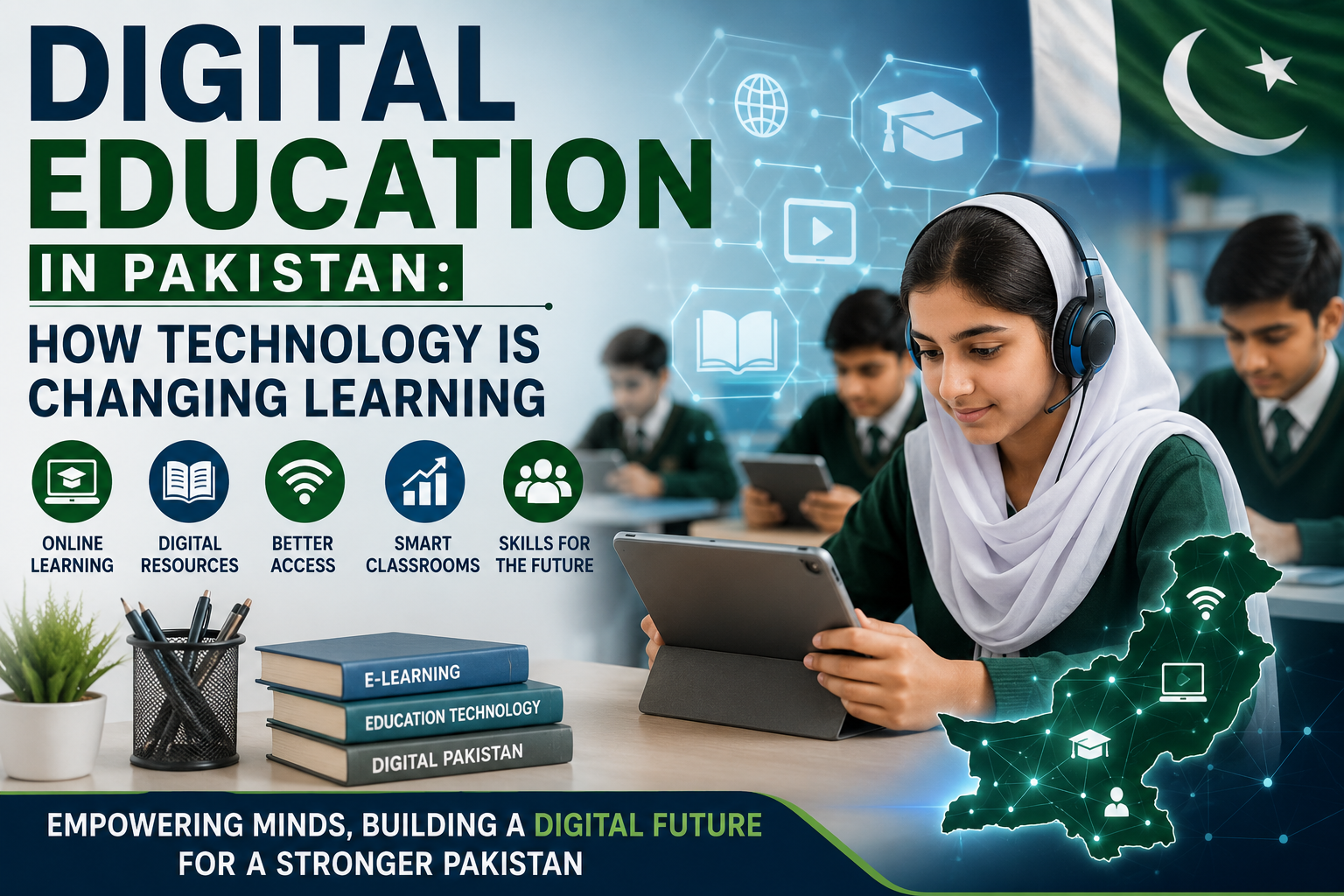
Digital education is becoming an increasingly important part of Pakistan’s education system. Technology has changed the way people communicate, work, shop and access information, and education is also experiencing this transformation. Students today can learn from digital books, educational videos, online classes, learning applications and interactive platforms without depending entirely on traditional classroom methods.
In Pakistan, digital education has gained particular importance because the country has a large young population and significant differences in educational access between urban and rural areas. Technology can provide additional learning opportunities to students who may not have access to well-equipped schools, libraries or specialized teachers.
The growth of smartphones, computers, internet services and online educational platforms has made learning resources more accessible than before. At the same time, digital education also brings challenges, including limited internet access, lack of devices, teacher training requirements and the digital divide between different communities.
The future of education in Pakistan will likely involve a combination of traditional classroom teaching and digital learning. The goal should not be to replace teachers with technology but to use technology as a tool that helps teachers and students learn more effectively.
What Is Digital Education?
Digital education refers to learning and teaching that uses digital technologies. It can take place inside a traditional classroom, through online classes or through a combination of both.
Examples of digital education include:
Online classes
Digital textbooks
Educational videos
Learning applications
Virtual classrooms
Online quizzes
Digital assignments
Educational websites
Computer-based learning
Interactive presentations
Online libraries
Digital education gives students additional ways to understand subjects. Instead of relying only on a textbook, a student can watch an explanation, use an interactive activity and practice questions online.
This flexibility is one of the major advantages of technology in education.
The Growth of Digital Education in Pakistan
Digital education in Pakistan has developed significantly over recent years. The importance of online and technology-supported learning became especially visible when schools and educational institutions needed alternatives to physical classrooms.
Since then, digital learning has continued to develop through government programs, educational institutions, private platforms and technology initiatives.
The Federal Ministry of Education and Professional Training lists a Digital Learning and Technology Integration Roadmap among its 2026 education policy initiatives. This reflects the growing importance of technology integration in the country's education planning.
Digital education is also connected with broader efforts to improve the quality of education. Technology can support teachers, provide learning resources and help students access information beyond the classroom.
Why Digital Education Is Important for Pakistan
Pakistan faces several educational challenges. These include differences in school quality, shortages of resources in some areas, teacher availability and unequal access to educational opportunities.
Digital education cannot solve all these problems by itself, but it can become an important part of the solution.
For example, a student in a remote area may not have access to a specialized teacher for a particular subject. Through digital resources, that student may be able to watch lessons, access explanations and practice exercises.
Similarly, students can use online resources to revise lessons at home.
This means technology can make education more flexible and accessible.
Digital Learning Gives Students More Learning Resources
One of the biggest advantages of digital education is the huge amount of educational material available online.
Students can find resources related to subjects such as:
Mathematics
Physics
Chemistry
Biology
Computer science
English
History
Geography
Languages
Digital resources can explain difficult concepts through text, images, animations and videos.
For example, a complicated scientific process can be difficult to understand from a written paragraph alone. An animation can make the process easier to visualize.
This can make learning more interesting and understandable for many students.
Online Classes and Virtual Learning
Online classes have become another important part of digital education.
Students can attend classes using computers, tablets or smartphones when appropriate technology and internet access are available.
Virtual learning can be useful for students who:
Cannot regularly travel to an institution
Need additional lessons
Want to revise previous topics
Need access to specialized courses
Prefer flexible learning schedules
However, online education works best when students have reliable internet, suitable devices and supportive teachers.
It should therefore complement classroom education rather than be considered a universal replacement for schools.
The Role of Smartphones in Education
Smartphones are widely used in Pakistan and can provide students with access to educational resources.
A smartphone can be used for:
Watching educational videos
Reading digital books
Searching for information
Practicing vocabulary
Taking online quizzes
Joining online classes
Using educational applications
However, students need guidance when using smartphones for education.
The same device that provides educational resources can also contain distractions. Social media, games and unrelated content can make it difficult for students to concentrate.
Therefore, digital literacy should include learning how to use technology responsibly and productively.
Digital Education and Teachers
Technology does not remove the importance of teachers.
Teachers remain essential because they explain concepts, understand student difficulties, provide feedback and create supportive learning environments.
Technology can make teachers more effective by providing additional resources.
A teacher can use:
Digital presentations
Educational videos
Online quizzes
Interactive activities
Digital assignments
Online research resources
For example, instead of explaining a difficult concept only through a textbook, a teacher can combine a short explanation with a visual presentation or educational animation.
This can make lessons more engaging.
Importance of Teacher Training
Digital education cannot succeed if teachers are not comfortable using technology.
Teachers should receive training in areas such as:
Digital classroom tools
Online teaching
Educational applications
Digital assessment
Internet safety
Creating digital learning materials
Using multimedia in lessons
Professional development is therefore an important part of digital education reform.
The Federal Ministry's current education policy initiatives include professional development alongside digital learning and quality education, reflecting the need to develop teachers as part of broader reforms.
Digital Education in Rural Pakistan
One of the biggest opportunities for digital education is reaching students in rural and underserved communities.
Students in major cities may have access to better-equipped schools, private academies, libraries and specialized teachers.
Students in remote communities may have fewer educational resources.
Digital technology can potentially reduce some of this gap.
For example, a digital learning center could provide students with educational content that may otherwise be difficult to access.
However, this requires infrastructure.
Without reliable electricity, internet connectivity and affordable devices, digital education cannot reach everyone equally.
The Digital Divide
The digital divide refers to differences in access to technology.
Not every Pakistani student has:
A smartphone
A computer
Reliable internet
Electricity
Affordable data
A suitable place for online study
This is one of the biggest challenges facing digital education.
If technology-based education is introduced without considering these differences, students from low-income or remote communities could fall further behind.
Therefore, digital education policies should focus on digital inclusion.
Affordable Digital Learning
Making digital education successful requires affordable access.
Possible solutions include:
Community digital learning centers
School computer labs
Affordable internet packages for education
Offline learning content
Public digital libraries
Shared devices in schools
Government-supported educational platforms
Offline resources can be especially useful in areas where internet connectivity is unreliable.
Students should be able to continue learning even when constant internet access is not available.
Digital Textbooks and E-Libraries
Traditional textbooks remain important, but digital books provide additional advantages.
Digital textbooks can be:
Easily updated
Stored on devices
Accessed from different locations
Combined with multimedia
Used for quick searches
E-libraries can also give students access to a wide range of educational material.
For higher education students, digital academic resources can be particularly valuable because they can access research papers, reference materials and online courses.
Interactive Learning
Digital technology can make learning more interactive.
Traditional teaching may sometimes involve a teacher explaining information while students listen and take notes.
Digital learning can add:
Interactive questions
Simulations
Educational games
Visual demonstrations
Instant quizzes
Digital experiments
Interactive learning can encourage students to participate more actively.
Instead of simply receiving information, students can interact with the material.
Digital Assessment
Technology can also change how students are assessed.
Online quizzes can provide immediate feedback. Teachers can use digital systems to identify topics where students are struggling.
Digital assessment can help teachers understand:
Which questions students answer incorrectly
Which topics need revision
Which students require additional support
How students are progressing
However, digital assessment should be designed carefully to ensure fairness and accessibility.
Artificial Intelligence and Education
Artificial intelligence is becoming an important part of modern technology.
AI tools can potentially support education by helping students:
Understand difficult concepts
Practice languages
Generate study questions
Organize notes
Receive explanations
Practice problem-solving
Teachers can also use AI-supported tools for lesson planning and educational activities.
However, students should not depend entirely on AI for their learning.
The purpose of technology should be to support understanding and independent thinking, not to do all the thinking for students.
Schools should also teach students about responsible and ethical technology use.
Digital Skills for Future Careers
The modern job market increasingly requires digital skills.
Students who understand technology may have opportunities in areas such as:
Software development
Graphic design
Digital marketing
Data analysis
Artificial intelligence
Cybersecurity
E-commerce
Online communication
Content creation
This makes digital literacy an important part of modern education.
Students do not necessarily need to become programmers, but they should understand basic digital tools and how technology affects their future careers.
Digital Education and Higher Education
Universities and colleges can benefit significantly from digital learning.
Students can use online platforms to:
Attend lectures
Access research materials
Submit assignments
Participate in discussions
Take online courses
Collaborate on projects
Digital learning can also connect Pakistani students with international educational resources.
A university student can potentially learn from courses offered by institutions around the world without physically traveling abroad.
This creates new opportunities for academic development.
Benefits of Digital Education for Students
Digital education offers many potential benefits.
1. Flexible Learning
Students can often learn at a convenient time and pace.
2. Wider Access
Students can access educational materials from different sources.
3. Visual Learning
Videos, animations and diagrams can make difficult concepts easier to understand.
4. Personalized Practice
Students can repeat lessons or practice questions according to their needs.
5. Career Skills
Technology-based learning can develop digital skills useful for future careers.
6. Faster Access to Information
Students can search for educational information quickly.
7. Collaboration
Online tools can allow students to work together on projects.
Challenges of Digital Education in Pakistan
Despite its advantages, digital education has several challenges.
Lack of Internet Access
Some areas still have limited or unreliable connectivity.
Cost of Devices
Computers, tablets and smartphones may be expensive for some families.
Electricity Problems
Reliable electricity is important for digital learning.
Lack of Teacher Training
Teachers may need additional support to use digital tools effectively.
Distractions
Students can easily become distracted by entertainment and social media.
Quality of Online Content
Not every educational resource available online is accurate or reliable.
Cyber Safety
Students need to understand online privacy and safe internet use.
These challenges need to be addressed for digital education to become more inclusive.
How Schools Can Improve Digital Learning
Schools can introduce technology gradually.
A practical approach could include:
Providing basic computer facilities.
Training teachers.
Introducing digital educational resources.
Creating school libraries with digital content.
Using technology for selected lessons.
Providing offline resources where internet access is limited.
Teaching students responsible technology use.
Schools do not need to become completely digital overnight.
A balanced approach can combine traditional teaching with modern technology.
The Role of Parents in Digital Education
Parents also have an important role.
They can help students by creating a suitable study environment and encouraging responsible use of technology.
Parents can:
Encourage educational use of devices
Help students manage study time
Monitor online learning when appropriate
Encourage reading
Discuss internet safety
Support school assignments
The objective should not simply be to give children more screen time. It should be to make technology more useful for learning.
Digital Education and Equal Opportunities
One of the most important goals of digital education should be equal opportunity.
Technology should help reduce educational inequality rather than increase it.
A successful digital education system should consider students who have limited:
Income
Internet access
Electricity
Devices
Educational support
Government programs, schools and educational organizations can work together to expand access.
Digital education should be designed around the needs of students rather than simply around the availability of technology.
Government's Role in Digital Education
The government has an important role in developing the infrastructure required for digital learning.
This includes:
Internet connectivity
Digital education platforms
Teacher training
School technology
Educational content
Digital literacy programs
Policies for responsible technology use
The Federal Ministry's 2026 policy framework includes digital learning and technology integration, demonstrating that digital education is becoming part of the country's broader education reform agenda.
Long-term planning is essential because digital transformation cannot be completed through short-term projects alone.
The Future of Digital Education in Pakistan
The future of digital education in Pakistan is likely to involve a blended learning model.
Blended learning combines traditional classroom teaching with digital resources.
For example, a teacher may explain a topic in class, students may watch an educational video at home, and then complete an online quiz for practice.
This approach combines the strengths of both methods.
Teachers provide human guidance and interaction, while technology provides additional resources and flexibility.
As internet access improves and digital tools become more affordable, technology may become increasingly integrated into everyday education.
What Should Pakistan Focus on Next?
Pakistan can strengthen digital education by focusing on several priorities:
Affordable internet access
Better digital infrastructure
Teacher training
Digital learning content in local languages
School computer facilities
Digital literacy
Online safety
Support for rural communities
Accessible educational platforms
Responsible use of artificial intelligence
The focus should remain on learning outcomes, not simply the number of devices or digital platforms introduced.
A school does not become technologically advanced merely because it has computers. Technology becomes valuable when it actually helps students learn better.
Conclusion
Digital education is changing the way students learn in Pakistan. From online classes and digital textbooks to educational videos, interactive tools and AI-supported learning, technology is creating new possibilities for students and teachers.
However, digital education is not a complete solution to every educational challenge. Pakistan still needs strong schools, qualified teachers, modern curricula, reliable infrastructure and inclusive policies.
The most successful approach will likely be a balanced combination of traditional classroom education and digital learning.
If Pakistan can improve internet access, provide affordable technology, train teachers and create high-quality educational content, digital education can become an important tool for improving learning opportunities across the country.
The ultimate goal should be simple: use technology to make quality education more accessible, engaging and effective for every student.
FAQs
1. What is digital education?
Digital education uses technology such as computers, smartphones, online platforms and digital resources for learning.
2. Why is digital education important in Pakistan?
It can provide students with wider access to educational resources and flexible learning opportunities.
3. What are the challenges of digital education in Pakistan?
Limited internet, device costs, electricity issues, teacher training and the digital divide are major challenges.
4. Can technology replace teachers?
No. Technology can support teachers, but human guidance and interaction remain essential.
5. What is the future of digital education in Pakistan?
The future is likely to combine traditional classroom teaching with digital and online learning.