Introduction
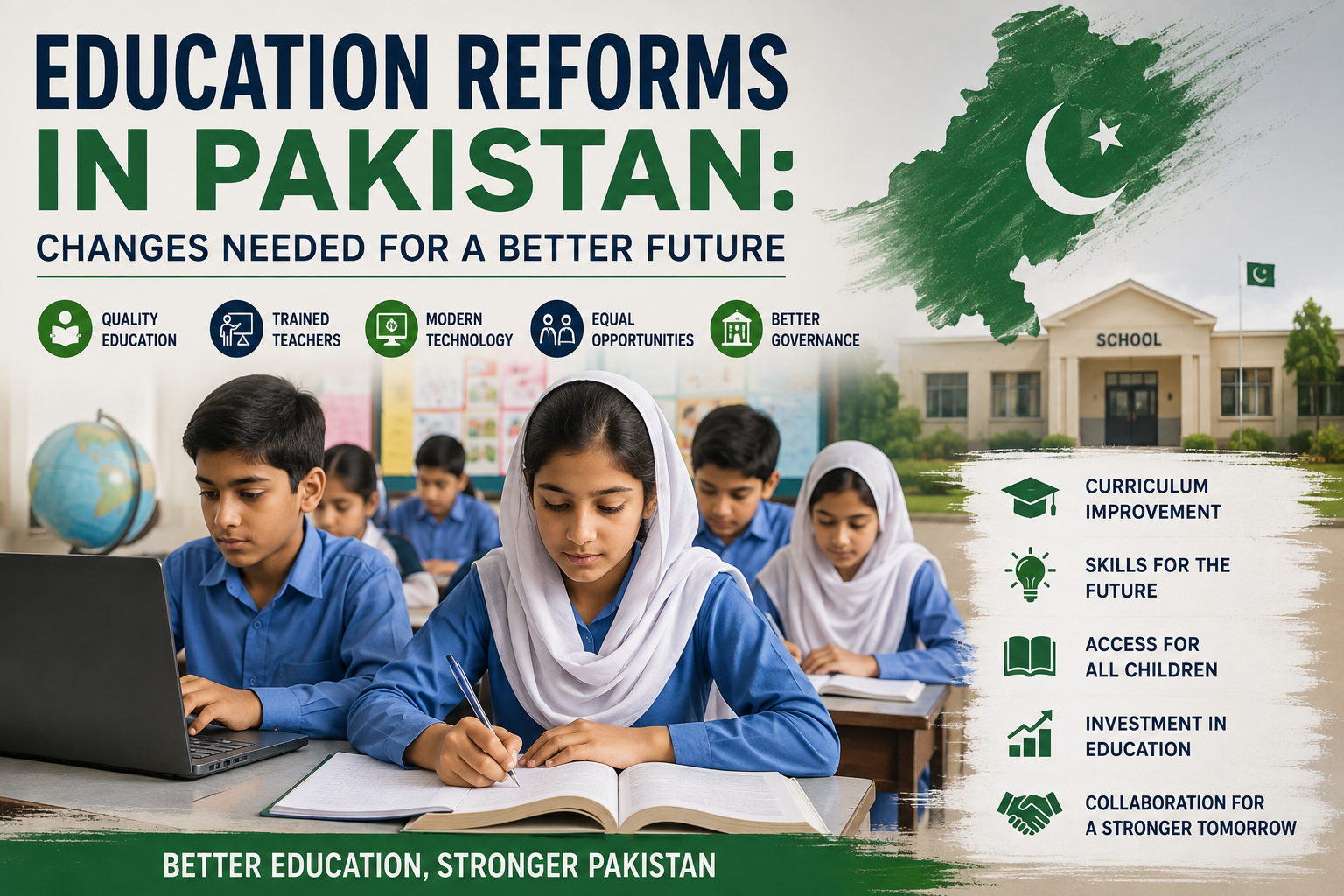
Education is one of the most important foundations of a successful country. A strong education system does not only teach students how to read and write; it prepares young people to think, solve problems, communicate effectively, use technology and contribute positively to society. For a country like Pakistan, where a large and growing young population represents both an opportunity and a challenge, improving education is essential for long-term economic and social development.
Pakistan's education sector has been receiving renewed attention in 2026. The Federal Ministry of Education and Professional Training has been working on several initiatives related to quality education, digital learning, teacher development, skills and access to education. The ministry has also presented a Draft Federal Education Policy 2026 for public feedback, with an emphasis on more inclusive education and lifelong learning and skills development
Recent developments show that education reform is not simply about building more schools. It involves improving what students learn, how teachers teach, how examinations are conducted, how technology is used and how children who are outside the formal education system can be brought into learning opportunities.
The question, therefore, is not whether Pakistan needs education reforms. The bigger question is: What kind of reforms can create a better and more effective education system for the future?
Understanding Education Reforms in Pakistan
Education reforms refer to planned changes designed to improve the education system. These changes can involve curriculum, teaching methods, examinations, teacher training, school infrastructure, technology, educational policies and access to education.
Pakistan has introduced different education policies and initiatives over the years. However, one of the biggest challenges has often been the gap between policy and implementation.
A policy may contain strong ideas, but its success depends on whether those ideas reach classrooms. Teachers need training, schools need resources, students need appropriate learning materials and education departments need reliable systems for monitoring progress.
The current reform discussion is increasingly focused on quality, innovation, digital learning, foundational education and skills. The Federal Ministry's listed policies for 2026 include a roadmap for digital learning and technology integration, a quality education and innovation roadmap, a professional development framework and a strategy related to special education.
This indicates that education reform is becoming broader than traditional curriculum changes.
Why Does Pakistan Need Education Reforms?
Pakistan's education system faces several interconnected challenges. These include unequal access, differences between public and private schools, teacher training needs, outdated learning practices, examination pressure and limited access to modern technology in some communities.
Another major issue is that many children remain outside school. Addressing this problem requires more than simply increasing enrollment. Children need safe schools, qualified teachers, learning materials and an environment that encourages them to remain in education.
The government has continued to focus on out-of-school children. In August 2026, the Federal Education Ministry and JICA agreed to strengthen national systems for addressing the out-of-school children challenge.
This is important because an education system cannot achieve its full potential if a large number of children never enter or complete formal education.
1. Improving the Quality of Public Schools
Public schools play a crucial role in Pakistan's education system, particularly for families who cannot afford expensive private education.
One important education reform should therefore be the improvement of public-school quality.
Quality education requires several elements:
Qualified and motivated teachers
Appropriate classrooms
Learning materials
Libraries and laboratories
Clean drinking water
Functional sanitation facilities
Electricity and internet where possible
Safe learning environments
Effective school leadership
Improving infrastructure alone, however, is not enough.
A school may have a beautiful building but still provide weak learning outcomes if teaching quality is poor. Similarly, a highly qualified teacher may struggle if the classroom lacks basic educational resources.
Education reform should therefore take a balanced approach that improves both physical infrastructure and learning quality.
The Federal Ministry's 2026 quality education and innovation roadmap is structured around interconnected reform areas, including digital and innovative learning and creating an enabling learning environment.
2. Modernizing the Curriculum
The curriculum determines what students learn and which skills they develop.
For many years, education in Pakistan has often been associated with memorization and examination preparation. Memorization has a role in learning, but students also need opportunities to understand concepts, ask questions and solve problems.
A modern curriculum should encourage:
Critical thinking
Creativity
Communication
Collaboration
Problem-solving
Digital literacy
Research skills
Financial awareness
Civic responsibility
Practical knowledge
Students should not only be asked to remember information. They should also learn how to use information.
For example, instead of simply memorizing a scientific definition, students can be encouraged to understand how the concept applies to everyday life.
Similarly, computer education should not be limited to basic theoretical information. Students should gradually develop practical digital skills appropriate to their age.
Pakistan's curriculum reform discussions have increasingly emphasized analytical abilities, creativity, problem-solving and other skills needed by 21st-century learners.
3. Better Teacher Training
Teachers are at the heart of education reform.
Even the best curriculum cannot succeed without teachers who understand how to teach it effectively.
Teacher training should not be a one-time activity. Teachers need continuous professional development throughout their careers.
Modern teacher training can include:
Classroom management
Student-centered learning
Digital teaching tools
Assessment techniques
Inclusive education
Communication skills
Critical-thinking activities
Child development
Mental and social wellbeing
Subject-specific teaching methods
Pakistan's Federal Ministry lists a Professional Development Framework among its 2026 education policies, showing the importance being given to teacher development.
Teachers should also be given access to practical resources. Training becomes more useful when teachers can apply new methods directly in their classrooms.
4. Moving From Rote Learning to Conceptual Learning
One of the most important reforms Pakistan can make is shifting from excessive rote learning toward conceptual understanding.
Rote learning means remembering information mainly for examinations. Conceptual learning means understanding the idea behind the information and being able to apply it.
For example, a mathematics student should not only memorize a formula. The student should understand:
What the formula means
Why it works
When it should be used
How it can solve a real problem
The same principle applies to science, computer studies, economics and other subjects.
A conceptual approach can make students more confident and independent learners.
It can also reduce the belief that education is simply about obtaining marks.
5. Reforming the Examination System
Examinations strongly influence student behavior.
If examinations mainly reward memorization, students and teachers naturally focus on memorizing information.
Education reform should therefore include assessment reform.
Examinations can include more questions that test:
Understanding
Application
Analysis
Problem-solving
Interpretation
Practical knowledge
This does not mean eliminating traditional examinations completely. Instead, the assessment system should measure a broader range of learning outcomes.
Digital technologies can also improve examination administration and processing. The Federal Ministry has previously highlighted reforms involving assessment and modernization of examination processing through digital technologies.
A better assessment system can encourage better learning.
6. Expanding Digital Education
Technology has transformed education around the world.
Pakistan also has significant opportunities to use technology to improve learning.
Digital education can provide students with:
Online lectures
Educational videos
Digital textbooks
Interactive exercises
Virtual learning resources
Online libraries
Educational applications
Remote learning opportunities
However, digital education must be introduced carefully.
Not every student has a smartphone, computer or reliable internet connection. Therefore, technology-based reforms should not create another educational divide.
The goal should be inclusive digital education.
Schools and government programs can explore affordable digital resources, community learning centers, offline educational content and other solutions for students who have limited connectivity.
The Federal Ministry currently lists a roadmap specifically focused on digital learning and technology integration in the Federal Directorate of Education.
7. Focusing on Foundational Learning
Children need strong foundations before they can successfully progress through advanced education.
Reading, writing, mathematics and basic comprehension are fundamental skills.
If a student reaches higher grades without mastering these skills, later education becomes increasingly difficult.
Therefore, Pakistan's education reforms should prioritize early learning.
Teachers should regularly assess whether young students can:
Read age-appropriate material
Understand simple passages
Write clearly
Perform basic mathematical operations
Explain concepts in their own words
Recent education initiatives in Pakistan have also focused on foundational learning. For example, the Federal Ministry highlighted innovative teacher aid kits designed to strengthen foundational learning.
Strong foundations can improve the entire education journey.
8. Bringing More Children Into Education
Education reform cannot be successful without addressing children who are outside school.
There can be many reasons why children do not attend school, including poverty, distance, family circumstances, limited school availability and social barriers.
Solutions need to be designed according to local conditions.
Possible approaches include:
Expanding schools in underserved areas
Supporting low-income families
Strengthening non-formal education
Providing flexible learning opportunities
Improving transportation where necessary
Supporting girls' education
Creating pathways back into formal education
Pakistan's federal government and partners have continued working on systems for out-of-school children.
This issue should remain a long-term national priority rather than a short-term campaign.
9. Strengthening Girls' Education
Girls' education is an important part of national development.
When girls receive quality education, the benefits can extend to families, communities and the economy.
Education reforms should therefore ensure that girls have access to safe, affordable and high-quality education.
This is especially important in areas where girls face greater barriers to schooling.
Recent education programs in Balochistan demonstrate how targeted interventions can expand access and improve learning opportunities. A UNICEF-supported Balochistan program that concluded in June 2026 reported that more than 760,000 children had accessed quality education opportunities, including nearly 335,000 girls.
Such examples show that targeted investment can make a meaningful difference.
10. Making Education More Inclusive
Every student learns differently.
Education reforms should make schools more inclusive for children with disabilities and students who require additional support.
Inclusive education can involve:
Accessible school buildings
Trained teachers
Appropriate learning materials
Assistive technologies
Flexible teaching methods
Awareness among students and staff
Pakistan's Federal Ministry lists a strategy for strengthening public-sector special education institutes among its current policy initiatives.
The wider goal should be to ensure that educational opportunities are not limited because of disability or learning needs.
11. Connecting Education With Skills
Modern economies require more than academic qualifications.
Students increasingly need practical skills that can help them continue their education, enter employment or develop entrepreneurial opportunities.
Education reforms should therefore create stronger connections between academic learning and skills development.
Students can benefit from exposure to areas such as:
Information technology
Programming
Digital literacy
Communication
Entrepreneurship
Technical skills
Creative industries
Financial literacy
Career planning
In June 2026, the government, UNICEF and Generation Unlimited launched Pur Azm Pakistan, a national platform intended to connect young people with skills, employment, entrepreneurship and economic opportunities.
Such initiatives highlight the growing importance of connecting education with real-world opportunities.
12. Improving Career Guidance
Many students complete school or college without knowing which career paths are available to them.
Career guidance can help students understand:
Their interests
Their strengths
Different professions
University options
Technical education
Skills-based careers
Employment opportunities
Schools and colleges should provide age-appropriate career information.
Students should not feel that only a small number of traditional careers are successful. Pakistan's changing economy requires people with diverse academic, technical and creative skills.
Good career guidance can help students make better educational decisions.
13. Supporting Student Wellbeing
Education is not only about academic performance.
Students learn better when they feel safe, supported and respected.
Schools should pay attention to student wellbeing, healthy relationships, positive classroom environments and appropriate support systems.
In August 2026, the Federal Ministry highlighted the importance of putting student wellbeing at the heart of education.
This is an important part of modern education because academic success and student wellbeing are closely connected.
Schools should create environments where students can ask questions, make mistakes and learn without unnecessary fear.
14. Using Data to Improve Education
Education departments need reliable information to make effective decisions.
Data can help policymakers understand:
School enrollment
Attendance
Dropout rates
Teacher availability
Student learning outcomes
School infrastructure
Regional differences
Pakistan has been working on education information systems and related initiatives. The Federal Ministry's 2026 procurement records include work connected with EMIS, or Education Management Information Systems.
Reliable data can help governments direct resources toward areas where they are most needed.
15. Reducing the Gap Between Urban and Rural Education
Educational opportunities are not always equal across Pakistan.
Students in major cities may have greater access to:
Better-equipped schools
Internet
Libraries
Laboratories
Private academies
Career counseling
Digital resources
Students in remote communities may have fewer options.
Education reforms should therefore focus on reducing geographical inequality.
Investment in rural education can include teacher support, infrastructure, digital resources, transportation solutions and community-based learning.
The goal should be that a student's educational opportunities do not depend entirely on where they were born.
16. Strengthening Public-Private Cooperation
Government alone cannot solve every education challenge.
Private organizations, universities, technology companies, nonprofit organizations and international partners can contribute through carefully designed programs.
However, partnerships should have clear goals, transparency and measurable outcomes.
The objective should always remain student benefit rather than simply increasing the number of projects.
Pakistan has already worked with international partners on education access, foundational learning, digital learning and out-of-school children.
17. What Can Parents Do?
Education reform is not only the responsibility of governments and schools.
Parents also have an important role.
Parents can support children by:
Encouraging reading
Taking an interest in schoolwork
Helping children develop study routines
Encouraging questions
Supporting healthy use of technology
Avoiding excessive comparison with other students
Communicating with teachers
Encouraging practical learning
Parents should also understand that marks are important but are not the only measure of learning.
A child who can think, communicate and solve problems is developing valuable skills for the future.
18. What Can Students Do?
Students are also active participants in education reform.
Students can improve their learning by developing habits such as:
Reading beyond textbooks
Practicing concepts
Asking questions
Learning digital skills
Working on projects
Improving communication
Developing time management
Learning from mistakes
Students should view education as preparation for life rather than only preparation for examinations.
19. The Role of Technology and Artificial Intelligence
Artificial intelligence is changing many areas of modern life, including education.
AI-based tools can potentially help students understand difficult concepts, practice languages, organize information and receive personalized learning support.
However, students should learn to use AI responsibly.
AI should support learning rather than replace thinking.
Schools and education policymakers will increasingly need to teach students how to evaluate digital information, protect privacy, identify unreliable information and use technology ethically.
Digital literacy will therefore become an increasingly important component of education.
20. Making Education Reform Sustainable
One of Pakistan's biggest challenges is ensuring that reforms continue over the long term.
Education systems require years of consistent investment.
A successful reform should have:
Clear objectives
Adequate funding
Teacher training
Monitoring mechanisms
Reliable data
Community participation
Regular evaluation
Long-term political and administrative commitment
Short-term projects may create temporary improvements, but sustainable reforms require continuity.
The Federal Ministry's current reform agenda demonstrates an increasing focus on quality, innovation, digital learning, professional development and skills.
The Importance of the Federal Education Policy 2026
One of the most significant current developments is the Draft Federal Education Policy 2026.
The Federal Ministry invited public feedback on the draft, describing its goal as contributing to a more inclusive and effective approach to lifelong learning and skills development.
A policy framework can provide direction, but its real impact depends on implementation.
For Pakistan, an effective future education policy should address both access and quality.
Children need to enter school, but they also need to learn effectively once they are there.
Challenges That Could Slow Education Reform
Despite the opportunities, several challenges can make reform difficult.
Limited Resources
Education requires sustained financial investment. Schools need teachers, infrastructure, learning materials and technology.
Unequal Access
Regional differences can make it difficult to implement identical reforms everywhere.
Teacher Shortages
Some areas may have difficulties attracting and retaining qualified teachers.
Digital Divide
Technology-based education may leave behind students who lack internet or devices.
Implementation Gaps
Policies can be strong on paper but weak in practical implementation.
Examination Culture
Changing from memorization toward conceptual learning requires changes in teaching and assessment.
Social Barriers
Poverty and other social challenges can prevent children from attending or completing school.
These challenges mean that education reform must be carefully planned rather than based on a single solution.
A Vision for the Future of Education in Pakistan
The ideal education system for Pakistan should combine traditional academic knowledge with modern skills.
Students should leave school with the ability to:
Read and write confidently
Understand mathematics
Think critically
Solve problems
Communicate effectively
Work with others
Use technology responsibly
Understand their communities
Explore career opportunities
Continue learning throughout life
The education system should also provide opportunities for children from different economic and geographical backgrounds.
A child from a remote village should have a genuine opportunity to develop their talents just as a child from a major city does.
Conclusion
Education reforms in Pakistan are essential for building a stronger and more prosperous future. Current developments in 2026 show increased attention toward quality education, digital learning, teacher development, foundational learning, student wellbeing, skills and access for out-of-school children.
However, successful reform requires more than announcing new policies.
Pakistan needs consistent implementation, trained teachers, modern curriculum, better assessments, improved public schools, inclusive education and greater use of technology. At the same time, the country must ensure that children who are currently outside the education system are given meaningful opportunities to learn.
The future of Pakistan depends greatly on the quality of education provided to its young population. A modern education system can help students become not only successful professionals but also creative thinkers, responsible citizens and productive members of society.
Education reform should therefore be viewed as a long-term national investment.
If Pakistan can successfully combine access, quality, technology, skills and inclusion, its education system can become much better prepared for the challenges and opportunities of the future.
FAQs
1. What are education reforms in Pakistan?
Education reforms are changes designed to improve teaching, curriculum, schools, and learning opportunities.
2. Why does Pakistan need education reforms?
To improve education quality, reduce inequality, and provide better opportunities for students.
3. How can technology improve education in Pakistan?
Digital tools can make learning more accessible, interactive, and flexible.
4. What is the role of teachers in education reforms?
Teachers need proper training and modern teaching methods to improve student learning.
5. What is the future of education in Pakistan?
The future is expected to focus more on digital learning, practical skills, and quality education.