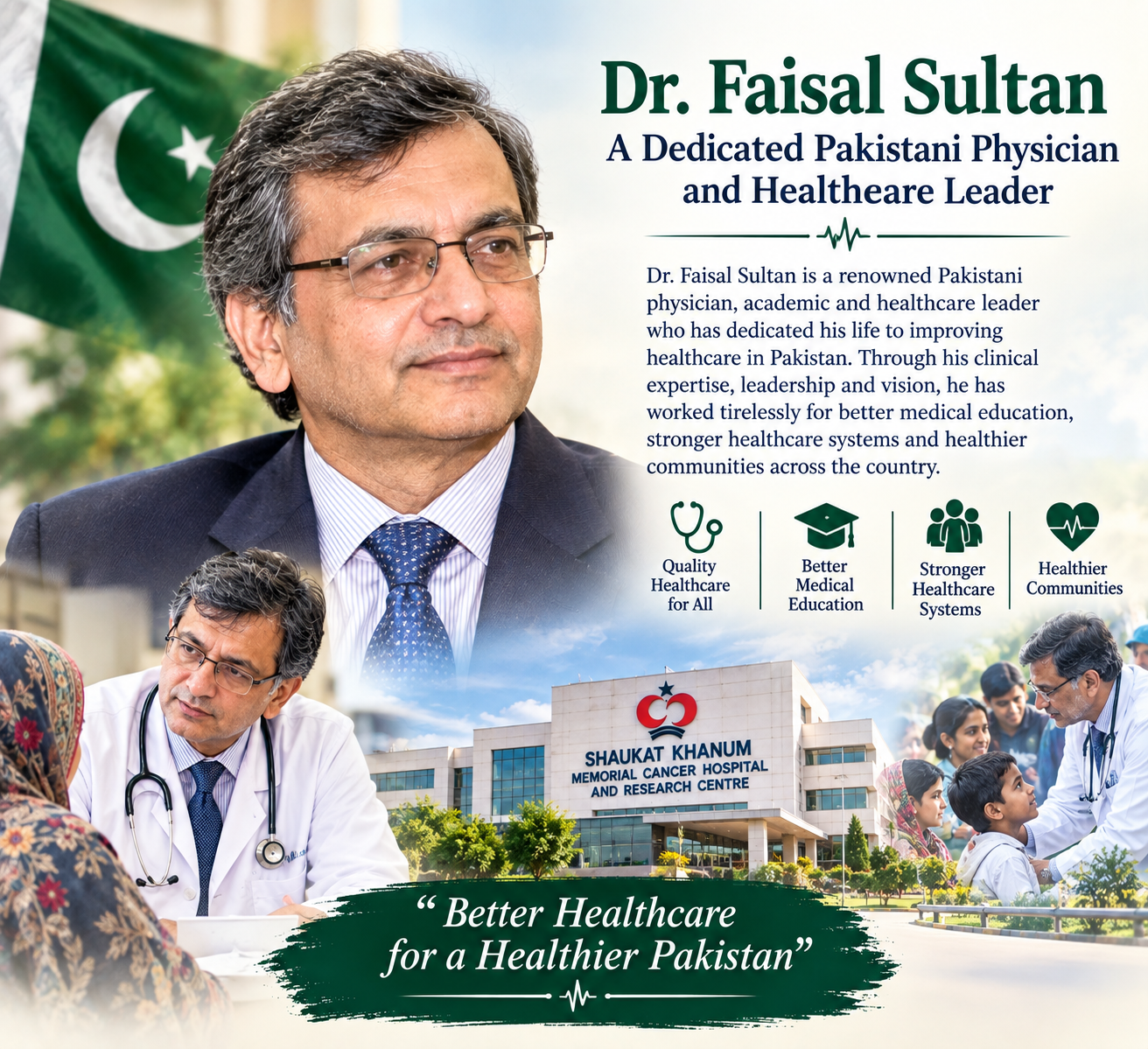
Dr.Faisal Sultan is a well-known Pakistani physician and healthcare leader who has made important contributions to medicine and public health in Pakistan. He is particularly recognized for his work in infectious diseases, healthcare management, medical education, and national health policy. Over the years, he has worked in both clinical medicine and public health, making him an important figure in Pakistan's healthcare sector.
Dr. Sultan's professional journey shows how a doctor can contribute to society in many different ways. A physician can treat individual patients, teach future doctors, help develop healthcare institutions, and contribute to national health policies. Dr. Sultan's career reflects all of these roles.
His experience in infectious diseases became especially important during major public health challenges. His work has demonstrated the importance of scientific knowledge, careful planning, teamwork, and effective communication during health emergencies.
Early Interest in Medicine
Dr. Faisal Sultan chose medicine as his professional field because of the opportunity it provides to understand diseases and help people. Medicine requires years of education and training, but it also requires patience, responsibility, and continuous learning.
During medical education, students learn about the human body, diseases, diagnosis, treatment, and patient care. However, becoming a good doctor requires more than memorizing medical information. Doctors must also learn how to communicate with patients and families and how to make responsible decisions.
Dr. Sultan's later career showed a strong interest in both clinical medicine and broader healthcare issues. His professional path eventually led him toward infectious diseases and healthcare leadership.
Medical Education and Professional Training
Dr. Sultan received his medical education in Pakistan and later developed specialized expertise in infectious diseases and related areas.
Specialization is an important part of modern medicine. As medical knowledge expands, doctors often focus on particular areas so that they can develop deeper expertise.
Infectious disease medicine is particularly important because infections can affect individuals, families, hospitals, and entire communities. Doctors working in this field need to understand how infections spread, how they can be diagnosed, and how patients can be treated.
They also need to understand prevention and public health measures.
Dr. Sultan's professional development in this area helped prepare him for both clinical responsibilities and larger healthcare challenges.
Becoming an Infectious Disease Specialist
Infectious diseases are illnesses caused by microorganisms such as bacteria, viruses, fungi, and parasites. Some infections remain limited to individual patients, while others can spread widely within communities.
An infectious disease specialist may work with patients suffering from complicated infections and may also advise hospitals and public health authorities about infection prevention.
Dr. Sultan became associated with infectious disease medicine in Pakistan and developed experience in managing complex health issues.
His work in this field became particularly significant because Pakistan, like many other countries, faces challenges involving infectious diseases, hospital infections, antimicrobial resistance, and public health emergencies.
Role in Healthcare Institutions
Dr. Sultan has been associated with important healthcare institutions and organizations during his career.
Working within a healthcare institution requires more than medical knowledge. Hospitals depend on doctors, nurses, pharmacists, laboratory staff, administrators, and many other professionals.
A healthcare leader must understand how these different groups work together.
Dr. Sultan's career has included responsibilities involving healthcare management and leadership. These experiences helped him understand the importance of strong systems in delivering effective healthcare.
A good healthcare system needs trained professionals, reliable laboratories, appropriate medicines, good communication, and effective planning.
Contribution to Medical Education
Medical education is another important part of Dr. Sultan's professional life.
Doctors cannot stop learning after receiving their medical degrees. Medical science changes continuously as researchers discover new information and develop new treatments.
Teaching allows experienced physicians to share knowledge with younger doctors and medical students.
Dr. Sultan's involvement in medical education reflects the importance of developing future healthcare professionals.
A strong medical education system benefits society because today's students become tomorrow's doctors, researchers, teachers, and healthcare leaders.
Importance of Public Health
Public health focuses on protecting and improving the health of populations rather than treating only individual patients.
For example, vaccination programs, disease surveillance, sanitation, health education, and infection-control measures are all parts of public health.
Dr. Sultan's career has included both individual medical care and broader public health responsibilities.
This combination is important because many health problems cannot be solved through hospitals alone. Preventing disease can sometimes save more lives than treating disease after it occurs.
Public health professionals therefore work to identify risks, educate communities, and develop strategies to reduce illness.
Work During Health Emergencies
Dr. Sultan became particularly visible to the Pakistani public during major health emergencies.
Health emergencies can place enormous pressure on doctors and healthcare systems. Hospitals may experience increased numbers of patients, while healthcare workers may face difficult working conditions.
During such situations, clear communication becomes extremely important.
People need accurate information about symptoms, prevention, testing, treatment, and when to seek medical help.
Doctors and health officials also need reliable scientific evidence to guide their decisions.
Dr. Sultan's experience in infectious diseases made his expertise especially relevant during such challenging periods.
Contribution During the COVID-19 Pandemic
The COVID-19 pandemic created an unprecedented healthcare challenge across the world, including Pakistan.
During the pandemic, Dr. Sultan became an important national healthcare figure. His medical background and experience in infectious diseases were relevant to discussions about the virus, prevention, healthcare capacity, and public health measures.
The pandemic demonstrated why infectious disease specialists are important.
COVID-19 affected hospitals, schools, workplaces, businesses, families, and communities. Governments had to make difficult decisions while scientific understanding of the new virus was still developing.
Doctors and public health experts played an important role in explaining the situation to the public.
Dr. Sultan's public role during this period helped highlight the importance of science-based healthcare decisions.
Leadership in National Health Affairs
Dr. Sultan also served in important health-related leadership responsibilities at the national level.
National healthcare leadership involves dealing with many different issues. These include hospitals, disease prevention, medical education, vaccination, medicines, healthcare workers, and public health programs.
A national health leader must consider the needs of a very large and diverse population.
Pakistan has both urban and rural communities, and healthcare access can vary significantly between regions.
Therefore, national health policies need careful planning and coordination.
Dr. Sultan's professional experience in medicine and public health gave him a background that was useful for these responsibilities.
Importance of Evidence-Based Medicine
One of the important principles of modern healthcare is evidence-based medicine.
Evidence-based medicine means using reliable scientific research, clinical experience, and patient needs when making healthcare decisions.
Doctors should not depend only on rumors or unverified information.
This principle became particularly important during public health emergencies when misinformation could spread quickly.
Dr. Sultan's professional background in infectious diseases has been connected with the importance of scientific evidence and responsible medical decision-making.
For patients, this approach helps ensure that medical recommendations are based on reliable information.
Fighting Misinformation
Misinformation is a serious challenge in healthcare.
People may receive medical claims through social media, messaging applications, websites, or conversations with friends. Some information may be inaccurate or misleading.
During health emergencies, misinformation can create fear and confusion.
Medical professionals have an important responsibility to communicate clearly and correct false information.
Dr. Sultan's public communication during health-related discussions helped emphasize the importance of listening to qualified medical professionals and relying on scientific information.
This is an important lesson for everyone: health decisions should be based on trustworthy sources rather than rumors.
Importance of Vaccination
Vaccination is one of the major tools used in public health to prevent infectious diseases.
Vaccines help prepare the immune system to respond to specific infections. Large vaccination programs can reduce the spread and severity of certain diseases.
During the COVID-19 pandemic, vaccination became a major part of global public health strategies.
Doctors and health officials had to explain the benefits and limitations of vaccines while also addressing public concerns.
Dr. Sultan's involvement in national health discussions contributed to public awareness about vaccination and other preventive measures.
Healthcare Access in Pakistan
Pakistan faces many healthcare challenges.
The country has a large population, and healthcare resources are not distributed equally everywhere. Some people live close to major hospitals, while others may have limited access to specialized services.
There are also challenges involving healthcare costs, trained staff, medical equipment, and public health infrastructure.
Healthcare leaders therefore have to think about both quality and accessibility.
Dr. Sultan's career demonstrates the importance of strengthening healthcare systems so that medical services can reach more people.
Importance of Strong Hospitals
Hospitals are an essential part of healthcare systems, particularly for serious illnesses and emergencies.
A strong hospital requires much more than a building.
It needs qualified doctors, nurses, laboratories, medicines, diagnostic equipment, emergency services, and good management.
Hospitals must also maintain infection-control practices to protect both patients and healthcare workers.
Dr. Sultan's professional experience has given him an understanding of these challenges and the importance of organized healthcare institutions.
Role of Healthcare Workers
Doctors are often the most visible healthcare professionals, but healthcare depends on teamwork.
Nurses, laboratory technicians, pharmacists, paramedics, administrative staff, cleaners, and many other workers contribute to patient care.
The COVID-19 pandemic especially showed how important healthcare workers are.
They worked under difficult circumstances and helped hospitals continue operating during a major global crisis.
Dr. Sultan's career reflects the importance of cooperation among different healthcare professionals.
Communication with the Public
A doctor's role is not limited to the examination room.
When a health issue affects a large population, doctors may also need to communicate with the public.
Good health communication should be clear, respectful, and based on evidence.
People may not understand complicated medical terminology, so healthcare professionals need to explain important information in simple language.
Dr. Sultan's public role demonstrated the importance of doctors participating in public discussions about health.
Professionalism and Responsibility
Professionalism is an essential quality for doctors.
A professional doctor should respect patients, maintain confidentiality, continue learning, and make responsible medical decisions.
Doctors also need to understand the limits of their knowledge and consult other specialists when necessary.
Dr. Sultan's long career in medicine and healthcare leadership illustrates the importance of professionalism and responsibility.
Inspiration for Medical Students
Dr. Faisal Sultan's career can be an inspiration for students who want to enter medicine.
Medical education is demanding and requires consistent study.
Students need to develop strong knowledge of science, but they also need communication skills, discipline, patience, and empathy.
Dr. Sultan's career demonstrates that medical professionals can develop different paths after completing their education.
A doctor can work in clinical practice, research, teaching, hospital administration, public health, or government healthcare leadership.
Lessons from His Career
There are many lessons that students and young professionals can learn from Dr. Sultan.
The first is the importance of education. Medical knowledge provides the foundation for professional work.
The second is the importance of continuous learning. Medicine changes quickly, so doctors need to remain updated.
The third is the importance of teamwork. Healthcare is rarely the work of one person.
The fourth is the importance of communication. Medical knowledge has little value if patients cannot understand important advice.
The fifth is the importance of public service. Doctors can use their expertise to improve the health of entire communities.
Contribution to Pakistan
Dr. Sultan's contribution to Pakistan can be viewed through several areas: clinical medicine, infectious disease expertise, medical education, healthcare leadership, and public health communication.
His career demonstrates how specialized medical knowledge can become useful at both individual and national levels.
When a doctor treats a patient, the impact may be limited to that individual and family. When a doctor contributes to public health policy, education, or disease prevention, the impact can reach much larger groups.
This broader contribution is an important part of Dr. Sultan's professional legacy.
The Importance of Young Healthcare Professionals
Pakistan needs a new generation of doctors, nurses, researchers, and public health professionals.
Young healthcare workers will face new challenges, including emerging infectious diseases, antimicrobial resistance, changing population needs, and technological developments.
The experiences of established healthcare leaders can help younger professionals understand these challenges.
Dr. Sultan's career provides an example of how medical knowledge can be combined with leadership and public service.
Future of Healthcare in Pakistan
The future of healthcare in Pakistan depends on many factors.
The country needs stronger hospitals, better primary healthcare, improved disease prevention, modern laboratories, trained healthcare workers, and greater public awareness.
Technology will also play an increasingly important role.
Digital health services, electronic medical records, telemedicine, and modern diagnostic tools can improve access to healthcare when they are implemented properly.
At the same time, basic healthcare services remain extremely important.
The future healthcare system should combine modern technology with strong human care.
A Lasting Professional Legacy
Dr. Faisal Sultan's professional legacy is connected with medicine, infectious disease care, public health, healthcare leadership, and medical education.
His career shows that being a doctor is not only about treating diseases. It can also involve teaching, research, leadership, communication, and serving society.
His work during major health challenges demonstrated the importance of experienced medical professionals in guiding communities through difficult situations.
Conclusion
Dr. Faisal Sultan is an important Pakistani physician and healthcare leader whose career has contributed to medicine and public health. His experience in infectious diseases, medical education, healthcare management, and national health affairs has made him a respected figure in Pakistan's healthcare sector.
His professional journey provides valuable lessons for students and young doctors. It shows the importance of education, continuous learning, scientific evidence, teamwork, communication, and public service.
Healthcare is not only about hospitals and medicines. It is also about building systems that protect communities and helping people understand how to maintain their health.
Dr. Sultan's career demonstrates how a medical professional can contribute at many levels, from caring for patients to supporting broader public health efforts. His work remains an example of how medical knowledge, leadership, and dedication can be used to serve society.
FAQs
1. Who is Dr. Faisal Sultan?
Dr. Faisal Sultan is a Pakistani physician and healthcare leader known for his expertise in infectious diseases and public health.
2. What is Dr. Faisal Sultan known for?
He is known for his medical work, healthcare leadership, public health contributions, and involvement in national health affairs.
3. What is Dr. Faisal Sultan's medical specialty?
He is associated with infectious disease medicine and internal medicine.
4. Did Dr. Faisal Sultan play a role during COVID-19?
Yes. His infectious disease expertise and healthcare leadership made him a prominent figure in Pakistan's response and public health discussions during the COVID-19 pandemic.
5. Why is Dr. Faisal Sultan an inspiration for students?
His career shows how education, medical knowledge, leadership, and public service can be combined to contribute to society.