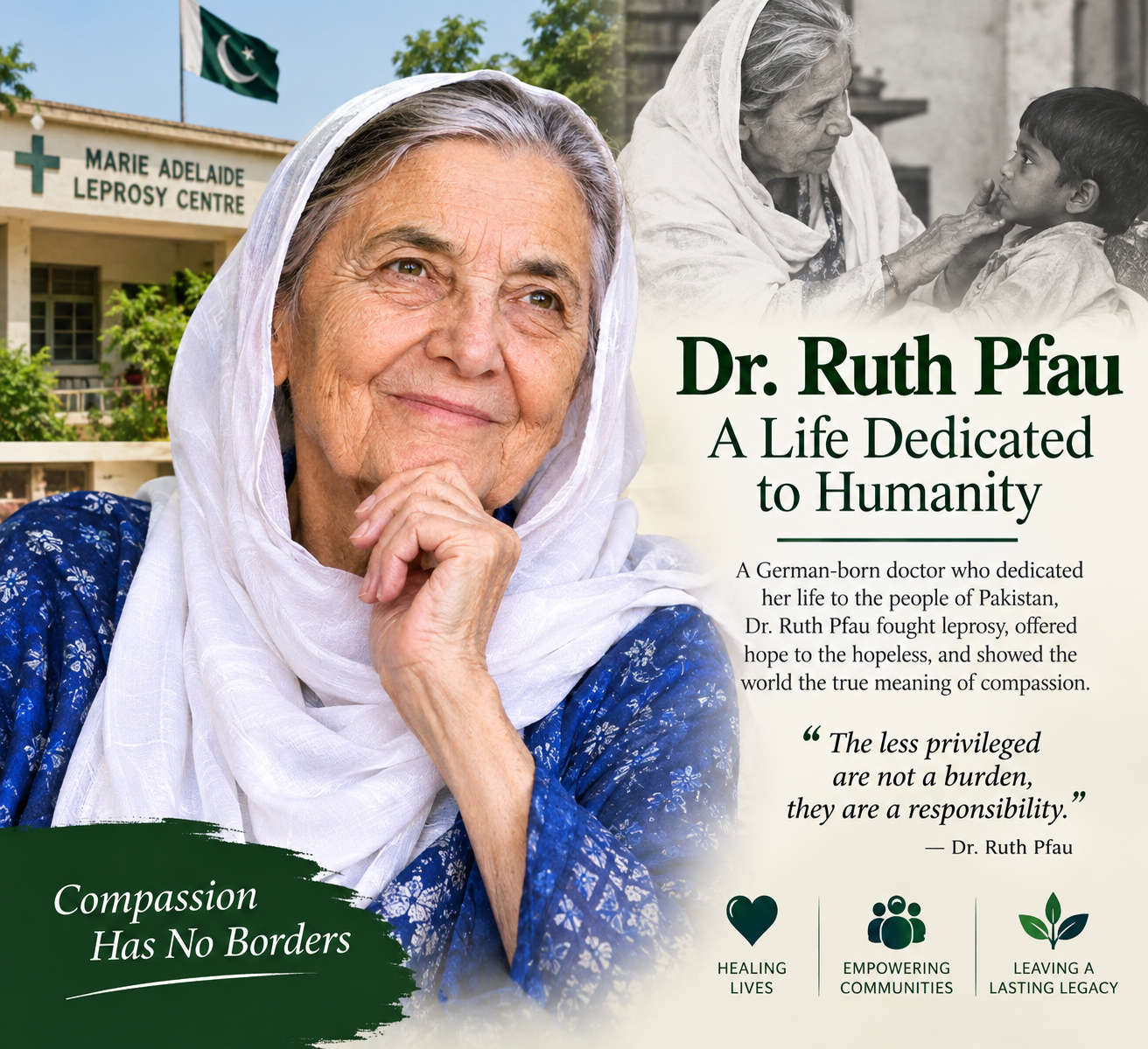
Dr. Ruth Pfau was one of the most remarkable welfare personalities associated with Pakistan. Although she was born in Germany, she devoted more than five decades of her life to serving the people of Pakistan. She became especially famous for her tireless struggle against leprosy, a disease that once carried a great deal of fear, misunderstanding, and social stigma. Through her medical knowledge, courage, compassion, and determination, she helped thousands of patients receive treatment and dignity.
Dr. Ruth Pfau arrived in Pakistan in 1960. During her early years in the country, she encountered people suffering from leprosy in Karachi and was deeply affected by their condition. Instead of simply feeling sympathy for them, she decided to make their welfare the purpose of her life. She worked to improve medical treatment, establish healthcare facilities, train medical workers, and create awareness about leprosy. Her efforts eventually became part of a nationwide campaign to control the disease.
The Marie Adelaide Leprosy Centre (MALC) became closely associated with her life's work. What began as a small effort to care for neglected patients developed into a major network for diagnosis, treatment, rehabilitation, and awareness. The centre's own historical account records that Dr. Pfau joined the work in 1960 and helped transform the early dispensary into a proper treatment and rehabilitation centre.
Early Life of Dr. Ruth Pfau
Dr. Ruth Pfau was born in Leipzig, Germany, in 1929. She grew up during a difficult period in European history. The Second World War and the destruction around her influenced her understanding of suffering and human vulnerability. Despite the difficulties of her early life, she developed an interest in medicine and eventually pursued medical education.
She studied medicine and later became associated with the Society of the Daughters of the Heart of Mary. Her medical training and spiritual commitment eventually led her toward a life devoted to helping people who were suffering.
Her decision to work with disadvantaged people was not based on wealth or fame. She believed that medicine should be used to restore human dignity. This philosophy later became one of the most important features of her work in Pakistan.
Arrival in Pakistan
Dr. Ruth Pfau came to Pakistan in 1960. At that time, healthcare facilities were limited in many areas, particularly for people who were poor and socially marginalized.
During her stay in Karachi, she encountered a community of people affected by leprosy. Many patients were not only suffering from the disease but were also facing rejection and discrimination. Their condition deeply affected Dr. Pfau.
Instead of returning to a more comfortable life, she decided to remain in Pakistan and serve these patients. The Ruth Pfau Foundation records that her first encounter with people affected by leprosy in Karachi became a defining moment in her life and work.
This decision changed the course of both her life and the history of leprosy treatment in Pakistan.
Her Fight Against Leprosy
Leprosy was once surrounded by fear and misunderstanding. Many people did not understand the disease properly and treated patients as if they were dangerous or untouchable. This social stigma made the lives of patients even more difficult.
Dr. Pfau understood that fighting leprosy required more than medicine. It required education, awareness, rehabilitation, and compassion.
She visited patients, studied their conditions, organized treatment, and worked with other healthcare professionals. She also travelled to distant parts of Pakistan where patients had little or no access to medical facilities.
Her approach was based on a simple principle: every patient deserved treatment and respect.
She did not judge people because of their illness. Instead, she treated them as human beings who needed medical care and emotional support.
Marie Adelaide Leprosy Centre
One of the greatest institutions associated with Dr. Ruth Pfau is the Marie Adelaide Leprosy Centre in Karachi.
The centre's history explains that the early work began with a small dispensary serving people affected by leprosy. When Dr. Pfau arrived in 1960, she became an important part of the effort and helped transform the basic facility into a proper treatment and rehabilitation centre.
The centre became much more than a place where patients received medicine. It developed into a place where people could find hope, rehabilitation, education, and dignity.
The work also expanded beyond Karachi. Treatment and control centres were established in different parts of Pakistan so that patients living far away could receive assistance.
According to Pakistan's Ministry of Foreign Affairs, Dr. Pfau helped establish leprosy treatment centres in more than 150 cities and towns and contributed to the development of a national programme for controlling the disease.
Establishment of a National Programme
Dr. Ruth Pfau realized that a national problem required a national response. Treating individual patients was important, but controlling the disease throughout Pakistan required organized planning.
In 1968, she played an important role in persuading the Government of Pakistan to undertake a National Leprosy Control Programme in cooperation with the Marie Adelaide Leprosy Centre. This programme helped establish treatment and control centres across the country.
This was a major step because it transformed the fight against leprosy from a small charitable effort into a broader public-health programme.
Dr. Pfau also supported the training of doctors, paramedics, and other healthcare workers. She understood that lasting progress depended on building local medical capacity.
Her Work in Remote Areas
Dr. Ruth Pfau did not restrict her work to major cities.
She travelled to remote and underserved areas of Pakistan to identify patients and understand the challenges they faced. Many people living in villages and distant regions could not easily travel to large hospitals.
For such communities, the availability of local treatment centres was extremely important.
Her willingness to travel and work in difficult circumstances demonstrated her commitment to the people she served. She believed that healthcare should reach people rather than waiting for vulnerable people to somehow reach healthcare.
This philosophy made her work particularly meaningful for poor communities.
Changing Social Attitudes
Perhaps one of Dr. Pfau's most important achievements was changing the way society looked at people affected by leprosy.
A disease can cause physical suffering, but social rejection can create another kind of suffering. Patients may feel isolated, ashamed, or unwanted when society treats them unfairly.
Dr. Pfau challenged these attitudes through education and personal example.
She showed that patients should not be treated as outcasts. They deserved medical treatment, family support, education, employment opportunities, and respect.
Her work therefore had two dimensions: medical treatment and social rehabilitation.
The legacy of the Marie Adelaide Leprosy Centre continues to emphasize treatment, rehabilitation, dignity, and community-based healthcare.
Her Role as a Medical Adviser
Dr. Pfau's expertise became recognized at the national level. In 1979, she was appointed Federal Advisor on Leprosy to the Ministry of Health and Social Welfare of the Government of Pakistan.
This position reflected the importance of her experience and knowledge.
As an adviser, she could contribute not only to individual patient care but also to national strategies for controlling the disease.
Her role demonstrated how welfare work can influence public policy when it is supported by professional knowledge and practical experience.
Pakistan's Progress Against Leprosy
The efforts of Dr. Ruth Pfau and many other healthcare workers contributed significantly to Pakistan's progress in controlling leprosy.
In 1996, the World Health Organization recognized Pakistan as having achieved leprosy control according to the relevant public-health target. Pakistan's Ministry of Foreign Affairs describes this as an important result of Dr. Pfau's long campaign against the disease.
This achievement was not the result of one person alone. Doctors, nurses, government officials, social workers, volunteers, donors, patients, and communities all contributed to the broader effort.
However, Dr. Pfau became a symbol of that struggle because she had dedicated her life to it.
Beyond Leprosy
Dr. Ruth Pfau's welfare work did not stop with leprosy.
As healthcare programmes developed, the broader work associated with the Marie Adelaide Leprosy Centre also included areas such as tuberculosis control and blindness prevention.
This shows that her vision was broader than fighting one disease. She wanted disadvantaged communities to have better access to healthcare generally.
Her work demonstrated the importance of prevention as well as treatment.
Service During Difficult Times
Dr. Pfau also participated in humanitarian relief efforts during major crises in Pakistan.
She was involved in relief activities following the 2005 earthquake and the 2010 floods. Her willingness to help people during emergencies demonstrated that her welfare philosophy extended beyond her main medical mission.
For her, service was not simply a profession. It was a responsibility toward humanity.
Awards and Recognition
Dr. Ruth Pfau received numerous national and international awards during her lifetime.
Among the Pakistani honours associated with her are Hilal-e-Imtiaz and Hilal-e-Pakistan. She also received international recognition, including the Ramon Magsaysay Award for Public Service in 2002.
She was also granted honorary Pakistani citizenship in 1988. This was a powerful recognition of her connection with the country she had chosen to serve for decades.
These awards were important, but Dr. Pfau's greatest achievement was the difference she made in the lives of ordinary people.
Why Dr. Ruth Pfau Is Called a Welfare Personality
A welfare personality is someone who works for the improvement of society and the well-being of others.
Dr. Ruth Pfau fits this description because her life was centred around service.
She worked for people who were often ignored by society. She provided medical care, promoted awareness, supported rehabilitation, trained healthcare workers, and helped develop systems that could serve patients on a national scale.
Her work also teaches an important lesson: welfare is not only about giving money or material goods. It can also mean giving time, knowledge, education, medical treatment, emotional support, and respect.
Her Personality and Character
Dr. Pfau was widely admired for her dedication and humility.
She could have chosen a comfortable life, but instead she spent decades working with poor and marginalized communities.
Her character teaches us several important qualities:
Compassion toward suffering people
Courage in difficult situations
Patience when solving long-term problems
Professional dedication
Respect for every human being
Commitment to public service
Willingness to work beyond personal comfort
These qualities make her an inspiring role model for young people.
Dr. Ruth Pfau and the Meaning of Humanity
Dr. Ruth Pfau's story is ultimately a story about humanity.
She was born in Germany but devoted her life to Pakistan. She showed that humanity is not limited by nationality, language, religion, or geographical boundaries.
Her patients did not need to know where she was born. They needed someone who would stand beside them when society had turned away.
That is one reason why her legacy remains powerful.
The Punjab Women Development Department described her in 2026 as a figure remembered for more than five decades of service against leprosy and for restoring health, dignity, and hope to thousands of people.
Her Final Years and Death
Dr. Ruth Pfau continued to be remembered and respected in Pakistan throughout her later years.
She died in Karachi on August 10, 2017, at the age of 87.
Pakistan honoured her with a state funeral. The Ministry of Foreign Affairs noted that she was buried with full state honours in Karachi and highlighted her decades of service to disadvantaged people affected by leprosy.
Her death was widely mourned because she had become more than a doctor. She had become a symbol of compassion and public service.
Her Lasting Legacy
Dr. Ruth Pfau's legacy continues through the institutions and programmes connected with her work.
The Marie Adelaide Leprosy Centre continues to provide healthcare and support to communities across Pakistan. A 2026 account published by Dawn reported that the organization had treated and cured more than 60,000 patients over its history and had expanded its services to a nationwide network.
This demonstrates that a person's greatest legacy may be the institutions and values they leave behind.
Dr. Pfau did not simply treat patients during her lifetime. She helped build a system capable of continuing to serve people after her death.
Lessons for Pakistani Youth
The life of Dr. Ruth Pfau contains many lessons for young people.
First, it teaches that one person can make a difference. A single individual may not solve every problem, but consistent effort can create meaningful change.
Second, her life teaches the importance of education. Her medical knowledge became a powerful tool for helping others.
Third, she teaches us not to judge people because of illness, poverty, or social status.
Fourth, her life shows that success is not measured only by money or fame. A successful life can also be measured by the number of people helped and the positive change created in society.
Finally, Dr. Pfau teaches us that service requires patience. Some social problems cannot be solved in a few months or years. They require decades of dedication.
Conclusion
Dr. Ruth Pfau was one of Pakistan's most respected welfare personalities. Her life was dedicated to serving people affected by leprosy and other health problems. From her arrival in Pakistan in 1960 to her death in 2017, she spent decades working for people who were often neglected and socially isolated.
Her contribution went far beyond medical treatment. She helped establish healthcare facilities, supported a national leprosy-control programme, trained healthcare workers, travelled to underserved areas, promoted awareness, and fought the social stigma associated with leprosy.
Her efforts contributed to Pakistan's achievement of leprosy control in 1996, an important milestone in the country's public-health history.
Dr. Ruth Pfau's life reminds us that true welfare work is based on compassion, courage, knowledge, and consistency. She did not serve people because she expected fame or wealth. She served because she believed that every human being deserved dignity and care.
Although she is no longer alive, her message continues through the people and institutions that carry forward her mission. Her story will remain an important part of Pakistan's history and a source of inspiration for future generations.
FAQs
1. Who was Dr. Ruth Pfau?
Dr. Ruth Pfau was a German-born doctor and humanitarian who dedicated most of her life to serving people in Pakistan, particularly patients affected by leprosy.
2. When did Dr. Ruth Pfau come to Pakistan?
Dr. Ruth Pfau came to Pakistan in 1960 and began her long humanitarian journey in the country.
3. What was Dr. Ruth Pfau famous for?
She was famous for her decades-long struggle against leprosy and her work with the Marie Adelaide Leprosy Centre and Pakistan's national leprosy-control efforts.
4. What awards did Dr. Ruth Pfau receive?
She received several national and international honours, including Hilal-e-Imtiaz, Hilal-e-Pakistan, and the Ramon Magsaysay Award for Public Service.
5. When did Dr. Ruth Pfau die?
Dr. Ruth Pfau died on August 10, 2017, in Karachi. Pakistan honoured her with a state funeral in recognition of her exceptional service.