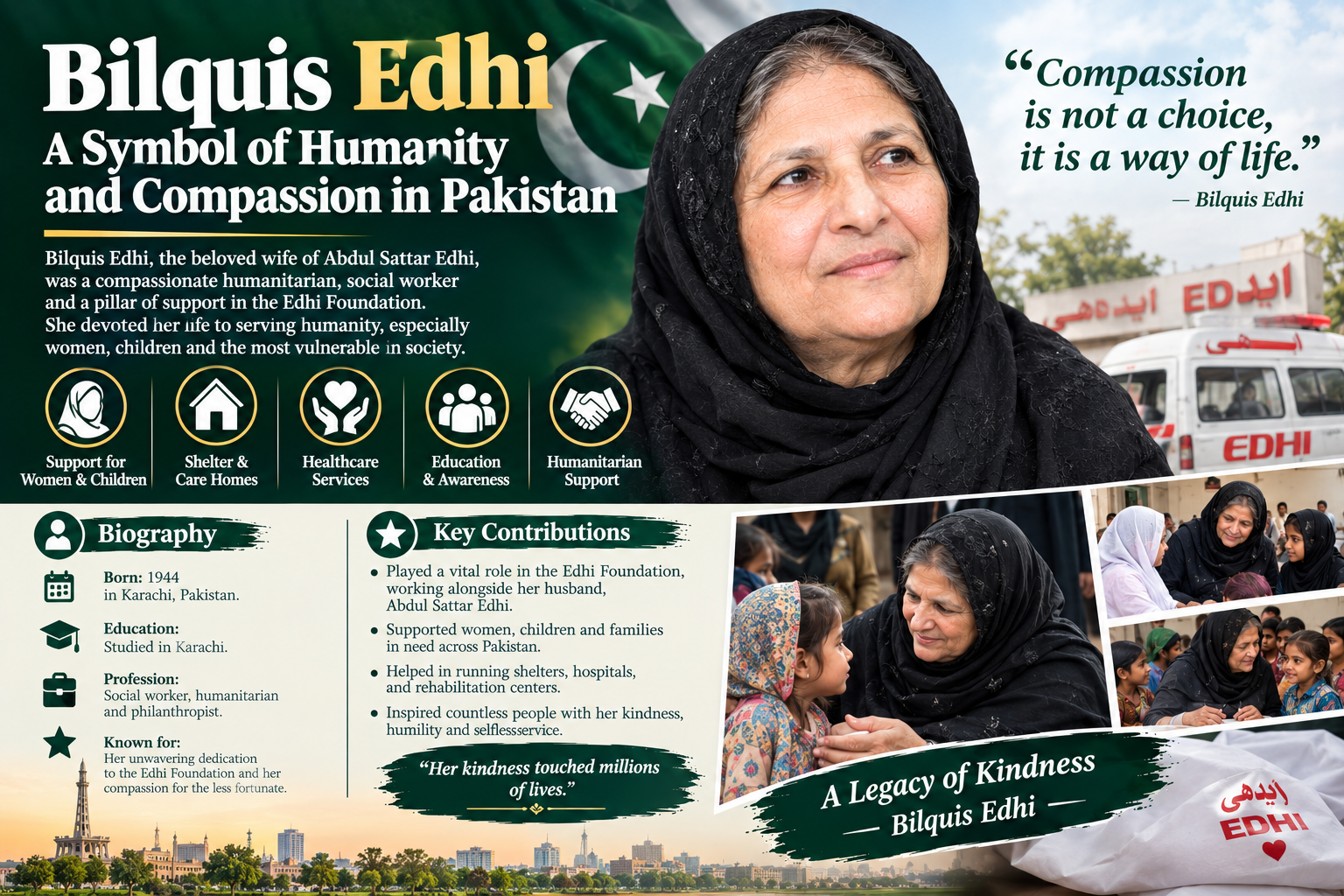
Bilquis Edhi was one of Pakistan's most respected humanitarian personalities. For decades, she dedicated her life to helping poor families, abandoned children, women, patients, and other vulnerable members of society. She worked alongside her husband, Abdul Sattar Edhi, and became an important figure in the development of the Edhi Foundation.
Her story is inspiring because she chose a life of service at a time when nursing and social welfare were not easy paths for many women in Pakistan. She began her professional journey as a nurse and gradually became an important part of one of the country's best-known welfare movements.
Bilquis Edhi's contribution is especially important because she focused strongly on women and children. Through maternity services, children's homes, care for abandoned babies, and other welfare activities, she helped create a system where vulnerable people could receive protection and support.
The Edhi Foundation describes Bilquis Bano Edhi as a humanitarian who began her journey as a nurse at the Edhi Nurses Training Centre. After marrying Abdul Sattar Edhi in 1966, she worked with him to help poor and vulnerable people despite having limited financial resources.
Her life demonstrates that humanitarian work is not limited to one profession, one gender, or one social class. A nurse can become a social leader. A small welfare effort can become a major institution. And one person's compassion can inspire generations.
Early Life of Bilquis Edhi
Bilquis Bano Edhi was born on August 14, 1947. According to a Dawn remembrance published after her death, she entered the nursing profession at a young age and joined the dispensary associated with Abdul Sattar Edhi's welfare work in 1965.
At that time, nursing was not necessarily a common career choice for every young woman in Pakistan. Her decision to enter the profession reflected her interest in caring for people.
Nursing introduced Bilquis to people who were sick, poor, and in need of assistance. This experience helped shape the humanitarian role she would later play.
Her early professional life was therefore connected with service from the beginning.
She was not simply interested in having a career. Her work placed her directly in contact with people who needed compassion and medical assistance.
Becoming a Nurse
Bilquis Edhi began her journey at the Edhi Nurses Training Centre. The Edhi Foundation's official profile identifies nursing as the beginning of her humanitarian journey.
Nursing requires patience, responsibility, discipline, and compassion.
A nurse often meets people during some of the most difficult moments of their lives. This makes nursing more than a technical profession. It also requires understanding and kindness.
Bilquis developed these qualities through her work.
Her nursing experience later became extremely useful in the wider welfare activities she undertook with Abdul Sattar Edhi.
She understood the needs of mothers, newborn babies, sick people, and families who could not afford proper medical support.
Meeting Abdul Sattar Edhi
Bilquis Edhi met Abdul Sattar Edhi while working in his welfare setup.
According to Dawn's account, she was working as a nurse when she met Edhi and later married him in 1966.
Their marriage became the beginning of a long partnership in humanitarian work.
Rather than separating their personal and professional lives completely, they worked together to expand services for people in need.
Their partnership lasted for decades and became an important part of the history of the Edhi Foundation.
A Partnership Built on Service
Bilquis and Abdul Sattar Edhi shared a strong commitment to helping disadvantaged people.
The Edhi Foundation's official biography says that after their marriage, they worked together to help poor people despite having limited financial resources.
Their partnership demonstrates that social change can be strengthened when people share a common purpose.
Abdul Sattar Edhi became widely known for ambulance services and broad humanitarian work, while Bilquis became especially associated with maternity care, children's welfare, and support for women.
Together, they created a powerful humanitarian team.
Bilquis Edhi and Women's Welfare
One of Bilquis Edhi's most important contributions was her work for women.
Women from poor families can face many difficulties when they need medical treatment, maternity care, or safe accommodation.
Bilquis understood these problems through both her nursing experience and her welfare work.
She helped develop services that provided support to women, especially mothers and women facing difficult circumstances.
The Edhi Foundation credits her with an important role in running maternity-related services and helping with adoption activities.
Her work demonstrated the importance of having welfare services that understand the specific needs of women.
Maternity Services
Maternity care was a major part of Bilquis Edhi's humanitarian work.
Pregnancy and childbirth can be challenging, particularly for women who lack financial resources or family support.
Through the welfare system associated with the Edhi Foundation, Bilquis helped provide maternity-related services to women who needed assistance.
Her nursing background gave her a practical understanding of maternal healthcare.
She recognised that helping a mother can also protect the life and future of her child.
This made maternity services an important part of her humanitarian vision.
Care for Newborn Children
Bilquis Edhi became particularly associated with the protection of abandoned and vulnerable newborn babies.
The Edhi Foundation provides children's homes and welfare services for vulnerable children. It also maintains cradles at Edhi centres where abandoned babies can be left safely rather than being exposed to dangerous circumstances.
This was an important humanitarian idea.
Instead of ignoring the problem of abandoned children, Bilquis and the Edhi Foundation worked to provide a safe alternative.
The approach was based on protection and care.
It reflected the belief that every child deserves a chance to live in safety and receive attention.
The Cradle Initiative
The cradles associated with Edhi centres became one of the most recognisable aspects of the foundation's child welfare work.
They provided a way for vulnerable parents to leave babies in a protected environment rather than abandoning them in unsafe places.
This initiative reflected the practical nature of the Edhi welfare system.
The organisation did not simply discuss social problems.
It attempted to create practical solutions.
Bilquis's involvement in child welfare helped strengthen this mission.
Adoption and Child Welfare
Bilquis Edhi also played an important role in adoption-related activities.
The Edhi Foundation's official profile specifically mentions her work with adoptions.
The purpose of such work was to give vulnerable children opportunities for care and family support.
For a child without adequate family protection, a safe and supportive home can make a major difference.
Bilquis understood that child welfare was not only about providing temporary shelter.
It was also about giving children dignity, protection, and opportunities for a better future.
Children's Homes
The Edhi Foundation developed homes and facilities for children who were abandoned or lacked adequate family support.
Bilquis was closely associated with this side of the organisation's work.
These facilities were designed to provide children with basic necessities and care.
The organisation continues to list children's homes and orphanage centres among its major welfare services.
This is an important part of Bilquis Edhi's legacy because children are among the most vulnerable members of society.
A Voice for Vulnerable Women
Bilquis Edhi's humanitarian work also demonstrated that women can become powerful leaders in social welfare.
She began as a nurse but eventually became a nationally recognised humanitarian.
Her example encouraged the idea that women can contribute to society through healthcare, education, social work, leadership, and community service.
Her journey is therefore meaningful for young Pakistani girls and women who want to build careers based on service.
Working During Difficult Times
Pakistan has experienced many difficult periods, including natural disasters, accidents, poverty, and social crises.
The Edhi welfare network responded to many of these challenges.
Dawn's remembrance of Bilquis described the presence of Edhi ambulances and welfare workers during periods of violence, natural disasters, and other emergencies.
Bilquis's contribution was part of this larger humanitarian system.
Her work demonstrated the importance of remaining committed to people even when circumstances are difficult.
A Simple and Humble Personality
Bilquis Edhi was widely remembered as a simple and approachable woman.
Dawn described her as a seemingly simple woman whose humanitarian personality reflected a strong and deeply human character.
Her lifestyle was connected with the same values that defined the Edhi movement: simplicity, compassion, and service.
She did not need luxury or fame to make an impact.
Her influence came from the work she performed and the people she helped.
Working Alongside Abdul Sattar Edhi
Bilquis and Abdul Sattar Edhi worked together for approximately five decades.
Their partnership was not based only on family life. It was also a shared humanitarian mission.
Dawn reported that they were married for 50 years before Abdul Sattar Edhi's death in 2016.
During those decades, they helped develop an organisation that provided services to people across Pakistan.
Their story shows how a shared purpose can strengthen both personal and social relationships.
Her Role After Abdul Sattar Edhi
When Abdul Sattar Edhi died in 2016, many people wondered how his humanitarian mission would continue.
Bilquis Edhi continued supporting the mission.
Dawn reported in 2017 that she remained involved in the welfare work and expressed confidence that the work would continue.
This was important because the Edhi Foundation had become much larger than one individual.
It had developed systems, staff, volunteers, donors, and facilities that could continue serving people.
Bilquis helped carry the spirit of the mission forward.
A Legacy of Continuity
One of the greatest achievements of Bilquis Edhi was her contribution to continuity.
Humanitarian organisations need more than inspiring founders.
They need people who can continue the mission, manage services, care for beneficiaries, and maintain public trust.
Bilquis played an important role in ensuring that the humanitarian spirit of the Edhi movement remained alive.
Her work helped demonstrate that a welfare mission can continue across generations.
Recognition and Awards
Bilquis Edhi received significant recognition for her humanitarian work.
The Edhi Foundation states that she received major honours including the Hilal-e-Imtiaz and Lenin Peace Prize, and that she and Abdul Sattar Edhi received the Ramon Magsaysay Award for Public Service in 1986.
These awards reflected the importance of their humanitarian services.
However, awards were not the main purpose of Bilquis's life.
Her greatest contribution was the practical help she provided to people.
Ramon Magsaysay Award
The Ramon Magsaysay Award is one of the well-known recognitions associated with the Edhi couple.
Bilquis and Abdul Sattar Edhi received the award for public service in 1986, according to the Edhi Foundation.
This recognition helped bring international attention to their humanitarian work.
It also demonstrated that a welfare movement built in Pakistan could become an example of public service beyond the country.
Hilal-e-Imtiaz
Bilquis Edhi also received the Hilal-e-Imtiaz for her humanitarian services.
The award is one of Pakistan's significant civilian honours.
Its association with Bilquis reflects the national importance of her work.
She became recognised not only as Abdul Sattar Edhi's wife but also as a humanitarian personality in her own right.
International Recognition
Bilquis Edhi's work gained attention outside Pakistan because of the scale and nature of the Edhi Foundation's services.
The foundation's official profile notes that Abdul Sattar and Bilquis Edhi received recognition from national and international organisations.
Their work demonstrated how a community-based welfare organisation could develop a broad humanitarian impact.
Humanitarian Services of the Edhi Foundation
To understand Bilquis Edhi's contribution, it is important to understand the wider system she helped build.
The Edhi Foundation provides healthcare, education, ambulance services, children's homes, orphanage centres, shelters, graveyard services, and other welfare assistance.
These services address different stages of human need.
A person may need emergency transportation.
Another may need medical care.
A child may need protection.
A mother may need maternity services.
A homeless person may need shelter.
A vulnerable family may need food or clothing.
The foundation attempts to respond to many of these needs.
Service Without Discrimination
The Edhi Foundation describes itself as non-commercial, non-political, and non-communal, and says its services are provided without discrimination based on colour, class, or creed.
This principle is strongly connected with Bilquis Edhi's humanitarian legacy.
Helping people should not depend on their wealth or social position.
A person who needs assistance deserves respect.
This inclusive approach helped the Edhi Foundation develop trust among different communities.
Compassion as a Leadership Quality
Bilquis Edhi's life demonstrates that compassion can be a form of leadership.
Leadership does not always mean holding an official political position.
It can mean identifying a problem, helping people, organising resources, and encouraging others to contribute.
Bilquis did this through nursing and welfare work.
Her leadership was based on service rather than authority.
The Importance of Nursing
Bilquis Edhi's story is also an inspiring example of the importance of nursing.
Nurses play a major role in healthcare systems.
They care for patients, support families, assist doctors, and provide comfort during difficult situations.
Bilquis began her humanitarian journey through nursing and later expanded her work into wider social welfare.
Her story demonstrates how professional skills can become the foundation for broader social service.
Women as Social Leaders
Bilquis Edhi became an important example of female leadership in Pakistan.
Her work demonstrated that women can lead major humanitarian efforts.
She contributed to healthcare, child protection, maternity services, and social welfare.
Her achievements can encourage young women to develop skills and use those skills for the benefit of society.
Her life shows that leadership can take many forms.
A Role Model for Young People
Young people can learn many lessons from Bilquis Edhi.
The first is compassion.
The second is discipline.
The third is patience.
The fourth is responsibility.
The fifth is consistency.
She did not create her legacy in a single day.
She spent decades working for vulnerable people.
Students can apply these values in their own lives.
They can help classmates, support community activities, respect elderly people, care for children, and contribute to welfare projects.
The Power of Teamwork
Bilquis Edhi's story also teaches the value of teamwork.
The Edhi Foundation was not created by one person working alone.
It involved Abdul Sattar Edhi, Bilquis Edhi, their family, nurses, ambulance workers, volunteers, donors, doctors, and many other supporters.
Every person had a role.
This teaches an important lesson: major social change usually happens when many people contribute to a shared purpose.
Family and Humanitarian Service
The Edhi family became closely associated with humanitarian work.
The Edhi Foundation's profile notes that Abdul Sattar and Bilquis Edhi's children were encouraged to continue the family's service-oriented mission.
This illustrates how values can be passed from one generation to another.
A family legacy does not have to be about wealth or property.
It can also be about kindness, responsibility, and service.
Bilquis Edhi's Final Years
Bilquis Edhi remained associated with humanitarian work throughout her life.
She passed away on April 15, 2022, after a long life dedicated to service.
Her death was widely mourned across Pakistan.
Dawn's remembrance described her as a major social worker whose humanitarian identity had grown through decades of service.
Her passing marked the end of an important chapter in Pakistan's humanitarian history.
Her Lasting Influence
Although Bilquis Edhi is no longer alive, her influence continues through the welfare institutions associated with her name and work.
The Edhi Foundation continues to provide services to people in need.
Its current website highlights its ongoing commitment to underserved communities and lists healthcare, education, ambulance services, children's homes, hospitals, and other welfare activities.
This continuing work ensures that Bilquis's humanitarian values remain relevant.
Why Bilquis Edhi Matters to Pakistan
Pakistan has many challenges, and social welfare remains important.
Government institutions have major responsibilities, but charities and community organisations also play an important role.
Bilquis Edhi demonstrated how dedicated citizens can contribute to solving social problems.
Her life showed that humanitarian service can become a national institution when it is built on honesty, compassion, and public trust.
Her Message of Hope
Bilquis Edhi's life sends a message of hope.
A person does not have to begin with great wealth.
She started as a nurse.
She worked with the resources available to her.
She helped one person at a time.
Over the years, those individual acts of service became part of a much larger humanitarian movement.
This is an important lesson for everyone.
Big achievements often begin with small acts.
The Meaning of True Service
True service means helping people without expecting something in return.
Bilquis Edhi's life reflected this principle.
Her work was centred around people who needed assistance.
She did not make humanitarian work about personal fame.
Her recognition came because of the work itself.
This makes her an excellent example of selfless service.
A Legacy for Future Generations
The future generation can continue Bilquis Edhi's values.
Young people can learn that kindness is not weakness.
Helping someone is not a small achievement.
Respecting vulnerable people is an important part of a healthy society.
Volunteering, donating useful items, supporting educational activities, and helping people in difficult circumstances are all ways of following the spirit of humanitarian service.
Conclusion
Bilquis Edhi was an extraordinary Pakistani humanitarian whose life was devoted to caring for people in need. She began her journey as a nurse and later became an important part of the Edhi Foundation alongside Abdul Sattar Edhi.
Her contribution to maternity care, women's welfare, child protection, adoption-related activities, and broader social welfare made her an important figure in Pakistan's humanitarian history.
She demonstrated that women can play a powerful role in building and leading social welfare institutions.
Her partnership with Abdul Sattar Edhi lasted for decades and became one of the most meaningful humanitarian partnerships in Pakistan.
She remained committed to vulnerable people even during difficult times.
Her awards, including the Hilal-e-Imtiaz and the Ramon Magsaysay Award for Public Service, reflected the importance of her contribution.
However, the greatest measure of Bilquis Edhi's success is not the number of awards she received.
It is the number of people who received care, protection, shelter, medical assistance, and hope through the welfare system she helped build.
Her life teaches us that compassion can become action, action can become service, and service can become a legacy.
Bilquis Edhi will always be remembered as a symbol of kindness, courage, simplicity, and humanitarian service in Pakistan.
Her story reminds us that one person with dedication can help change countless lives.
Most importantly, her legacy encourages future generations to understand that a better society is created when people care about one another
FAQs
1. Who was Bilquis Edhi?
Bilquis Edhi was a Pakistani humanitarian and nurse who worked alongside Abdul Sattar Edhi and contributed greatly to the Edhi Foundation.
2. What was Bilquis Edhi famous for?
She was particularly known for her work in maternity care, women's welfare, children's welfare, and support for abandoned children
3. When did Bilquis Edhi marry Abdul Sattar Edhi?
Bilquis Edhi married Abdul Sattar Edhi in 1966.
4. What awards did Bilquis Edhi receive?
Among her recognised honours were the Hilal-e-Imtiaz and Lenin Peace Prize; she and Abdul Sattar Edhi also received the 1986 Ramon Magsaysay Award for Public Service.
5. What is Bilquis Edhi's legacy?
Her lasting legacy includes decades of humanitarian service, especially for women and children, and her contribution to the development and continuation of the Edhi Foundation