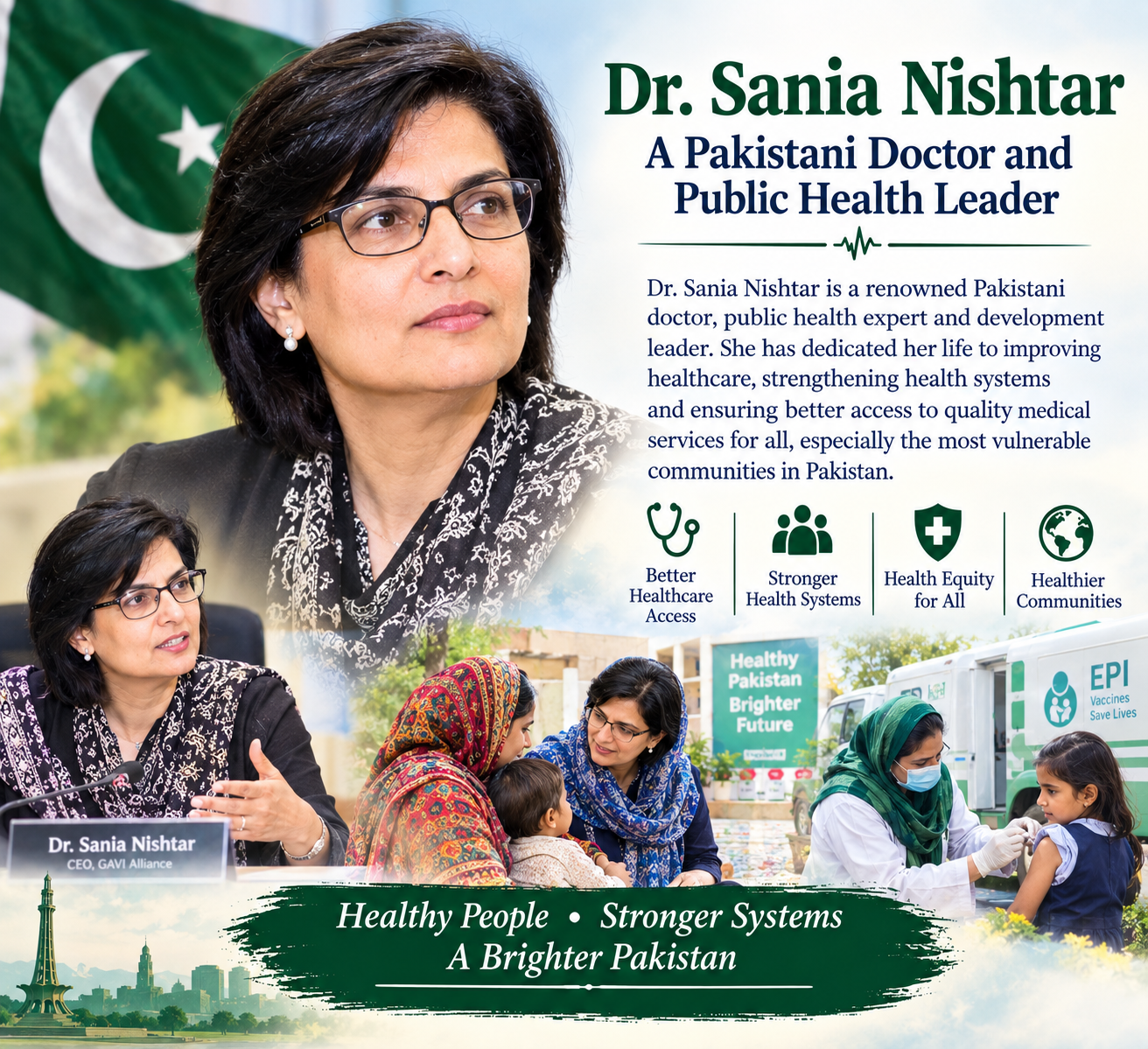
Dr. Sania Nishtar is a well-known Pakistani doctor, public health expert, and healthcare leader. She has spent a large part of her professional life working to improve health systems, social protection, and public welfare in Pakistan. Her career is an example of how medical education can be used not only to treat individual patients but also to improve the lives of millions of people.
As a physician, Dr. Nishtar developed a strong understanding of healthcare and the challenges faced by ordinary people. Over time, her work expanded from medicine into public health, health policy, social protection, and development. She became particularly recognized for her efforts to create systems that could support vulnerable and low-income communities.
Her professional journey is important because Pakistan needs healthcare leaders who understand both medicine and the wider social conditions that affect people's health. Poverty, education, nutrition, access to hospitals, and employment can all influence health outcomes. Dr. Nishtar's career has addressed many of these connected issues.
Early Life and Interest in Medicine
Dr. Sania Nishtar developed an interest in medicine and chose healthcare as her professional field. Becoming a doctor requires years of education, practical training, and dedication. Medical students have to study subjects such as anatomy, physiology, pathology, pharmacology, and many other areas of medical science.
For Dr. Nishtar, medicine eventually became more than a profession. It became a way to understand some of the major problems affecting Pakistani society.
A doctor sees patients individually, but public health professionals also look at health problems at the level of communities and populations. This broader perspective became an important part of Dr. Nishtar's career.
Medical Education
Dr. Nishtar completed her medical education and developed expertise in healthcare and public health. Her academic background helped her understand both clinical medicine and the larger systems that influence people's health.
Medical education teaches doctors how to identify diseases and provide appropriate care. However, public health requires an additional understanding of prevention, policy, research, economics, and social conditions.
Dr. Nishtar's career demonstrates the value of combining these different areas.
Her education also helped her develop an interest in healthcare reform. Instead of focusing only on individual treatment, she became interested in how healthcare systems could be improved for larger populations.
From Medicine to Public Health
Public health is different from traditional clinical medicine.
A clinical doctor usually focuses on diagnosing and treating individual patients. A public health professional looks at patterns of disease and ways to prevent illness across communities.
For example, if many people in an area suffer from the same disease, public health experts investigate why this is happening and what can be done to reduce the problem.
This may involve vaccination, clean water, nutrition, health education, disease prevention, or better healthcare facilities.
Dr. Nishtar's professional work developed strongly in this direction. She became known for connecting medical knowledge with health policy and social development.
Focus on Healthcare Reform
Healthcare systems can face many problems, including limited resources, unequal access, high costs, shortages of trained professionals, and weak infrastructure.
Pakistan has a large population with very different healthcare needs. People living in major cities may have access to specialized hospitals, while people in remote or rural areas may face greater difficulties.
Healthcare reform aims to make the system more effective, accessible, and fair.
Dr. Nishtar has contributed to discussions and initiatives focused on improving healthcare and public welfare.
Her work highlights the importance of planning healthcare policies around the real needs of the population.
Understanding the Link Between Poverty and Health
One of the important ideas in public health is that economic conditions can affect health.
A family with limited income may have difficulty paying for medical treatment, buying nutritious food, traveling to a hospital, or taking time away from work to visit a doctor.
Children in poor households may also face problems related to nutrition and education.
These issues show that health cannot always be separated from economic and social conditions.
Dr. Nishtar's work has reflected an understanding of these connections. Her involvement in social protection and public welfare has therefore been closely related to improving people's overall well-being.
Role in Social Protection
Social protection refers to programs and policies designed to support people who face economic hardship or other vulnerabilities.
Such programs can provide financial assistance or other forms of support to families who need help.
Dr. Nishtar played an important role in the development and leadership of Pakistan's social protection initiatives.
Her medical background gave her a perspective on the relationship between poverty and health.
When families receive support during difficult economic conditions, they may be better able to meet essential needs such as food, education, and healthcare.
The Ehsaas Programme
Dr. Sania Nishtar became particularly well known in Pakistan for her leadership role in the Ehsaas Programme.
The Ehsaas Programme was introduced as a major social protection and poverty-reduction initiative. It included a range of programs intended to support vulnerable segments of society.
The program aimed to address poverty and provide assistance to people facing economic difficulties.
Dr. Nishtar was closely associated with its development and implementation.
The initiative brought together ideas related to social protection, economic support, health, nutrition, and inclusion.
Supporting Vulnerable Communities
Vulnerable communities can include low-income families, children, older people, people with disabilities, and others facing difficult social or economic circumstances.
Public welfare programs can help such groups access basic necessities.
Dr. Nishtar's work emphasized the importance of identifying people who need assistance and creating organized systems to provide support.
This is an important lesson in public administration: good intentions need strong systems to become effective results.
A welfare program must have clear rules, reliable data, transparent processes, and mechanisms to reach the people who need assistance.
Importance of Digital Systems
Modern technology can improve the delivery of public services.
Digital databases and identification systems can help governments identify eligible people and reduce administrative difficulties.
Technology can also make it easier to monitor programs and distribute financial support.
Dr. Nishtar's work in social protection included an emphasis on using modern systems and data to improve program delivery.
This approach is important for large countries because traditional paperwork can be slow and difficult to manage at a national scale.
Transparency and Accountability
Public welfare programs involve public resources, so transparency is extremely important.
Citizens need confidence that assistance reaches the people for whom it is intended.
Accountability helps institutions identify problems, reduce waste, and improve performance.
Dr. Nishtar has emphasized the importance of evidence, data, and organized systems in public policy.
Her work demonstrates that successful welfare programs require not only funding but also good governance.
Public Health and Prevention
Prevention is one of the most important principles of public health.
Treating a disease after it develops can be expensive and difficult. Preventing the disease in the first place can often reduce suffering and healthcare costs.
Vaccination, health education, maternal care, child nutrition, clean water, sanitation, and disease screening are examples of preventive health measures.
Dr. Nishtar's career has included a strong focus on public health and prevention.
Her work shows that governments and healthcare institutions need to invest in prevention as well as treatment.
Importance of Women's Health
Women's health is an important part of national healthcare.
Women may face particular healthcare needs related to pregnancy, childbirth, nutrition, reproductive health, and other conditions.
Improving women's health can also benefit families and communities because women often play major roles in caring for children and households.
Public health policies therefore need to consider women's needs and ensure that they can access appropriate medical services.
Dr. Nishtar's work in public health has contributed to broader discussions about inclusive healthcare and social welfare.
Child Health and Nutrition
Children need good nutrition and healthcare for healthy growth and development.
Poor nutrition during childhood can affect physical development, learning, and long-term health.
Public health programs can help address these problems through nutrition support, awareness campaigns, maternal healthcare, vaccination, and access to medical services.
Dr. Nishtar's work has recognized the importance of addressing social and economic factors that influence health.
Helping children today can create healthier and more productive communities in the future.
International Recognition
Dr. Nishtar has also gained recognition beyond Pakistan for her work in public health and development.
Her career has included participation in international discussions about healthcare, social protection, and global development.
International cooperation is important because many health challenges cross national borders.
Diseases can spread between countries, while issues such as poverty, nutrition, climate change, and healthcare access affect many societies.
Professionals with experience in both national and international policy can contribute to broader solutions.
Leadership Qualities
Dr. Nishtar's career demonstrates several important leadership qualities.
One is long-term thinking. Healthcare and social protection programs often require years of planning and development.
Another is the ability to work across different fields.
A healthcare leader may need to understand medicine, economics, technology, administration, and public policy.
Communication is another important quality. Leaders need to explain complex policies in ways that ordinary people can understand.
These qualities have been important throughout Dr. Nishtar's professional journey.
Challenges in Public Health
Pakistan faces many public health challenges.
These include infectious diseases, non-communicable diseases, maternal and child health concerns, malnutrition, limited healthcare access, and differences between urban and rural areas.
Population growth also increases pressure on healthcare facilities.
Solving these challenges requires cooperation between government institutions, doctors, nurses, researchers, communities, and international organizations.
Dr. Nishtar's career demonstrates why public health needs professionals who can connect medical knowledge with policy and administration.
Importance of Evidence-Based Policy
Good public policy should be based on reliable information.
Evidence helps policymakers understand the size of a problem, identify effective solutions, and measure results.
Without reliable data, it can be difficult to know whether a program is actually helping people.
Dr. Nishtar has emphasized the importance of data and evidence in healthcare and social protection.
This approach can help governments make more informed decisions and improve programs over time.
A Role Model for Young Women
Dr. Nishtar's career is also an inspiration for young women who want to enter medicine, public health, science, or leadership.
Her professional journey demonstrates that women can contribute to society through education, research, healthcare, administration, and public service.
Young students can learn from her commitment to education and her willingness to work on difficult social problems.
Her story encourages students to think beyond traditional career paths and explore opportunities where their knowledge can benefit society.
Inspiration for Medical Students
Medical students can learn several lessons from Dr. Nishtar's career.
First, medical education can open doors to many professional fields.
A medical graduate can become a clinician, researcher, teacher, public health specialist, administrator, or policy expert.
Second, healthcare requires continuous learning.
Medical science changes rapidly, so professionals need to stay updated.
Third, doctors can have an impact beyond hospitals.
They can contribute to disease prevention, health education, healthcare planning, and public policy.
Contribution to Pakistan
Dr. Nishtar's contribution to Pakistan extends beyond her identity as a doctor.
She has worked on healthcare, public health, social protection, and policy issues.
Her involvement in major national initiatives has brought attention to the importance of organized welfare systems and evidence-based decision-making.
Her career also demonstrates the connection between health and social development.
A healthy population is essential for a country's economic and social progress.
Vision for Better Healthcare
Better healthcare requires more than building hospitals.
It requires strong primary healthcare, trained workers, reliable medicines, preventive programs, health education, modern technology, and financial protection for patients.
People should be able to receive necessary healthcare without facing unbearable financial pressure.
Public health systems also need to reach communities before serious health problems develop.
Dr. Nishtar's work reflects many of these principles.
The Importance of Service
One of the strongest lessons from Dr. Nishtar's career is the importance of service.
Medicine is a profession built around helping people.
Public health extends this idea to entire communities.
Social protection extends it further by helping people who may be facing economic hardship.
When these areas work together, they can create stronger and healthier societies.
Future of Public Health in Pakistan
Pakistan's future health system will need to respond to changing challenges.
Technology will become increasingly important in healthcare delivery, data management, disease monitoring, and communication.
At the same time, basic healthcare services will remain essential.
Pakistan will also need more trained healthcare professionals and stronger public health institutions.
Education will play a major role because healthier communities require people who understand disease prevention and healthy living.
The experience of professionals like Dr. Nishtar can provide useful lessons for future healthcare leaders.
Legacy of Dr. Sania Nishtar
Dr. Sania Nishtar has created a professional legacy that connects medicine with public health and social welfare.
Her career demonstrates that a doctor can contribute to society in many ways.
She has worked on issues that affect not only individual patients but also families and communities.
Her involvement in healthcare policy and social protection has made her an important figure in Pakistan's public service landscape.
Her story is especially valuable for students who want to understand how education can become a tool for social change.
Conclusion
Dr. Sania Nishtar is a prominent Pakistani doctor, public health expert, and healthcare leader. Her career demonstrates how medical knowledge can be used to address wider social problems.
From medicine and public health to social protection and policy, she has worked in areas that affect the lives of ordinary people.
Her association with the Ehsaas Programme brought her national attention and highlighted the importance of organized social protection for vulnerable communities.
Her career also teaches important lessons about evidence-based policy, technology, transparency, leadership, and public service.
For young people, especially students interested in medicine and public health, Dr. Nishtar's journey is an example of how education and dedication can create opportunities to serve society.
Her work reminds us that healthcare is not only about treating illness. It is also about prevention, dignity, opportunity, and creating systems that help people live healthier and more secure lives.
FAQs
1. Who is Dr. Sania Nishtar?
Dr. Sania Nishtar is a Pakistani doctor, public health expert, and healthcare leader.
2. What is Dr. Sania Nishtar famous for?
She is widely known for her work in public health, healthcare policy, and social protection.
3. What was Dr. Sania Nishtar's role in the Ehsaas Programme?
She played a major leadership role in the development and implementation of the Ehsaas Programme.
4. Why is Dr. Sania Nishtar important in public health?
Her work connects medicine with public health, social protection, policy, and improving healthcare systems.
5. What can students learn from Dr. Sania Nishtar?
Students can learn the importance of education, leadership, continuous learning, public service, and using professional knowledge to help society.