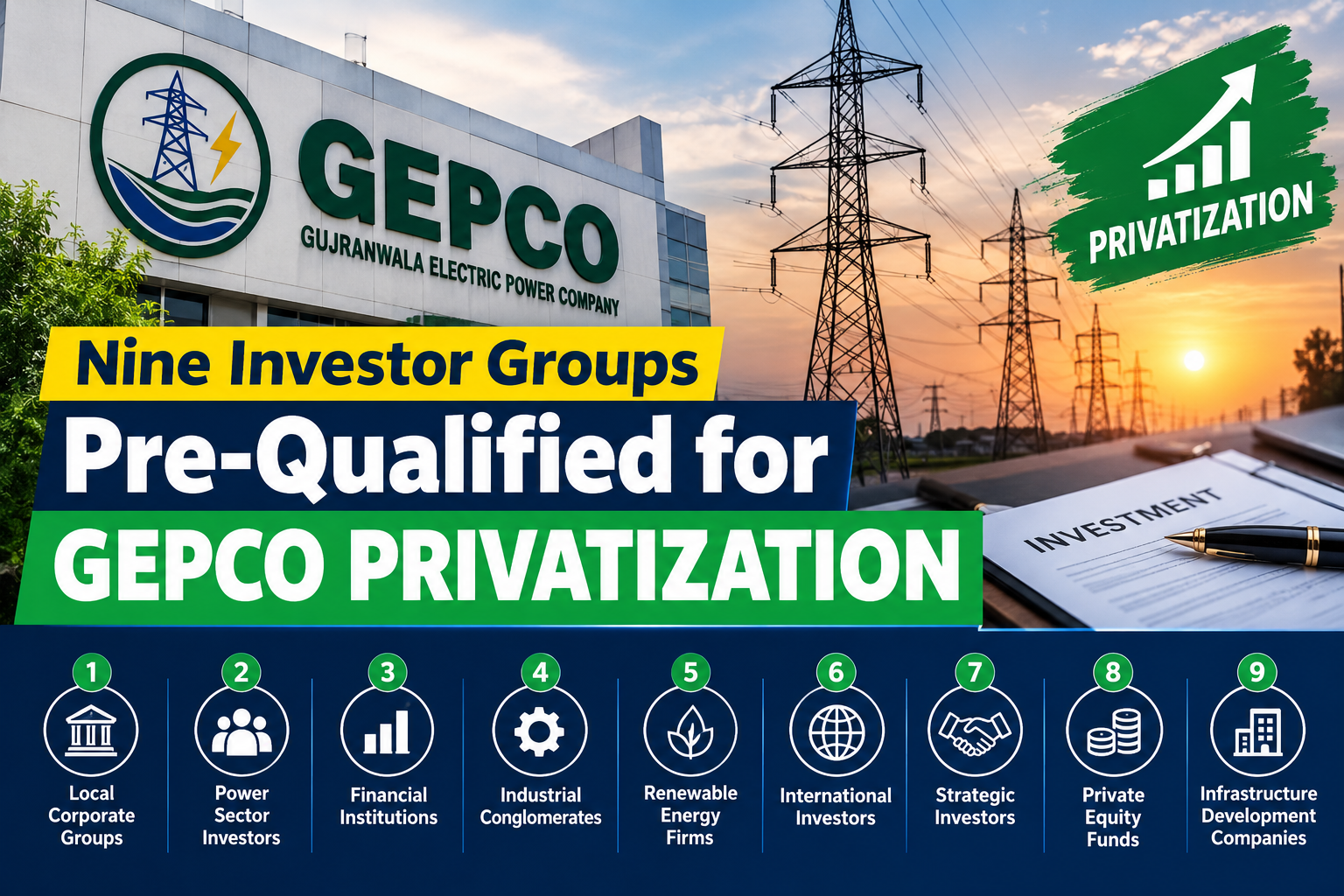
The privatization process of the Gujranwala Electric Power Company (GEPCO) has moved forward with the pre-qualification of nine investor groups. The development is an important step in the government’s broader efforts to improve the performance of Pakistan’s power distribution sector and attract private investment.
GEPCO is one of Pakistan’s major electricity distribution companies and serves a large consumer base in parts of Punjab. Its operations include the distribution and supply of electricity to residential, commercial, agricultural, and industrial consumers.
The participation of nine investor groups indicates significant interest in the company and could create competition during the next stages of the privatization process.
What Is GEPCO?
Gujranwala Electric Power Company, commonly known as GEPCO, is responsible for distributing electricity across several areas of Punjab. The company operates a large electricity distribution network that connects consumers with the national power system.
Its service area includes important industrial and commercial regions, making its performance significant for both households and businesses.
Like other distribution companies in Pakistan, GEPCO faces challenges related to electricity losses, recovery of bills, infrastructure maintenance, and the growing demand for reliable electricity.
Nine Investor Groups Pre-Qualified
The pre-qualification of nine investor groups represents a major development in the privatization process.
Pre-qualification means that these groups have met the initial requirements established for participation. It does not necessarily mean that any of them has already purchased the company.
The qualified groups will be able to participate in subsequent stages of the process, subject to the applicable rules and requirements.
The presence of multiple potential investors can encourage competition and potentially help the government achieve better terms through a transparent bidding process.
Why Is GEPCO Privatization Important?
Pakistan’s power sector has faced financial and operational difficulties for many years. Distribution companies are particularly important because they operate at the final stage between the electricity system and consumers.
Problems such as electricity theft, technical losses, outdated infrastructure, weak bill recovery, and operational inefficiencies can place pressure on the entire power sector.
The government hopes that private-sector participation can introduce stronger management practices, investment, modern technology, and improved accountability.
If successful, such changes could contribute to better electricity distribution and improved services for consumers.
Interest From Turkish Companies
The latest development has also attracted attention because Turkish energy companies are among the potential investors participating in the process.
Turkey and Pakistan have maintained economic and commercial relations across several sectors. Turkish companies have previously shown interest in Pakistan’s infrastructure and energy markets.
The participation of international investors could bring additional expertise and investment to the distribution sector.
Foreign companies may also introduce international management practices and technological solutions that could help improve operational efficiency.
Potential Benefits for Consumers
One of the biggest questions surrounding privatization is how it could affect ordinary electricity consumers.
A more efficient distribution company could potentially provide better service, faster complaint resolution, improved maintenance, and fewer technical problems.
Modernization of electricity networks could also help reduce technical losses and improve the reliability of electricity supply.
However, privatization alone does not automatically guarantee better services. The outcome will depend on the quality of regulation, investment commitments, management, and consumer-protection measures.
Reducing Electricity Losses
Electricity losses remain one of the major challenges facing Pakistan’s power distribution system.
There are two broad categories of losses: technical losses and commercial losses.
Technical losses occur naturally during the transmission and distribution of electricity, although they can be reduced through better infrastructure and modern equipment.
Commercial losses can result from issues such as electricity theft, inaccurate metering, and poor bill recovery.
A private investor may have stronger incentives to reduce these losses because improved efficiency can strengthen the company’s financial performance.
Improving Bill Recovery
Another important challenge is the recovery of electricity bills.
When consumers do not pay their bills on time, distribution companies face cash-flow problems. This can contribute to difficulties across the wider power sector.
Better billing systems, digital payment options, modern meters, and stronger monitoring can potentially improve collection rates.
A successful privatization model could therefore focus not only on electricity supply but also on modernizing customer and billing systems.
Modern Technology in Electricity Distribution
Technology is increasingly important in the electricity sector.
Smart meters, automated monitoring systems, digital complaint platforms, remote meter reading, and data-based electricity management can help distribution companies identify problems more quickly.
Technology can also make it easier to detect unusual consumption patterns and identify potential electricity theft.
Investment in these systems could be an important part of GEPCO’s future modernization if the privatization process moves forward successfully.
Importance for Industry
GEPCO serves areas that include significant industrial and commercial activity.
Reliable electricity is essential for factories, businesses, markets, and small enterprises. Frequent interruptions or poor-quality electricity can increase production costs and affect business operations.
Improving the reliability of electricity distribution could therefore benefit not only households but also the wider economy.
Industrial consumers generally require stable power supplies because interruptions can disrupt production schedules and increase operational expenses.
Government’s Privatization Strategy
The GEPCO process is part of a wider effort to reform Pakistan’s electricity distribution sector.
The government has been examining different approaches to improve the performance of distribution companies and reduce the financial burden associated with inefficiencies in the power system.
Privatization is one possible approach, while other options can include management contracts, restructuring, improved regulation, and greater private-sector participation.
The government’s broader objective is to create a more financially sustainable and efficient electricity sector.
Importance of Transparent Bidding
Transparency will be particularly important as the GEPCO privatization process moves ahead.
Investors, consumers, employees, and other stakeholders will closely watch the bidding process and the conditions attached to any eventual transaction.
Clear rules and competitive bidding can help ensure that the process is credible and protects the public interest.
The government will also need to communicate important details regarding investment commitments, regulatory requirements, consumer protection, and future management.
Concerns and Challenges
Despite the potential benefits, privatization can also create concerns.
Consumers may worry about electricity tariffs, service charges, disconnections, and the treatment of customers who struggle to pay their bills.
Employees may also have questions about job security, salaries, pensions, and changes in management.
These issues need to be addressed carefully through appropriate policies and regulatory safeguards.
A successful privatization process should balance the interests of investors with the needs of consumers and employees.
Role of NEPRA
The National Electric Power Regulatory Authority, or NEPRA, has an important role in Pakistan’s electricity sector.
Regulation is necessary regardless of whether a distribution company is publicly or privately managed.
An effective regulatory framework can help ensure that companies follow service standards, comply with applicable rules, and protect consumer interests.
Strong regulation will therefore remain important if GEPCO moves into private-sector management.
Future Investment
The pre-qualification of nine investor groups could open the door to significant future investment in GEPCO.
Potential investment could be directed toward upgrading electricity networks, replacing outdated equipment, improving substations, installing modern meters, and strengthening digital systems.
Long-term investment is especially important because electricity infrastructure requires continuous maintenance and modernization.
If the new management invests effectively, consumers could eventually see improvements in service quality and reliability.
Impact on Pakistan’s Power Sector
The GEPCO process could also have implications beyond the company itself.
If privatization produces positive results, it may influence future decisions regarding other electricity distribution companies.
A successful model could demonstrate how private investment and stronger management can be combined with effective regulation to improve electricity distribution.
On the other hand, challenges during the process could provide lessons for future reforms.
For this reason, policymakers and industry observers will closely follow the next stages of the GEPCO transaction.
Looking Ahead
The pre-qualification of nine investor groups is only one stage of a longer process. The government will now need to proceed through the remaining steps according to the approved privatization framework.
Potential investors will assess GEPCO’s financial position, assets, operations, customer base, infrastructure, and future growth potential.
The government, meanwhile, will need to ensure that the process remains competitive and transparent.
The final outcome will depend on several factors, including investor commitments, regulatory conditions, valuation, and the terms of the transaction.
Conclusion
The pre-qualification of nine investor groups for GEPCO marks an important development in Pakistan’s electricity-sector reform efforts. The interest shown by multiple investors, including Turkish energy companies, highlights the potential of Pakistan’s power distribution market.
Privatization could bring investment, modern technology, improved management, and stronger operational efficiency. However, achieving these benefits will require transparent procedures, effective regulation, consumer protection, and meaningful investment commitments.
For Pakistan, the larger goal is not simply to transfer ownership but to create a more reliable, efficient, and financially sustainable electricity distribution system. The coming stages of the GEPCO privatization process will therefore be closely watched by investors, consumers, employees, and policymakers.
FAQs
1. What is GEPCO?
GEPCO stands for Gujranwala Electric Power Company and is responsible for electricity distribution in several areas of Punjab.
2. How many investor groups have been pre-qualified?
Nine investor groups have been pre-qualified for the GEPCO privatization process.
3. Why is GEPCO privatization important?
The process aims to attract investment, improve operational efficiency, modernize infrastructure, and strengthen electricity distribution.
4. Are Turkish companies interested in GEPCO?
Yes, Turkish energy companies are among the groups showing interest in the privatization process.
5. Will privatization automatically reduce electricity prices?
Not necessarily. Electricity prices are influenced by multiple factors, including generation costs, government policies, taxes, and regulatory decisions.