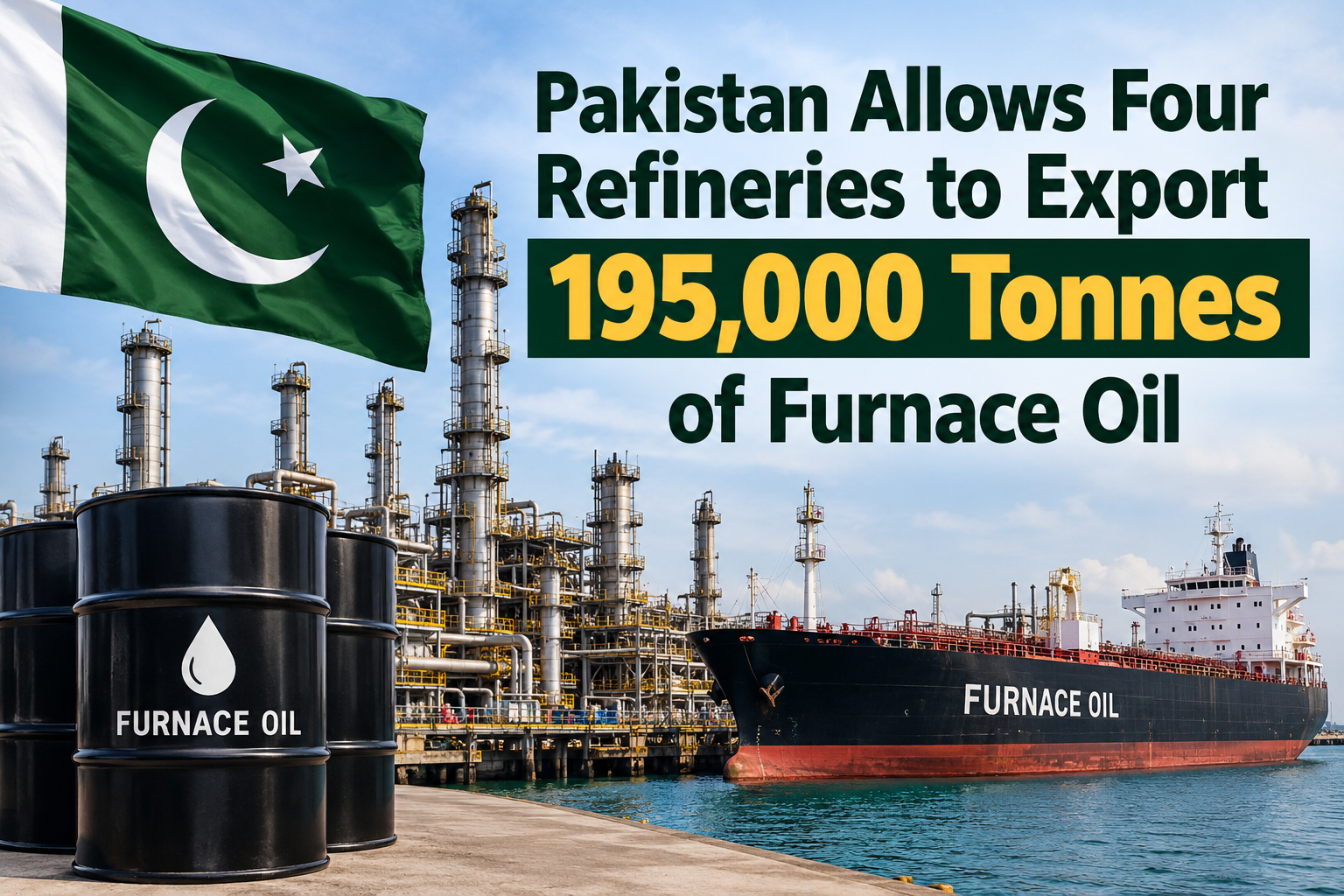
Pakistan has allowed four oil refineries to export up to 195,000 tonnes of furnace oil during October, marking an important development for the country’s petroleum and energy sector. The decision is aimed at managing surplus furnace oil stocks while providing refineries with greater flexibility in handling their production and storage requirements.
The approval comes as Pakistan continues to manage its energy resources and improve efficiency across the petroleum sector. Furnace oil remains an important industrial fuel, although its role in electricity generation has changed significantly in recent years as Pakistan has increasingly focused on other energy sources.
Allowing refineries to export surplus furnace oil can help reduce pressure on domestic storage facilities and provide companies with access to international markets.
What Is Furnace Oil?
Furnace oil is a heavy liquid fuel produced during the refining of crude oil. It has traditionally been used by power plants, industrial facilities, boilers, and other large-scale consumers that require significant amounts of fuel.
In Pakistan, furnace oil has historically played an important role in thermal power generation. However, changes in the country’s energy mix and greater use of alternative fuels have reduced its importance in some areas.
The demand for furnace oil can therefore fluctuate depending on electricity generation requirements, international energy prices, and domestic industrial activity.
Why Has Pakistan Allowed the Exports?
The decision to allow exports is closely linked to the management of surplus stocks.
When refineries produce more furnace oil than the domestic market requires, excess inventories can create storage challenges. If storage facilities become full, refineries may face operational difficulties.
Exports provide an alternative market for the surplus product.
By allowing refineries to sell furnace oil internationally, authorities can help companies manage inventories while generating export revenues.
Four Refineries Included
The latest decision permits four refineries to export furnace oil during October.
The combined export quantity is expected to reach up to 195,000 tonnes.
The permission provides refineries with an opportunity to manage their inventories according to market conditions.
The exact quantity exported by each refinery may depend on available stocks, production levels, international demand, shipping arrangements, and commercial considerations.
Benefits for Refineries
For refineries, the ability to export surplus furnace oil can provide greater operational flexibility.
Storage capacity is an important part of refinery operations. Excess inventory can increase costs and restrict the ability of a refinery to manage incoming crude oil and other petroleum products.
Exporting surplus furnace oil can help free up storage space and improve inventory management.
It can also provide refineries with an additional source of revenue.
Impact on Pakistan’s Energy Sector
The decision also reflects changes taking place in Pakistan’s energy sector.
The country has been attempting to diversify its energy mix and improve the efficiency of electricity generation.
Furnace oil is generally more expensive and less environmentally attractive than several alternative fuels and renewable energy sources. As a result, its use in power generation has become more limited compared with earlier periods.
However, refineries can still produce furnace oil as part of the refining process.
Exporting excess production can therefore help align refinery output with changing domestic demand.
Managing Domestic Supply
Although exports have been approved, the government must also consider domestic energy requirements.
Petroleum products are essential for transportation, industry, electricity generation, and other economic activities.
Authorities need to ensure that export arrangements do not create shortages in the domestic market.
Export permissions are therefore generally connected to assessments of local supply and demand.
This approach allows the government to support refinery operations while maintaining energy security.
International Market Opportunities
International markets can provide opportunities for Pakistani refineries to sell products that have limited demand domestically.
Global furnace oil demand varies between countries and industries.
Some markets continue to use heavy fuel oil for industrial applications, marine operations, and power generation.
If Pakistani refineries can sell their surplus at competitive international prices, exports could help improve their financial position.
However, international sales are influenced by global prices, shipping costs, exchange rates, and competition from other producers.
Foreign Exchange Considerations
Petroleum products are an important part of Pakistan’s international trade.
Pakistan imports substantial quantities of crude oil and petroleum products, while exports of refined products can generate foreign exchange.
Furnace oil exports can therefore contribute to foreign exchange earnings, although the overall impact depends on export prices and quantities.
The country’s external account remains an important consideration for economic policymakers.
Increasing exports of locally produced petroleum products can provide some support to the balance of payments.
Storage Challenges
Storage capacity is an important issue for refineries.
Petroleum products must be stored safely in specialized facilities. Maintaining large quantities of surplus inventory can increase operational costs and create logistical difficulties.
If domestic demand is weak, stocks can accumulate.
Exporting surplus furnace oil provides refineries with a way to reduce inventory levels and maintain smoother operations.
This can become particularly important when refinery production continues while domestic consumers require less furnace oil.
Impact on Power Generation
Furnace oil has historically been used extensively by thermal power plants in Pakistan.
However, the power sector has gradually moved toward other fuels and technologies.
Natural gas, imported fuels, hydropower, nuclear energy, solar power, wind energy, and other sources now contribute to Pakistan’s electricity mix.
As the role of furnace oil in power generation changes, refineries may increasingly need alternative markets for the product.
Exports can therefore help refineries adjust to changes in domestic energy demand.
Environmental Considerations
Furnace oil is a relatively heavy fuel and can produce significant emissions when burned.
Environmental concerns have contributed to efforts in many countries to reduce dependence on heavy fuel oil and shift toward cleaner energy sources.
Pakistan is also working to expand renewable energy and improve environmental sustainability.
From this perspective, exporting surplus furnace oil does not necessarily represent an expansion of its domestic use. Instead, it can be viewed as an inventory-management measure for products already produced during refining.
Importance of Refinery Operations
Pakistan’s refineries play an important role in the domestic energy system.
They process crude oil into products such as petrol, diesel, kerosene, jet fuel, and other petroleum products.
Their efficient operation is essential for maintaining domestic fuel supplies.
However, refineries must manage a range of products simultaneously. Demand for one product may be high while demand for another remains weak.
Export flexibility can help refineries manage these differences.
Support for the Petroleum Industry
The export permission can also provide some support to Pakistan’s petroleum industry.
Refineries face several challenges, including aging infrastructure, high operating costs, changing fuel demand, and the need for modernization.
Additional market opportunities can improve their ability to manage these pressures.
Long-term investment in refinery upgrades remains important for improving efficiency and increasing the production of higher-value petroleum products.
Role of Government Policy
Government policy has a major influence on Pakistan’s petroleum sector.
Authorities regulate imports, exports, pricing, storage, refining operations, and fuel standards.
A predictable policy environment can help companies make long-term investment decisions.
At the same time, the government needs to balance the interests of refineries with consumer needs and national energy security.
Future of Furnace Oil in Pakistan
The future role of furnace oil in Pakistan is likely to depend on changes in electricity generation, industrial demand, international markets, and refinery modernization.
As the country increases its use of renewable energy and other fuels, domestic demand for furnace oil may continue to change.
Refineries may therefore need to become more flexible and focus increasingly on producing fuels and products with stronger domestic and international demand.
Broader Economic Impact
The petroleum sector has a significant impact on Pakistan’s economy.
Fuel prices affect transportation, agriculture, manufacturing, electricity generation, and household expenses.
Efficient refinery operations can help strengthen domestic energy supply and reduce some dependence on imported refined products.
Exports of surplus petroleum products can also contribute to foreign exchange earnings.
However, the broader economic impact of furnace oil exports will depend on international prices, export volumes, and the cost of imported crude oil.
Looking Ahead
The approval for four refineries to export up to 195,000 tonnes of furnace oil during October provides a short-term mechanism for managing surplus production.
The policy can help refineries reduce storage pressure, improve inventory management, and access international markets.
At the same time, Pakistan will need to continue evaluating the changing role of furnace oil within its energy system.
Long-term improvements will likely require refinery modernization, better energy planning, greater use of cleaner energy sources, and stronger integration between domestic production and market demand.
Conclusion
Pakistan’s decision to allow four refineries to export 195,000 tonnes of furnace oil in October is an important development for the country’s petroleum industry.
The measure can help refineries manage surplus stocks, reduce storage pressure, generate potential export revenues, and adapt to changing domestic demand.
While furnace oil has historically played an important role in Pakistan’s energy sector, its importance is changing as the country diversifies its energy mix and expands alternative sources.
The latest export permission provides a practical short-term solution for managing surplus furnace oil. In the longer term, continued investment in refinery modernization and a more diversified energy strategy will be essential for building a stronger and more efficient petroleum sector.
FAQs
1. How much furnace oil can the four refineries export?
The four refineries have been allowed to export up to 195,000 tonnes during October.
2. Why is Pakistan allowing furnace oil exports?
The exports can help refineries manage surplus stocks, reduce storage pressure, and access international markets.
3. What is furnace oil used for?
Furnace oil can be used in industrial facilities, boilers, power generation, and other large-scale fuel applications.
4. Will the exports create a domestic furnace oil shortage?
Export permissions are subject to domestic supply and demand conditions, so authorities need to ensure adequate local availability.
5. What is the future of furnace oil in Pakistan?
Its domestic role is changing as Pakistan increasingly uses alternative fuels and renewable energy, while refineries continue to explore export opportunities for surplus production.