Introduction
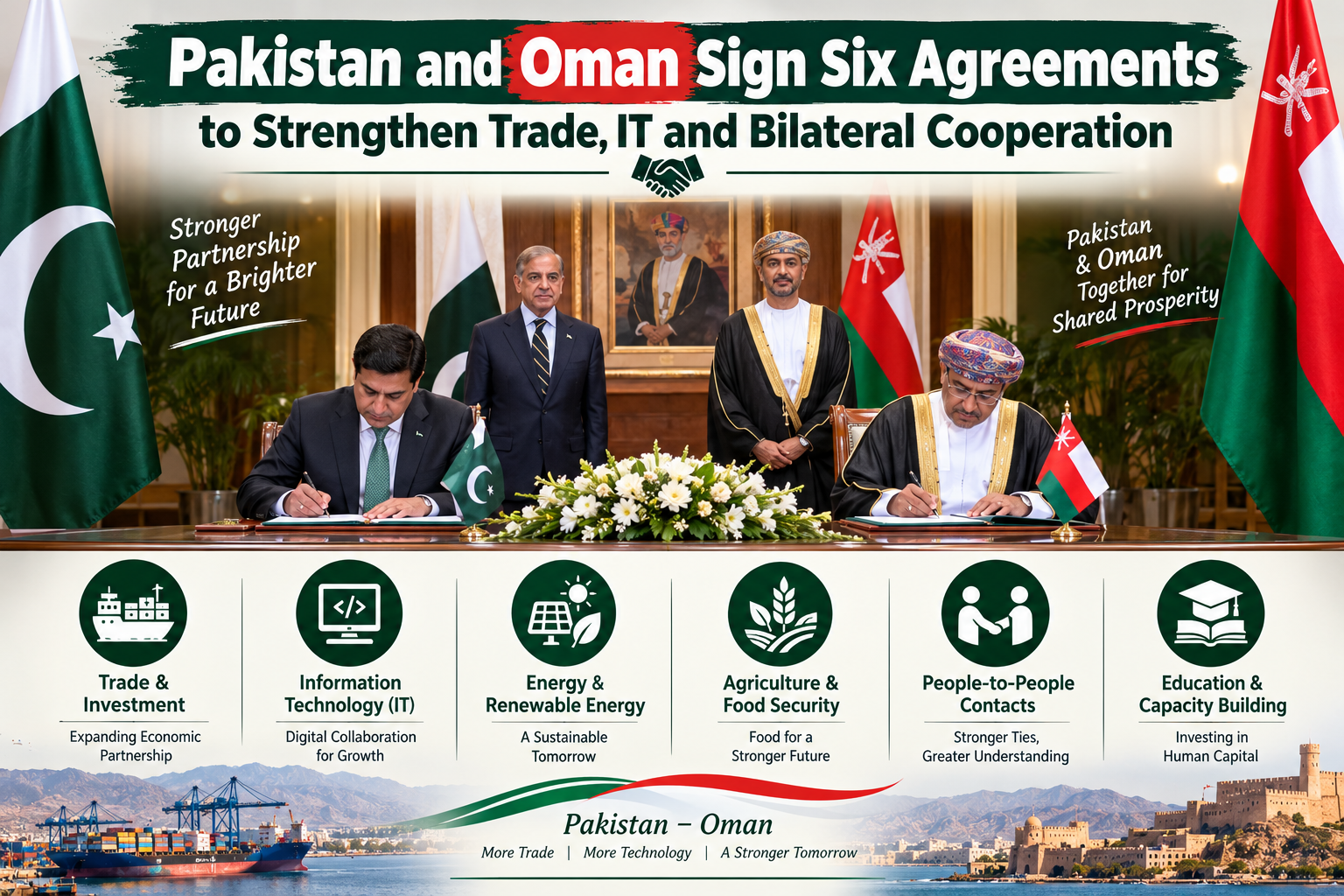
Pakistan and Oman have taken another step towards strengthening their longstanding relationship after exchanging six agreements and memoranda of understanding during high-level meetings in Islamabad. The agreements were exchanged on October 14, 2026, in the presence of Prime Minister Shehbaz Sharif and visiting Omani Foreign Minister Sayyid Badr bin Hamad bin Hamood Al Busaidi.
The development came during the eighth session of the Pakistan–Oman Joint Ministerial Commission, which brought officials from both countries together to discuss cooperation in several areas. These included information technology, telecommunications, media, archives, trade, investment, agriculture, energy, education and workforce development.
The agreements represent an effort to strengthen institutional connections and create opportunities for closer cooperation between the two countries. They also reflect the importance both governments attach to maintaining productive diplomatic relationships and expanding economic engagement.
Pakistan and Oman share geographical proximity, historical connections, cultural links and longstanding people-to-people relationships. Their position along important maritime routes also makes cooperation in trade, logistics and regional affairs significant.
Although the agreements establish frameworks for collaboration, their practical value will depend on implementation. Businesses, government departments and relevant institutions will need to turn the commitments into effective programmes that deliver measurable benefits.
The latest development therefore provides an opportunity to examine the agreements, the sectors involved and the potential implications for Pakistan's economy and international partnerships.
What Happened During the Pakistan–Oman Meetings?
The agreements were exchanged in Islamabad during the eighth session of the Pakistan–Oman Joint Ministerial Commission. Prime Minister Shehbaz Sharif witnessed the exchange, while Deputy Prime Minister and Foreign Minister Ishaq Dar and Omani Foreign Minister Sayyid Badr bin Hamad bin Hamood Al Busaidi participated in the diplomatic engagements.
According to official announcements, the six documents included the protocol recording the minutes of the joint commission's eighth session, an agreement concerning visa exemptions for holders of specified official passports, and a memorandum of understanding on records and archives.
Three additional memoranda covered information and broadcasting, information technology and telecommunications, and news exchange and media cooperation. <Cite refs={["turn426049search8","turn426049search10"]}/>
The agreements were designed to strengthen cooperation between relevant government institutions and support the exchange of information, expertise and administrative practices.
The meetings also provided an opportunity to discuss broader economic relations. Both sides emphasised the importance of trade, investment, maritime connectivity, agriculture, energy, education and workforce mobility.
The joint commission serves as a formal mechanism through which the two countries can review their relationship, identify shared priorities and coordinate future initiatives.
The central challenge now is to ensure that the agreements are followed by practical action, clear responsibilities and sustained engagement between the institutions involved.
Understanding the Six Agreements
The six documents cover different areas of cooperation, but they share a common purpose: strengthening the institutional relationship between Pakistan and Oman.
Some documents establish formal arrangements between governments, while others provide a framework for cooperation between particular departments.
The protocol recording the minutes of the eighth joint commission session documents the outcomes of the meeting and provides a basis for follow-up discussions.
The visa exemption agreement concerns holders of diplomatic, special, official and service passports. It should not be confused with a general visa-free arrangement for all Pakistani and Omani citizens.
The memorandum on records and archives focuses on institutional cooperation involving historical documents, official records and archives management.
Other memoranda address information and broadcasting, IT and telecommunications, and the exchange of news and information.
Together, these documents provide a framework for closer cooperation across several administrative and professional fields.
Their effectiveness will depend on how relevant institutions interpret their responsibilities, organise activities and measure progress.
For Pakistan, the agreements also demonstrate the value of maintaining diplomatic channels that support both immediate cooperation and longer-term economic objectives.
Why Pakistan–Oman Relations Matter
Pakistan and Oman have maintained diplomatic relations for decades, supported by geographical proximity, cultural connections and economic links.
Oman occupies an important position along the Arabian Sea and near major maritime routes. Pakistan's coastline, ports and commercial connections also make maritime cooperation relevant to the relationship.
The two countries have opportunities to work together in trade, logistics, investment, education, technology and human resource development.
Their relationship also extends beyond formal diplomacy. Families, professionals and business communities have connections across the two countries, contributing to people-to-people exchanges.
For Pakistan, stronger engagement with Oman can support efforts to diversify economic partnerships and expand access to regional markets.
For Oman, closer cooperation with Pakistan can strengthen commercial links and provide opportunities for collaboration with Pakistani businesses, institutions and skilled professionals.
However, geographical proximity and friendly relations do not automatically guarantee economic growth. Businesses need reliable regulations, practical commercial arrangements and confidence that agreements will be implemented.
Sustained institutional engagement is therefore essential to turning diplomatic goodwill into concrete outcomes.
Trade and Investment: An Important Area of Cooperation
Trade and investment were among the major topics discussed during the joint commission's session.
Expanding commercial relations can create opportunities for companies in both countries. Pakistani businesses may explore opportunities in food products, agricultural goods, textiles, manufactured products, technology services and other sectors, depending on market demand and applicable regulations.
Omani companies may also identify opportunities to work with Pakistani partners in logistics, services, infrastructure-related activities and other areas of mutual interest.
However, specific commercial benefits will depend on market conditions, product standards, shipping arrangements, customs procedures and the ability of businesses to meet buyers' requirements.
One of the challenges facing international trade is the gap that can exist between a diplomatic agreement and the day-to-day requirements of commercial activity.
Companies need information about market access, documentation, regulations, payment arrangements and potential partners before committing resources.
Both governments can help by improving communication between business communities and making relevant information easier to obtain.
A predictable commercial environment can encourage companies to explore new markets and establish longer-term relationships.
The joint commission's discussions on trade and investment provide a framework for further work in this direction.
Joint Working Groups to Support Implementation
A major outcome of the discussions was the emphasis on strengthening institutional cooperation through joint working groups.
According to official statements, the areas identified for these mechanisms include trade and investment, agriculture, oil and gas, and labour and human resource development. <Cite refs={["turn426049search4","turn426049search7"]}/>
Joint working groups can help government departments address specific issues in a more organised way.
Instead of relying only on high-level meetings, officials can use these groups to exchange information, review progress and identify obstacles that require attention.
For example, a working group focused on trade and investment could examine barriers affecting businesses and identify opportunities for commercial engagement.
A group concerned with agriculture could discuss agricultural products, food security, technical knowledge and possible areas of cooperation.
Labour and human resource development discussions could focus on skills, training, professional qualifications and the needs of employers.
The effectiveness of these groups will depend on regular meetings, clear objectives, suitable technical expertise and follow-up arrangements.
Establishing a working group is only the beginning. Its success should ultimately be measured by the problems it resolves and the practical opportunities it helps create.
Information Technology and Telecommunications Cooperation
Information technology is becoming an increasingly important part of economic development, public administration and international business. Pakistan and Oman have identified IT and telecommunications as areas in which closer institutional cooperation can support shared objectives.
Pakistan has a growing technology sector that includes software development, IT-enabled services, digital marketing, business process services and technology education. Pakistani professionals and companies work with customers in different international markets, providing a foundation for further collaboration.
Oman is also pursuing economic diversification and digital development. Cooperation between the two countries could create opportunities for technology companies, training institutions and businesses seeking reliable international partners.
The memorandum covering IT and telecommunications provides a framework for institutional engagement in this area. Potential areas of collaboration may include the exchange of technical knowledge, professional training, digital services and discussions about emerging technologies.
However, the memorandum itself does not automatically establish new contracts, guarantee investment or create employment opportunities. Those outcomes would depend on future initiatives and the decisions of participating institutions and businesses.
To maximise the potential benefits, both countries can encourage professional exchanges, business-to-business meetings and cooperation between technology organisations.
Improved communication between technology companies could help them understand each other's markets, identify commercial opportunities and develop services that respond to real business needs.
For Pakistan, deeper engagement with Oman could provide another opportunity to showcase its technology capabilities and build relationships with international partners.
Media Cooperation and the Exchange of News
The agreements also include cooperation in information and broadcasting, alongside news and information exchange.
Media institutions play an important role in helping people understand developments in other countries. Professional exchanges can improve knowledge of different societies, cultures, economic conditions and regional affairs.
Cooperation between Pakistani and Omani media organisations could support the sharing of professional experience, broadcasting practices and information about developments relevant to both countries.
The arrangements may also provide opportunities for institutional dialogue about journalism, communication technology and media production.
Reliable information is particularly important during periods of regional uncertainty. Accurate reporting can help audiences understand diplomatic developments without relying on rumours or misleading claims.
At the same time, media cooperation should support professional standards, factual accuracy and responsible communication.
Agreements concerning information exchange do not mean that every news organisation will automatically establish a partnership. Specific activities will depend on the participating institutions and any subsequent arrangements.
The practical value of this cooperation will therefore depend on whether media organisations use the framework to develop meaningful professional exchanges and improve the quality of information available to their audiences.
Archives and Historical Documentation
Another agreement concerns cooperation between the National Archives of Pakistan and Oman's National Records and Archives Authority.
Archives preserve documents that help governments, researchers and members of the public understand historical developments. They may contain official correspondence, administrative records, historical publications and other materials that contribute to national and regional history.
Cooperation in archives management can support the exchange of professional knowledge and practices related to preserving historical records.
Institutions may explore methods for organising collections, maintaining documents, improving access to historical information and applying suitable preservation technologies.
Digital preservation is especially important because it can help protect records from deterioration while making selected materials easier for researchers to consult.
Any digitisation programme must also consider copyright, privacy, security and the legal requirements governing access to official documents.
Pakistan and Oman share historical connections through trade, maritime activity, migration and cultural exchanges. Historical records from both countries may therefore be valuable for researchers studying their longstanding relationship.
The memorandum provides an institutional basis for cooperation, although specific archival projects would require further planning and implementation.
Visa Exemptions for Certain Official Passport Holders
The six documents include an agreement concerning mutual visa exemptions for holders of diplomatic, special, official and service passports.
Such arrangements are generally intended to facilitate official travel and government engagement between participating countries.
Easier official travel can help diplomats, government representatives and authorised officials attend meetings, participate in consultations and maintain institutional contacts.
This may be particularly useful when the two governments are working to expand cooperation across several sectors.
However, the scope of the agreement is important. The announced arrangement concerns specified categories of passports and should not be interpreted as a general visa-free travel policy for every Pakistani or Omani citizen.
Ordinary passport holders should continue to consult the applicable immigration requirements before making travel arrangements.
Clear communication about eligibility, documentation and the implementation date of any new arrangement is essential to avoid confusion.
The agreement can support closer official engagement, but its practical benefits will depend on the rules and procedures applied by the relevant authorities.
Agriculture and Food Security
Agriculture was another area discussed during the Pakistan–Oman Joint Ministerial Commission.
Agriculture remains important to Pakistan's economy, rural employment and food supply. The country produces a range of crops and agricultural products, while farmers and businesses depend on reliable access to markets.
Oman, meanwhile, has its own food security priorities and relies on a combination of domestic production and international trade to meet its requirements.
Cooperation could provide opportunities for discussions about agricultural trade, food supply chains, technical knowledge and improved commercial connections.
For Pakistani agricultural businesses, international markets can offer opportunities to diversify their customer base. However, exporters must meet relevant quality standards, food safety requirements and import regulations.
Businesses also need reliable transport arrangements and information about demand before making substantial investments.
Potential cooperation in agriculture should therefore focus on practical issues such as market research, logistics, quality assurance and communication between businesses.
Joint working groups can provide a forum for identifying opportunities and addressing obstacles.
Any future commercial benefits will depend on the agreements reached, market conditions and the ability of producers and traders to meet the needs of buyers.
Energy, Oil and Gas Cooperation
Energy is another important area in the relationship between Pakistan and Oman.
Reliable energy supplies are essential for economic activity, industrial production, transport and household needs. Changes in energy prices and supply conditions can influence business costs and national economic planning.
Pakistan has significant energy requirements, while Oman has experience in the energy sector and an important position in regional energy markets.
The two countries can use institutional discussions to explore areas of mutual interest, exchange information and examine potential commercial opportunities.
Oil and gas cooperation may involve discussions between relevant authorities and companies, depending on commercial feasibility and applicable regulations.
However, the latest agreements should not be interpreted as proof that a specific energy supply contract or new investment project has already been finalised.
Any project would require its own negotiations, technical assessments, financing arrangements and regulatory approvals.
A careful approach can help ensure that future cooperation is commercially sound and consistent with the needs of both countries.
Maritime Connectivity and Logistics
Pakistan and Oman have an important geographical connection through the Arabian Sea. Maritime trade and logistics therefore represent significant areas of potential cooperation.
Efficient ports, shipping services and logistics networks can help businesses move goods between markets. Reliable transport arrangements can also reduce uncertainty for exporters and importers.
Pakistan's ports connect its economy with international shipping routes, while Oman's location provides access to important maritime corridors.
Closer institutional engagement could support discussions about port operations, shipping connections, logistics services and commercial opportunities.
Improved connectivity can benefit businesses that need predictable delivery schedules and efficient cargo handling.
However, maritime cooperation requires investment, technical expertise, suitable infrastructure and coordination among relevant organisations.
Trade agreements and diplomatic meetings can help establish the conditions for cooperation, but operational improvements depend on practical planning and implementation.
The countries can also benefit from continued dialogue about safe navigation and regional stability, particularly because disruptions to important maritime routes can affect international trade.
Workforce Mobility and Professional Development
Workforce mobility and human resource development featured prominently in the discussions between Pakistani and Omani officials.
Workers with appropriate skills can contribute to economic activity in both countries. Employers need people who possess relevant technical knowledge, professional qualifications and practical experience.
Pakistan has a large workforce, including professionals in fields such as information technology, engineering, healthcare, education and skilled trades.
Oman has employment requirements across different sectors, although opportunities depend on economic conditions, employer demand, qualifications and applicable immigration rules.
Institutional cooperation could support discussions about professional training, skills development and workforce requirements.
Better information about qualifications and employment standards can help employers and prospective workers understand the requirements of particular occupations.
Training institutions may also explore ways to align educational programmes with the skills needed by businesses.
Nevertheless, the agreements do not guarantee jobs or automatically change employment and immigration requirements.
Any employment opportunity must comply with the relevant laws, contractual terms and professional standards.
Responsible workforce cooperation should protect workers' rights, promote transparent recruitment and help ensure that skills development responds to genuine labour-market needs.
Education, Tourism and People-to-People Connections
Education and people-to-people engagement are also important elements of Pakistan–Oman relations.
Educational exchanges can help students and professionals learn about different societies, develop new skills and build international connections.
Universities, research institutions and training organisations may find opportunities to cooperate through academic discussions, professional events and exchanges of expertise.
Tourism can also contribute to stronger relationships by encouraging people to experience another country's culture, history and traditions.
Pakistan and Oman have distinct cultural attractions and historical connections that may interest visitors, researchers and educational groups.
Developing these connections requires clear travel information, suitable services and cooperation between relevant institutions.
People-to-people relationships can strengthen diplomatic ties by creating connections that extend beyond formal government meetings.
However, new exchange programmes or tourism initiatives would require additional planning and cannot be assumed to have been launched simply because the countries have signed broader cooperation documents.
What the Agreements Could Mean for Pakistani Businesses
For Pakistani businesses, the most important question is whether the new agreements lead to practical commercial opportunities.
Companies interested in the Omani market will need to understand customer requirements, pricing, product standards and import regulations.
Businesses in technology and professional services may explore opportunities to establish relationships with Omani organisations. Agricultural producers and manufacturers may investigate demand for their products, while logistics companies could examine ways to support cross-border trade.
Small and medium-sized enterprises may particularly benefit from better access to information about international markets.
Government-supported business forums and commercial delegations can help companies meet potential partners and learn about relevant regulations.
However, companies should assess opportunities carefully. International expansion involves costs, competition and regulatory requirements, and not every business will find the same market attractive.
The agreements provide a diplomatic framework that may support further engagement, but commercial success will depend on the quality of business relationships and the competitiveness of individual products and services.
Challenges That Could Affect Implementation
Despite the opportunities, several challenges could affect the practical results of Pakistan–Oman cooperation.
One challenge is ensuring that government institutions follow through on their commitments. Agreements may establish broad objectives, but progress requires clear responsibilities, suitable resources and regular communication.
Another challenge is identifying projects that are commercially viable. Businesses need reliable market information and a clear understanding of regulations before investing.
Differences in administrative procedures can also create delays. Better communication between relevant authorities may help resolve these issues.
Economic conditions, transport costs and changes in international markets can affect the viability of commercial activities.
To address these challenges, both countries should establish realistic priorities, monitor progress and communicate the outcomes of joint initiatives.
Regular meetings of working groups can help officials identify obstacles and recommend practical solutions.
Transparent reporting can also make it easier to assess whether the agreements are producing tangible benefits.
The long-term success of the partnership will depend less on the number of documents signed and more on the results achieved through their implementation.
What Happens Next?
Following the eighth session of the Pakistan–Oman Joint Ministerial Commission, attention is expected to focus on the implementation of agreed outcomes and continued institutional engagement.
Officials have emphasised the importance of regular coordination and effective follow-up through joint working groups.
Both countries can use these mechanisms to identify priorities, review progress and determine where additional agreements or practical initiatives may be needed.
Business communities may also benefit from opportunities to exchange information and explore potential commercial partnerships.
Future progress should be assessed through clear indicators, such as new institutional projects, stronger business connections, improved professional exchanges and measurable developments in areas of cooperation.
It is important to distinguish these potential outcomes from results that have already been confirmed.
The agreements establish a framework for collaboration, while future developments will depend on the decisions of participating institutions and businesses.
Conclusion
Pakistan and Oman have exchanged six agreements and memoranda of understanding to strengthen cooperation across several sectors, including official travel arrangements, information technology, telecommunications, media and archives.
The documents were exchanged in Islamabad during the eighth session of the Pakistan–Oman Joint Ministerial Commission, with Prime Minister Shehbaz Sharif witnessing the proceedings.
The discussions also covered broader areas of mutual interest, including trade, investment, agriculture, energy, maritime connectivity, education and workforce development.
For Pakistan, closer engagement with Oman offers an opportunity to strengthen regional relationships and explore additional economic partnerships. For Oman, cooperation with Pakistan provides a framework for expanding institutional and commercial connections.
Nevertheless, the true value of the agreements will depend on implementation. Government departments, businesses and other relevant organisations must translate commitments into practical initiatives that respond to real needs.
Regular coordination, transparent communication and careful evaluation will be essential to achieving meaningful results.
The latest development demonstrates that diplomatic engagement can create opportunities for cooperation across multiple sectors. Sustained follow-through will determine how effectively those opportunities benefit the people and economies of both countries.
Frequently Asked Questions (FAQs)
1. How many agreements did Pakistan and Oman exchange in October 2026?
The two countries exchanged six agreements and memoranda of understanding during the eighth session of the Pakistan–Oman Joint Ministerial Commission.
2. Which sectors are covered by the agreements?
The documents cover official passport visa exemptions, records and archives, information and broadcasting, IT and telecommunications, and news and media cooperation.
3. Who represented Pakistan during the meetings?
Deputy Prime Minister and Foreign Minister Ishaq Dar represented Pakistan in the joint commission discussions, while Prime Minister Shehbaz Sharif witnessed the exchange of agreements.
4. Could the agreements create opportunities for Pakistani businesses?
They may support future opportunities by strengthening institutional relationships and encouraging cooperation in trade, technology, investment and other areas. Actual commercial benefits will depend on implementation and market conditions.
5. Do the agreements allow all Pakistani citizens to travel to Oman without a visa?
No. The announced visa exemption agreement concerns holders of specified diplomatic, special, official and service passports. Ordinary passport holders remain subject to applicable visa requirements.