Introduction
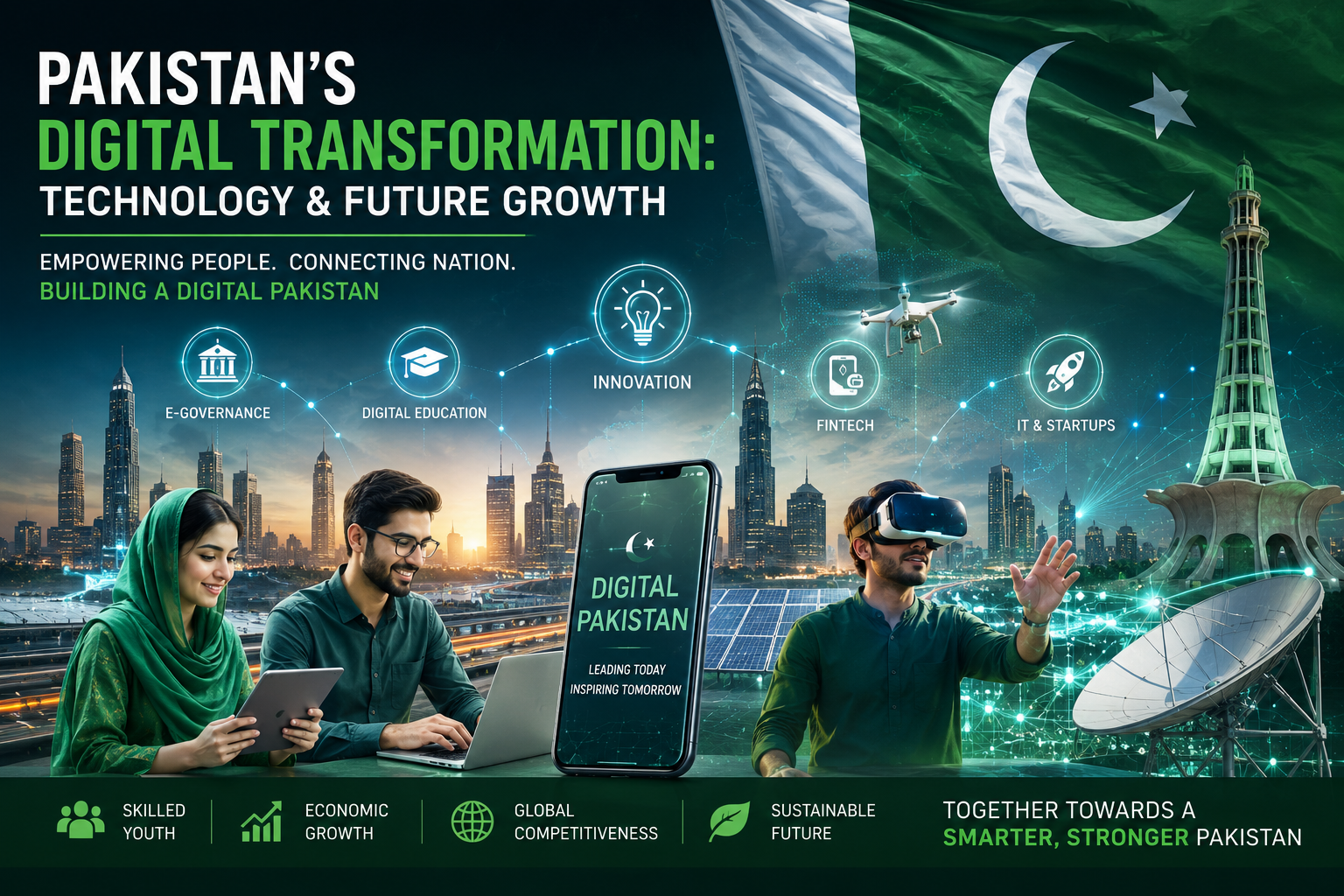
Pakistan is entering an important stage in its digital transformation. Technology is no longer limited to computers, mobile phones, or social media. It is increasingly becoming part of education, business, banking, government services, healthcare, agriculture, communication, and employment. As internet access expands and digital services become more common, technology is changing the way Pakistanis study, work, communicate, shop, and conduct business.
This transformation has gained additional momentum in 2026. Pakistan’s information technology and digital sectors have continued to receive attention as potential drivers of economic growth, exports, employment, and innovation. The Pakistan Economic Survey 2025–26 reported strong growth in the IT sector, including a 19.7% increase in ICT export remittances to $3.38 billion during July–March FY2026 compared with the same period of the previous year.
Recent developments have also highlighted the growing importance of artificial intelligence, digital skills, digital payments, e-commerce, cybersecurity, cloud infrastructure, and technology-based government services. In August 2026, Pakistan and Google signed an MoU focused on digital skills, AI, education, digital payments and technology-driven government transformation, with an ambition to help take the country’s digital economy and IT exports toward $30 billion by 2030.
Pakistan’s digital transformation is therefore not simply a technology story. It is increasingly an economic and social development story.
What Does Digital Transformation Mean for Pakistan?
Digital transformation means using modern technology to improve the way individuals, businesses, institutions, and governments operate.
For Pakistan, this can include:
Digital government services
Online education and training
Artificial intelligence
E-commerce
Digital banking and payments
Freelancing
IT and software exports
Cloud computing
Cybersecurity
Digital entrepreneurship
Smart agriculture
Digital healthcare
Online communication and collaboration
The purpose is not merely to replace paper with computers. A successful digital transformation should make services faster, more accessible, more transparent, and more efficient.
Pakistan Digital Authority describes the broader national objective as building a digitally empowered Pakistan through digital society, digital economy, digital infrastructure, and digital governance
Growth of Pakistan’s IT and Digital Economy
One of the strongest reasons for optimism about Pakistan’s digital future is the expansion of its IT sector.
According to Pakistan’s Economic Survey 2025–26, ICT export remittances increased by 19.7% to $3.38 billion during July–March FY2026. The survey also highlighted AI training, freelancing, startup incubation, semiconductor design, and advanced digital skills as important areas of development.
Other official reporting indicated that Pakistan’s IT and ICT exports reached approximately $4.6 billion during the last fiscal year, while freelancer remittances reached $1.76 billion.
These figures demonstrate that technology can contribute directly to Pakistan’s foreign-exchange earnings.
Unlike traditional industries that often require large physical infrastructure, many digital businesses can sell services internationally from Pakistan. Software development, graphic design, digital marketing, accounting, animation, mobile applications, game development, cybersecurity, and other technology services can be delivered to customers around the world.
This creates an important opportunity for Pakistan’s young population.
Technology and Employment Opportunities for Pakistani Youth
Pakistan has a large and increasingly technology-aware young population. Digital transformation can create new opportunities for students and young professionals who develop relevant skills.
The employment landscape is changing rapidly. In addition to traditional careers, young Pakistanis can work in areas such as:
Software development
Artificial intelligence
Data analysis
Cybersecurity
Cloud computing
Digital marketing
E-commerce
UI/UX design
Mobile application development
Game development
Content creation
Freelancing
IT support
The government has also emphasized the importance of improving the quality of IT training. In July 2026, the prime minister directed that IT training courses should undergo credible third-party validation, while the government reported continued growth in IT exports and digital infrastructure.
The key lesson is that simply having internet access is not enough. Pakistan needs a workforce that can use technology productively.
Artificial Intelligence and Pakistan’s Future
Artificial intelligence is one of the most important technologies shaping Pakistan’s future.
AI can potentially improve many areas of the economy. In education, AI-powered tools can support personalized learning. In agriculture, data and intelligent systems can help farmers make better decisions. In healthcare, technology can assist with information management and certain diagnostic processes. In business, AI can automate repetitive tasks and improve productivity.
Pakistan has also been developing its policy and institutional framework around AI. The Economic Survey 2025–26 highlighted the country’s AI Policy 2025 and initiatives involving AI training, research, and advanced digital skills.
The recent Pakistan-Google agreement further demonstrates the growing importance of AI. The partnership includes plans and areas of cooperation involving AI skills, education, career certificates, digital payments, and possible AI infrastructure initiatives.
For Pakistan, the challenge will be ensuring that AI creates opportunities rather than simply replacing routine tasks. Education and skills development will therefore remain essential.
Google’s Growing Engagement With Pakistan
A significant recent development has been the expansion of Google’s engagement with Pakistan.
In August 2026, Google’s first Pakistan office was inaugurated, with the company highlighting its interest in the country’s digital future, youth skills, AI, gaming, and technology ecosystem.
The development is important because international technology companies can contribute more than investment. Their presence can potentially support training, entrepreneurship, access to global markets, technology adoption, and local innovation.
Pakistan’s partnership with Google also includes a focus on digital skills and educational opportunities. The government and Google announced initiatives involving career certificates and access to AI tools for students.
Such partnerships can become valuable if they are connected with long-term education and employment strategies.
Digital Education in Pakistan
Education is one of the areas where digital transformation can have a particularly broad impact.
Students can increasingly access:
Online lectures
Digital textbooks
Educational videos
Online courses
AI-assisted learning tools
Virtual classrooms
Digital libraries
Skill-development programmes
This is especially important for students who may not have access to high-quality educational institutions nearby.
However, Pakistan must also address the digital divide. Not every student has the same access to fast internet, computers, smartphones, or reliable electricity.
Therefore, digital education should complement traditional education rather than create another barrier for students from disadvantaged communities.
The Rise of Freelancing
Freelancing has become one of the most visible examples of Pakistan’s digital opportunity.
A freelancer can provide services to international clients without physically moving to another country. This can create opportunities for people living in major cities as well as smaller towns, provided they have suitable internet access and professional skills.
Pakistan’s recent IT growth has been accompanied by strong freelancer activity. Official reporting placed freelancer remittances at around $1.76 billion during the last fiscal year.
The long-term potential is considerable, but sustainable freelancing requires more than learning one technical skill. Freelancers also need communication, project management, financial literacy, professional conduct, and the ability to continuously update their skills.
Digital Payments and Financial Inclusion
Digital transformation is also changing the financial sector.
Mobile banking, digital wallets, online transfers, and other electronic payment systems can make financial services more convenient. They can also help small businesses participate in the formal digital economy.
Pakistan’s recent technology partnerships have specifically included digital payments as an area of development.
Digital finance can be particularly important for people who have historically had limited access to traditional banking services.
However, trust and security are essential. People need confidence that their financial information is protected and that digital transactions are reliable.
E-Commerce and Digital Businesses
E-commerce is another important part of Pakistan’s digital transformation.
Consumers can increasingly purchase products and services through online platforms, while small businesses can use digital channels to reach customers beyond their local communities.
For Pakistani entrepreneurs, this means a small business does not necessarily have to depend entirely on a physical shop. Social media, websites, digital marketing, online payments, and delivery services can help businesses reach wider markets.
Pakistan has also been working on policies designed to strengthen e-commerce and digital trade. Earlier government discussions highlighted the development of an updated e-commerce policy aimed at supporting MSME digitization, logistics, and cross-border trade
The future of Pakistani commerce will likely involve a combination of physical and digital business models.
Digital Government Services
Another major area of transformation is government.
Citizens increasingly expect government services to be available online instead of requiring repeated visits to offices.
Digital government can potentially improve:
Public-service delivery
Record management
Transparency
Administrative efficiency
Citizen access
Data management
Communication between departments
Pakistan has already been moving in this direction. In July 2026, the government reported that 130 government services had been digitized under the Digital Nation Pakistan initiative.
The development of government cloud and digital infrastructure is also becoming a national priority. The Pakistan Digital Authority has described work involving government-wide directory services, e-office implementation, sovereign government cloud infrastructure, and national AI capabilities.
Data Governance and Digital Security
As Pakistan becomes more digital, data protection becomes increasingly important.
Government departments, banks, businesses, schools, hospitals, and technology companies all handle large amounts of information. This makes responsible data management essential.
In 2026, Pakistan Digital Authority highlighted the proposed National Data Governance Policy, designed to establish a framework for how public institutions collect, manage, and share data.
Strong data governance can help Pakistan build trust in digital services.
Cybersecurity is equally important. As more activities move online, individuals and organizations need greater awareness of account security, privacy, fraud prevention, and responsible digital behavior.
Technology and Small Businesses
Small and medium-sized enterprises can benefit greatly from digital transformation.
A small Pakistani business can use technology to:
Advertise products online
Communicate with customers
Manage orders
Accept digital payments
Track inventory
Analyze sales
Reach international customers
Build a recognizable brand
Recent initiatives have specifically targeted Pakistani SMEs. In July 2026, Meta announced a programme intended to train 1,000 Pakistani SMEs in digital business, AI-powered tools, and online marketing strategies.
This illustrates how digital skills are becoming relevant not only to technology companies but also to traditional businesses.
Challenges Facing Pakistan’s Digital Transformation
Despite the opportunities, Pakistan faces several challenges.
1. Digital Divide
Internet access and digital resources are not equally available everywhere. Rural and underserved communities may face weaker connectivity and fewer training opportunities.
2. Skills Gap
Technology changes quickly. Workers need continuous training to remain competitive.
3. Cybersecurity
Greater digital adoption also creates greater cybersecurity responsibilities.
4. Infrastructure
Reliable broadband, electricity, cloud infrastructure, data centres, and modern telecommunications networks are essential.
5. Digital Literacy
People need to understand not only how to use technology but also how to use it responsibly and safely.
6. Unequal Opportunities
Digital transformation should benefit people across different regions and economic backgrounds rather than being concentrated only in major cities.
The Importance of 5G and Better Connectivity
Connectivity is the foundation of the digital economy.
Without reliable internet, students cannot fully benefit from online education, freelancers cannot consistently serve international clients, and businesses cannot depend on digital systems.
Pakistan has been working on improving telecommunications infrastructure. Government reporting in July 2026 indicated a significant increase in available mobile spectrum and highlighted preparations for broader connectivity initiatives.
Future improvements in mobile networks and broadband could support AI applications, cloud services, e-commerce, remote work, online education, and other digital activities.
Technology and Pakistan’s Rural Economy
Digital transformation should not remain limited to Islamabad, Lahore, Karachi, or other major urban centres.
Rural Pakistan can also benefit from technology.
Farmers can potentially use digital tools for weather information, market prices, agricultural knowledge, supply-chain management, and financial services. Rural students can access online educational resources. Small businesses can use digital platforms to find new customers.
The real success of digital transformation will therefore depend partly on whether technology can reduce geographical inequality.
Pakistan’s Digital Future
Pakistan’s digital future will depend on the decisions made today.
The country has several advantages: a large young population, growing IT capabilities, expanding digital infrastructure, increasing international technology partnerships, and a growing number of people interested in online work and entrepreneurship.
At the same time, Pakistan must continue investing in education, connectivity, cybersecurity, data governance, research, and high-quality skills development.
The ambition is increasingly visible in national policy. Pakistan’s government has discussed a target of taking the digital economy and IT exports toward $30 billion by 2030, while recent initiatives have focused on AI, digital skills, e-commerce, digital payments, and digital government.
Achieving such ambitions will require consistent policies rather than short-term projects.
Conclusion
Pakistan’s digital transformation represents one of the country’s most important long-term development opportunities.
Technology is already influencing education, employment, banking, business, government, communication, and entrepreneurship. The growth of IT exports and freelancing demonstrates that digital services can generate significant economic value, while developments in artificial intelligence and digital infrastructure are opening new possibilities.
Recent partnerships with major technology companies, including Google, show that Pakistan is attracting increasing attention as a potential digital market and talent hub.
However, technology alone cannot transform a country. Pakistan needs skilled people, reliable infrastructure, strong institutions, responsible data policies, cybersecurity, and equal access to digital opportunities.
If these areas continue to develop together, digital transformation can become much more than a technological upgrade. It can become a foundation for economic growth, youth employment, innovation, better public services, and greater global competitiveness.
For Pakistan, the digital future is no longer a distant idea. It is already taking shape—and the country’s ability to prepare its people for that future will determine how successfully it can turn technological change into lasting national progress.
5 FAQs
1. What is digital transformation in Pakistan?
Digital transformation in Pakistan means using technologies such as AI, digital payments, e-commerce, online education, and digital government services to improve the economy and daily life.
2. How is technology helping Pakistan’s economy?
Technology is supporting IT exports, freelancing, startups, e-commerce, digital payments, and new employment opportunities, particularly for young people.
3. What role does AI play in Pakistan’s digital future?
AI can improve education, business productivity, agriculture, healthcare, public services, and other sectors while creating demand for new digital skills.
4. What are the major challenges to digital transformation in Pakistan?
Major challenges include limited digital access in some areas, skills gaps, cybersecurity risks, infrastructure limitations, and unequal access to technology.
5. How can Pakistani youth benefit from digital transformation?
Young Pakistanis can benefit by learning skills such as AI, software development, cybersecurity, digital marketing, data analysis, graphic design, and freelancing.