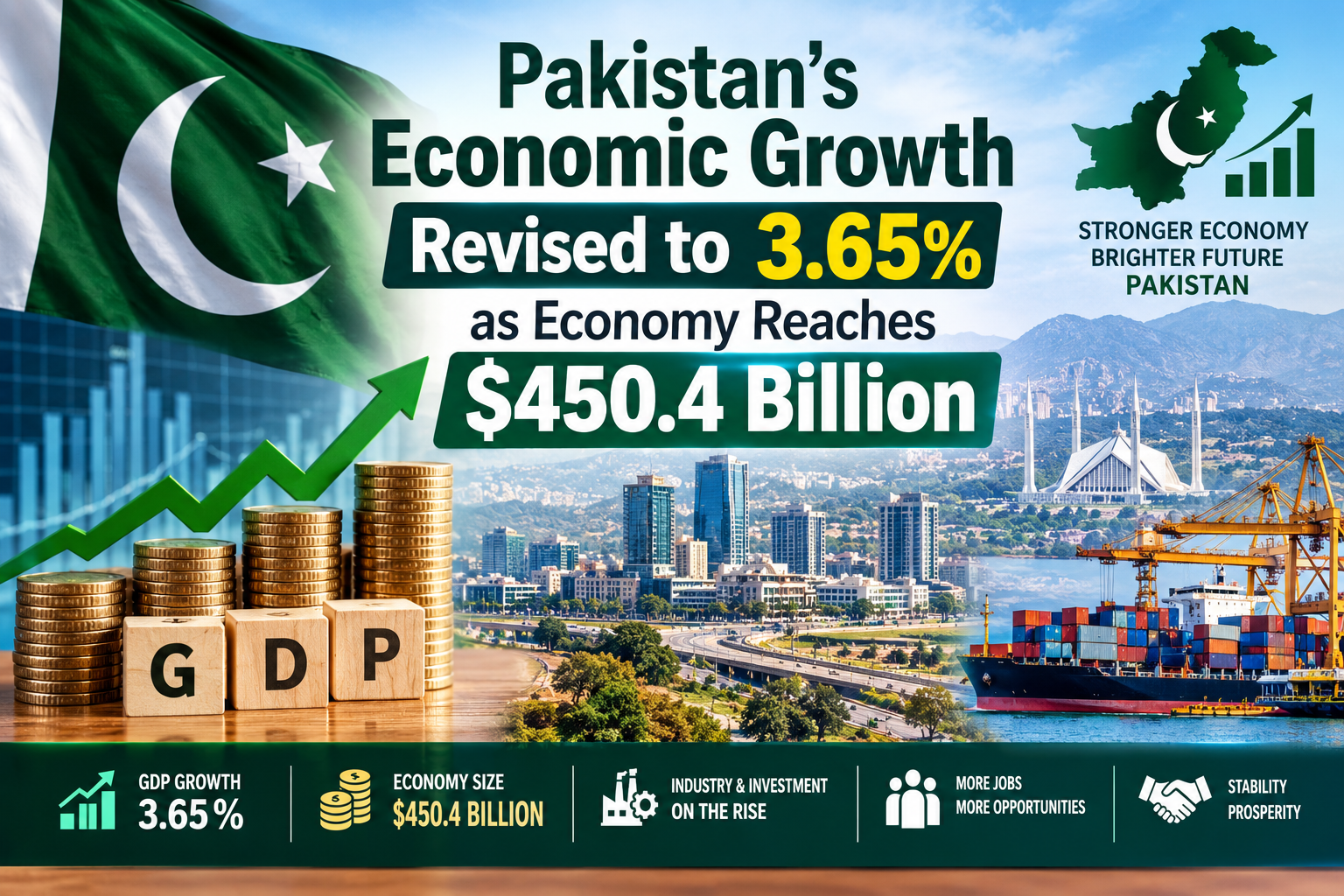
Pakistan’s economy recorded 3.65% growth during the fiscal year 2025–26, according to revised estimates approved by the National Accounts Committee (NAC) on October 19, 2026. The updated figures place the country’s economic size at approximately $450.4 billion, while growth slowed to 2% in the final quarter of the fiscal year.
The latest figures present a mixed picture of Pakistan’s economic performance. Agriculture performed better than previously estimated, while industrial and services growth were revised downward. These developments highlight both the progress made in selected sectors and the challenges that remain for businesses, workers, farmers, and policymakers.
Understanding Pakistan’s Latest GDP Growth Figures
Gross Domestic Product, commonly known as GDP, measures the total value of goods and services produced within a country over a particular period. It is one of the most widely used indicators for assessing economic activity.
When GDP increases, it generally means that the economy is producing more goods and services. However, economic growth does not automatically mean that every household becomes financially better off. Inflation, employment opportunities, income distribution, and the cost of essential goods also influence living standards.
Pakistan’s revised annual growth rate of 3.65% is slightly lower than the earlier estimate of 3.70%. The revision was approved during the 118th meeting of the National Accounts Committee after adjustments to economic data and quarterly estimates.
Although the difference between the two annual estimates is relatively small, the updated numbers offer a more detailed picture of the country’s economic performance.
The economy was valued at Rs126.4 trillion, equivalent to approximately $450.4 billion, during FY2025–26. Per capita income was reported at Rs531,897, or around $1,896. These figures provide a broad measure of economic size and average income, but per capita income does not represent the actual earnings of every Pakistani citizen.
For policymakers, businesses, and households, the more important question is whether economic growth can translate into sustainable employment, improved purchasing power, and better access to essential services.
Why Was Economic Growth Revised Downward?
The National Accounts Committee reviews economic estimates as updated information becomes available. These calculations can change when new data on production, imports, trade, and other economic activities are incorporated.
In Pakistan’s latest revision, annual GDP growth for FY2025–26 declined from the previously estimated 3.70% to 3.65%. The committee also revised the figures for the previous fiscal year, reducing the FY2024–25 growth estimate from 3.18% to 3.11%.
Such revisions are part of the process of measuring a large and complex economy. Initial estimates are often prepared before every data point becomes available. Later assessments can provide a more complete understanding of economic activity.
However, the revised figures also show why it is important to examine the performance of individual sectors rather than relying only on the overall growth rate.
Agriculture recorded stronger growth than previously expected, while industry and services performed below earlier estimates. These differences affected the final national growth figure.
The slowdown during the fourth quarter was particularly notable. Pakistan’s economy grew by 2% in that quarter, compared with 6.07% in the corresponding period of the previous fiscal year. The official assessment noted that the unusually strong comparison period contributed to the apparent slowdown.
The figures do not mean that every economic activity declined. Instead, they indicate that overall growth lost momentum towards the end of the year, with substantial differences between sectors.
Agriculture Provides Support to the Economy
Agriculture remains an important part of Pakistan’s economy because it supports food production, rural employment, livestock activities, and several manufacturing industries.
The revised estimates put agricultural growth at 3.50% in FY2025–26, compared with the earlier estimate of 2.89%. Improved estimates for important crops and other agricultural activities contributed to this upward revision.
The improvement matters because agricultural performance can influence food availability, rural incomes, and the supply of raw materials to industries.
Improved performance of major crops
The growth estimate for important crops was revised upward from 0.65% to 1.59%. Wheat and maize contributed to the improved assessment.
Other crops performed more strongly than previously estimated, with growth revised from 2.43% to 4.28%.
The updated data reported increases in the production of several agricultural products, including pulses, fruits, tomatoes, oilseeds, and green fodder. Tomato production recorded particularly strong growth in the annual figure.
These improvements demonstrate the importance of crop diversity. Pakistan’s agricultural performance depends on more than a single commodity, and different crops respond differently to weather conditions, input costs, market demand, and farming practices.
Challenges facing farmers
Despite the improved growth estimate, farmers continue to face several economic considerations.
The costs of seeds, fertilisers, pesticides, machinery, fuel, and irrigation can affect profitability. Farmers also need dependable access to markets, storage facilities, transportation, and reliable information about prices.
Production increases do not necessarily guarantee higher earnings. If market prices decline sharply or transportation costs rise, farmers may struggle to benefit fully from a successful harvest.
Water management is another important concern. Efficient irrigation, improved water storage, suitable crop choices, and modern farming techniques can help farmers use available resources more effectively.
Agricultural research and extension services can also support productivity by providing information about crop diseases, soil conditions, and changing weather patterns.
For Pakistan to maintain agricultural growth, improvements in production should be accompanied by efforts to strengthen farmers’ incomes, reduce avoidable losses, and improve the efficiency of supply chains.
Industrial Growth Faces Fresh Pressure
Industry is another important contributor to economic activity. It includes manufacturing, mining, construction, utilities, and other activities that produce goods or support production.
The latest national accounts estimates put industrial growth at 3.34% in FY2025–26, down from the earlier estimate of 3.51%. The revision reflected weaker estimates for some industrial activities, particularly large-scale manufacturing.
Industrial performance matters because factories and related businesses generate employment, supply products to domestic markets, and contribute to exports.
When manufacturing activity expands, it can create demand for transport, packaging, warehousing, maintenance, and other services. When it slows, these connected businesses may also experience weaker demand.
Manufacturing performance remains uneven
The growth estimate for large-scale manufacturing was revised downward from 6.11% to 5.01%.
This does not mean that all manufacturing industries contracted. Different sectors experienced different conditions, with some reporting stronger activity and others facing difficulties.
Manufacturing performance can be influenced by production costs, access to financing, consumer demand, imported inputs, electricity prices, exchange-rate movements, and the availability of reliable infrastructure.
For manufacturers, predictable economic conditions are important when deciding whether to expand production, purchase equipment, recruit workers, or invest in new facilities.
Small and medium-sized businesses also play an important role in industrial development. Improving their access to finance, technical training, digital services, and domestic supply chains could help strengthen the wider manufacturing sector.
Mining and quarrying show improvement
The revised estimates showed that mining and quarrying grew by 1.52%, compared with the previous estimate of 0.38%.
The improvement was associated with stronger reported production of natural gas, crude oil, and coal.
Mining and energy-related activities can contribute to economic output, but their long-term benefits depend on responsible resource management, investment, infrastructure, and environmental safeguards.
Developing these activities also requires attention to workplace safety and the needs of communities living near extraction sites.
Pakistan’s industrial sector would benefit from a balanced approach that supports manufacturing, encourages productive investment, improves energy efficiency, and promotes sustainable use of natural resources.
Services Sector Continues to Expand
The services sector includes activities such as transportation, communications, banking, retail, education, healthcare, and public administration.
According to the revised estimates, services growth was adjusted downward from 4.09% to 3.81% for FY2025–26. Although the revised rate was lower than initially expected, the sector continued to expand.
Services are important to Pakistan because they connect producers with consumers and support the everyday functioning of the economy.
For example, transport businesses move agricultural products and manufactured goods, financial institutions facilitate payments and lending, and communication services enable businesses to reach customers.
Wholesale and retail trade
The growth estimate for wholesale and retail trade declined from 3.71% to 2.37%.
The National Accounts Committee linked the weaker performance to changes in manufacturing and imports.
Trade activity is affected by household purchasing power, the availability of products, business costs, and the confidence of consumers and sellers.
When families face pressure from essential expenses, they may reduce discretionary purchases. Retailers can then experience slower sales, while wholesalers may adjust their orders.
Improving trade activity requires a healthy relationship between household demand, business investment, and efficient supply chains. Digital payments, better inventory management, and improved transport systems can also help businesses operate more effectively.
Information and communication
Information and communication recorded stronger growth than previously estimated. Its annual growth rate was revised upward from 7.52% to 9.53%.This performance highlights the growing importance of digital services in Pakistan’s economy.
Telecommunications, software development, online business services, and digital platforms can support productivity across multiple industries. Businesses can use technology to manage operations, communicate with customers, and access new markets.
The expansion of digital services can also create opportunities for young people to develop skills in programming, digital marketing, data analysis, cybersecurity, and other technology-related fields.
However, wider benefits depend on affordable internet access, dependable electricity, appropriate training, and opportunities for people in smaller cities and rural communities.
Digital development should therefore remain connected to education, workforce preparation, and access to reliable infrastructure.
Financial and insurance services
The growth estimate for finance and insurance improved from 0.32% to 4.23%, according to the revised national accounts.
A functioning financial sector helps households and businesses make payments, manage savings, obtain financing, and protect themselves against certain risks.
For economic growth to become more inclusive, financial services must be accessible to small businesses and people who have limited access to traditional banking.
Clear regulations, responsible lending practices, consumer protection, and financial education can help strengthen public confidence in financial institutions.
What Does the $450.4 Billion Economy Mean?
Pakistan’s estimated economic size of $450.4 billion provides a broad indication of the value of its annual economic output. The national accounts placed the economy at Rs126.4 trillion in FY2025–26, compared with Rs114.9 trillion, or $408.7 billion, in the previous fiscal year.
The figures show an increase in the reported size of the economy, but they need to be interpreted carefully.
GDP measured in Pakistani rupees can rise because of increased production, changes in prices, or a combination of both. Its value in US dollars is also influenced by the exchange rate.
Therefore, an increase in the dollar value of GDP does not automatically mean that every household has become wealthier or that purchasing power has increased by the same proportion.
The quality of economic growth matters as much as the headline figure. Stronger growth is more beneficial when it supports productive employment, improves household incomes, increases access to essential services, and encourages investment.
For policymakers, the challenge is to turn overall economic expansion into improvements that people can experience in their daily lives.
Per Capita Income and Household Living Standards
Pakistan’s reported per capita income reached Rs531,897, equivalent to approximately $1,896, during FY2025–
Per capita income is calculated by dividing the total income or output measure used in the national accounts by the population. It is useful for broad economic comparisons, but it does not show how income is distributed among individuals.
Some households earn substantially more than the reported average, while others earn considerably less. Employment status, family size, location, and living expenses all influence individual financial circumstances.
For ordinary families, the affordability of food, housing, education, healthcare, electricity, and transportation is particularly important.
Economic growth can improve living standards when businesses create productive jobs and wages increase sustainably. However, if the prices of essential goods rise faster than household incomes, families may continue to experience financial pressure despite positive GDP growth.
This is why economic policy needs to consider inflation, employment, productivity, and income opportunities alongside the overall growth rate.
What Pakistan Needs to Strengthen Economic Growth
Pakistan’s revised economic figures point to several areas that deserve continued attention.
First, investment in productive industries is important. Businesses need predictable policies, reliable energy supplies, efficient transportation, and access to financing to expand their operations.
Second, agricultural productivity requires continued improvement. Better irrigation, suitable seeds, modern farming practices, storage facilities, and access to markets can help farmers improve output and reduce losses.
Third, skills development should match employment needs. Technical education, vocational training, and digital skills can help young people prepare for opportunities in manufacturing, services, and technology.
Fourth, small businesses need opportunities to grow. Simplified regulations, responsible lending, digital payment systems, and improved access to markets can help entrepreneurs build sustainable businesses.
Finally, economic progress must benefit communities across the country. Investment in education, healthcare, infrastructure, and essential public services can help ensure that growth supports wider social development.
These measures require coordination between federal and provincial governments, businesses, educational institutions, and other stakeholders. Their results should be assessed through reliable data on employment, productivity, incomes, and public welfare.
Economic Outlook for Pakistan
Pakistan’s economic outlook will depend on how effectively the country addresses its structural challenges while building on areas of strength.
The revised FY2025–26 figures show continued economic expansion, supported in part by agriculture and several service industries. However, slower fourth-quarter growth and downward revisions in industry and services indicate that momentum remains uneven.
Future performance will depend on domestic demand, investment, agricultural conditions, industrial production, trade, and the broader financial environment.
Businesses will be watching for predictable policies and opportunities to expand. Farmers will need productive growing seasons and dependable access to markets. Workers will benefit when economic activity translates into stable jobs and sustainable earnings.
The latest GDP estimates are an important starting point for understanding these developments, but they do not determine the country’s future performance on their own.
Consistent economic planning, responsible financial management, stronger productivity, and investment in human development will remain important for supporting long-term growth.
Conclusion
Pakistan’s GDP growth was revised to 3.65% for FY2025–26, while the estimated size of the economy reached $450.4 billion. The updated figures, approved by the National Accounts Committee on October 19, 2026, show that agriculture performed better than previously estimated, whereas industrial and services growth were revised downward.
The 2% expansion recorded in the final quarter highlights the importance of strengthening economic momentum. At the same time, continued growth in agriculture, information and communication, and selected service industries provides areas on which policymakers and businesses can build.
For Pakistan, the main challenge is to ensure that economic expansion supports productive employment, sustainable business investment, improved household purchasing power, and better public services.
A stronger economy requires more than a larger GDP figure. It requires opportunities that reach workers, farmers, entrepreneurs, and families throughout the country. With consistent policies and a focus on productivity and human development, Pakistan can work towards more sustainable and inclusive economic progress.
Frequently Asked Questions (FAQs)
1. What is Pakistan’s GDP growth rate for FY2025–26?
Pakistan’s GDP growth rate was revised to 3.65%, down from the previous estimate of 3.70%.
2. What is the size of Pakistan’s economy in 2026?
According to the revised national accounts, Pakistan’s economy was valued at approximately $450.4 billion during FY2025–26.
3. Why was Pakistan’s GDP growth revised?
The National Accounts Committee incorporated updated economic data, including revised import information and annual and quarterly economic indicators.
4. Which sector performed best in the revised annual estimates?
Agriculture performed better than previously estimated, with its growth rate revised upward to 3.50% for FY2025–26.
5. What are Pakistan’s main economic challenges?
Key challenges include strengthening industrial production, creating sustainable jobs, improving productivity, supporting small businesses, and making essential goods and services more affordable.