Introduction
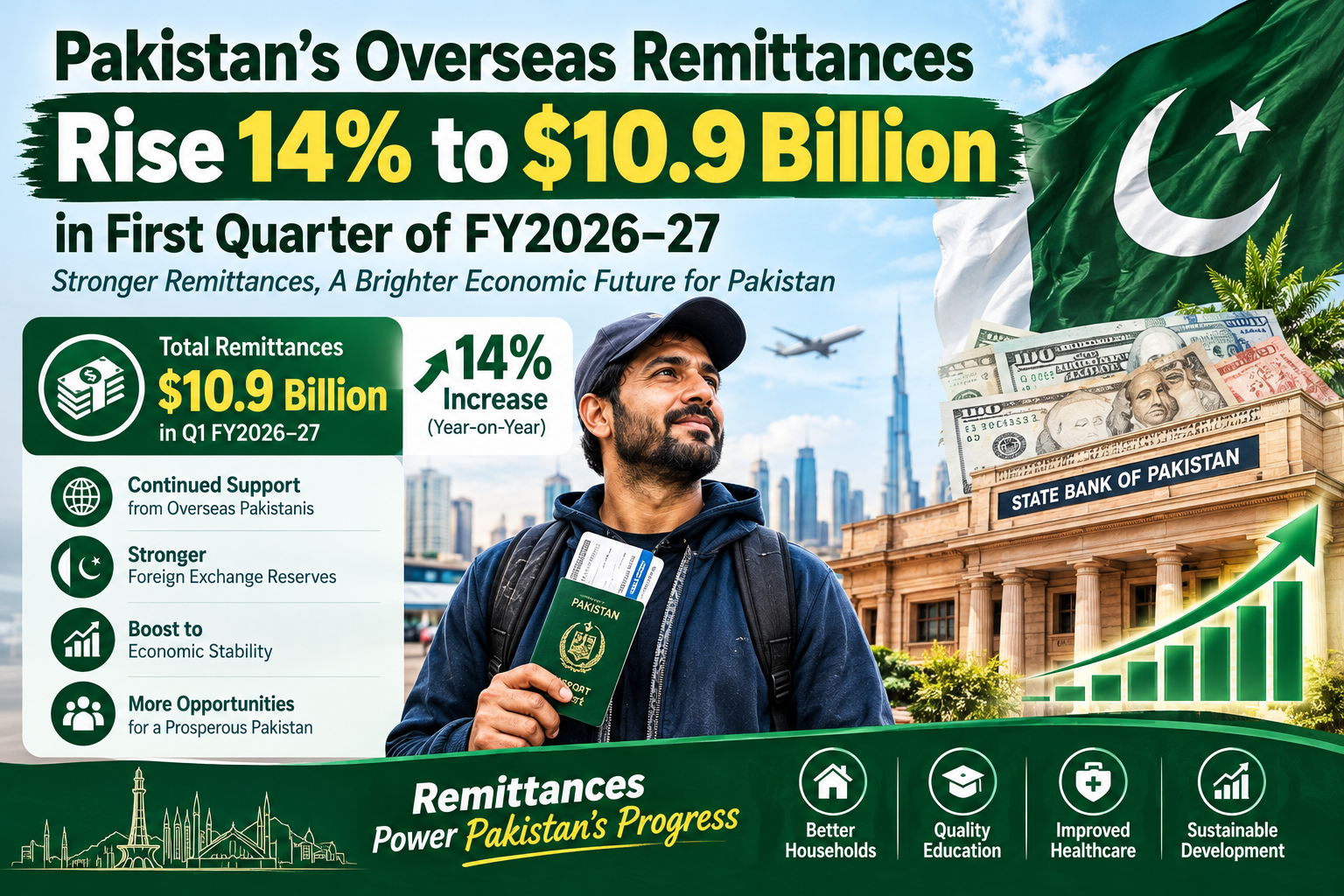
Pakistan has recorded a significant increase in money sent home by overseas workers, with workers’ remittances reaching approximately $10.9 billion during the first quarter of fiscal year 2026–27. According to data released by the State Bank of Pakistan (SBP), inflows increased by 14% compared with the same period of the previous fiscal year.
The figures cover July, August and September 2026. During these three months, Pakistan received approximately $10.875 billion in remittances, compared with $9.537 billion during the corresponding period a year earlier. This represents an increase of around $1.338 billion.
The latest figures underline the important role played by overseas Pakistanis in supporting families and contributing to the country's foreign exchange inflows. Millions of Pakistani workers live and work abroad, sending money to relatives who use it for household expenses, education, healthcare, housing and other needs.
Saudi Arabia remained the largest source of remittances during the quarter, followed by the United Arab Emirates (UAE), the United Kingdom and other major destinations. In September alone, Pakistan received approximately $3.6 billion from overseas workers.
Although the quarterly growth is encouraging, remittances declined slightly compared with August. This distinction shows why both annual and monthly figures matter when evaluating the country's economic performance.
The increase provides support to Pakistan's external financial position, but remittances are not a complete solution to the country's economic challenges. Their long-term contribution depends on continued employment opportunities abroad, secure and affordable transfer channels, stable economic policies and stronger domestic production.
1. Pakistan Receives $10.9 Billion in Three Months
The State Bank of Pakistan reported that workers' remittances reached approximately $10.875 billion during July–September 2026.
During the same period in the previous fiscal year, Pakistan received around $9.537 billion. The difference of approximately $1.338 billion represents year-on-year growth of 14%.
This increase is significant because remittances are an important source of foreign currency for Pakistan. They help families meet everyday expenses and contribute to the country's ability to finance international payments.
For many households, money sent by relatives working abroad is a regular part of the family budget. It may cover rent, groceries, school fees, healthcare, electricity bills and other essential costs.
The wider economy also benefits when overseas earnings enter Pakistan through formal financial channels. These inflows can support foreign exchange availability and help reduce some of the pressure associated with international payments.
However, the quarterly increase should be interpreted in context. Remittances are only one component of the country's external accounts. Imports, exports, services payments, debt obligations and other financial flows also influence Pakistan's economic position.
The latest figures therefore represent a positive development, but they should not be treated as proof that all economic pressures have been resolved.
2. September Remittances Reach $3.6 Billion
Pakistan received approximately $3.587 billion in workers' remittances during September 2026, according to the SBP data reported by the Associated Press of Pakistan and other news organisations.
The amount was 12.7% higher than the approximately $3.184 billion received in September 2025.
However, September inflows were 1.9% lower than the approximately $3.657 billion recorded in August 2026.
These two comparisons tell different stories.
The year-on-year increase shows that remittance inflows remained stronger than in the same month a year earlier. The month-on-month decline indicates that the total received was slightly lower than in the immediately preceding month.
A monthly decline does not automatically indicate a lasting downward trend. Transfers can change from month to month because of payment schedules, seasonal factors, exchange-rate conditions and other circumstances affecting workers and their families.
For this reason, economists and policymakers generally examine several months of data instead of drawing conclusions from a single movement.
The fact that monthly inflows remained above $3.5 billion throughout the first quarter provides useful context for understanding the overall performance.
Nevertheless, maintaining strong inflows throughout the fiscal year will depend on conditions in the countries where Pakistani workers are employed and on their continued ability to send money home.
3. Saudi Arabia Remains Pakistan's Largest Remittance Source
Saudi Arabia remained the leading source of workers' remittances to Pakistan during the first quarter of FY2026–27.
According to reported SBP figures, inflows from Saudi Arabia reached approximately $2.687 billion during July–September 2026, representing an increase of 16.2% compared with the same period of the previous fiscal year.
Saudi Arabia has long been an important destination for Pakistani workers in various sectors. Their earnings support families in Pakistan and contribute to the country's international financial inflows.
The importance of Saudi Arabia is also visible in the monthly data. In September 2026, Pakistani workers sent approximately $899.1 million from the kingdom, making it the largest individual source for that month.
These figures demonstrate the continued importance of employment opportunities in Saudi Arabia to Pakistani households.
At the same time, dependence on a small number of major destinations can create risks. Changes in employment conditions, economic activity, labour-market policies or living costs in a host country may affect workers' ability to save and send money home.
Pakistan can reduce some of this exposure over time by supporting skills development, expanding access to diverse overseas labour markets and creating more productive employment opportunities at home.
4. United Arab Emirates Remains a Major Contributor
The United Arab Emirates was another major source of remittances during the first quarter.
Reported figures show that inflows from the UAE reached approximately $2.236 billion during July–September 2026, increasing by 12.6% compared with the corresponding period a year earlier.
In September alone, Pakistan received approximately $748.5 million from the UAE.
The country hosts a large community of Pakistani workers employed in areas such as construction, retail, transport, hospitality, professional services and other sectors.
Their earnings help support families in Pakistan, while formal money transfers contribute to the country's foreign exchange inflows.
The UAE's role highlights the close economic connections between Pakistan and Gulf economies. Employment, trade, investment and financial transfers all contribute to these relationships.
For workers and their families, access to reliable transfer services is particularly important. Fees, exchange rates, transaction speed and the availability of nearby service providers can affect how much money ultimately reaches the recipient.
Encouraging safe, transparent and affordable transfer channels can help workers retain more of their earnings and make remittance services more accessible.
5. Remittances from the United Kingdom Show Strong Growth
The United Kingdom recorded the highest growth rate among several major remittance sources highlighted in the quarterly data.
According to reports based on SBP figures, remittances from the UK increased by 19.4% to approximately $1.634 billion during July–September 2026.
The UK is home to a significant Pakistani community, including workers, professionals, students and families with financial connections to Pakistan.
Money sent from the country supports relatives and contributes to Pakistan's wider foreign exchange inflows.
The increase also illustrates that remittance growth is not limited to Gulf destinations. Transfers from Western countries remain an important part of the overall picture.
However, the quarterly increase does not necessarily mean that every month recorded the same rate of growth. Monthly inflows can fluctuate, and comparisons should be made using the relevant periods.
The UK figures also show why Pakistan benefits from maintaining financial links with a diverse range of overseas communities.
Reliable banking services, transparent exchange rates and accessible digital transfer options can make it easier for people abroad to support their families.
6. Remittances from the United States and European Union
The United States also contributed significantly to Pakistan's remittance inflows.
Reported data show that remittances from the US reached approximately $931 million during the first quarter of FY2026–27, an increase of 15.5% compared with the same period a year earlier.
The European Union remained another important source. Quarterly inflows from EU countries reached approximately $1.405 billion, representing growth of 17.2% in the figures reported by Business Recorder.
These transfers come from Pakistani communities living in different European countries, including Italy, Spain, Germany, Greece and France.
The contribution of multiple destinations is important because remittance flows reflect the combined earnings and financial decisions of workers and families across different labour markets.
A broad range of source countries can help reduce reliance on any single economy, although the Gulf region remains particularly important to Pakistan's total inflows.
The figures also reinforce the value of accessible formal transfer channels. Workers should be able to compare fees and exchange rates and choose legitimate services that suit their needs.
Lower transfer costs can make a difference to families receiving regular payments, particularly when household budgets are limited.
7. Why Remittances Matter to Pakistan's Economy
Remittances have several important economic effects.
First, they provide direct financial support to households. Families receiving money from overseas relatives may use it to pay for food, education, medical treatment, housing and daily transportation.
Second, remittances bring foreign currency into Pakistan. This can support the country's external accounts and contribute to the availability of foreign exchange for international payments.
Third, remittance-funded spending supports economic activity. When families purchase goods and services, their spending becomes income for retailers, service providers and other businesses.
Fourth, these transfers can help families manage financial emergencies or invest in longer-term priorities, such as education, home improvements or small businesses.
However, the economic impact varies between households. Some families depend heavily on overseas income for basic needs, while others may save a portion or use it for investment.
Remittances do not automatically create new productive industries or guarantee sustained economic growth. Their broader impact depends partly on how the money is used and on the opportunities available within the domestic economy.
Policies that improve education, employment, financial inclusion and business conditions can help households make productive choices with the resources they receive.
8. Remittances and Pakistan's Foreign Exchange Position
Pakistan requires foreign currency to pay for imported goods, energy, machinery, medicines and other international transactions. It also needs to meet external debt obligations and other payments.
Remittances are an important source of foreign currency because they bring money into the country from workers and families abroad.
When inflows remain strong, they can help support the external account and reduce some of the pressure created by international payments.
However, remittances are not the same as export earnings. They reflect money transferred by individuals, while exports generate revenue from goods and services sold internationally.
Both are important, but they play different roles in the economy.
If imports and other external payments rise faster than the country's foreign currency inflows, pressure on the external account can continue even when remittances increase.
This is why Pakistan also needs to strengthen exports, improve productivity, attract sustainable investment and manage external obligations responsibly.
A strong remittance performance can provide support, but long-term economic stability requires several sources of foreign exchange and a productive domestic economy.
9. The Role of Formal Banking and Digital Transfers
The method used to send money can affect transaction costs, convenience and the reliability of the transfer.
Formal banking channels, licensed exchange companies and legitimate digital remittance services provide ways for overseas workers to transfer funds to recipients in Pakistan.
These services can offer transaction records, customer support and established procedures for addressing errors or disputes.
Digital services may also reduce the need for recipients to travel long distances to collect money, depending on the service and the recipient's access to a bank account or mobile wallet.
However, service charges and exchange rates differ. Customers should compare the total amount that will reach the recipient rather than considering only the advertised transfer fee.
Financial institutions can help by making charges transparent, improving digital access and providing clear information in languages customers understand.
The government and financial sector have also shown interest in encouraging formal remittance channels. Incentives and banking-sector initiatives may help increase their use, although their effectiveness depends on accessibility, affordability and public confidence.
For workers abroad, secure and reliable transfers are especially important because the money often supports relatives who depend on it for everyday needs.
10. How Remittances Affect Pakistani Families
The impact of remittances is often most visible at the household level.
For some families, money sent by an overseas relative covers essential expenses that would otherwise be difficult to manage. It may help pay school fees, purchase books, meet medical costs or maintain a household during a period of unemployment.
Other families may use remittances to improve housing, acquire tools for work or establish a small business.
Regular transfers can also help households manage fluctuations in local income. This may be particularly useful when a family member works in agriculture, informal employment or another occupation with irregular earnings.
However, the benefits are not distributed equally. Families with relatives working abroad receive support directly, while households without such connections may not benefit from remittance inflows.
The ability to send money also depends on the overseas worker's earnings and expenses. High living costs in the host country can limit how much money remains available for transfer.
Remittances should therefore be recognised as an important source of household support, but not as a replacement for accessible public services, good employment opportunities or effective social protection.
11. Challenges That Could Affect Future Remittance Growth
Despite the strong first-quarter performance, several factors could influence remittances during the remainder of FY2026–27.
Overseas Employment Conditions
Remittance growth depends partly on whether Pakistani workers can find and retain employment abroad. Changes in recruitment, labour demand, wages or work permits may affect the amount they send home.
Living Costs in Host Countries
Workers must cover their own expenses before deciding how much money to send to their families. Higher housing, transportation or food costs abroad may reduce their available savings.
Regional Economic Uncertainty
Economic uncertainty in major destination countries can affect job opportunities and household budgets. Pakistan's reliance on Gulf inflows means that developments in the region deserve particular attention.
Transfer Costs
High transaction fees or unfavourable exchange rates can reduce the amount received by families. Affordable, reliable services can help maintain the attractiveness of formal channels.
Domestic Economic Conditions
Inflation and changes in household expenses also influence how families use remittances. Strong inflows may provide support, but they cannot by themselves resolve every challenge facing the domestic economy.
Monitoring these factors can help policymakers understand whether quarterly growth is likely to continue.
12. Can Pakistan Reach Its Annual Remittance Target?
The increase during the first quarter has strengthened expectations that Pakistan could make progress towards its remittance target for FY2026–27.
The State Bank's annual projection reported in the news coverage is approximately $44 billion.
The first-quarter total of about $10.875 billion represents a substantial contribution towards that target. However, achieving the full-year figure will depend on remittance flows during the remaining nine months.
Monthly inflows can vary, so the first quarter alone cannot establish whether the annual projection will be met.
A useful assessment requires comparing subsequent monthly data with previous trends, employment conditions in major host countries and changes in transfer behaviour.
The government and financial institutions can support formal remittances by improving access to legitimate transfer services, keeping costs competitive and maintaining confidence in the domestic financial system.
At the same time, policymakers should avoid treating an annual target as guaranteed. Economic forecasts are estimates and may change as new information becomes available.
The quarterly increase is encouraging, but the final outcome will depend on actual inflows throughout the fiscal year.
13. Why Pakistan Must Strengthen Its Domestic Economy Too
Remittances can provide essential support, but a sustainable economic strategy must also strengthen domestic production and employment.
Pakistan needs businesses that can compete internationally, create jobs and generate revenue from exports. Improvements in education, vocational training, infrastructure, energy reliability and access to finance can support these goals.
A stronger domestic economy can create more opportunities for people who wish to work in Pakistan rather than relying exclusively on employment abroad.
It can also help families use remittances productively when they choose to invest in education, housing or business activities.
The goal should not be to discourage overseas Pakistanis from supporting their families. Instead, the country can recognise the value of their contribution while working to improve opportunities at home.
A balanced approach would combine continued engagement with overseas communities, affordable transfer services and domestic reforms that encourage investment and employment.
This would help ensure that remittances remain a source of support without becoming the only pillar of Pakistan's external financial stability.
Conclusion
Pakistan's workers' remittances increased by 14% to approximately $10.9 billion during the first quarter of FY2026–27, according to State Bank of Pakistan data reported on October 9 and 10, 2026.
Saudi Arabia remained the largest source, while the UAE, United Kingdom, United States and European Union also contributed significant inflows. September remittances reached approximately $3.6 billion, rising 12.7% compared with the same month last year despite a modest decline from August.
The increase highlights the continuing importance of overseas Pakistanis to household incomes and the country's foreign exchange position. For families, remittances can help pay for essential expenses, education, healthcare and housing. For the wider economy, they provide an important source of external inflows.
However, remittances alone cannot resolve Pakistan's structural economic challenges. Sustainable progress also requires stronger exports, productive employment, reliable financial services, sound economic management and opportunities for investment.
The first-quarter figures represent an encouraging development, but continued growth will depend on employment conditions abroad, transfer costs and broader economic circumstances.
By improving formal remittance channels and strengthening the domestic economy, Pakistan can make better use of the financial contribution made by its overseas community.
FAQs
1. How much remittance did Pakistan receive in the first quarter of FY2026–27?
Pakistan received approximately $10.875 billion in workers' remittances between July and September 2026.
2. How much did remittances increase?
Remittances increased by 14% compared with the same period of the previous fiscal year.
3. Which country sent the most remittances to Pakistan?
Saudi Arabia remained the largest source, contributing approximately $2.687 billion during the first quarter.
4. How much did Pakistan receive in September 2026?
Pakistan received approximately $3.587 billion in September, up 12.7% year-on-year but down 1.9% compared with August.
5. Why are remittances important for Pakistan?
They support families' living expenses and bring foreign currency into the country, helping support Pakistan's external accounts. They complement, but do not replace, exports and other sources of economic growth.