Introduction
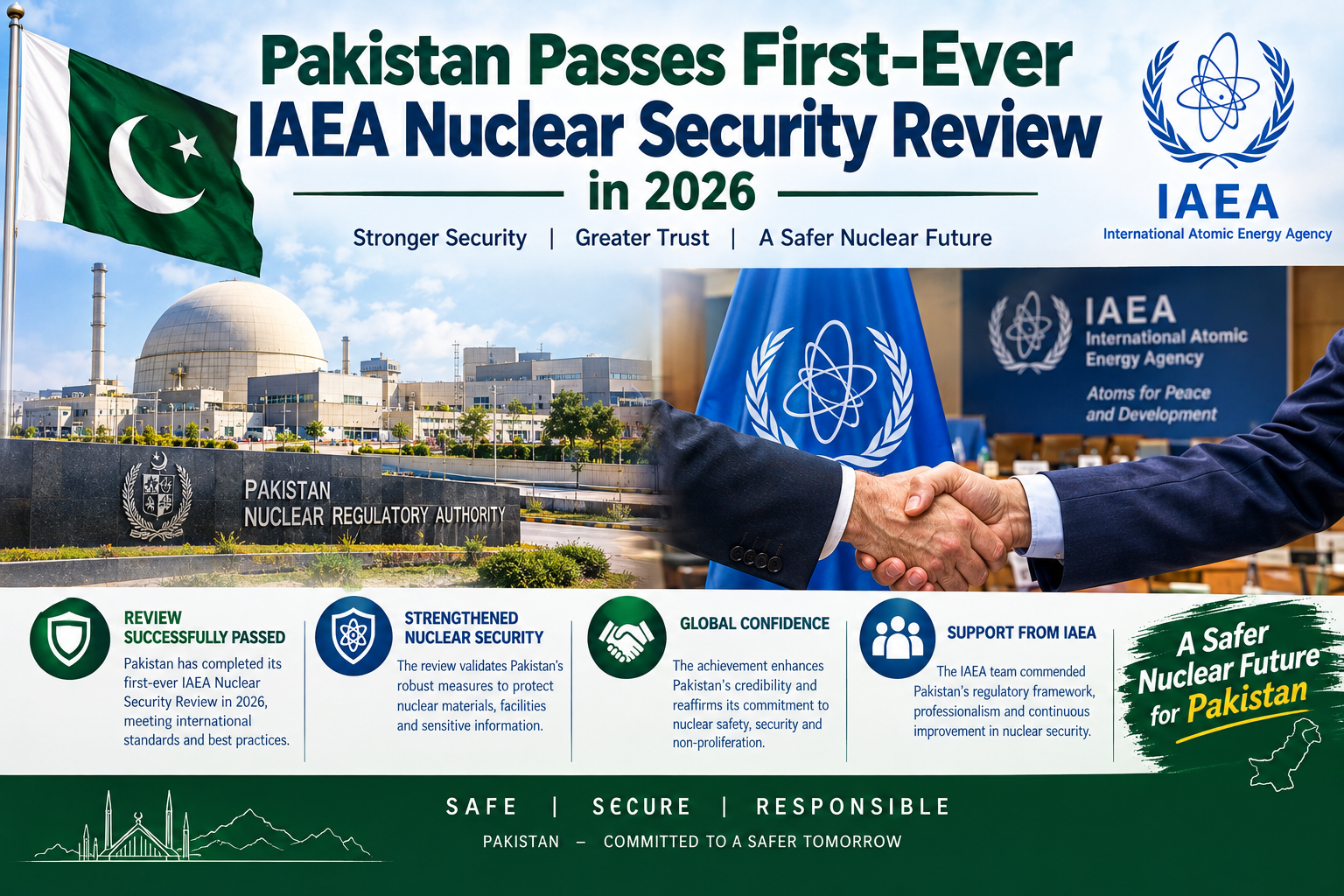
Pakistan has completed its first-ever International Physical Protection Advisory Service (IPPAS) review conducted by the International Atomic Energy Agency (IAEA), marking an important development in the country’s nuclear security and regulatory oversight.
According to reports published on October 10, 2026, an international team of experts concluded a comprehensive 12-day mission and assessed Pakistan’s legal, regulatory and operational arrangements for protecting nuclear materials and facilities. The team described Pakistan’s nuclear security regime as robust and provided recommendations intended to strengthen relevant rules, procedures and practices further.
The mission was conducted at the invitation of Pakistan’s government and hosted by the Pakistan Nuclear Regulatory Authority (PNRA), in coordination with the Pakistan Atomic Energy Commission (PAEC) and other relevant national organisations.
The review matters because nuclear technology is used in several peaceful fields, including electricity generation, medicine, agriculture, research and industrial applications. Maintaining effective security and regulatory arrangements is essential to protecting nuclear materials, facilities, workers and the wider public.
The completion of the IPPAS mission also provides an opportunity to examine Pakistan’s engagement with international nuclear security standards, the responsibilities of its regulatory institutions and the importance of continuous improvement.
Although the assessment represents a positive development, it should not be interpreted as a declaration that every possible risk has disappeared. International reviews identify strengths as well as areas where additional improvements may be beneficial.
1. Pakistan Completes Its First-Ever IPPAS Mission
The first-ever IPPAS mission to Pakistan concluded following a 12-day review of the country’s nuclear security arrangements.
The assessment examined the legal and regulatory framework governing the physical protection of nuclear materials and facilities. It also considered how relevant arrangements are implemented in practice.
The International Physical Protection Advisory Service is an IAEA peer-review service through which international experts assist countries in evaluating and strengthening their nuclear security systems.
The mission to Pakistan was undertaken at the government’s invitation. The Pakistan Nuclear Regulatory Authority hosted the review in coordination with the Pakistan Atomic Energy Commission and other relevant organisations.
According to official statements, the international team acknowledged the cooperation, transparency and professionalism demonstrated during the mission.
The team’s overall assessment described Pakistan’s nuclear security regime as robust. It also provided recommendations to help strengthen the country’s legal, regulatory and operational arrangements further.
The distinction between an assessment and a guarantee is important. A positive review provides an informed evaluation of a country’s arrangements at the time of the mission. It does not eliminate the need for continuing supervision, updated procedures, staff training and periodic reassessment.
For Pakistan, the review represents an opportunity to build on existing arrangements and continue engaging with international expertise in nuclear security.
2. Understanding the International Atomic Energy Agency
The International Atomic Energy Agency is an international organisation that promotes the safe, secure and peaceful use of nuclear science and technology.
Its work includes nuclear safety, nuclear security, safeguards, technical cooperation and assistance to countries developing peaceful nuclear applications.
Although these areas are related, they are not identical.
Nuclear safety concerns preventing accidents and reducing their consequences if they occur. It includes matters such as the safe design, operation and maintenance of nuclear facilities.
Nuclear security focuses on protecting nuclear and other radioactive materials and associated facilities against theft, unauthorised access and other malicious acts.
Nuclear safeguards involve measures used to verify that nuclear materials and activities are not diverted from peaceful purposes, in accordance with the applicable international agreements.
These distinctions are important when reporting on Pakistan’s IPPAS mission. The assessment was specifically concerned with physical protection and nuclear security arrangements. It should not automatically be described as a comprehensive evaluation of every aspect of nuclear safety or safeguards.
The IAEA works with participating countries through international standards, technical advice, expert missions, training and cooperation.
Its role is particularly important because nuclear technology involves specialised materials and facilities that require careful oversight. International cooperation can help countries compare their practices with recognised approaches and identify opportunities for improvement.
3. What Is the IPPAS Review?
The International Physical Protection Advisory Service, commonly known as IPPAS, is an IAEA service designed to help countries evaluate and strengthen their nuclear security arrangements.
An IPPAS mission brings together international expertise to review relevant national frameworks and provide advice on their implementation.
The process can examine legislation, regulations, institutional responsibilities and selected practical arrangements for protecting nuclear materials and facilities.
The purpose is not simply to issue a public statement about a country’s performance. A peer review provides an opportunity to assess established practices, identify potential weaknesses and recommend improvements.
Such assessments can also encourage discussion between national authorities and international specialists about the continuing development of nuclear security.
For participating countries, the recommendations can help inform future regulatory work, staff training, institutional planning and reviews of existing procedures.
The findings of an IPPAS mission should be understood in the context of its defined scope. A mission reviews specified arrangements rather than every possible aspect of a country’s nuclear programme.
Pakistan’s first IPPAS mission therefore represents an important step in international engagement, while ongoing national responsibility remains essential for maintaining effective security.
4. Why Nuclear Security Matters
Nuclear technology has important peaceful applications, but the materials and facilities involved require appropriate protection.
Nuclear power plants generate electricity that can support homes, businesses, hospitals and industries. Nuclear and radiation technologies also have uses in cancer treatment, medical diagnosis, agricultural research, food preservation and industrial inspection.
Protecting the materials and facilities involved in these activities helps support their continued safe and peaceful use.
Effective nuclear security requires clear laws, competent regulatory institutions, properly trained personnel and procedures that are regularly reviewed.
It also involves coordination between organisations with different responsibilities. Regulators, facility operators, emergency management authorities and other relevant institutions may all have roles within the broader national framework.
International cooperation can contribute by sharing experience, strengthening professional capabilities and helping countries assess their arrangements against recognised good practices.
For Pakistan, which uses nuclear technology for electricity generation and other civilian purposes, maintaining public confidence in the security of these activities is an important national responsibility.
The IPPAS review provides an external perspective on the framework established for that purpose.
5. The Role of the Pakistan Nuclear Regulatory Authority
The Pakistan Nuclear Regulatory Authority is a central institution responsible for regulating nuclear safety and radiation protection within its legal mandate.
Its work includes overseeing relevant facilities and activities to ensure that applicable regulatory requirements are followed.
Regulatory oversight is essential because the organisations operating nuclear facilities must meet established legal and technical requirements. A regulator provides a framework for authorisation, inspection, compliance and corrective action where necessary.
In the context of the IPPAS mission, PNRA hosted the international review in coordination with the Pakistan Atomic Energy Commission and other national organisations.
The mission gave the authority an opportunity to engage with international specialists and review the wider arrangements governing nuclear security.
Regulatory institutions must also adapt to changing technology and evolving standards. Equipment, operating practices and supply chains can change over time, creating a need for continued professional development and review.
The effectiveness of a regulatory framework depends not only on the existence of written rules but also on consistent implementation, qualified staff and the ability to identify and address problems.
The completion of the IPPAS mission provides a basis for continuing that work in line with the recommendations received.
6. The Role of the Pakistan Atomic Energy Commission
The Pakistan Atomic Energy Commission is involved in Pakistan’s nuclear science and technology activities, including peaceful applications in energy, medicine, agriculture and research.
Its work illustrates the range of areas in which nuclear technology can contribute to national development.
Medical applications, for example, can support the diagnosis and treatment of diseases. Research and agricultural applications can contribute to scientific understanding and improved practices. Nuclear power can also form part of the country’s wider electricity supply.
Because these activities involve specialised technologies, they require appropriate technical standards, qualified personnel and compliance with relevant regulatory requirements.
During the IPPAS mission, the Pakistan Atomic Energy Commission coordinated with PNRA and other organisations to facilitate the review.
Such coordination is important because nuclear security involves more than one institution. Clear responsibilities and effective communication can help ensure that relevant requirements are understood and implemented consistently.
The international assessment provides an opportunity for participating institutions to consider the recommendations and incorporate suitable improvements into their future work.
7. What the International Experts Found
The principal finding reported by Pakistani media was that the country had established a robust nuclear security regime for the physical protection of nuclear materials and facilities.
The experts reached this conclusion after conducting a 12-day review of the relevant framework.
The assessment also resulted in recommendations intended to strengthen legislation, regulations and procedures further.
Recommendations are a normal feature of peer-review processes. They do not necessarily mean that a country’s entire system is inadequate. Instead, they can identify ways to improve established arrangements or adapt them to changing circumstances.
In complex technical fields, even well-developed systems require periodic review. New technologies, updated international practices and changes in the wider environment can create opportunities for improvement.
The value of an external review therefore lies in both its assessment of existing strengths and its identification of areas that may benefit from further attention.
The reported findings offer a positive assessment of Pakistan’s framework while also highlighting the importance of acting on relevant recommendations.
The practical significance of the mission will depend partly on how the responsible institutions evaluate those recommendations and incorporate appropriate changes into their regulatory and operational work.
8. Nuclear Security and International Confidence
Nuclear security has an international dimension because concerns involving nuclear materials and facilities can extend beyond national borders.
Countries therefore have an interest in maintaining effective arrangements and cooperating on recognised standards and good practices.
Participation in an international peer review allows a country to demonstrate its willingness to have relevant arrangements examined by external experts.
For Pakistan, completing its first IPPAS mission represents a formal opportunity to engage with the IAEA’s nuclear security review process.
Such cooperation can contribute to dialogue between national institutions and international specialists. It may also support the exchange of experience and strengthen understanding of regulatory approaches.
However, international confidence depends on more than a single review. It is built through sustained institutional performance, transparent engagement where appropriate, effective regulation and continued attention to emerging challenges.
Countries also have different legal frameworks and operational circumstances, so international assessments must be interpreted within the scope of the particular mission.
Pakistan’s engagement with the IPPAS process is therefore best understood as one part of its wider effort to maintain and improve nuclear security.
9. The Importance of Recommendations and Continuous Improvement
One of the key lessons from the review is that a positive assessment should be accompanied by a commitment to ongoing improvement.
Nuclear security is not a task that can be completed permanently. It requires continuing attention to legislation, regulatory practices, staff competence and institutional coordination.
Recommendations from international experts can help national authorities identify where changes may be useful.
The responsible institutions can examine each recommendation, determine its relevance and decide how to address it within the applicable national framework.
Progress may involve updating procedures, reviewing regulatory guidance, improving training or strengthening coordination between organisations.
Any changes should be implemented carefully and evaluated to determine whether they achieve their intended purpose.
Continuous improvement is important in other regulated fields as well. Aviation, healthcare, electricity generation and industrial safety all depend on systems that are reviewed and updated over time.
For nuclear security, the consequences of inadequate protection make sustained institutional attention particularly important.
The completion of the IPPAS mission should therefore be seen as a milestone within an ongoing process rather than the end of the work.
10. The Connection Between Nuclear Technology and Economic Development
Nuclear technology can contribute to economic and social development when it is used peacefully and managed responsibly.
Electricity generation is one of its best-known applications. Reliable power supplies are important for households, manufacturing, healthcare, education and digital services.
Nuclear science also contributes to medical diagnosis and treatment. Radiation-based techniques can help healthcare professionals diagnose certain conditions and deliver specialised therapies.
In agriculture, scientific applications may support research into crops, soil conditions and food preservation. Industrial applications can assist with inspection, measurement and quality control.
These benefits depend on suitable infrastructure, trained professionals, appropriate funding and effective regulation.
Security and safety arrangements are therefore not separate from development. They help create the conditions under which nuclear technology can be used responsibly.
A credible regulatory framework can support the long-term operation of civilian nuclear activities by establishing clear expectations and maintaining oversight.
Pakistan’s IPPAS mission is relevant to this broader picture because it concerns the framework protecting nuclear materials and facilities involved in these activities.
11. Nuclear Security Is Different from Nuclear Safety
News coverage sometimes uses the terms nuclear security and nuclear safety interchangeably. In technical and policy discussions, however, the distinction matters.
Nuclear safety is primarily concerned with preventing accidents and protecting people and the environment from radiation-related harm arising from accidental events.
Nuclear security is concerned with protecting relevant materials and facilities against malicious acts, including theft, unauthorised access and sabotage.
Both areas contribute to the responsible use of nuclear technology, but they address different types of risks.
A country needs appropriate arrangements for each area, supported by clear responsibilities and qualified personnel.
The IPPAS service specifically addresses nuclear security and physical protection. The fact that Pakistan completed an IPPAS mission should therefore not be taken as proof that every nuclear safety issue or every other regulatory matter was examined in the same review.
Accurate terminology helps the public understand what an international assessment actually covered.
It also ensures that reporting recognises the specific work performed by the experts rather than making broader claims than the evidence supports.
12. The Importance of International Standards
International standards and guidance can help countries develop consistent approaches to specialised technical challenges.
In nuclear security, international instruments and good practices provide a framework for cooperation and national implementation.
The Convention on the Physical Protection of Nuclear Material and its 2005 Amendment are among the important international instruments associated with the protection of nuclear material.
The IAEA supports countries in understanding and implementing relevant commitments through technical guidance, expert advice and peer-review services.
National laws and regulatory systems remain essential because international principles must be implemented through the appropriate domestic institutions and procedures.
Peer reviews can help identify whether existing arrangements align with recognised approaches and where further work may be beneficial.
For Pakistan, the first IPPAS mission created an opportunity to assess its framework through this form of international engagement.
Continuing cooperation can support professional development and help relevant institutions remain informed about evolving practices.
13. The Importance of Responsible Public Communication
Nuclear issues can attract considerable public attention because they involve specialised technology and national responsibilities.
Accurate public communication is therefore essential. Reports should distinguish verified findings from assumptions and should avoid presenting a limited assessment as a guarantee against every possible risk.
The key reported finding from Pakistan’s mission was positive: the international experts described the country’s nuclear security regime as robust.
The mission also provided recommendations for further improvement. Both aspects belong in a balanced account of the review.
Public discussion should explain the purpose of IPPAS, the role of the IAEA and the responsibilities of national regulatory institutions in straightforward language.
It should also distinguish nuclear security from nuclear safety and safeguards, since these terms describe related but different areas of work.
Clear explanations can help readers understand why international reviews matter without exaggerating their conclusions.
For journalists and publishers, careful use of official statements and reputable reporting is particularly important when covering specialised subjects.
14. What Happens After the Review?
The completion of an IPPAS mission does not remove the need for ongoing national oversight.
Following an assessment, the relevant authorities can consider the recommendations and determine which improvements should be incorporated into their existing arrangements.
The exact follow-up measures depend on the recommendations, the applicable legal framework and the responsibilities of the institutions involved.
Maintaining an effective system also requires periodic evaluation, staff development and attention to changes in technology and international practice.
A country may use the lessons from a peer review to inform future regulatory planning and internal assessments.
It is important not to assume that every recommendation has already been implemented simply because a mission has concluded. Implementation is a separate process that may require additional work.
For Pakistan, the next stage is to build on the assessment by continuing to strengthen the relevant framework and maintaining constructive engagement with international nuclear security efforts.
This is how an international review can contribute to lasting improvements rather than serving only as a one-time event.
Conclusion
Pakistan’s completion of its first-ever International Physical Protection Advisory Service mission marks a significant development in its engagement with international nuclear security review processes.
The 12-day assessment by international experts concluded that Pakistan had established a robust framework for protecting nuclear materials and facilities. The mission also produced recommendations intended to strengthen relevant laws, regulations and procedures.
The review was hosted by the Pakistan Nuclear Regulatory Authority in coordination with the Pakistan Atomic Energy Commission and other national organisations.
Its importance extends beyond the formal completion of an international assessment. Effective nuclear security supports the responsible use of nuclear technology in electricity generation, healthcare, research and other peaceful applications.
The findings also underline the value of international cooperation, professional expertise and continuous improvement.
A positive review should be understood as an assessment of the arrangements examined, not as a guarantee that every possible risk has been eliminated. Continued oversight and appropriate follow-up remain essential.
By considering the recommendations and maintaining cooperation with international institutions, Pakistan can continue working to strengthen its nuclear security framework and support the safe, secure and peaceful use of nuclear technology.
FAQs
1. What is the IPPAS mission?
The International Physical Protection Advisory Service is an IAEA peer-review service that helps countries assess and strengthen their nuclear security arrangements.
2. What did the IAEA team conclude about Pakistan?
The international experts described Pakistan’s nuclear security regime as robust after a 12-day review and provided recommendations for further improvement.
3. Which Pakistani organisation hosted the review?
The Pakistan Nuclear Regulatory Authority hosted the mission in coordination with the Pakistan Atomic Energy Commission and other relevant organisations.
4. Is nuclear security the same as nuclear safety?
No. Nuclear security focuses on protecting nuclear materials and facilities against malicious acts, while nuclear safety focuses on preventing accidents and reducing their consequences.
5. Does completing the review mean that no further improvements are needed?
No. The mission provided recommendations, and continued oversight and appropriate follow-up remain important for maintaining and strengthening nuclear security.