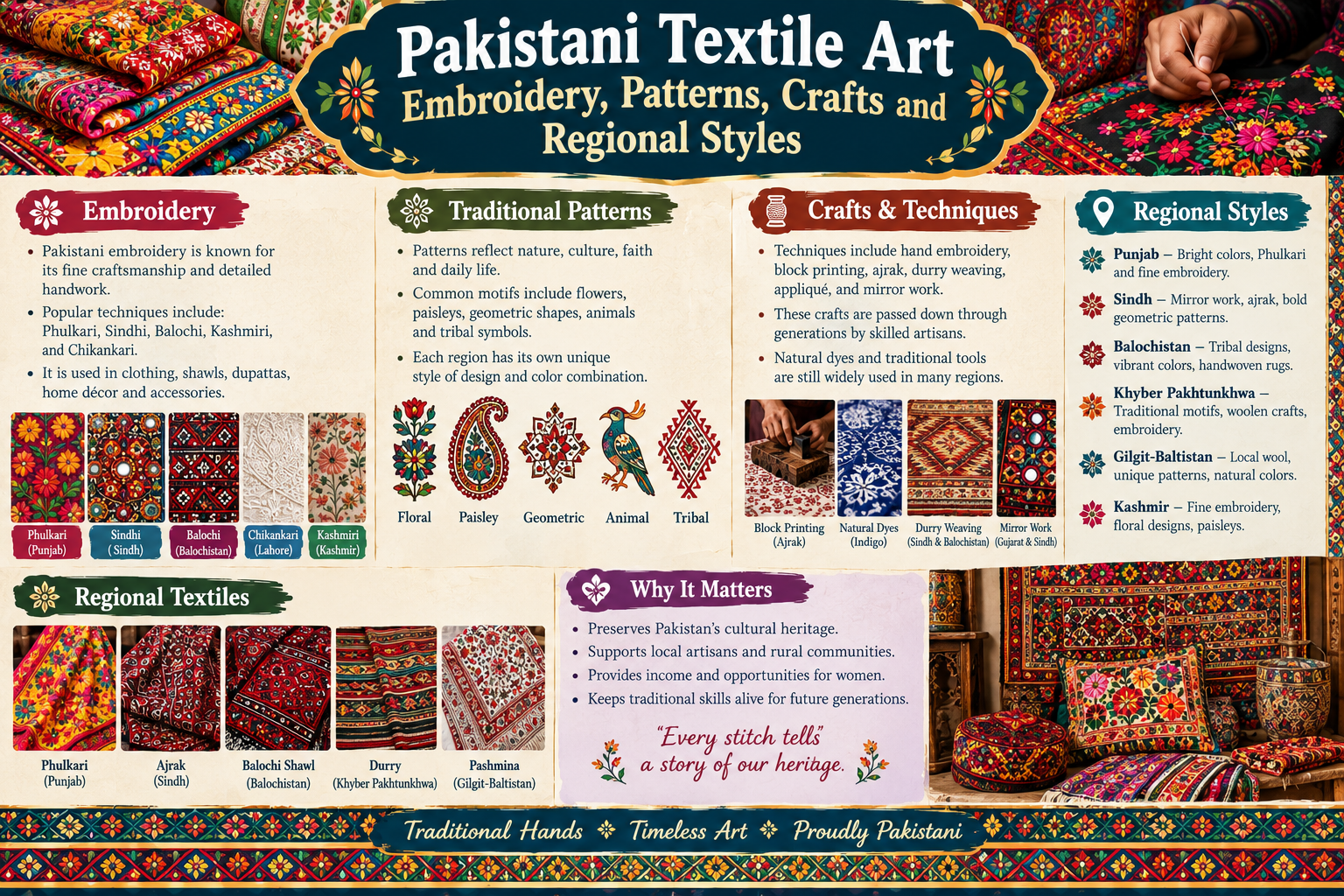
Pakistan has a rich and diverse tradition of textile art that reflects the country’s history, culture, regional identities, and creativity. From colorful embroidery and handwoven fabrics to traditional patterns and decorative stitching, Pakistani textile art has remained an important part of everyday life and cultural expression. Different regions of Pakistan have developed their own textile techniques, designs, colors, and patterns, making the country’s textile heritage highly diverse.
Textile art is not limited to clothing. It can also be found in shawls, scarves, bags, wall decorations, household fabrics, bridal garments, traditional caps, quilts, cushions, and many other handmade products. In many communities, textile skills are passed from one generation to another, helping preserve traditional knowledge.
Pakistan’s textile traditions have also developed alongside modern fashion. Designers and artisans increasingly combine traditional embroidery and patterns with contemporary cuts and designs. As a result, Pakistani textile art can be seen in both traditional clothing and modern fashion collections.
History of Textile Art in Pakistan
The history of textile art in the region that is now Pakistan goes back thousands of years. Archaeological discoveries from ancient settlements show that people in the Indus Valley were familiar with textile production and decorative crafts.
The ancient communities of the Indus Valley used natural materials to make fabrics and other useful objects. Cotton was particularly important in the region. Over centuries, textile production developed through changing civilizations, trade connections, cultural exchanges, and technological improvements.
Later periods introduced new artistic influences, patterns, weaving techniques, and decorative styles. Islamic artistic traditions also influenced textile decoration through geometric designs, floral patterns, calligraphy, and symmetrical compositions.
The Mughal period contributed to the development of elaborate decorative arts, including textiles. Fine fabrics, detailed embroidery, floral motifs, and luxurious materials became associated with royal and elite clothing.
Over time, different regions developed distinctive textile traditions. Punjab, Sindh, Balochistan, Khyber Pakhtunkhwa, and other areas developed their own approaches to embroidery, weaving, dyeing, and decoration.
Today, these traditions continue to influence Pakistani fashion and handmade crafts.
Importance of Textile Art in Pakistani Culture
Textile art is closely connected with Pakistani culture. Traditional clothing often communicates regional identity, social traditions, celebrations, and personal creativity.
Embroidery and decorative stitching are particularly important because many handmade designs contain patterns associated with specific communities or regions. A particular color combination or embroidery style may immediately remind people of a particular area.
Textiles also play an important role during weddings, festivals, family celebrations, and religious occasions. Embroidered dresses, shawls, dupattas, and traditional garments are commonly prepared for special events.
Handmade textiles can also represent family traditions. In some households, embroidery techniques are taught by mothers, grandmothers, or other family members to younger generations.
This makes textile art more than a decorative activity. It is also a way of preserving cultural knowledge.
Pakistani Embroidery
Embroidery is one of the most recognizable forms of Pakistani textile art. It involves decorating fabric with threads using different stitches and techniques.
Pakistani embroidery can be simple or highly detailed. Some designs use small repeated patterns, while others cover large sections of a garment.
Common embroidery elements include:
Floral designs
Leaves and vines
Geometric shapes
Birds and animals
Repeated borders
Traditional symbols
Abstract patterns
Mirror work
Decorative stitching
Different regions use different combinations of these elements.
Embroidery may be done by hand or with machines. Hand embroidery is especially valued for its detailed craftsmanship and connection with traditional skills.
Sindhi Textile Art
Sindh has one of Pakistan’s most distinctive textile traditions. Sindhi textiles are known for colorful patterns, embroidery, mirror work, and decorative designs.
One of the most famous examples is Sindhi embroidery. It often includes bright colors, geometric patterns, floral forms, and small mirrors known as shisha.
Mirror work creates a distinctive visual effect because small pieces of reflective material are attached to fabric.
Sindhi embroidery can be found on:
Dresses
Shawls
Bags
Caps
Cushion covers
Wall decorations
Traditional accessories
Sindh is also famous for ajrak, a traditional printed textile associated strongly with Sindhi cultural identity.
Ajrak usually features repeated geometric patterns and deep, rich colors. It is traditionally produced through a complex process involving block printing and dyeing.
Ajrak is used as a shawl, scarf, decorative cloth, and cultural symbol.
Punjabi Textile Art
Punjab has a long tradition of embroidery, weaving, decorative stitching, and colorful fabrics.
Punjabi textile traditions include various embroidery styles and regional crafts. Phulkari is one of the most famous examples.
The word Phulkari is associated with floral embroidery. Traditionally, it involved colorful thread work on fabric, often creating repeated floral and geometric patterns.
Phulkari has historically been connected with women’s clothing, shawls, and special occasions.
The colorful embroidery gives the fabric a lively appearance. Different designs can communicate regional traditions and individual creativity.
Punjabi textile art can also be seen in traditional dresses, dupattas, shawls, and household textiles.
Balochistan Textile Art
Balochistan is known for its distinctive embroidery traditions. Balochi embroidery is often highly detailed and can require considerable time and skill.
Traditional Balochi garments may feature elaborate embroidery around sleeves, necklines, borders, and other sections.
Common elements include:
Geometric patterns
Repeated shapes
Floral-inspired designs
Bright thread colors
Decorative borders
Mirror work in some traditions
Balochi embroidery is particularly important because traditional clothing can reflect community identity and cultural heritage.
The detailed work found on traditional Balochi dresses demonstrates the patience and skill of artisans.
Textile Traditions of Khyber Pakhtunkhwa
Khyber Pakhtunkhwa also has a rich tradition of textile crafts. Traditional clothing, shawls, woven fabrics, and embroidery reflect the cultural diversity of the region.
Wool and other materials are important in areas where colder climates influence clothing traditions.
Traditional shawls and woven textiles can provide both practical warmth and decorative value.
Different communities have their own patterns and methods, making textile traditions within the province diverse.
Embroidery may appear on women's garments, accessories, and decorative household items.
Kashmiri Textile Influence in Pakistan
Kashmiri textile traditions have also influenced textile art in Pakistan. Kashmir is historically known for fine shawls, embroidery, weaving, and decorative textile work.
Kashmiri-inspired patterns can be found in shawls and other fabrics. Floral motifs, detailed borders, and delicate designs are particularly common.
Shawls with intricate embroidery remain popular for formal and traditional clothing.
Kashmiri textile traditions demonstrate how textile art can move across geographic and cultural boundaries while developing new local expressions.
Phulkari Embroidery
Phulkari is one of the best-known embroidery traditions associated with the Punjab region.
Traditional Phulkari uses colorful threads to create floral and geometric patterns. The designs may cover large portions of the fabric or be concentrated in specific areas.
Phulkari has historically been associated with special occasions and ceremonial clothing.
Modern designers have also incorporated Phulkari-inspired patterns into contemporary clothing. Today, similar decorative ideas can appear on:
Kurtas
Dupattas
Shawls
Bags
Jackets
Cushion covers
Accessories
The continued popularity of Phulkari shows how traditional textile techniques can adapt to modern fashion.
Mirror Work in Pakistani Textiles
Mirror work is another distinctive feature of South Asian textile traditions. Small reflective pieces are attached to fabric and surrounded by decorative stitching.
In Pakistan, mirror work can be found particularly in the textile traditions of Sindh and Balochistan.
The reflective pieces catch light and create a striking appearance. They can be arranged in geometric or decorative patterns.
Mirror work is often used on traditional clothing, bags, shawls, and accessories.
Although traditionally handmade, modern textile production can also use machine-assisted techniques to create similar decorative effects.
Pakistani Block Printing
Block printing is an important textile decoration technique in Pakistan.
In block printing, a carved wooden block is used to transfer a design onto fabric. The process can involve repeated printing, different colors, and careful alignment.
Traditional block printing may produce:
Floral motifs
Geometric patterns
Borders
Repeated symbols
Decorative compositions
Sindhi ajrak is one of the most famous examples of traditional textile printing associated with Pakistan.
Block printing remains popular because it gives fabrics a handmade appearance.
Modern designers also use block printing to create contemporary clothing and home textiles.
Ajrak and Sindhi Identity
Ajrak is much more than a decorative textile. It has become an important symbol of Sindhi culture.
Its repeated patterns, traditional colors, and printing techniques give it a distinctive appearance.
Ajrak can be worn as a shawl or scarf, displayed during cultural events, or used as a decorative textile.
Its importance demonstrates how textiles can become symbols of regional identity.
The preservation of ajrak traditions also supports traditional craftsmanship and keeps older printing techniques alive.
Handwoven Textiles
Hand weaving is another important part of Pakistan’s textile heritage.
In hand weaving, threads are arranged carefully to create fabric. Traditional weaving can produce different textures, patterns, and fabric weights.
Handwoven textiles may include:
Cotton fabrics
Woolen fabrics
Shawls
Decorative cloth
Traditional garments
Household textiles
Hand weaving requires knowledge of materials, thread preparation, patterns, and weaving techniques.
Although industrial textile production is now widespread, handmade weaving continues to have cultural and artistic importance.
Textile Patterns in Pakistani Art
Patterns are an essential part of Pakistani textile art.
Many patterns are inspired by nature. Flowers, leaves, vines, birds, and other natural forms appear frequently.
Geometric patterns are also common. Squares, diamonds, circles, lines, and repeated shapes can create complex compositions.
Some patterns are highly symmetrical, while others have a more free-flowing appearance.
Traditional patterns can also be combined with modern designs.
This allows designers to maintain cultural references while creating clothing suitable for contemporary fashion.
Floral Motifs
Floral designs are among the most common patterns in Pakistani textiles.
Flowers can be represented realistically or in stylized forms. Leaves and vines are often added to create complete decorative compositions.
Floral embroidery can appear on:
Sleeves
Necklines
Borders
Dupattas
Shawls
Bridal clothing
Home decorations
Floral designs are popular because they can work with both traditional and modern fashion.
Geometric Patterns
Geometric designs are another important element of Pakistani textile art.
Triangles, diamonds, squares, circles, lines, and repeated shapes can create visually balanced designs.
Geometric patterns are particularly important in several regional embroidery and printing traditions.
They can be used as borders, central motifs, or all-over patterns.
The combination of geometry and bright colors gives many Pakistani textiles their distinctive character.
Textile Art and Pakistani Fashion
Pakistani fashion has played an important role in keeping traditional textile techniques visible.
Modern designers often use traditional embroidery, printing, weaving, and decorative patterns in contemporary clothing.
Traditional techniques may be applied to modern silhouettes such as:
Long shirts
Kurtas
Two-piece outfits
Three-piece suits
Shawls
Jackets
Formal dresses
This combination creates a bridge between traditional craftsmanship and modern fashion.
Bridal Textile Art in Pakistan
Bridal clothing is one of the most detailed areas of Pakistani textile design.
Wedding dresses may include extensive embroidery, decorative borders, thread work, beads, sequins, and other embellishments.
Traditional textile techniques are often combined with modern fashion trends.
Different regions also have different bridal clothing traditions. This creates a wide range of colors, embroidery styles, fabrics, and designs.
Handcrafted details can make bridal garments visually distinctive and culturally meaningful.
Textile Art in Home Decoration
Pakistani textile art is not limited to clothing.
Traditional textile designs can also be used in home decoration.
Examples include:
Cushion covers
Bedspreads
Wall hangings
Table runners
Rugs
Decorative cloth
Quilts
Curtains
Embroidered and printed household textiles can add cultural character to interior spaces.
Traditional patterns are increasingly combined with modern interior styles.
Quilting and Patchwork
Quilting and patchwork are also found in Pakistani textile traditions.
Patchwork involves joining pieces of fabric to create larger decorative designs. Different colors, textures, and patterns can be combined.
Quilting adds layers and stitching to create warm and decorative textile products.
These techniques can turn leftover pieces of fabric into useful objects, making them practical as well as artistic.
Role of Women in Textile Art
Women have historically played an important role in preserving many Pakistani textile traditions.
Embroidery, stitching, weaving, and other textile skills have often been taught within families and communities.
For many women, textile craftsmanship has provided an opportunity to contribute to household income.
Today, women artisans and craft groups continue to produce handmade textiles for local and international markets.
Digital platforms have also created new opportunities for artisans to display and sell handmade products.
Textile Art and Rural Communities
Textile crafts can be particularly important in rural communities.
Handmade products can provide additional income while allowing traditional skills to remain active.
Craft-based economic activities may involve embroidery, weaving, stitching, dyeing, printing, and other processes.
Supporting artisans can therefore have both cultural and economic benefits.
When consumers purchase authentic handmade textiles, they can contribute to the continuation of traditional craftsmanship.
Modern Textile Design in Pakistan
Modern Pakistani textile design combines traditional ideas with contemporary creativity.
Designers may take an old embroidery pattern and place it on a modern garment. Traditional block-printing concepts can also be used with contemporary colors and fabric styles.
Technology has made textile design more efficient. Digital design software allows designers to experiment with patterns before production.
At the same time, handmade techniques remain valuable because they provide unique details that mass production cannot always reproduce.
Textile Industry and Traditional Crafts
Pakistan has a large textile industry, with textile production being an important part of the country's economy.
Large-scale textile manufacturing produces fabrics and garments for domestic and international markets.
Traditional textile crafts operate alongside this industrial sector.
The two areas are different but can also influence each other. Industrial textile producers may use traditional patterns, while designers working with handmade crafts may use modern fabrics and production methods.
This combination helps Pakistani textiles remain relevant in changing markets.
Challenges Facing Traditional Textile Art
Despite its importance, traditional textile art faces several challenges.
One major challenge is the decline of certain traditional skills when younger generations choose other professions.
Another challenge is the competition between handmade products and inexpensive machine-made alternatives.
Traditional craftsmanship can also require significant time and effort, which can increase production costs.
Some artisans may have limited access to larger markets.
Preserving textile traditions therefore requires education, fair opportunities, market access, and appreciation for handmade craftsmanship.
Preserving Pakistani Textile Heritage
There are several ways to preserve Pakistani textile traditions.
Museums, cultural organizations, schools, craft centers, designers, and local communities can all contribute.
Documentation is also important. Traditional patterns and techniques can be recorded through photographs, books, videos, and digital archives.
Teaching textile skills to younger generations can help prevent traditional techniques from disappearing.
Modern businesses can also help by creating sustainable markets for handmade products.
Global Recognition of Pakistani Textiles
Pakistani textiles have gained attention beyond the country's borders.
Traditional embroidery, colorful fabrics, shawls, block printing, and regional designs can appeal to international audiences.
Pakistani textile products are also connected with the country's fashion industry and export sector.
Global interest in handmade products has created opportunities for artisans and designers.
However, maintaining authenticity and giving proper recognition to craftspeople remain important parts of responsible cultural promotion.
Future of Pakistani Textile Art
The future of Pakistani textile art will likely involve a combination of tradition and innovation.
Traditional techniques can continue to survive when they are adapted to modern lifestyles.
For example, an old embroidery technique can be used on a contemporary jacket, bag, or home accessory.
Digital marketing can also help artisans reach customers outside their local communities.
Young designers have an opportunity to study traditional textile heritage and reinterpret it through modern design.
This can keep Pakistani textile art active rather than treating it only as a historical tradition.
Conclusion
Pakistani textile art represents a rich combination of history, craftsmanship, regional identity, and creativity. From Punjabi Phulkari and Sindhi embroidery to Balochi designs, Ajrak, mirror work, hand weaving, block printing, and traditional shawls, every region contributes something distinctive to the country's textile heritage.
Textiles are deeply connected with Pakistani clothing, celebrations, family traditions, and cultural identity. They are also an important source of creative and economic opportunities for artisans.
Modern fashion has provided new ways to use traditional techniques, while digital platforms can help handmade crafts reach wider audiences.
Preserving Pakistani textile art requires appreciation for traditional skills, support for artisans, education for younger generations, and opportunities for craftspeople to participate in modern markets.
Pakistan's textile heritage is therefore not only a record of the past. It is a living form of art that continues to develop through new ideas, modern fashion, and the creativity of Pakistani artisans.
FAQs
1. What is Pakistani textile art?
Pakistani textile art includes embroidery, weaving, printing, stitching, dyeing, mirror work, and decorative fabric techniques that reflect the country's cultural and regional traditions.
2. What are some famous Pakistani textile traditions?
Some famous traditions include Phulkari, Ajrak, Sindhi embroidery, Balochi embroidery, mirror work, block printing, and traditional shawl making.
3. What is Phulkari?
Phulkari is a traditional embroidery style associated with Punjab. It is known for colorful floral and geometric patterns created with decorative thread work.
4. What is Ajrak?
Ajrak is a traditional printed textile strongly associated with Sindhi culture. It is known for repeated geometric patterns and traditional dyeing and block-printing techniques.
5. Why is Pakistani textile art important?
Pakistani textile art is important because it preserves cultural heritage, supports artisans, represents regional identities, and continues to influence modern Pakistani fashion and design.