Pakistan is a country with a rich and diverse cultural heritage. Its different provinces and regions have developed their own artistic traditions, crafts, patterns, music, clothing, architecture, and decorative styles. Regional arts are an important part of Pakistani culture because they preserve the history, identity, creativity, and traditions of local communities.
Punjab, Sindh, Balochistan, and Khyber Pakhtunkhwa each have distinctive artistic traditions. These traditions are influenced by geography, history, local materials, community life, religion, architecture, and generations of craftsmanship.
Regional art can be found in embroidery, pottery, wood carving, textile printing, jewelry, painting, architecture, carpets, traditional clothing, decorative objects, and many other forms.
Modern Pakistani artists and designers continue to take inspiration from these regional traditions. Traditional patterns may appear on contemporary clothing, home decorations, accessories, paintings, and other creative products.
Understanding regional arts therefore provides a deeper understanding of Pakistan's cultural diversity.
What Are Regional Arts?
Regional arts are creative traditions that develop within particular geographical or cultural communities.
They often reflect the environment and lifestyle of the people who produce them.
For example, communities in areas with strong weaving traditions may develop distinctive textiles, while regions known for clay resources may develop specialized pottery traditions.
Regional art can include:
Embroidery
Textile printing
Weaving
Pottery
Wood carving
Metalwork
Jewelry
Painting
Calligraphy
Sculpture
Architecture
Traditional clothing
Decorative crafts
These forms of art can be practical, decorative, ceremonial, or symbolic.
Importance of Regional Art in Pakistan
Regional art helps preserve cultural identity.
Pakistan is home to many communities with different languages, traditions, and historical experiences. Regional arts provide a visual expression of this diversity.
Traditional crafts are also connected with family knowledge. Skills may be passed from parents and grandparents to younger generations.
Regional arts can also provide economic opportunities for artisans.
Handmade products can be sold in local markets, tourist areas, exhibitions, craft fairs, and online stores.
The preservation of these traditions can therefore have both cultural and economic importance.
Arts of Punjab
Punjab is one of Pakistan's most culturally rich regions. Punjabi culture is known for colorful clothing, embroidery, crafts, poetry, music, architecture, and traditional celebrations.
The artistic traditions of Punjab have developed through centuries of cultural interaction.
Phulkari Embroidery
Phulkari is one of the most famous textile traditions associated with Punjab.
The word is commonly connected with floral embroidery. Traditional Phulkari designs use colorful threads to create flowers, geometric forms, and repeated patterns.
Phulkari has historically been used on shawls, dupattas, clothing, and ceremonial textiles.
The detailed embroidery requires patience and skill.
Today, Phulkari-inspired designs can also be seen in modern fashion products such as:
Kurtas
Dupattas
Shawls
Bags
Jackets
Cushion covers
Accessories
Modern designers have helped introduce traditional Punjabi embroidery to new audiences.
Punjabi Pottery
Pottery is another traditional craft found in Punjab.
Local artisans work with clay to create useful and decorative objects.
Traditional pottery may include:
Water containers
Cooking vessels
Bowls
Plates
Decorative pots
Lamps
Household objects
Pottery can be decorated with painted patterns, carved designs, or simple natural finishes.
Different areas of Punjab have their own pottery traditions and styles.
Punjabi Woodwork
Wood carving and furniture making are also important parts of Punjabi craftsmanship.
Artisans may create decorative wooden furniture, doors, boxes, frames, and household objects.
Traditional designs can include floral and geometric patterns.
Woodwork demonstrates how functional objects can also become forms of art.
Punjabi Architecture
Punjab has a long architectural history.
Historic mosques, forts, gardens, tombs, havelis, and other buildings demonstrate the influence of different periods.
Mughal architecture is particularly important in cities such as Lahore.
Decorative tile work, brickwork, calligraphy, arches, domes, and gardens are important elements of the region's architectural heritage.
Modern Punjabi architecture exists alongside these historic structures.
Truck Art and Punjab
Truck art is a widely recognized Pakistani art form and can be found across the country, including Punjab.
Decorated trucks feature colorful paintings, patterns, lettering, flowers, landscapes, animals, and other decorative elements.
Punjabi poetry and cultural references may also appear in truck decoration.
The art form demonstrates how everyday transportation can become a moving canvas.
Arts of Sindh
Sindh has a distinctive artistic identity shaped by its ancient history, desert landscapes, river culture, traditional crafts, and diverse communities.
Sindhi arts are especially known for textiles, embroidery, pottery, printing, jewelry, and traditional decorative designs.
Ajrak
Ajrak is one of the most recognizable symbols of Sindhi culture.
It is a traditional printed textile featuring repeated geometric patterns and distinctive colors.
Producing traditional Ajrak can involve several stages of block printing and dyeing.
Wooden blocks are used to transfer designs onto fabric.
Ajrak can be worn as a shawl or scarf and can also be used as a decorative textile.
Its cultural importance extends beyond its appearance because it represents Sindhi heritage and identity.
Sindhi Embroidery
Sindhi embroidery is known for detailed patterns, colorful threads, and decorative techniques.
Some forms include mirror work, in which small reflective pieces are attached to fabric.
Embroidery may appear on dresses, shawls, bags, caps, cushions, and other objects.
Geometric shapes, floral forms, and repeated designs are common.
The detailed work demonstrates the skill and patience of local artisans.
Sindhi Pottery
Sindh also has a long pottery tradition.
Clay is shaped into vessels and decorative objects using traditional methods.
Some pottery is decorated with painted patterns or glazed surfaces.
Multani and Sindhi ceramic traditions also demonstrate the wider artistic connections between different parts of Pakistan.
Hala Crafts
Hala is an important craft center in Sindh.
The area is known for traditional crafts including pottery, woodwork, textiles, and decorative arts.
Hala's blue and turquoise decorative styles are particularly recognizable.
Traditional crafts from the region demonstrate how local communities have preserved artistic techniques through generations.
Sindhi Jewelry
Traditional Sindhi jewelry can feature silver, beads, mirrors, and other decorative materials.
Jewelry can be associated with traditional clothing and cultural celebrations.
Different communities may have distinctive jewelry styles.
Traditional ornaments are therefore not only decorative objects but also part of cultural identity.
Sindhi Wood Carving
Wood carving is another important craft in Sindh.
Artisans may decorate furniture, doors, frames, boxes, and other objects.
Detailed patterns can transform ordinary wooden objects into decorative pieces.
Traditional woodwork often combines practical design with artistic decoration.
Arts of Balochistan
Balochistan is Pakistan's largest province by area and has a distinctive cultural heritage.
Its artistic traditions are influenced by geography, local communities, historical trade connections, and traditional lifestyles.
Balochi embroidery, carpets, jewelry, pottery, and decorative crafts are among the region's important artistic forms.
Balochi Embroidery
Balochi embroidery is particularly well known for its detailed geometric designs.
Traditional dresses may feature embroidery around the neckline, sleeves, front panels, and borders.
The designs can include:
Geometric shapes
Repeated patterns
Floral elements
Decorative lines
Mirror work
Colorful thread combinations
The embroidery can require many hours of work.
Traditional Balochi clothing therefore represents both artistic skill and cultural heritage.
Balochi Carpets
Carpet weaving is another traditional craft associated with Balochistan.
Carpets can feature geometric patterns and traditional motifs.
Wool and other fibers may be used depending on the local tradition.
Handmade carpets are valued because each piece reflects the skills and design choices of its maker.
Balochi Jewelry
Traditional Balochi jewelry can include elaborate necklaces, earrings, bracelets, head ornaments, and other accessories.
Silver and other decorative materials may be used.
Jewelry is often combined with traditional clothing to create a complete cultural appearance.
Balochistan Pottery
Pottery traditions also exist across Balochistan.
Local clay and traditional techniques are used to produce household and decorative objects.
Simple forms can be enhanced with painted or carved patterns.
Pottery demonstrates how regional art can develop from locally available materials.
Traditional Architecture
Balochistan has architectural traditions adapted to its climate and geography.
Traditional homes and structures may use locally available materials and designs suited to environmental conditions.
Historic forts and other structures also reflect the region's long history.
Architecture therefore forms an important part of Balochistan's cultural landscape.
Arts of Khyber Pakhtunkhwa
Khyber Pakhtunkhwa has a diverse artistic heritage influenced by its mountainous geography, historic trade routes, local communities, and traditional lifestyles.
Its arts include embroidery, wood carving, carpets, metalwork, pottery, jewelry, architecture, and traditional textiles.
Pashtun Embroidery
Traditional embroidery is an important part of women's clothing and decorative textiles in the region.
Colorful threads and repeated patterns can be used to decorate dresses, shawls, and other fabrics.
Some designs are highly detailed and require considerable craftsmanship.
Wood Carving
Wood carving is an important craft in areas of Khyber Pakhtunkhwa.
Artisans can create detailed designs on doors, furniture, boxes, and architectural elements.
Floral and geometric patterns are common.
Wood carving is particularly suitable for regions where wood has historically been an accessible material.
Peshawari Crafts
Peshawar has a long history of handicrafts and traditional markets.
The city's historic bazaars have been associated with carpets, metalwork, wood products, traditional clothing, jewelry, and other crafts.
The city's cultural environment has been shaped by its location along historic trade routes.
This history contributed to the exchange of artistic ideas and materials.
Peshawari Chappal
Peshawari chappal is a traditional type of footwear associated with the region.
It is generally made from leather and has become recognized as an important part of regional clothing culture.
Modern versions may use different colors and decorative elements while maintaining the traditional basic design.
Carpets and Rugs
Carpet weaving is another important craft tradition in Khyber Pakhtunkhwa.
Handmade carpets may feature geometric patterns and traditional motifs.
Carpet making requires skill in preparing materials, arranging threads, creating patterns, and maintaining consistent construction.
These crafts can also provide income for artisans.
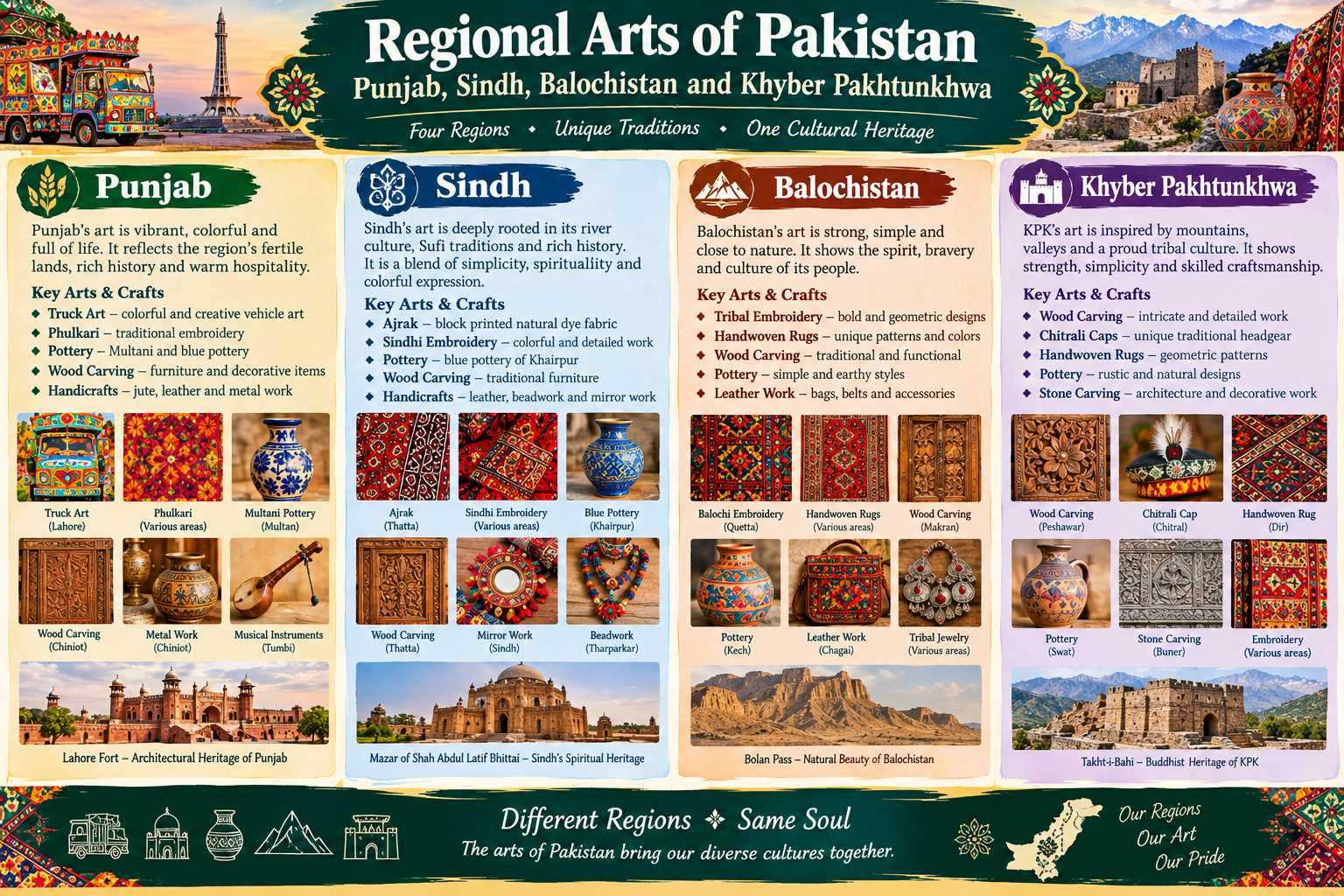
Comparison of Regional Art Traditions
The four major provinces have different artistic traditions.
Punjab is strongly associated with Phulkari, pottery, woodwork, architecture, and colorful textile traditions.
Sindh is especially known for Ajrak, embroidery, mirror work, pottery, Hala crafts, and traditional jewelry.
Balochistan is recognized for Balochi embroidery, carpets, jewelry, pottery, and regional architectural traditions.
Khyber Pakhtunkhwa is known for wood carving, embroidery, carpets, traditional footwear, metalwork, and crafts associated with historic markets.
Although these traditions are different, they also share some common characteristics.
Many use:
Handmade techniques
Geometric patterns
Floral motifs
Natural or traditional materials
Family-based knowledge
Decorative borders
Regional colors
Cultural symbols
This combination of similarities and differences creates Pakistan's diverse artistic identity.
Regional Clothing as an Art Form
Traditional clothing is an important form of regional art.
Clothing can communicate regional identity through colors, embroidery, fabric, patterns, and accessories.
Punjabi clothing may feature embroidered fabrics and colorful dupattas.
Sindhi clothing can feature Ajrak and mirror-work embroidery.
Balochi dresses are often recognized for detailed embroidery.
Traditional clothing in Khyber Pakhtunkhwa may include regional fabrics, embroidery, shawls, and traditional accessories.
Modern Pakistani fashion frequently draws inspiration from these regional styles.
Regional Jewelry
Jewelry traditions vary across Pakistan.
Traditional jewelry may include:
Necklaces
Earrings
Bracelets
Rings
Anklets
Head ornaments
Decorative chains
Materials can include silver, beads, stones, glass, metal, and other locally available resources.
Jewelry can have decorative, cultural, and ceremonial roles.
Modern jewelry designers often reinterpret regional motifs for contemporary customers.
Regional Pottery
Pottery is found in different areas of Pakistan.
Although the basic process involves shaping clay and firing it, regional styles can be very different.
Pottery can vary in:
Shape
Color
Decoration
Glazing
Surface design
Production techniques
Some pottery is made for everyday use, while other pieces are created primarily for decoration.
Regional Textile Patterns
Textile patterns are among the most visible forms of regional art.
Punjab is known for colorful embroidery traditions.
Sindh has distinctive Ajrak patterns and embroidered textiles.
Balochistan is known for detailed embroidered garments.
Khyber Pakhtunkhwa also has regional embroidery and woven textile traditions.
Patterns can communicate cultural identity even when used in modern clothing.
Influence of Nature on Regional Arts
Nature has influenced many Pakistani artistic traditions.
Flowers, leaves, birds, mountains, rivers, deserts, and other natural forms can inspire patterns and designs.
For example, floral patterns appear in embroidery and textiles across different regions.
Geography can also influence the materials used by artisans.
Communities may use materials that are locally available, such as clay, wool, wood, cotton, leather, or natural dyes.
Role of Artisans
Artisans are central to the preservation of regional arts.
Their skills often require years of practice.
An artisan may learn a particular technique from family members and continue using it throughout their career.
Supporting artisans helps preserve traditional skills.
It can also provide income and employment within local communities.
Women Artisans
Women play an important role in many textile and embroidery traditions.
Embroidery skills are often taught within families and communities.
Women artisans can produce clothing, shawls, bags, household textiles, and decorative pieces.
These crafts can provide opportunities for women to contribute to household income.
Access to wider markets can increase the economic value of these skills.
Regional Arts and Tourism
Regional arts are also important for tourism.
Visitors often look for handmade products that represent the culture of the area they visit.
Craft markets can therefore become important parts of tourism economies.
Examples include:
Traditional textiles
Pottery
Jewelry
Carpets
Woodwork
Embroidered clothing
Decorative objects
Cultural tourism can create opportunities for artisans while introducing visitors to Pakistan's heritage.
Modern Fashion and Regional Arts
Pakistani fashion designers increasingly use regional artistic traditions as sources of inspiration.
Traditional embroidery can appear on modern dresses.
Ajrak-inspired patterns can be used on contemporary shirts, scarves, bags, and home products.
Balochi embroidery can inspire modern jackets and accessories.
Punjabi Phulkari can be incorporated into modern fashion.
Khyber Pakhtunkhwa wood-carving patterns can influence furniture and interior design.
This shows how traditional art can adapt to modern lifestyles.
Digital Platforms and Regional Crafts
The internet has created new opportunities for regional artisans.
Previously, an artisan might have depended mainly on local markets.
Today, social media and online stores can help handmade products reach customers in other cities and countries.
Digital platforms can also be used to:
Display products
Share crafting processes
Promote cultural stories
Connect artisans with designers
Build small businesses
Reach new customers
Digital marketing can therefore support traditional craftsmanship.
Challenges Facing Regional Arts
Regional arts face several challenges.
Traditional skills can decline when younger generations move toward other professions.
Machine-made products can also compete with handmade crafts because they may be produced more quickly and cheaply.
Artisans may have difficulty accessing larger markets.
Raw materials can become more expensive.
Another challenge is ensuring that artisans receive fair compensation for their work.
Preserving Regional Arts
Preservation requires cooperation between communities, educational institutions, cultural organizations, businesses, designers, and consumers.
Traditional techniques can be documented through books, photographs, videos, museums, and digital archives.
Young people can be encouraged to learn traditional skills.
Craft training programs can provide practical opportunities.
Museums and cultural centers can organize exhibitions and demonstrations.
Consumers can also help by valuing authentic handmade products.
Future of Regional Arts in Pakistan
The future of regional Pakistani arts depends on balancing tradition with innovation.
Traditional crafts do not necessarily need to remain exactly the same.
Artisans and designers can adapt old techniques for modern products.
For example, traditional embroidery can be used on contemporary accessories.
Ajrak patterns can be applied to modern home décor.
Wood carving can be combined with modern furniture.
Traditional pottery can be redesigned for contemporary interiors.
These approaches can help cultural traditions remain active.
Importance of Cultural Diversity
Pakistan's regional arts demonstrate that national culture can contain many different local identities.
Punjab, Sindh, Balochistan, and Khyber Pakhtunkhwa each contribute distinctive traditions.
These differences do not reduce the importance of Pakistani culture. Instead, they demonstrate its diversity.
Regional art allows people to celebrate local heritage while also contributing to the broader cultural identity of Pakistan.
Conclusion
Regional arts of Pakistan represent centuries of creativity, craftsmanship, cultural exchange, and community traditions. Punjab, Sindh, Balochistan, and Khyber Pakhtunkhwa each have distinctive artistic identities expressed through embroidery, textiles, pottery, woodwork, jewelry, carpets, architecture, clothing, and decorative crafts.
Punjab is widely associated with Phulkari, colorful textiles, pottery, woodwork, and historic architecture. Sindh is famous for Ajrak, embroidery, mirror work, Hala crafts, pottery, and jewelry. Balochistan has a strong tradition of detailed embroidery, carpets, jewelry, pottery, and regional architecture. Khyber Pakhtunkhwa contributes wood carving, embroidery, carpets, traditional footwear, metalwork, and crafts associated with its historic cities and communities.
These regional traditions are valuable not only because they are beautiful but also because they preserve cultural knowledge and provide opportunities for artisans.
Modern fashion, tourism, online platforms, museums, educational institutions, and cultural organizations can all help keep these traditions alive.
The future of Pakistani regional art depends on giving traditional crafts opportunities to develop while respecting their cultural origins. When traditional skills are combined with modern creativity, Pakistan's regional arts can continue to remain meaningful for future generations.
FAQs
1. What are regional arts of Pakistan?
Regional arts are traditional creative practices associated with different areas and communities of Pakistan, including embroidery, pottery, textiles, woodwork, jewelry, carpets, and architecture.
2. What is Punjab famous for in traditional art?
Punjab is particularly known for Phulkari embroidery, colorful textiles, pottery, woodwork, traditional crafts, and historic architecture.
3. What is Sindh famous for?
Sindh is well known for Ajrak, Sindhi embroidery, mirror work, Hala crafts, pottery, traditional jewelry, and distinctive textile designs.
4. What are famous arts of Balochistan?
Balochistan is known for detailed Balochi embroidery, carpets, jewelry, pottery, traditional clothing, and regional architectural traditions.
5. What is Khyber Pakhtunkhwa known for in arts and crafts?
Khyber Pakhtunkhwa has traditions of wood carving, embroidery, carpets, metalwork, traditional footwear, jewelry, and crafts associated with historic markets and communities.