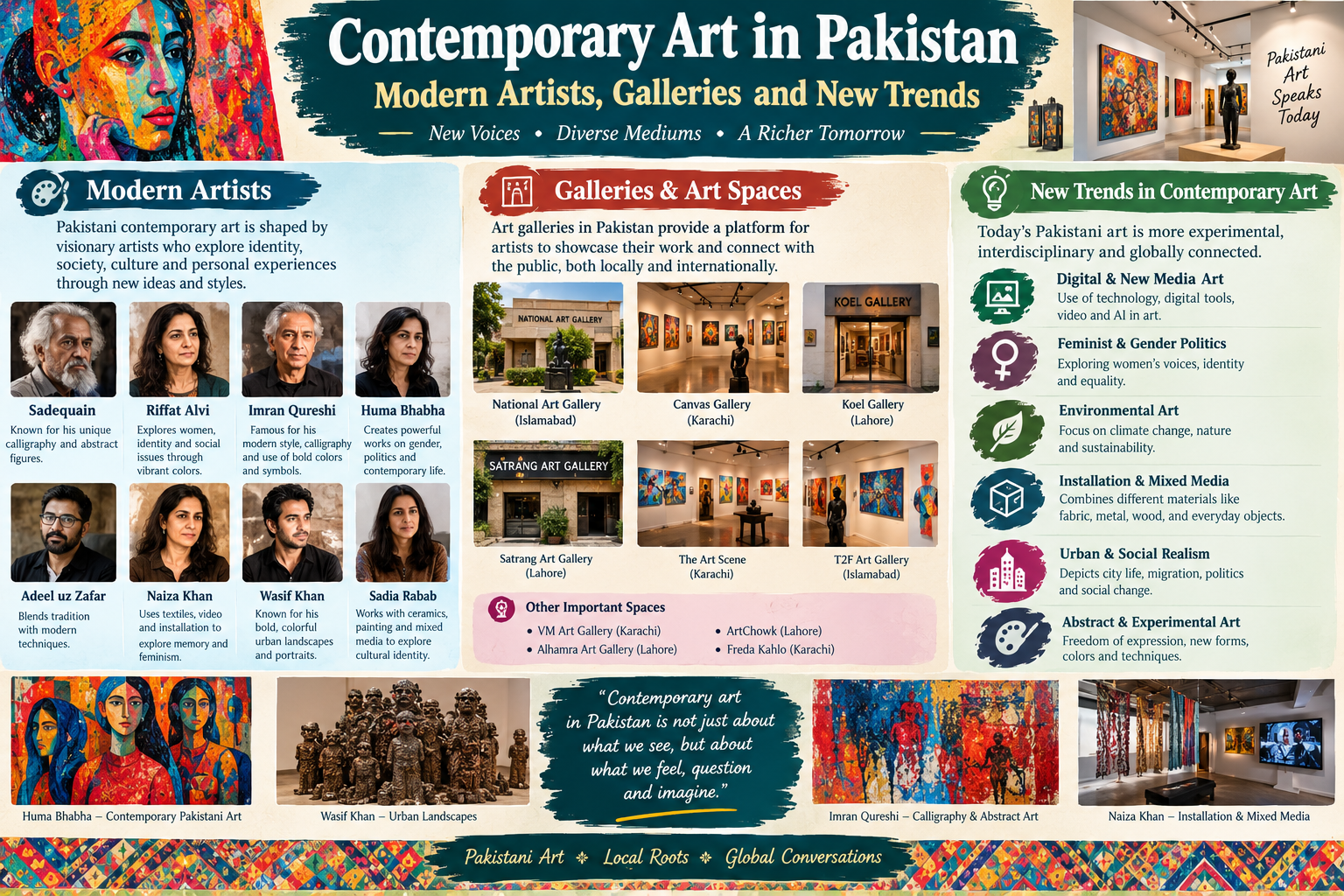
Contemporary art in Pakistan represents a changing and diverse creative landscape shaped by history, culture, society, technology, and individual expression. Pakistani artists today work with many different forms, including painting, drawing, sculpture, photography, video, installation art, digital art, miniature painting, textiles, and mixed media.
While traditional Pakistani art remains important, contemporary artists often explore new ideas and modern ways of presenting them. They may combine traditional techniques with current subjects, creating artwork that connects Pakistan’s cultural heritage with the changing world.
The development of contemporary art in Pakistan has been influenced by art schools, universities, galleries, museums, independent art spaces, collectors, cultural organizations, and the growing use of digital platforms. Major cities such as Lahore, Karachi, and Islamabad have become important centers for exhibitions and artistic activity.
Pakistani contemporary art is also diverse because artists come from different cultural, educational, and regional backgrounds. Their work may explore identity, history, architecture, nature, family, cities, memory, technology, social change, and everyday life.
What Is Contemporary Art?
Contemporary art generally refers to art created in the present or recent period. Unlike a single artistic style, contemporary art includes many different approaches and techniques.
An artist may use traditional paint and canvas, while another may create a digital artwork or installation. Some artists combine several mediums in one project.
Contemporary art can include:
Painting
Sculpture
Photography
Video art
Installation art
Digital art
Mixed media
Textile art
Miniature painting
Performance-based work
Printmaking
The wide range of forms allows artists to experiment and communicate ideas in different ways.
History of Modern Art in Pakistan
To understand contemporary art in Pakistan, it is useful to look at the development of modern art after independence.
Pakistan became an independent country in 1947. During the decades that followed, artists developed new approaches while continuing to engage with regional traditions.
Art education played an important role in this development. Institutions helped train generations of painters, sculptors, designers, and other artists.
Traditional miniature painting also became an important area of experimentation. Artists began exploring ways to reinterpret miniature techniques through modern subjects and contemporary ideas.
Over time, Pakistani artists became increasingly connected with international art communities.
The development of galleries, exhibitions, art fairs, universities, and cultural institutions created additional opportunities for artists to present their work.
Lahore and Contemporary Art
Lahore has a long history of artistic and cultural activity. The city has played an important role in the development of Pakistani painting, miniature art, architecture, literature, music, and theatre.
Art education institutions in Lahore have trained many well-known Pakistani artists.
The city also has galleries and cultural spaces where contemporary artists can exhibit their work.
Lahore's historic environment provides an interesting source of inspiration. Mughal architecture, old markets, gardens, streets, traditional crafts, and modern urban life can all appear in contemporary artistic expressions.
Artists working in Lahore may therefore combine historical references with modern subjects.
Karachi and Contemporary Art
Karachi is another major center of contemporary art in Pakistan.
As Pakistan's largest metropolitan city, Karachi offers artists a highly diverse urban environment.
The city includes historic neighborhoods, modern buildings, coastal landscapes, markets, commercial areas, and communities from different backgrounds.
Contemporary artists may use these environments as sources of inspiration.
Karachi is also home to galleries, art institutions, universities, cultural organizations, and exhibition spaces.
Its connection with international business and cultural networks has helped create opportunities for artists to interact with wider audiences.
Islamabad and the Art Scene
Islamabad also contributes to Pakistan's contemporary art landscape.
The city's museums, galleries, educational institutions, cultural organizations, and diplomatic community provide opportunities for exhibitions and cultural activities.
Islamabad's modern architecture and natural environment can also influence artists.
The city offers a different artistic atmosphere from the larger commercial centers of Lahore and Karachi.
Role of Art Schools
Art schools have played a major role in developing contemporary Pakistani art.
Students learn traditional foundations such as drawing, composition, color, design, and art history. They can then experiment with modern techniques and concepts.
Art education also introduces students to different mediums.
Students may work with:
Oil paint
Acrylic paint
Watercolor
Ink
Photography
Sculpture
Printmaking
Digital tools
Video
Mixed media
Art schools can therefore provide both technical skills and creative environments.
Miniature Painting and Contemporary Art
Miniature painting has a particularly important place in Pakistani art history.
Traditional miniature painting developed in South Asia through several historical periods and artistic traditions.
Contemporary Pakistani artists have reinterpreted miniature techniques in innovative ways.
Some artists maintain detailed brushwork and traditional materials while introducing modern subjects.
Others combine miniature painting with photography, digital imagery, collage, or large-scale compositions.
This approach demonstrates that traditional art does not necessarily have to remain unchanged.
Instead, traditional techniques can become part of new forms of artistic expression.
Contemporary Pakistani Artists
Pakistan has produced many influential artists whose work has contributed to modern and contemporary art.
Artists such as Shakir Ali, Sadequain, Zahoor ul Akhlaq, Rasheed Araeen, and others have played important roles in the development of modern Pakistani artistic practice.
Later generations continued to expand the possibilities of contemporary art.
Artists including Rashid Rana, Aisha Khalid, Imran Qureshi, Adeela Suleman, and others have become associated with different forms of contemporary artistic practice.
Their work demonstrates the variety of approaches found in Pakistani art.
Rather than representing one single style, contemporary Pakistani art includes many different methods and ideas.
Rashid Rana and Digital Approaches
Rashid Rana is known for work that explores images, scale, technology, and visual perception.
His artistic practice has included photography and digital techniques.
His work demonstrates how contemporary artists can use technology to question how viewers understand images.
Digital tools have become increasingly important in contemporary art because they allow artists to manipulate photographs, create compositions, and experiment with visual structures.
Imran Qureshi and Miniature Tradition
Imran Qureshi is known for combining elements of traditional miniature painting with contemporary artistic ideas.
His work demonstrates how historical techniques can be reinterpreted for modern audiences.
The detailed visual language associated with miniature painting can be combined with larger formats and contemporary subjects.
This relationship between tradition and innovation is one of the important features of contemporary Pakistani art.
Aisha Khalid and Textile-Inspired Practices
Aisha Khalid is associated with contemporary miniature painting and textile-inspired visual traditions.
Her artistic practice demonstrates the connection between detailed craftsmanship and contemporary ideas.
Patterns, repetition, decoration, and traditional visual references can become part of modern artworks.
This approach also shows how textile traditions and miniature painting can influence contemporary art.
Adeela Suleman and Sculpture
Adeela Suleman is known for sculpture and installations.
Her work demonstrates how contemporary Pakistani artists can use three-dimensional forms to explore themes connected with culture, history, society, and everyday life.
Sculpture provides artists with opportunities to work with materials and spaces rather than relying only on flat surfaces.
Sadequain and Pakistani Art History
Sadequain was one of the most prominent Pakistani artists of the twentieth century.
He was particularly known for calligraphy-inspired painting and large-scale murals.
His artistic language connected writing, visual form, and painting.
His contribution is important in understanding how traditional calligraphic forms became part of modern Pakistani art.
Calligraphy in Contemporary Art
Calligraphy continues to influence Pakistani contemporary art.
Artists may use Arabic and Urdu letters as visual elements rather than simply presenting written text.
Calligraphic forms can be enlarged, abstracted, repeated, or combined with painting.
This approach creates a relationship between language and visual design.
The continued use of calligraphy also demonstrates the connection between Pakistani artistic traditions and modern experimentation.
Contemporary Textile Art
Textiles remain an important part of contemporary Pakistani art.
Artists may use embroidery, fabric, thread, weaving, stitching, and traditional patterns in new ways.
Textile art can be displayed as wall-based work, installations, sculptures, or mixed-media pieces.
This provides an opportunity to connect contemporary art with Pakistan's long textile heritage.
Traditional embroidery and craft techniques can therefore move from clothing and household objects into gallery spaces.
Photography in Pakistan
Photography has become an important form of contemporary artistic expression.
Pakistani photographers work with portraits, landscapes, architecture, documentary subjects, urban environments, family life, and abstract compositions.
Digital cameras and smartphones have made photography more accessible.
Artists can also edit photographs using digital tools, creating new forms of visual storytelling.
Photography allows artists to document changing cities and communities while also exploring personal ideas.
Digital Art in Pakistan
Digital art is becoming increasingly visible in Pakistan.
Artists can use computers, tablets, animation software, photography programs, and other digital tools to create artwork.
Digital art may include:
Digital illustrations
Photo manipulation
Digital painting
Animation
3D artwork
Graphic compositions
Interactive projects
Social media has also made it easier for artists to share digital work with audiences.
Social Media and Pakistani Artists
Social media has changed how artists communicate with audiences.
In the past, artists often depended heavily on galleries, exhibitions, art publications, and personal networks.
Today, artists can display their work online and reach audiences directly.
Platforms can help artists:
Share new artwork
Announce exhibitions
Build portfolios
Connect with other artists
Reach international viewers
Promote workshops
Sell selected artwork
This does not replace galleries, but it creates another important channel for artistic communication.
Galleries in Pakistan
Art galleries provide important spaces for artists to exhibit their work.
Galleries can introduce artists to collectors, critics, students, researchers, and general audiences.
They may organize solo exhibitions, group shows, workshops, talks, and other cultural activities.
Major cities have developed active gallery communities.
Galleries also help preserve records of exhibitions and artists' careers.
Museums and Cultural Institutions
Museums and cultural institutions are important for preserving Pakistani art.
They can display historical and contemporary artworks and provide educational opportunities.
Museums help visitors understand connections between different periods of Pakistani art.
They can also preserve paintings, sculptures, manuscripts, photographs, and other cultural objects for future generations.
Art Exhibitions in Pakistan
Exhibitions give artists opportunities to present new work.
A solo exhibition focuses mainly on one artist, while a group exhibition may bring together artists around a theme or artistic approach.
Exhibitions can take place in galleries, museums, universities, cultural centers, and alternative spaces.
They allow audiences to encounter artwork directly rather than only through photographs online.
Art Fairs and International Exposure
Pakistani artists have also participated in international exhibitions and art fairs.
International exposure can help artists build professional connections and introduce Pakistani art to audiences in other countries.
However, international representation can also involve questions about how Pakistani culture is presented to global audiences.
Artists may choose to focus on local subjects, universal themes, or combinations of both.
Contemporary Art and Pakistani Identity
Identity is an important theme in contemporary Pakistani art.
Artists may explore questions related to culture, language, family, history, geography, and belonging.
Some artists use traditional symbols to express cultural identity.
Others deliberately experiment with modern or global visual languages.
This diversity shows that there is no single way to represent Pakistani identity through art.
Art and Urban Life
Pakistan's rapidly changing cities provide many subjects for contemporary artists.
Buildings, roads, advertisements, markets, transport, technology, and changing neighborhoods can all become artistic subjects.
Urban life may be represented through photography, painting, sculpture, installation, or digital art.
Artists can use these subjects to document how cities change over time.
Art and Historical Memory
History continues to influence Pakistani contemporary art.
Artists may reference historical architecture, old photographs, traditional objects, manuscripts, or cultural symbols.
Historical references can be used to explore how people understand the past.
Some artworks place historical imagery alongside modern elements.
This creates a dialogue between different periods.
Installation Art
Installation art is another form used by contemporary artists.
Instead of creating a single painting or sculpture, an artist may arrange multiple objects or materials within a space.
The audience may walk through or around the installation.
Installations can include:
Objects
Fabric
Light
Sound
Photographs
Sculptures
Video
Found materials
This approach changes the relationship between artwork and viewer.
Mixed Media Art
Mixed media art combines different materials or techniques.
For example, an artist might combine painting, photography, fabric, paper, and found objects.
Mixed media allows artists to experiment with texture and visual contrast.
It is particularly useful for artists who want to combine traditional crafts with contemporary methods.
Traditional Art Meets Modern Technology
One of the interesting trends in Pakistani contemporary art is the combination of traditional artistic practices with technology.
An artist may use traditional miniature painting alongside digital imagery.
Another artist may combine embroidery with photography.
Traditional calligraphy may also be transformed through digital design.
These combinations demonstrate that cultural heritage can remain relevant in a technology-driven world.
Contemporary Art and Young Artists
Young artists are becoming increasingly important in Pakistan's creative environment.
Universities and art schools provide training, while online platforms allow young creators to display their work.
Young artists may experiment with new materials and subjects.
They can also interact with international artistic communities through digital platforms.
This makes the contemporary art environment more connected than in previous decades.
Challenges for Pakistani Artists
Pakistani artists face several challenges.
One challenge is access to funding and professional opportunities.
Producing artwork can require expensive materials, studio space, equipment, transportation, and exhibition costs.
Another challenge is reaching wider audiences.
Artists outside major cities may have fewer opportunities to participate in established gallery networks.
Digital platforms can help reduce some geographic barriers, but access to technology and professional networks remains unequal.
Supporting the Art Community
The art community can be supported in several ways.
Educational institutions can provide strong art programs.
Galleries can create opportunities for emerging artists.
Cultural organizations can organize exhibitions, workshops, and talks.
Collectors can support artists by purchasing authentic artwork.
Audiences can contribute simply by visiting exhibitions and learning about Pakistani art.
Online communities can also help artists reach new audiences.
Role of Art Education
Art education should not only focus on technical drawing and painting.
Students can also learn about:
Art history
Local crafts
Pakistani artists
Contemporary practices
Digital art
Photography
Design
Museum studies
Cultural heritage
Learning about local artistic traditions can help young artists develop work that is connected to their own cultural environment.
Future of Contemporary Art in Pakistan
The future of contemporary Pakistani art is likely to become increasingly diverse.
Digital technology will provide new tools for artists.
Social media will continue to influence how artwork is shared.
Traditional crafts will remain a source of inspiration.
At the same time, new generations may develop artistic forms that are difficult to classify using older categories.
Artificial intelligence, digital animation, virtual environments, photography, and interactive media may become more common areas of artistic experimentation.
However, traditional painting, drawing, sculpture, miniature art, embroidery, and calligraphy will continue to have an important place.
Importance of Preserving Artistic Heritage
Modern artistic development does not mean traditional art should be forgotten.
Pakistan has a large artistic heritage that includes miniature painting, calligraphy, pottery, textiles, woodwork, architecture, truck art, embroidery, and many other forms.
Contemporary artists can help keep these traditions visible by studying them and creating new interpretations.
Museums, schools, cultural organizations, and communities also have a role in preserving historical knowledge.
Conclusion
Contemporary art in Pakistan is a diverse field that connects traditional heritage with modern creativity. Artists work across painting, miniature art, sculpture, photography, textiles, installation, digital art, calligraphy, and mixed media.
Cities such as Lahore, Karachi, and Islamabad provide important spaces for exhibitions, education, and artistic activity. Art schools, galleries, museums, cultural institutions, and online platforms all contribute to the development of the country's creative environment.
Pakistani artists continue to explore history, culture, identity, cities, technology, nature, and everyday life through different artistic forms. Some build on traditional miniature painting, calligraphy, embroidery, and other crafts, while others experiment with photography, digital tools, sculpture, and installation.
The future of contemporary Pakistani art will likely depend on a balance between heritage and innovation. By supporting artists, preserving traditional knowledge, encouraging art education, and creating opportunities for young creators, Pakistan can continue to develop a vibrant and diverse artistic culture.
FAQS
1. What is contemporary art in Pakistan?
Contemporary art in Pakistan includes modern artistic practices such as painting, photography, sculpture, installation, digital art, miniature painting, textiles, and mixed media.
2. Which cities are important for contemporary art in Pakistan?
Lahore, Karachi, and Islamabad are major centers for contemporary art, with galleries, educational institutions, museums, cultural organizations, and exhibitions.
3. How does traditional art influence contemporary Pakistani art?
Traditional forms such as miniature painting, calligraphy, embroidery, textiles, and decorative patterns are often combined with modern materials, subjects, and techniques.
4. What role does digital art play in Pakistan?
Digital tools allow Pakistani artists to create, edit, publish, and share artwork online. Social media also helps artists reach audiences beyond their local communities.
5. Why is contemporary Pakistani art important?
Contemporary Pakistani art provides a way to explore culture, history, identity, technology, everyday life, and changing society while continuing the country's long artistic traditions.