Introduction
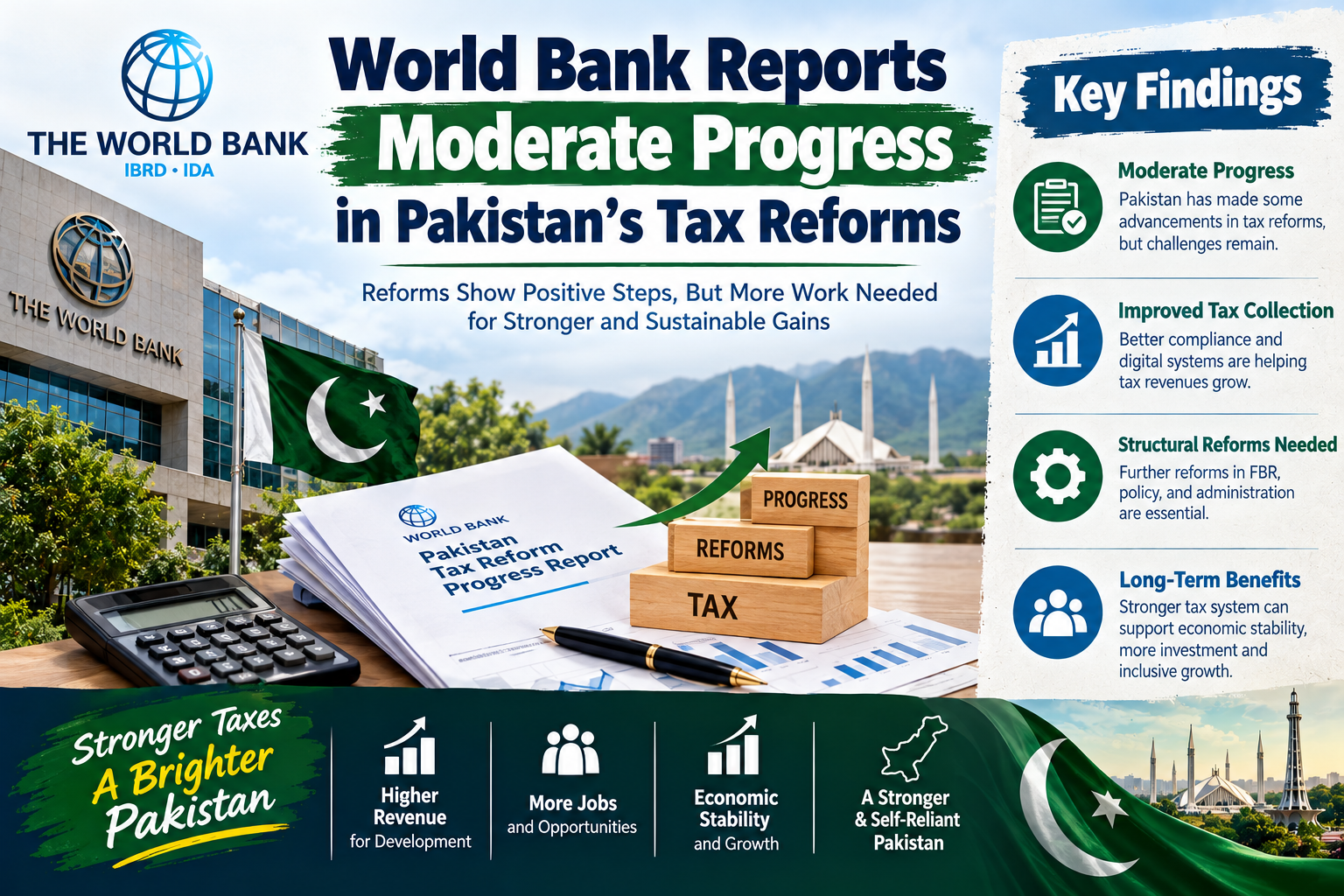
Pakistan’s efforts to reform its tax system have received a mixed assessment from the World Bank, which has described the implementation of key public finance programmes as moderately satisfactory while warning that substantial risks remain. The assessment highlights the difficult task facing the government as it attempts to increase tax revenue, improve public services, strengthen economic stability and reduce reliance on external borrowing.
Tax reform is one of the most important economic challenges facing Pakistan. For years, the country has struggled to collect sufficient revenue to meet its public spending requirements. The government must finance education, healthcare, infrastructure, security, social protection and debt payments while also creating conditions for businesses to invest and generate employment. When tax collection remains below the level needed to meet these responsibilities, the government often has to borrow more, reduce development spending or seek financial support from international institutions.
The World Bank’s assessment brings attention to both the progress made and the weaknesses that continue to affect Pakistan’s fiscal system. Although reform programmes have established important goals and introduced measures to improve revenue collection, their long-term success depends on effective implementation, better administration, a broader tax base and stronger coordination between federal and provincial authorities.
The challenge is not simply to collect more money. Pakistan also needs a tax system that is predictable, transparent and fair. Businesses need clear rules, ordinary citizens need confidence that public money is being used responsibly, and the government needs reliable revenue to support development without placing an excessive burden on a limited group of taxpayers.
World Bank Assessment of Pakistan’s Tax Reform Programmes
The World Bank’s latest assessment, reported on October 15, 2026, concerns programmes designed to support macroeconomic stability, improve public service delivery and increase Pakistan’s tax-to-gross domestic product ratio.
The assessment rated the overall implementation of the Pakistan Public Resources for Inclusive Development Multiphase Programmatic Approach as moderately satisfactory. The programmes were also described as carrying substantial risks, meaning that their objectives could face significant implementation challenges.
These two findings should be understood together. A moderately satisfactory assessment indicates that implementation has made progress, but it does not mean that all objectives have been achieved or that the programmes are free from serious weaknesses. The substantial-risk designation signals that continued attention is necessary to prevent delays, revenue shortfalls and difficulties in delivering the intended results.
The programmes aim to help Pakistan mobilise domestic resources and improve the way public money is managed. Their broader purpose is to strengthen the connection between revenue collection and the services citizens receive.
The tax-to-GDP ratio is a central indicator in this effort. It compares the taxes collected by the government with the total value of goods and services produced in the economy. A higher ratio can provide greater fiscal space for public investment, although the quality of tax policies and government spending matters just as much as the headline figure.
The World Bank’s programme framework seeks to increase this ratio to 15 percent over five years. Reaching such a target will require more than short-term collection drives. It will depend on lasting improvements in tax administration, compliance, policy design and the distribution of the tax burden.
Why Tax Reform Matters for Pakistan
Pakistan’s economic challenges cannot be addressed through borrowing alone. Loans can help a government manage temporary financial pressure, but borrowing creates future repayment obligations. Sustainable public finances require a reliable domestic revenue base that can support essential services and long-term development.
Tax revenue pays for many of the services people depend on every day. Schools require teachers, classrooms and learning materials. Hospitals need trained staff, medicines and functioning equipment. Roads, water systems and public transport require maintenance and investment. Social protection programmes also depend on public resources.
When revenue collection falls short, governments have fewer options. They may delay development projects, limit spending on essential services or increase borrowing. High debt-service costs can then reduce the amount available for education, healthcare and infrastructure.
Pakistan’s tax reform agenda is therefore closely connected to living standards and economic opportunity. A more effective tax system can help the government plan its spending with greater confidence, provided that revenue is used transparently and efficiently.
However, increasing tax collection must be approached carefully. If the government relies too heavily on a narrow group of registered businesses and salaried workers, it risks creating unfairness and discouraging formal economic activity. A stronger system should identify those who are legally required to pay taxes but remain outside effective enforcement, while making compliance easier for people and businesses that already follow the rules.
The Challenge of Expanding the Tax Base
One of the biggest obstacles to Pakistan’s tax reform efforts is the limited tax base. A tax base includes the people, businesses, transactions, income and economic activities that are subject to taxation under the law.
When a relatively small share of economic activity contributes to public revenue, the government faces pressure to collect more from taxpayers who are already registered. This can create a sense of unfairness and increase the cost of doing business.
Broadening the tax base means improving the identification and registration of eligible taxpayers, reducing unlawful exemptions, strengthening compliance and ensuring that different sectors are treated consistently under the law.
This process requires reliable information. Tax authorities need accurate records of business activity, income, property ownership and taxable transactions. Better data can help officials identify gaps between reported income and actual economic activity without relying entirely on broad or disruptive enforcement measures.
At the same time, the government must distinguish between deliberate non-compliance and genuine inability to meet complex administrative requirements. Small businesses may need clear guidance, accessible digital services and reasonable procedures to understand their obligations.
A broader tax base should not simply mean adding more paperwork for small enterprises. The objective should be to bring more economic activity into a transparent, documented system while reducing unnecessary compliance costs.
Improving the Role of the Federal Board of Revenue
The Federal Board of Revenue plays a central role in Pakistan’s federal tax system. Its responsibilities include administering major federal taxes, monitoring compliance, processing returns and supporting revenue collection.
Strengthening the FBR is therefore an important part of the broader reform agenda. Better technology, reliable taxpayer records, risk-based audits and improved staff training can help the organisation perform its duties more effectively.
Digital systems can make it easier to submit tax returns, document transactions and monitor payments. They can also reduce some opportunities for errors, inconsistent treatment and unnecessary interaction between taxpayers and officials.
However, technology alone cannot solve every problem. Digital systems must be reliable, accessible and supported by clear rules. Taxpayers need to know what information they must provide, how their data will be protected and how to correct mistakes.
The FBR also needs to ensure that enforcement decisions are consistent. Businesses should not face unpredictable treatment because similar cases are handled differently. Transparent procedures and meaningful review mechanisms can improve confidence in the tax system.
Risk-based auditing is another important area. Instead of treating every taxpayer in the same way, authorities can use credible information to prioritise cases that show stronger indicators of non-compliance. This can help focus resources where they are most useful, provided that decisions remain accountable and taxpayers retain appropriate rights.
For reform to deliver lasting benefits, improvements in administration must be measured not only by the amount collected but also by the quality, fairness and predictability of the process.
Digitalisation and Better Tax Compliance
Digitalisation has become an important part of tax administration in Pakistan. Electronic invoicing, online returns, integrated payment systems and data analysis can help authorities build a clearer picture of economic activity.
When transactions are documented electronically, businesses may find it easier to maintain records and demonstrate compliance. Tax authorities can also compare information from different sources to identify discrepancies that require further review.
The World Bank has previously supported Pakistan’s efforts to modernise tax collection and improve compliance through stronger information technology and data tools. Its Pakistan Raises Revenue project has included measures to broaden the taxpayer base, simplify parts of the tax system and improve the FBR’s technological capacity.
These efforts are important because paper-based systems can be slow, costly and difficult to monitor at scale. Digital services can reduce administrative delays and allow taxpayers to complete routine tasks without unnecessary visits to government offices.
Nevertheless, the transition needs careful planning. Some businesses have limited technical capacity, while others may struggle with internet access, unfamiliar software or changing documentation requirements. Training, clear instructions and responsive support services can make digital reforms more effective.
Data security must also remain a priority. Tax authorities handle sensitive financial and personal information, and public confidence depends on protecting that information from unauthorised access or misuse.
A successful digital tax system should therefore combine effective technology with clear legal safeguards, reliable service and practical support for taxpayers.
Tax Policy Must Be Fair and Predictable
Tax administration is only one part of reform. Tax policy determines what is taxed, how much is paid, which exemptions apply and how the overall burden is distributed.
Frequent policy changes can make it difficult for businesses to plan investment, manage cash flow and make long-term decisions. Uncertainty can also discourage entrepreneurs from expanding operations or entering the formal economy.
Pakistan needs a tax policy framework that supports revenue collection without creating unnecessary complexity. Clear rules, stable implementation schedules and effective communication can help taxpayers understand their responsibilities.
Fairness is equally important. A tax system may collect substantial revenue in the short term but still struggle to build public trust if taxpayers believe that similar economic activities are treated differently.
A more balanced approach requires the government to examine the overall distribution of the tax burden. Policymakers need to consider the treatment of income, consumption, property, agriculture and business activity while taking account of the legal responsibilities of federal and provincial governments.
Tax exemptions should also be reviewed carefully. Some exemptions may have a legitimate public purpose, while others may reduce revenue without producing sufficient economic or social benefits. Publishing clear information about tax expenditures can help the public understand how exemptions affect government finances.
Reform should not mean changing rules unpredictably. It should mean creating a simpler and more consistent system that taxpayers can understand and authorities can administer effectively.
Agriculture and the Need for Wider Participation
Agriculture remains an important part of Pakistan’s economy. It supports rural livelihoods, contributes to food production and supplies raw materials to several industries. Taxing agricultural income has also become an important part of discussions about broadening the country’s revenue base.
Historically, agricultural income taxation has involved significant provincial responsibilities and differences in implementation. Reform therefore requires coordination between the federal government and the provinces, along with clear rules that can be applied fairly.
Effective agricultural income taxation depends on appropriate legal frameworks, reliable records and administrative capacity. Authorities must be able to distinguish taxable income from relevant costs and apply the law consistently.
The objective should be to ensure that tax obligations are based on the applicable law and a taxpayer’s circumstances, rather than treating an entire sector as if every participant had the same income or capacity to pay.
Implementation is likely to require public awareness, accessible filing procedures and coordination between relevant government departments. Farmers and agricultural businesses need clear information about the rules, deadlines and documentation they must provide.
Agricultural taxation is also connected to the wider question of fiscal responsibility between different levels of government. Provinces have their own revenue responsibilities and service-delivery obligations. Improving coordination can help prevent gaps, duplication and confusion.
A fairer and more effective framework could strengthen provincial finances while supporting the broader national objective of sustainable revenue collection.
Property, Retail and the Informal Economy
Property transactions, retail activity and other areas of informal economic activity are often discussed in relation to Pakistan’s tax base. These sectors can be difficult to document fully, creating challenges for revenue authorities and businesses that already comply with the law.
Property taxation and transaction documentation require reliable records, consistent valuation practices and coordination between relevant departments. When property values are recorded inaccurately or administrative procedures are inconsistent, both taxpayers and government agencies may face difficulties.
Retail taxation presents a different set of challenges. The sector includes businesses of very different sizes, from small shops to large commercial operations. A practical system must recognise these differences while ensuring that applicable legal obligations are enforced.
For smaller businesses, simple registration and filing procedures can reduce the cost of compliance. For larger enterprises, accurate invoices and electronic records can improve transparency and help authorities verify reported activity.
The wider informal economy cannot be brought into a formal system through enforcement alone. Businesses also need reasons to participate, including predictable rules, access to financial services and confidence that registration will not expose them to arbitrary treatment.
The government should therefore combine reasonable enforcement with administrative simplification and support for formalisation. Clearer rules can make compliance more manageable and improve the quality of economic information available to policymakers.
Coordination Between Federal and Provincial Governments
Pakistan’s tax system is divided across different levels of government. The federal government and provincial authorities have distinct responsibilities, and coordination between them is essential for an effective national revenue strategy.
When tax rules and administrative procedures differ significantly across jurisdictions, businesses operating in multiple provinces may face unnecessary complexity. Separate systems can also increase the cost of filing returns and reconciling records.
Improved coordination can help reduce these burdens. Common data standards, compatible digital platforms and clearer administrative arrangements may make it easier for taxpayers to meet their obligations.
However, coordination should respect the constitutional responsibilities of each level of government. Reform does not necessarily require every tax to be administered by one institution. It requires the relevant authorities to cooperate, share appropriate information and avoid unnecessary duplication.
Provincial governments also need incentives and capacity to improve their own revenue collection. Stronger provincial finances can support local services and reduce excessive dependence on transfers from the federal government.
At the same time, revenue-sharing arrangements must be predictable enough to support responsible budgeting. Government departments need to know what resources will be available and what responsibilities they are expected to fulfil.
Better coordination can therefore improve both revenue collection and the quality of public spending.
Why the Tax-to-GDP Target Is Important
The tax-to-GDP ratio provides a broad measure of how much tax revenue a country collects relative to the size of its economy. Pakistan’s programme objective of reaching 15 percent over five years highlights the scale of the reform challenge.
A higher ratio can help create fiscal space, but the figure should not be treated as the only measure of success. The way revenue is raised and spent is equally important.
For example, a country might increase tax collection while creating unnecessary burdens for compliant businesses or households. Such an approach could undermine investment and weaken public confidence. Sustainable improvement requires better compliance, a fairer distribution of responsibilities and more efficient administration.
The government also needs to account for economic conditions. Growth, inflation, changes in consumption, business profitability and external shocks can all affect tax receipts. Revenue projections should therefore be based on realistic assumptions and regularly reviewed.
Progress should be measured against clear indicators. These might include the number of active taxpayers, filing compliance, processing times, the cost of compliance, the performance of digital systems and the effectiveness of enforcement.
Public reporting on these indicators can help citizens and businesses understand whether reforms are producing meaningful results.
How Tax Reform Can Affect Ordinary Citizens
Tax reform may appear to be a technical issue, but its consequences are felt across society.
When the government collects revenue more reliably, it may have greater capacity to finance schools, healthcare, transport, water systems and other public services. Reliable revenue can also improve budgeting and reduce the need for disruptive adjustments.
However, the benefits depend on how the money is used. Higher collections do not automatically guarantee better public services. Transparent procurement, effective planning and monitoring are also needed to ensure that funds reach their intended destinations.
Citizens are more likely to trust a tax system when they can see evidence that public resources are being used responsibly. Publishing budgets, reporting expenditure and explaining policy decisions can strengthen accountability.
The distribution of the tax burden also matters for household finances. Policymakers must consider how tax measures affect people with different incomes and economic circumstances. Measures that are poorly designed may increase costs for vulnerable households or place excessive pressure on small businesses.
A well-designed system should aim to collect legally owed revenue while protecting essential public priorities and supporting economic participation.
For ordinary taxpayers, improvements in digital services, simpler forms and clearer guidance can make compliance less stressful. These practical changes may not attract as much attention as major policy announcements, but they are central to building a reliable system.
Risks That Could Slow the Reform Process
The World Bank’s warning about substantial risks underlines the fact that reform plans can encounter obstacles even when their objectives are clear.
One risk is the gap between policy design and implementation. A government may announce ambitious measures, but results depend on whether institutions have the resources, skills and systems needed to carry them out.
Another risk is resistance to changes in existing arrangements. Tax reforms can affect established business practices and the financial interests of different groups. Sustained progress requires clear communication, consistent application of the law and credible evidence that responsibilities are being distributed fairly.
Administrative capacity is also important. Tax authorities need trained staff, dependable technology and effective management systems. Without these, complex reforms can create delays and confusion.
Economic uncertainty presents an additional challenge. Slower growth or unexpected changes in prices and business activity can affect revenue collection. If projections prove too optimistic, the government may face pressure to adjust spending or seek additional financing.
Coordination failures can also weaken results. Federal and provincial authorities may have different priorities, timelines or administrative capacities. Regular communication and clear responsibility for implementation can help reduce these problems.
Finally, public confidence cannot be taken for granted. Taxpayers may be less willing to comply when they believe the system is unfair or that public money is not being used effectively.
Addressing these risks requires steady implementation rather than reliance on short-term campaigns. Reforms need clear milestones, realistic timelines and regular assessments of what is working.
What the Government Needs to Do Next
Pakistan’s next steps should focus on turning reform objectives into measurable improvements.
First, the government needs to broaden the tax base in a fair and practical way. This includes improving registration, reducing unjustified exemptions and strengthening compliance across relevant sectors. Enforcement should be supported by reliable information and consistent procedures.
Second, the FBR and other tax authorities should continue improving digital services. Online filing, electronic invoicing and integrated payment systems can reduce administrative costs when they are accessible and dependable.
Third, tax policy should become more predictable. Businesses and households need clear rules, reasonable implementation periods and transparent explanations of major changes.
Fourth, federal and provincial governments should strengthen coordination. Better data-sharing arrangements and compatible administrative systems can reduce duplication and make compliance easier.
Fifth, the government should publish meaningful performance information. Reporting on revenue outcomes, taxpayer services and implementation milestones can help identify problems early and build public confidence.
Finally, improved revenue mobilisation must be accompanied by better spending management. Citizens should be able to see how public money supports education, healthcare, infrastructure and other essential priorities.
These measures are not quick fixes. They require institutional capacity, political commitment and consistent implementation. However, they can help create a more sustainable foundation for Pakistan’s public finances.
Implications for Pakistan’s Economic Outlook
A more effective tax system could strengthen Pakistan’s economic outlook by making government finances more predictable and reducing pressure to rely on borrowing. It could also help create space for investment in infrastructure, human development and services that support productivity.
Businesses may benefit when tax rules are clearer and administrative procedures become simpler. Greater predictability can improve planning, while better documentation can support formal business activity.
The government could also become better equipped to respond to economic shocks if it has a stronger domestic revenue base. Reliable revenue does not eliminate risks, but it can reduce the pressure to make sudden spending adjustments whenever external financing conditions change.
Nevertheless, tax reform is only one part of a broader economic agenda. Sustainable growth also depends on energy-sector performance, access to finance, investment conditions, trade competitiveness, education and the quality of public institutions.
Tax increases alone cannot resolve all of these challenges. The long-term objective should be a system that collects revenue fairly, supports productive economic activity and allows public resources to be used more effectively.
The World Bank’s assessment suggests that Pakistan has made progress in implementing its reform programmes but still faces substantial challenges. The next phase will be important in determining whether planned changes produce lasting improvements.
Conclusion
The World Bank’s latest assessment of Pakistan’s tax reform programmes presents a mixed picture. The moderately satisfactory rating indicates that implementation has moved forward, while the substantial-risk warning shows that major challenges remain.
Pakistan needs a broader tax base, more effective revenue administration, reliable digital systems and stronger coordination between federal and provincial governments. It must also ensure that tax rules are clear, predictable and fair to taxpayers across different sectors.
Achieving the programme’s tax-to-GDP objective will require sustained work rather than temporary collection drives. Progress must be supported by better institutions, transparent reporting and public confidence that government revenue is being used responsibly.
Ultimately, the success of tax reform should not be judged only by how much money the government collects. It should also be judged by whether the system becomes fairer, whether businesses can operate with greater certainty and whether public resources translate into better services for citizens.
For Pakistan, the opportunity is significant. A more transparent and efficient tax system can strengthen economic stability and support long-term development. Turning that opportunity into reality will depend on consistent implementation, realistic planning and a commitment to making the benefits of reform visible to the public.
Frequently Asked Questions (FAQs)
1. What did the World Bank say about Pakistan’s tax reforms?
The World Bank rated the implementation of key public finance reform programmes as moderately satisfactory while identifying substantial risks that could affect their success.
2. What is Pakistan’s tax-to-GDP target under the programme?
The programme aims to raise Pakistan’s tax-to-GDP ratio to 15 percent over five years.
3. Why does Pakistan need tax reforms?
Tax reforms can help broaden the revenue base, improve public finances, reduce reliance on borrowing and provide more resources for essential public services.
4. What role does the Federal Board of Revenue play in tax reforms?
The FBR administers major federal taxes and plays an important role in taxpayer registration, compliance, audits, digitalisation and revenue collection.
5. How could successful tax reforms benefit ordinary Pakistanis?
If revenue is collected fairly and spent effectively, successful reforms could help support better education, healthcare, infrastructure and other public services.
Add a stronger Pakistan-focused openingReduce repeated tax reform explanations