Pakistan's fashion industry has developed significantly over the past several decades. Today, Pakistani designers and fashion brands are known for traditional clothing, modern ready-to-wear collections, luxury fashion, bridal couture, lawn, embroidery, and creative textile designs. Among the established names in this industry is Sana Safinaz.
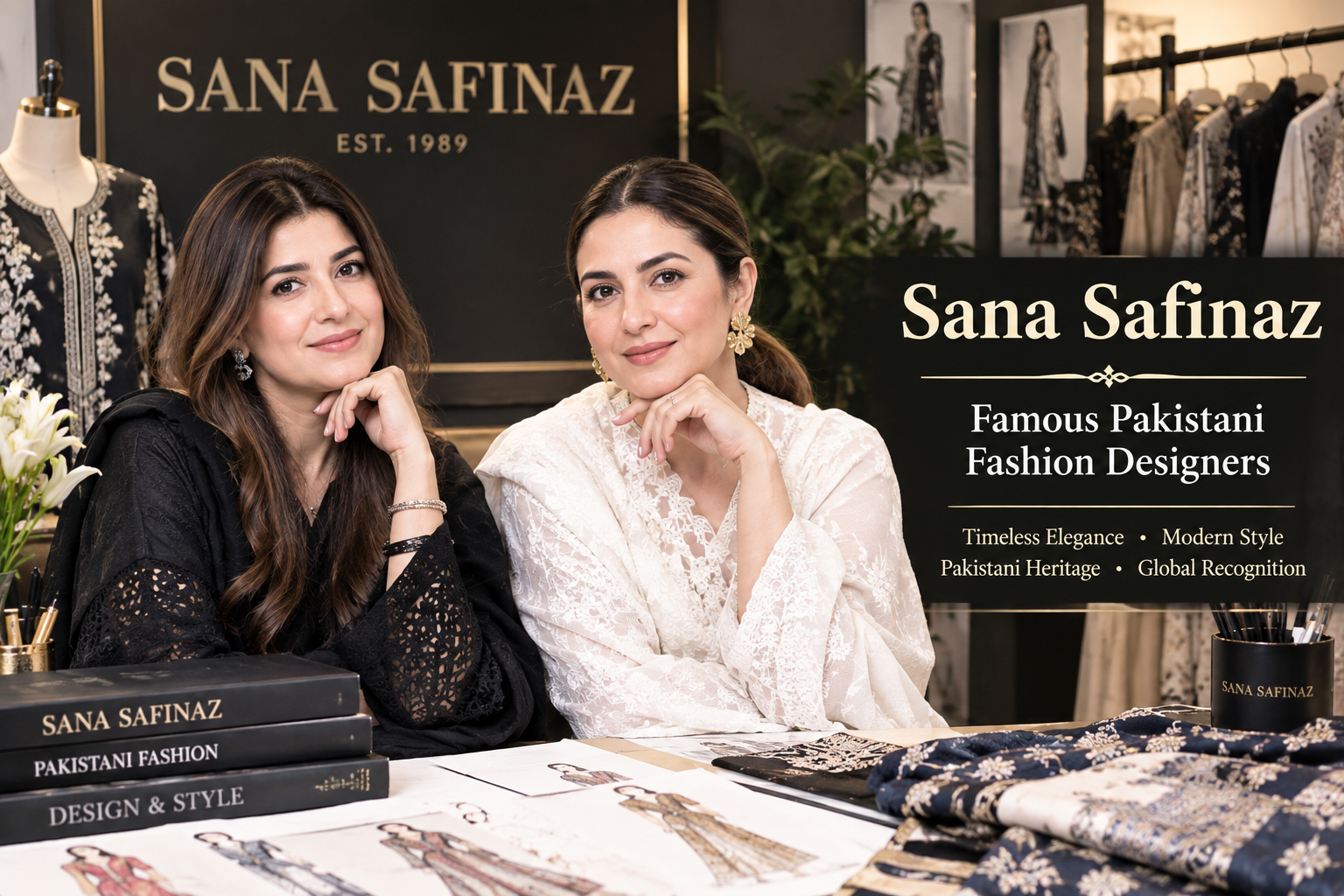
Sana Safinaz is a fashion brand founded by Sana Hashwani and Safinaz Muneer. The official brand history states that the label was established in 1989. Over the years, it has grown from a designer label into a diversified fashion business with clothing, retail, bridal, accessories, and home categories.
The careers of Sana Hashwani and Safinaz Muneer are closely connected with the development of modern Pakistani fashion. They entered the industry at a time when Pakistan's organized fashion business was much smaller than it is today. Through their work in bridal wear, lawn, prêt and retail, they helped develop a fashion brand that reached a broad customer base.
Founders of Sana Safinaz
Sana Safinaz was founded by Sana Hashwani and Safinaz Muneer.
The two designers began working together in the late 1980s. In an interview with Aurora, they discussed their early years in fashion and explained that their first work included bridal and light evening wear.
Their early approach was different from the large fashion businesses that exist today. At that time, the Pakistani fashion industry had fewer designers, fewer fashion publications, and fewer organized fashion platforms.
Sana and Safinaz gradually developed their business by experimenting with different areas of fashion and learning from their experiences.
Establishment in 1989
The official Sana Safinaz website states that the brand was established in 1989. It describes Sana Safinaz as a diversified Pakistani fashion label with apparel lines including prêt, diffusion and bridal couture.
Starting a fashion business in 1989 meant working in a very different market from today's fashion industry.
There were fewer fashion weeks, fewer specialized fashion publications, and fewer retail chains dedicated to designer clothing.
Sana and Safinaz developed their brand during this period of change and continued working as the fashion industry expanded.
Early Fashion Work
In an interview published by Aurora, Safinaz Muneer explained that the designers initially worked with bridal wear and light evening wear. Later, they moved into lawn.
This progression was important because bridal and evening wear allowed the designers to establish their identity in luxury fashion.
Their later move into lawn opened a different part of the market.
Lawn was already popular in Pakistan as a comfortable summer fabric, but designer lawn became a major fashion phenomenon when designers began introducing distinctive prints and collections.
Development of Designer Lawn
Sana Safinaz became closely associated with the development of designer lawn.
The designers told Aurora that they began working with lawn many years before their retail expansion. They also described their experience working with textile companies before deciding to develop lawn collections independently.
This was an important stage in the brand's development.
Designer lawn allowed fashion houses to bring their design ideas to a much larger customer market.
Instead of producing only a small number of expensive couture outfits, designers could create printed and embroidered fabrics for thousands of customers.
The Popularity of Lawn
Lawn eventually became one of the most recognizable parts of Pakistan's seasonal fashion market.
A Dawn report described the strong demand for Sana Safinaz lawn collections, including an event in 2011 where the collection attracted thousands of customers and sold out quickly.
The growth of designer lawn changed consumer behavior.
Customers began waiting for seasonal collections, following fashion campaigns, comparing prints, and buying multiple suits for the summer season.
Sana Safinaz became one of the brands associated with this development.
Lawn and Pakistani Culture
Lawn is particularly suitable for Pakistan's warm climate.
The fabric is lightweight and commonly used for summer clothing.
However, designer lawn changed the way the fabric was presented.
Instead of being viewed only as simple everyday summer fabric, lawn collections increasingly featured carefully designed prints, embroidered shirts, decorative dupattas, and coordinated pieces.
Sana Safinaz played a role in this development.
In a recent Dawn discussion about the history of designer lawn, Sana Safinaz was described as one of the brands that helped transform lawn into a major designer-led fashion category.
From Couture to Prêt
Another important stage in the brand's development was the move from couture toward prêt.
Prêt means ready-to-wear fashion.
Instead of ordering a completely customized outfit, customers can purchase ready-made clothing in standard sizes.
In their Aurora interview, Sana and Safinaz explained that over their years in the industry they moved from couture into prêt.
This allowed the brand to reach customers who wanted designer clothing but also wanted the convenience of ready-to-wear fashion.
Ready-to-Wear Fashion
Ready-to-wear became an important part of the Sana Safinaz business.
The official website currently lists categories including ready-to-wear, luxury prêt, formals, basics, essentials, exclusive collections and resort collections.
Ready-to-wear fashion has become increasingly important in Pakistan because many customers prefer clothing that is already stitched and ready to wear.
It also allows fashion brands to reach a wider market than traditional couture alone.
Opening Retail Stores
Sana Safinaz expanded from designer collections into retail.
The official company history states that a chain of Sana Safinaz retail outlets opened across Pakistan in 2013. The stores offered ready-to-wear clothing, unstitched designs, accessories and footwear.
Retail was an important change for the brand.
Instead of customers visiting only fashion exhibitions or ordering through designers, they could visit dedicated stores and browse different collections.
Expansion into High-Street Retail
The move into retail was a major business decision.
A Dawn report explained that Sana Hashwani and Safinaz Muneer moved into mass-market retail after years of being known for bridal wear and lawn collections. The report noted that they applied their experience with designer lawn to prêt and retail.
This expansion helped the brand move beyond its earlier luxury-focused image.
It also required the designers to understand manufacturing, sourcing, pricing, inventory and store management on a much larger scale.
Building a Fashion Business
Running a fashion brand involves many responsibilities.
Designers must think about fabrics, colors, prints and clothing styles.
At the same time, businesses need teams for production, retail, marketing, finance, logistics, customer service and communication.
Sana Safinaz developed into a business that combined these different functions.
In their interview with Aurora, the founders discussed bringing younger designers into the organization and hiring professionals to help with the business side as the brand grew.
Bridal Fashion
Bridal fashion remains an important part of Sana Safinaz.
The official brand website lists bridal among its major categories.
Pakistani bridal clothing often includes elaborate embroidery, luxurious fabrics, embellishment and traditional silhouettes.
Bridal designers need to work closely with clients because wedding clothing can involve detailed customization and personal preferences.
Sana Safinaz has maintained bridal couture as one of the areas of its fashion business.
Luxury Couture
Couture represents the more exclusive side of fashion.
Couture garments often involve detailed craftsmanship, elaborate embroidery and specialized construction.
Sana Safinaz's official website continues to include couture and bridal categories alongside its ready-to-wear collections.
This combination allows the brand to operate in both luxury and more accessible areas of fashion.
Fashion for Modern Women
The official Sana Safinaz website describes its retail offering as combining eastern and western aesthetics with contemporary clothing.
Modern Pakistani women may wear traditional shalwar kameez, western-inspired outfits, co-ords, kaftans, sarees, lehenga cholis and other styles depending on the occasion.
The current Sana Safinaz collection includes categories such as co-ords, kaftans, silk, lehenga choli and sarees.
This variety reflects the changing preferences of fashion customers.
Combining Tradition and Modern Design
Pakistani fashion often combines traditional cultural elements with modern styling.
Sana Safinaz has developed collections that use Pakistani textiles and clothing traditions while also experimenting with contemporary cuts and silhouettes.
This approach allows the brand to appeal to customers who want clothing that remains culturally familiar but also looks modern.
Accessories and Footwear
Fashion brands increasingly offer products beyond clothing.
Sana Safinaz expanded into accessories and footwear as part of its retail development.
The official company history specifically mentions accessories and footwear as part of its retail offering.
Accessories can include items such as bags, jewelry and other fashion products.
These products allow customers to complete an outfit using items from the same brand.
Expansion into Home Products
The current Sana Safinaz website also includes a Home category.
It lists products such as tableware, decorative objects, cushions, candles, stationery, bedding and towels.
This represents an expansion beyond traditional clothing.
A fashion brand can use its design language in home products by applying similar ideas about colors, patterns, materials and presentation.
Interior Design
Sana and Safinaz have also been involved in interior design.
In their Aurora interview, they discussed their interiors business and explained that it was handled as a separate creative activity.
Interior design and fashion share several creative elements.
Both involve colors, textures, patterns, materials and visual balance.
The designers' experience in fashion therefore provided another creative field in which they could work.
Fashion and Business
Sana Safinaz demonstrates the connection between creativity and business.
A designer may have creative ideas, but turning those ideas into a successful brand requires planning.
The company must source fabrics, produce garments, manage stores, market collections, maintain quality and respond to customer demand.
Sana and Safinaz have spoken openly about the business challenges involved in expanding from design into retail.
Their experience illustrates how fashion can become a large-scale commercial industry.
The Importance of Quality
Quality is an important part of fashion.
Customers consider fabric, stitching, printing, embroidery, color, finishing and durability when purchasing clothing.
In their interview with Aurora, Sana and Safinaz discussed maintaining product quality as their business grew.
Maintaining quality becomes more complicated when a business moves from small-scale couture production to large-scale retail.
This requires organized manufacturing and quality-control systems.
Creativity in Fashion
Creativity is central to the work of fashion designers.
Designers need to develop new prints, patterns, cuts, embroidery styles and collections.
At the same time, fashion creativity must respond to customers.
Sana Safinaz's history shows this balance between creative design and commercial fashion.
The founders have continued to develop different product categories rather than remaining limited to one type of clothing.
Fashion Shows
Fashion shows have historically been an important platform for Pakistani designers.
They provide an opportunity to present new collections and introduce new trends.
Sana Safinaz participated in Pakistan's developing fashion-show culture.
In their Aurora interview, the founders discussed how fashion weeks had grown significantly compared with the early years of their careers.
Fashion weeks also helped young designers receive media attention and connect with potential customers.
The Growth of Pakistan's Fashion Industry
When Sana and Safinaz started, Pakistan's fashion industry was much smaller.
In their interview, they recalled a time when there were relatively few fashion publications and limited infrastructure for designers. They also discussed the later growth of fashion magazines, blogs, design schools and fashion weeks.
Today, Pakistan has a much larger fashion ecosystem.
There are fashion schools, textile companies, designers, photographers, stylists, models, retailers, digital creators and online fashion stores.
Sana Safinaz developed alongside this growth.
Supporting the Fashion Industry
Fashion brands create opportunities for many different professionals.
Designers need textile manufacturers, printers, embroiderers, tailors, photographers, models, stylists, marketing teams and retail workers.
Sana and Safinaz have discussed how the growth of fashion creates employment throughout the industry.
The impact of a fashion business therefore extends beyond the designers themselves.
International Reach
Pakistani fashion has customers outside Pakistan as well.
Overseas Pakistanis often purchase Pakistani clothing for Eid, weddings and other cultural occasions.
The Sana Safinaz brand has also worked with international buyers and developed an online presence.
A 2011 Dawn report noted that the designers had international buyers and ambitions for further international expansion.
Today, online shopping makes it easier for Pakistani fashion brands to reach international customers.
Digital Fashion
Digital technology has changed the fashion industry.
Customers can see new collections through websites and social media without attending physical fashion events.
Fashion campaigns can be presented through photographs, videos and digital advertisements.
The current Sana Safinaz website provides online shopping across multiple categories.
This gives customers access to the brand's collections from different locations.
Sana Safinaz and Women Entrepreneurs
Sana Hashwani and Safinaz Muneer are examples of women who built a long-running fashion business in Pakistan.
They entered the industry when fashion entrepreneurship was developing and gradually expanded their business.
Their story demonstrates how women can work in creative industries as designers, entrepreneurs, managers and business leaders.
Their experience can also provide inspiration for young women interested in fashion and entrepreneurship.
Lessons for Young Fashion Designers
Young people interested in fashion can learn several lessons from the Sana Safinaz journey.
The first is that a fashion career requires patience.
The brand has developed over decades rather than becoming a large business immediately.
The second lesson is the importance of understanding customers.
Designers need to know what people want to wear and what price levels they can afford.
The third lesson is adaptability.
Sana Safinaz moved from bridal and evening wear into lawn, prêt, retail, accessories and other categories.
The fourth lesson is teamwork.
A large fashion company cannot be managed by one person alone.
Fashion Education
Students interested in fashion can study subjects such as fashion design, textile design, merchandising and fashion marketing.
Practical experience is also important.
Students can learn about fabrics, sewing, embroidery, illustration, pattern making, color theory and garment construction.
Business knowledge can also help because many designers eventually start their own labels.
The careers of Sana Hashwani and Safinaz Muneer demonstrate the importance of combining creative ability with business understanding.
Sana Safinaz Today
The current Sana Safinaz website shows a wide range of collections.
These include unstitched fabrics, ready-to-wear, luxury prêt, formals, bridal, couture, accessories, kidswear and home products.
The website also lists current seasonal collections, demonstrating the brand's continuing product development.
This broad range is very different from the small designer label with which the founders began their careers.
Continuing Fashion Legacy
Sana Safinaz has been active for more than three decades.
The official brand history identifies 1989 as the year the label was established.
The brand's long history gives it an important place in Pakistan's fashion story.
From bridal clothing and evening wear to designer lawn, prêt and retail, the company has participated in several major developments in the country's fashion market.
Conclusion
Sana Safinaz is one of Pakistan's established fashion labels. Founded by Sana Hashwani and Safinaz Muneer in 1989, the brand has developed from a designer label into a diversified fashion business.
The founders began with bridal and light evening wear and later became strongly associated with designer lawn. Their work helped bring designer-led fashion into a wider consumer market.
The brand later expanded into prêt and retail. Its retail chain began opening across Pakistan in 2013, offering ready-to-wear clothing, unstitched designs, accessories and footwear.
Today, Sana Safinaz offers a wide range of products including unstitched fabrics, ready-to-wear clothing, luxury prêt, formals, bridal wear, couture, accessories and home products.
The story of Sana Hashwani and Safinaz Muneer demonstrates how creativity, business planning, customer understanding and long-term commitment can contribute to the development of a fashion brand.
Their journey is also part of the broader story of Pakistan's fashion industry, which has grown from a relatively small creative field into a large industry involving designers, textile manufacturers, retailers, photographers, models, stylists and many other professionals.
For students and young people interested in fashion, Sana Safinaz provides an example of how a creative idea can develop into a long-term business while continuing to evolve with changing customer preferences.
Frequently Asked Questions
1. Who founded Sana Safinaz?
Sana Safinaz was founded by Sana Hashwani and Safinaz Muneer.
2. When was Sana Safinaz established?
The brand was established in 1989.
3. What is Sana Safinaz famous for?
Sana Safinaz is known for bridal couture, designer lawn, prêt, ready-to-wear fashion, formal clothing and unstitched fabrics.
4. When did Sana Safinaz start its retail outlets?
The official brand history states that its retail outlet chain opened in 2013 across Pakistan.
5. What products does Sana Safinaz offer?
Its current product range includes unstitched fabrics, ready-to-wear, luxury prêt, formals, bridal wear, couture, accessories, kidswear and home products.