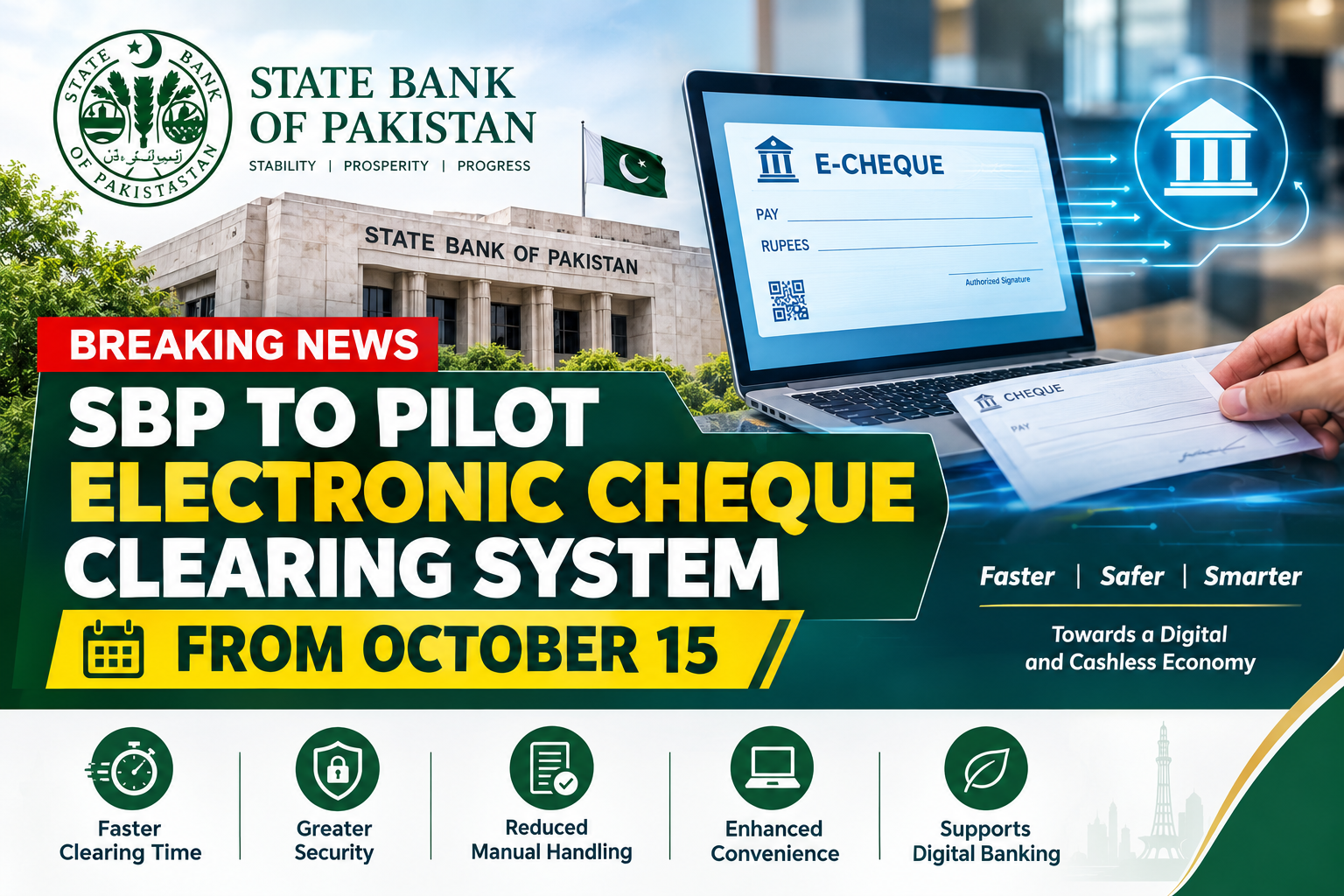
The State Bank of Pakistan (SBP) is preparing to introduce a pilot electronic cheque clearing system from October 15, marking another step toward the digital transformation of Pakistan’s banking sector. The initiative is designed to modernize cheque processing, improve efficiency, reduce delays, and provide banks with a more streamlined method of clearing cheque payments.
Cheque clearing has traditionally involved several steps between banks, including the physical movement and verification of cheques. The shift toward electronic processing is expected to make the process faster and more efficient by reducing dependence on physical documents and manual procedures.
The new pilot initiative reflects the growing importance of digital banking infrastructure in Pakistan. As customers increasingly use online banking, mobile applications, digital payments, and electronic transfers, financial institutions are also adopting technologies that can improve traditional banking services.
What Is Electronic Cheque Clearing?
Electronic cheque clearing is a system through which cheque information and images are exchanged digitally between banks and financial institutions instead of physically transporting the original cheque through the entire clearing process.
Under an electronic clearing arrangement, a bank can scan or digitally capture relevant cheque information and transmit it through a secure clearing system. The receiving institution can then process the transaction using the electronic information.
This approach can significantly reduce the time required for cheque processing.
It can also reduce the administrative burden associated with handling large quantities of physical cheques.
Why Is the SBP Introducing the Pilot?
The State Bank of Pakistan has been working to strengthen the country’s payment infrastructure and encourage greater use of digital financial services.
Although electronic transfers and mobile payments have become increasingly common, cheques continue to be used by individuals, businesses, institutions, and other organizations.
Modernizing cheque clearing can therefore improve an important part of the existing banking system.
The pilot will allow banks and the central bank to assess the system under practical operating conditions before wider implementation.
Expected Benefits for Customers
One of the most important potential benefits is faster cheque processing.
Traditional cheque clearing can take time because physical documents may need to move between different branches and banks. Electronic processing can reduce some of these delays by allowing cheque information to be transmitted digitally.
For customers, faster processing can mean quicker access to funds and greater certainty about the status of a transaction.
The system could also make banking more convenient for businesses that process large numbers of cheques.
Benefits for Banks
Banks can also benefit from electronic cheque clearing.
Physical cheque processing requires staff, transportation, document handling, storage, and other administrative resources. Digital processing can reduce some of these operational requirements.
Banks may also be able to improve their internal workflows by integrating electronic cheque information with existing banking systems.
Over time, greater automation can help financial institutions process transactions more efficiently.
Improved Efficiency
Efficiency is one of the main objectives of digital transformation in banking.
Financial institutions process millions of transactions every day. Even small improvements in the processing of individual transactions can create significant benefits when applied across the entire banking system.
Electronic cheque clearing can help reduce manual work and improve the speed at which information moves between financial institutions.
It can also make it easier for banks to track transactions through digital records.
Reduction in Physical Cheque Movement
Traditional cheque clearing depends heavily on the physical movement of documents.
A cheque deposited at one bank may need to be presented to another bank for payment. This creates logistical requirements involving transportation, handling, sorting, and secure storage.
Electronic clearing reduces the need to physically transport cheque documents between institutions.
This can make the clearing process more efficient and reduce the risks associated with moving physical financial documents.
Security and Verification
Security is an important consideration in any digital payment system.
Electronic cheque clearing requires secure systems for transmitting cheque images and transaction information between participating institutions.
Banks will need to follow appropriate authentication, verification, data protection, and cybersecurity procedures.
The use of electronic records can also improve the ability of financial institutions to monitor transactions and maintain detailed audit trails.
However, strong cybersecurity measures will remain essential to protect the system from fraud and unauthorized access.
Importance for Businesses
Businesses are among the major users of cheque payments in Pakistan.
Companies may issue or receive cheques for suppliers, customers, employees, contractors, and other financial obligations.
Delays in cheque clearing can sometimes affect cash-flow planning.
A faster electronic system could make it easier for businesses to predict when payments will be processed and funds will become available.
Small and medium-sized enterprises could particularly benefit from more efficient payment processing because cash-flow management is important for their daily operations.
Support for Digital Banking
Pakistan has been experiencing rapid growth in digital financial services.
Mobile banking applications, internet banking, instant payment systems, digital wallets, and electronic fund transfers have changed how many customers manage their finances.
Electronic cheque clearing complements these developments by modernizing one of the country’s older payment methods.
The initiative does not necessarily mean that cheques will disappear immediately. Instead, it provides a more modern infrastructure for processing cheques that are still used by customers and organizations.
Role of the State Bank of Pakistan
The State Bank of Pakistan plays a central role in regulating and developing Pakistan’s banking and payment systems.
By introducing the electronic cheque clearing pilot, the central bank can evaluate how banks handle digital cheque information and identify any technical or operational issues.
The pilot phase is particularly important because financial systems need to be tested carefully before being expanded on a larger scale.
The experience gained during the pilot can help improve the system before broader adoption.
Pilot Phase and Future Expansion
A pilot program allows authorities and participating banks to test a new system under controlled conditions.
During the initial phase, banks can identify technical problems, processing delays, compatibility issues, or other challenges.
Feedback from banks and customers can also help improve the system.
If the pilot performs successfully, electronic cheque clearing could eventually become more widely available across Pakistan’s banking sector.
Impact on Traditional Banking
The initiative represents a gradual transition from paper-based banking toward digital financial infrastructure.
Traditional banking processes often rely on physical documents and manual verification. Digital systems can automate many of these activities.
This does not mean that physical banking will disappear. Customers will continue to require branches and traditional financial services for many purposes.
However, electronic systems can make back-office operations faster and more efficient.
Potential Challenges
Despite its benefits, implementing an electronic cheque clearing system can involve several challenges.
Banks need compatible technology, reliable communication systems, trained employees, and effective cybersecurity measures.
Smaller financial institutions may require additional investment to upgrade their systems.
There may also be a learning curve for bank employees and customers who are accustomed to traditional cheque-processing procedures.
Ensuring that all participating institutions can operate the system reliably will therefore be an important part of the pilot.
Customer Awareness
Customer awareness will also play an important role.
Banks may need to explain how electronic cheque clearing works, how long transactions are expected to take, and what customers should do if a cheque is rejected or a technical problem occurs.
Clear communication can reduce confusion and help customers understand changes in the clearing process.
Banks can use branches, websites, mobile applications, SMS notifications, and other communication channels to provide information.
Strengthening Pakistan’s Payment Infrastructure
A modern payment system is important for economic development.
Efficient payment infrastructure allows businesses and individuals to transfer money more easily and supports commercial activity.
Electronic cheque clearing is one part of a broader transformation taking place within Pakistan’s financial sector.
Alongside instant payments, digital banking, mobile wallets, and online financial services, such initiatives can contribute to a more connected and efficient banking ecosystem.
Environmental Considerations
Reducing the physical movement of paper documents can also provide environmental benefits.
Electronic processing can lower the need for paper-based documentation, transportation, and physical storage.
Although the environmental impact of cheque clearing is relatively small compared with larger economic activities, digitalization across millions of transactions can gradually reduce the use of physical resources.
Future of Cheque Payments
The introduction of electronic clearing raises an important question about the future of cheques in Pakistan.
Digital payments are becoming increasingly popular, particularly among younger customers and technology-oriented businesses.
However, cheques remain useful in certain sectors and transactions.
Rather than immediately replacing cheques, electronic clearing can modernize the way existing cheque payments are processed.
Over time, customers may continue shifting toward instant digital payments, while electronic cheque clearing provides an efficient system for those who still use cheques.
Conclusion
The State Bank of Pakistan’s decision to pilot electronic cheque clearing from October 15 represents an important step in the modernization of the country’s banking system.
The initiative has the potential to make cheque processing faster, reduce physical document movement, improve operational efficiency, and provide banks with better digital records.
Businesses and individual customers could benefit from quicker processing and greater convenience, while banks may benefit from reduced manual work and improved workflows.
At the same time, successful implementation will require strong cybersecurity, reliable technology, staff training, and effective coordination between participating financial institutions.
As Pakistan continues to expand its digital financial infrastructure, electronic cheque clearing can serve as another important link between traditional banking and the country’s increasingly digital economy.
FAQs
1. What is electronic cheque clearing?
Electronic cheque clearing allows banks to exchange cheque information and images digitally instead of relying primarily on physical cheque movement.
2. When will the SBP pilot begin?
The pilot is scheduled to begin on October 15.
3. How can customers benefit?
Customers may experience faster cheque processing and quicker availability of funds.
4. Will electronic clearing eliminate cheques?
No. The system is designed to modernize cheque processing, while digital payment methods continue to expand.
5. Why is electronic cheque clearing important?
It can improve banking efficiency, reduce physical document movement, strengthen digital infrastructure, and streamline payment processing.