Introduction
Technology has changed many parts of everyday life. People use smartphones to communicate, computers to work, online platforms to study, and digital systems to manage businesses. The same technological development is now entering homes through smart home technology.
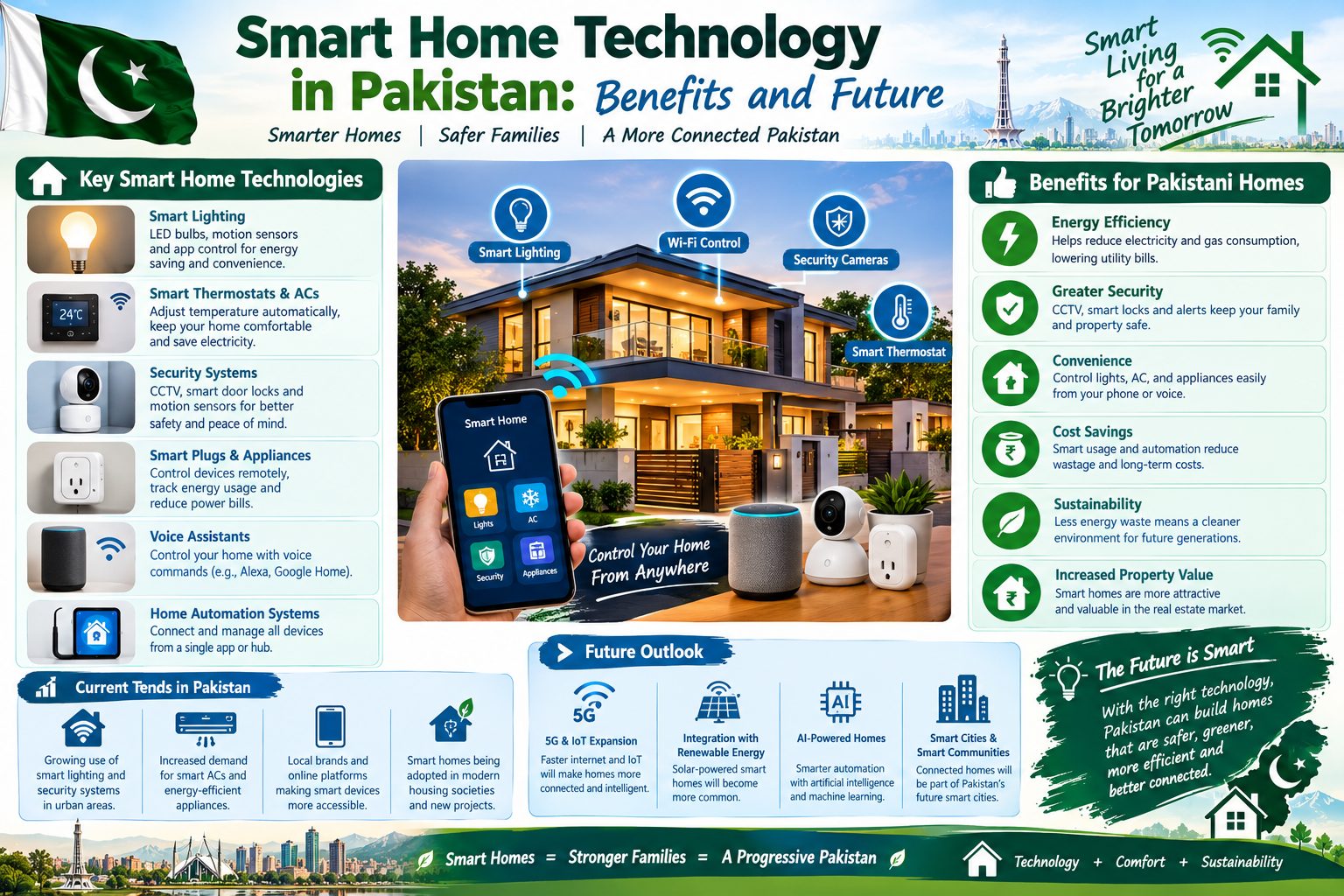
A smart home is a home where electronic devices and appliances can be connected and controlled through digital systems. Depending on the equipment, residents may be able to control lights, fans, air conditioners, televisions, security cameras, door locks, and other devices using a smartphone, remote control, voice commands, or an automated schedule.
Smart home technology is still developing in Pakistan, but interest in connected home devices is increasing. Modern houses, apartments, offices, and commercial properties can use different forms of automation to improve convenience, security, energy management, and everyday household activities.
The idea of a smart home does not necessarily mean that an entire house needs expensive technology. A person can start with a single smart bulb, camera, plug, or appliance and gradually add more devices.
Pakistan has particular reasons for exploring smart home technology. Energy management is important for households, security is a major concern for many communities, and smartphones and internet services have become common tools for communication and digital services.
At the same time, smart homes have challenges. Equipment costs, internet dependence, electricity requirements, technical knowledge, privacy, cybersecurity, and maintenance should all be considered before installing connected devices.
What Is Smart Home Technology?
Smart home technology refers to electronic devices and systems that can perform tasks automatically or be controlled digitally.
Traditional household devices usually require direct manual operation. For example, a person switches a normal light on and off using a wall switch.
A smart light can provide additional control. Depending on its features, it may be operated through a smartphone application, scheduled to turn on at a particular time, or connected with other smart devices.
Smart home technology usually combines several elements:
Electronic devices
Sensors
Internet or local networks
Mobile applications
Control systems
Automation software
Sometimes artificial intelligence
These elements work together to create a more connected household environment.
Smart Lights in Pakistani Homes
Smart lighting is one of the simplest ways to introduce home automation.
Smart bulbs can allow users to control lighting through a smartphone or compatible control system. Some models provide scheduling features, allowing lights to turn on or off at selected times.
For example, outdoor lights can be programmed to operate during particular hours. Interior lights can also be controlled without manually reaching for a switch when the system supports remote operation.
Smart lighting can also help households monitor how lights are being used.
Energy-efficient lighting combined with smart controls can potentially reduce unnecessary electricity consumption. However, actual savings depend on the type of lights, household habits, electricity rates, and how the system is used.
Smart Fans and Air Conditioners
Cooling is especially important in Pakistan because many regions experience hot summers.
Smart controllers can provide digital control over compatible fans and air conditioners. Some systems allow users to adjust settings remotely or create schedules.
For example, a household may be able to schedule an air conditioner to operate during particular periods rather than leaving it running continuously.
Smart temperature sensors can also provide information about indoor conditions.
Energy management is particularly useful for households that want to reduce unnecessary electricity consumption while maintaining comfortable indoor temperatures.
Smart TVs
Smart televisions have become increasingly common in modern homes.
A smart TV can connect to the internet and provide access to streaming platforms, online videos, applications, and other digital services.
Instead of using a television only for traditional broadcasts, families can use it for entertainment, educational videos, news, and other online content.
Smart TVs can also connect with other devices such as smartphones and computers.
For families, this can create a more connected entertainment and information system within the home.
Smart Home Security Cameras
Security is one of the major reasons people consider smart home technology.
Smart security cameras can allow residents to monitor selected areas of a property. Depending on the model and setup, users may be able to view camera feeds through a smartphone.
Some cameras provide motion detection and notifications. This can help residents become aware of activity around a monitored area.
Cameras may be used at entrances, gates, garages, shops, or other appropriate locations.
However, privacy should always be considered. Cameras should be installed responsibly and should not be used to invade the privacy of family members, neighbors, or other people.
Smart Doorbells
Smart doorbells combine a doorbell with electronic monitoring features.
Some systems include cameras and can send notifications when someone approaches the entrance.
A resident may be able to see who is at the door through a connected device.
This technology can provide an additional layer of awareness for homeowners, particularly in houses with external gates or entrances.
Smart Locks
Smart locks are another developing area of home automation.
Depending on the design, smart locks may use electronic codes, cards, smartphones, or other authentication methods.
They can provide an alternative to traditional physical keys.
Some systems can also maintain access records or allow temporary digital access.
However, security is extremely important when using connected locks. Users should select reliable products, keep software updated, and use strong authentication methods.
Smart Plugs
Smart plugs can turn certain traditional electrical devices into remotely controllable devices.
A compatible appliance connected through a smart plug may be controlled using a digital application.
For example, a user could schedule a lamp or another suitable appliance to turn on or off.
Smart plugs can be useful for households that want to experiment with automation without replacing every appliance.
However, users should make sure that the smart plug is properly rated for the electrical load of the appliance.
Smart Sensors
Sensors are an important part of smart homes.
Different sensors can detect different conditions, such as:
Motion
Temperature
Light levels
Door or window opening
Smoke
Water leaks
A sensor can send information to a control system, which may then trigger an appropriate action.
For example, a motion sensor could activate a light in a selected area.
Sensors can make automation more responsive because the system can react to changes in the environment.
Smart Energy Monitoring
Energy management is particularly relevant in Pakistan.
Electricity consumption can vary considerably between households depending on the number of appliances, cooling requirements, and daily habits.
Smart energy-monitoring devices can provide information about electricity use.
This information may help households understand which appliances or activities consume more energy.
When combined with energy-efficient appliances, monitoring can encourage more informed electricity use.
Smart Homes and Solar Energy
Solar energy and smart home technology can complement each other.
A solar energy system can generate electricity, while smart devices can help monitor and manage how that electricity is used.
For example, energy-monitoring systems can provide information about household consumption and solar generation.
Smart controllers may also help users manage certain appliances according to available energy.
This can be particularly useful for households interested in improving energy management.
However, solar systems and smart home systems should be designed and installed by qualified professionals where electrical work is involved.
Smart Home Technology in Pakistani Cities
Smart home technology is particularly visible in larger Pakistani cities where modern housing developments, technology businesses, and higher-speed internet services provide an environment for connected devices.
Cities such as Lahore, Islamabad, Karachi, Rawalpindi, and Faisalabad have growing technology markets and a wide range of electronic products.
Modern apartments and houses may include security cameras, smart TVs, automated lighting, digital locks, and other electronic systems.
As technology becomes more affordable, similar solutions may gradually become available to a wider range of households.
Smart Homes in Apartments
Smart home technology can also be useful in apartments.
Apartment residents may not be able to make major structural changes, but smaller devices can still provide automation.
Smart bulbs, plugs, cameras, sensors, and smart appliances can often be introduced without major construction work.
However, residents should follow building rules and obtain permission where required, especially when installing external cameras or making electrical changes.
Smart Homes and Elderly Family Members
Technology can sometimes make household tasks easier for elderly family members.
Remote control of lights, televisions, fans, or other suitable devices may reduce the need to move frequently.
Automated lighting can also be useful in areas where visibility is important.
However, technology should remain simple enough to use comfortably. Complicated systems can create confusion rather than convenience.
Smart Homes and Students
Students can also benefit from a well-organized smart home environment.
Smart lighting can help create suitable study conditions, while smart devices can provide access to educational content.
A connected television or computer can be used for online learning.
At the same time, students should manage digital distractions. Smart technology should support productive activities rather than create additional interruptions.
Smart Home Technology and Education
Smart homes can also introduce children and students to modern technology.
Young learners can develop an understanding of sensors, networks, automation, programming, and electronics through age-appropriate educational projects.
Students studying computer science or electronics can experiment with simple automation projects using suitable educational equipment.
This can connect classroom concepts with practical applications.
Smart Homes and Internet Connectivity
Most smart home systems depend on some form of network connection.
Wi-Fi is commonly used for connecting household devices, while some systems may use other wireless communication technologies.
A reliable home network can improve the experience of connected devices.
However, internet outages can affect cloud-dependent smart devices.
For this reason, some systems are designed to provide local control even when internet access is unavailable.
When choosing smart home equipment, users should understand whether a device requires continuous internet access.
Privacy in Smart Homes
Privacy is an important issue in connected homes.
Some smart devices collect information about how they are used. Cameras and microphones can also involve particularly sensitive information.
Users should understand what information a device collects and how it is stored.
Privacy settings should be reviewed carefully.
Households should avoid connecting unnecessary devices to sensitive areas and should use appropriate security measures.
Cybersecurity for Smart Homes
Connected devices can create cybersecurity risks if they are poorly protected.
Users should change default passwords where applicable and use strong, unique passwords.
Software and firmware should be updated when manufacturers provide security updates.
Home Wi-Fi should also be protected with appropriate security settings.
It is important to purchase electronic products from trustworthy sources and follow manufacturer security guidance.
Cybersecurity is especially important for cameras, smart locks, computers, and other devices that may handle sensitive information.
Cost of Smart Home Technology in Pakistan
The cost of a smart home can vary greatly.
A basic setup might involve only a few relatively simple devices, while a complete automated house can require considerably more equipment and professional installation.
The total cost can depend on:
Number of devices
Device quality
Brand
Installation requirements
Network equipment
Electrical work
Security systems
Maintenance
Consumers should consider their actual needs rather than purchasing unnecessary devices.
Starting with essential features can make smart home technology more affordable.
Choosing Smart Home Devices
Consumers should consider several factors before buying smart devices.
Compatibility
Devices should work with the chosen control system or ecosystem.
Security
Security features and update support are important.
Reliability
A device should be suitable for the environment and expected workload.
Warranty
A clear warranty can provide additional protection.
Power Requirements
Users should understand how much electricity a device consumes.
Internet Requirements
Some devices may require continuous internet access.
Installation
Electrical equipment should be installed safely and, where necessary, by qualified professionals.
Smart Home Technology and Energy Efficiency
Automation alone does not guarantee lower electricity consumption.
A smart device can still consume electricity, and automation can sometimes encourage people to use more devices.
The greatest benefits may come when smart technology is combined with energy-efficient appliances and responsible household habits.
For example, scheduling an air conditioner can help avoid unnecessary operation, while energy-efficient lighting can reduce electricity use.
The technology should therefore be viewed as a management tool rather than a guaranteed method of reducing bills.
Smart Homes and Artificial Intelligence
Artificial intelligence may play a growing role in future smart homes.
AI systems can potentially analyze household patterns and help automate certain activities.
For example, an intelligent system might learn preferred temperature settings or identify common usage patterns.
AI can also be used in security systems to help analyze activity.
However, AI-powered systems can involve additional privacy and security considerations. Users should understand how personal data is processed.
Voice-Controlled Smart Homes
Voice control allows users to operate compatible devices using spoken commands.
This can make some smart home systems easier to use.
For example, a user may be able to control compatible lights or appliances through a voice-enabled system.
Voice technology is becoming increasingly sophisticated, but language and accent support can vary between products.
For Pakistani users, support for commonly spoken languages and accents can be an important consideration.
Smart Home Technology and Small Businesses
Smart technology is not limited to houses.
Small shops, offices, clinics, and other businesses can use smart cameras, lighting controls, energy-monitoring devices, and access systems.
These technologies can help businesses monitor their premises and manage certain electronic systems.
Smart energy management may also help businesses understand their electricity consumption.
Employment Opportunities
The development of smart home technology can create opportunities for technicians and technology professionals.
People with skills in electronics, networking, electrical systems, software, cybersecurity, and automation can potentially work in this growing field.
Installation and maintenance also require trained workers.
Educational institutions and technical training centers can help students develop practical skills related to automation and connected devices.
Challenges for Smart Homes in Pakistan
Several challenges may affect the growth of smart homes.
High Initial Cost
Advanced systems can be expensive.
Electricity Issues
Power interruptions can affect some devices.
Internet Dependence
Cloud-connected systems may have limited functionality during internet outages.
Technical Knowledge
Users may need help with installation, configuration, and troubleshooting.
Maintenance
Electronic equipment may require updates, repairs, or replacement.
Privacy Concerns
Connected devices can collect sensitive information.
Cybersecurity Risks
Poorly protected devices may create security vulnerabilities.
These challenges do not eliminate the usefulness of smart technology, but they show why careful planning is important.
The Future of Smart Homes in Pakistan
The future of smart homes in Pakistan may involve greater integration between electronics, internet services, renewable energy, and automation.
Smart energy systems may become more useful as households look for ways to manage electricity consumption.
Solar systems could work with intelligent monitoring tools to provide better information about energy production and usage.
Security systems may become more connected, while smart appliances may offer greater automation.
Artificial intelligence could also introduce more personalized household management.
As electronic technology develops and prices change, smart home products may become accessible to more households.
Practical Approach to Building a Smart Home
A household does not need to automate everything at once.
A practical approach is to begin with one or two useful devices.
For example, a family might start with smart lighting or a security camera.
After understanding how the system works, additional devices can be added.
This gradual approach can help users understand costs, compatibility, security, and maintenance before investing in a larger system.
Importance of Responsible Technology Use
Smart home technology should improve people's lives rather than make them completely dependent on complicated systems.
Manual controls should remain available where appropriate.
Users should know how important devices work and what to do if the network or automation system stops working.
Regular maintenance, software updates, secure passwords, and responsible privacy practices can make connected homes safer and more reliable.
Conclusion
Smart home technology is becoming an important part of modern electronic development in Pakistan. From smart lights and security cameras to connected televisions, sensors, smart plugs, automated appliances, and energy-monitoring systems, electronic technology is providing new ways to manage household activities.
The benefits can include convenience, improved monitoring, flexible control, better information about energy use, and opportunities for automation. Smart technology can also connect homes with solar energy systems, smartphones, internet services, and other digital platforms.
However, a smart home is not simply a collection of electronic devices. Successful implementation requires careful planning, reliable equipment, secure networks, proper installation, privacy protection, and responsible use.
Pakistan also faces challenges such as device costs, electricity interruptions, internet availability, technical knowledge, and cybersecurity. These factors need to be considered as the smart home market develops.
The future may bring more intelligent and connected homes, with artificial intelligence, renewable energy, sensors, automation, and digital security working together. As technology becomes more accessible, smart home systems may become increasingly relevant to Pakistani households.
The most useful approach is to select technology according to actual household needs. A simple and secure system can often provide meaningful benefits without requiring every part of a home to become automated.
Smart home technology therefore represents not only a trend in electronics but also a developing approach to making homes more connected, efficient, convenient, and technologically prepared for the future.
FAQs
1. What is smart home technology?
Smart home technology uses connected electronic devices, sensors, networks, and software to control or automate household activities such as lighting, security, entertainment, and energy management.
2. What smart devices can be used in Pakistani homes?
Common options include smart bulbs, smart plugs, security cameras, smart TVs, sensors, smart locks, smart appliances, and energy-monitoring systems.
3. Are smart homes expensive in Pakistan?
The cost depends on the number and type of devices. A household can begin with a few basic devices and gradually expand the system instead of installing a complete setup at once.
4. Do smart home devices need the internet?
Many smart devices use Wi-Fi or internet services, but some systems can continue to provide certain functions through local networks even when internet access is unavailable.
5. What is the future of smart homes in Pakistan?
The future may include greater use of artificial intelligence, smart energy management, solar integration, connected appliances, automated security, sensors, and more advanced home-control systems.