Introduction
Education is one of the most important foundations of a country's development. Pakistan has a large and young population, making access to quality education an important national need. Over time, technology has introduced new ways for students to learn and for teachers to present information.
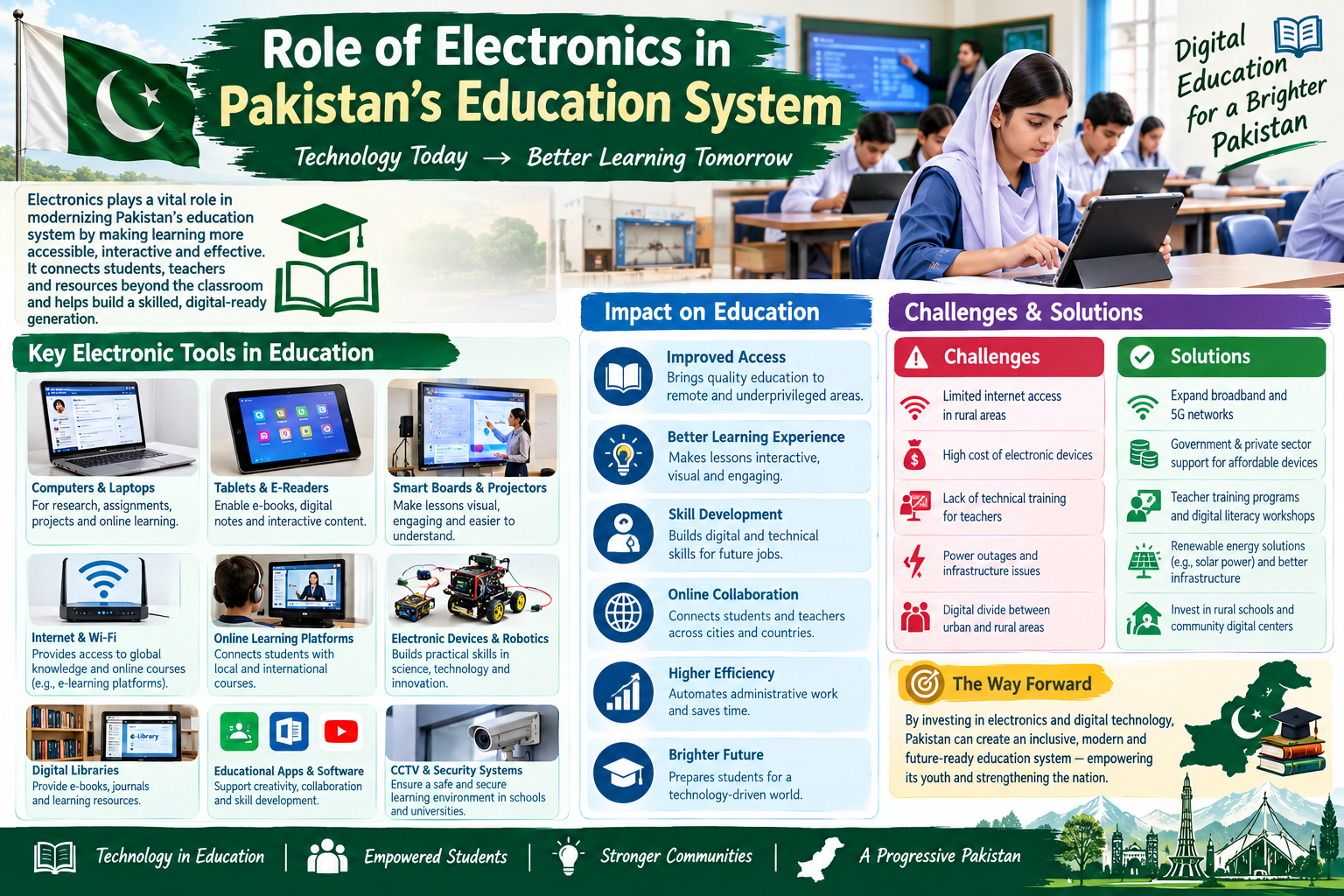
Electronic devices are now found in many educational environments. Schools, colleges, universities, training centers, and homes may use computers, laptops, smartphones, projectors, digital screens, printers, scanners, calculators, and other devices.
In the past, education mainly depended on textbooks, notebooks, blackboards, and face-to-face classroom teaching. These methods continue to be important, but electronic technology has added new possibilities. Students can now watch educational videos, search digital libraries, attend online classes, use learning applications, prepare presentations, and communicate with teachers through digital platforms.
Electronics do not replace the importance of teachers. Instead, they can provide teachers and students with additional tools for explaining concepts, practicing skills, finding information, and communicating.
The use of electronics in Pakistan's education system is still developing. Some institutions have access to advanced technology, while others face challenges related to electricity, internet connectivity, equipment costs, technical training, and maintenance. Understanding both the benefits and challenges of educational electronics is therefore important.
The Beginning of Technology in Pakistani Education
The use of electronic technology in education did not begin with smartphones or the internet. Radios, televisions, audio recordings, calculators, and other electronic devices were used as educational tools long before modern digital technology became widespread.
Educational broadcasts could provide information to students and the general public. Television also became a medium for educational programming.
Calculators became useful in subjects involving mathematics, science, accounting, and engineering. They helped students perform calculations and focus more on understanding mathematical processes.
Computers later introduced a much wider range of possibilities. Students could use educational software, type assignments, create presentations, perform calculations, and learn programming.
This gradual development prepared the education system for today's digital environment.
Computers in Pakistani Schools and Colleges
Computers have become an important educational tool. Computer laboratories can provide students with practical experience in information technology and digital skills.
Students can use computers to learn programming, word processing, presentations, spreadsheets, graphic design, databases, and internet research.
For computer science students, access to computers is especially important because many concepts require practical work.
Computers can also support subjects outside computer science. Students can prepare reports, create presentations, conduct research, solve mathematical problems, and organize study materials.
Teachers can use computers to prepare lesson plans, presentations, tests, worksheets, and educational resources.
Laptops and Portable Learning
Laptops provide many of the capabilities of desktop computers while allowing students to work in different locations.
Students can use laptops for assignments, presentations, research, programming, online classes, and digital note-taking.
For college and university students, laptops can become an important part of academic life. A single device can store textbooks, notes, presentations, research documents, and educational software.
However, not every student has equal access to a personal computer. Device affordability remains an important consideration when discussing digital education in Pakistan.
Schools and institutions can help by providing computer laboratories, shared devices, or other forms of access where possible.
Smartphones as Educational Devices
Smartphones are among the most widely used electronic devices in modern life. Their educational potential is significant because many students already use them for communication and internet access.
A smartphone can provide access to dictionaries, calculators, educational videos, online articles, learning applications, digital books, and communication platforms.
Students can use smartphones to review lessons, search for explanations, record lectures where permitted, and communicate with classmates.
Teachers can also use smartphones to share announcements, assignments, study materials, and other educational information.
However, smartphones can also create distractions. Social media, games, notifications, and unrelated content can interfere with study time. Responsible use and appropriate classroom policies are therefore important.
Tablets in Education
Tablets provide a larger screen than smartphones while remaining portable.
They can be used for reading digital books, viewing educational videos, taking notes, practicing questions, and using interactive learning applications.
Tablets can be particularly useful for younger students when educational content is designed appropriately.
Digital textbooks can reduce the need to carry multiple heavy books, although reliable device access and electricity for charging remain necessary.
Projectors and Digital Displays
Projectors have changed the way teachers can present information in classrooms.
Instead of writing every point on a blackboard, a teacher can display presentations, diagrams, photographs, maps, videos, graphs, and other visual material.
Digital displays and interactive boards provide additional possibilities. Teachers can interact with displayed content, write digitally, and demonstrate concepts visually.
Visual learning can be especially useful for subjects such as physics, biology, geography, computer science, and mathematics.
For example, a physics teacher can use an animation to demonstrate motion, while a biology teacher can display labeled diagrams of biological structures.
Electronics and Science Education
Science subjects benefit significantly from electronic technology.
Students can use digital simulations to observe scientific processes that may be difficult to demonstrate physically.
In physics, electronic instruments can help students measure quantities such as time, temperature, voltage, current, and other variables.
In chemistry and biology, computers can provide access to simulations, diagrams, research materials, and educational videos.
Electronic laboratory equipment can also improve the practical learning experience when properly installed and maintained.
Technology should complement practical experiments rather than completely replacing hands-on learning where physical experimentation is essential.
Electronics in Mathematics Education
Mathematics is another subject where electronics can provide useful support.
Calculators can help students perform complex calculations, while computers can display graphs and mathematical relationships.
Educational software can provide practice questions and immediate feedback.
Students can use spreadsheets to organize numerical information and explore patterns.
Graphing tools can help learners understand functions, equations, statistics, and other mathematical concepts visually.
However, students should also understand the mathematical methods behind the answers. Technology is most useful when it supports mathematical understanding rather than becoming a substitute for learning basic concepts.
Electronics and Computer Science
Computer science education naturally depends on electronic devices.
Students need computers or similar devices to practice programming and develop software.
Programming languages can be learned through practical exercises. Students can create simple applications, websites, games, databases, and automation projects.
Electronics can also connect computer science with hardware. Microcontrollers, sensors, robotics kits, and development boards can help students explore embedded systems.
This combination can introduce students to areas such as robotics, artificial intelligence, automation, and the Internet of Things.
Online Education in Pakistan
The internet has expanded educational opportunities beyond the physical classroom.
Students can access online courses, educational websites, recorded lectures, digital books, tutorials, and virtual classrooms.
Online education can be particularly useful for students who live far from educational institutions or need flexible study arrangements.
A student can potentially learn from a teacher or educational institution located in another city or country.
However, successful online learning requires more than an internet connection. Students need suitable devices, electricity, digital skills, self-discipline, and access to reliable educational content.
Teachers also need training in online teaching methods.
Digital Libraries and E-Books
Electronic technology has changed access to books and research materials.
Digital libraries can provide students with access to books, research papers, journals, reports, and other resources.
E-books can be stored on computers, tablets, and smartphones, making large collections easier to carry.
Students can use search functions to find specific words or topics within digital documents.
For university students and researchers, online academic databases can provide access to scholarly information.
Digital resources do not necessarily replace physical libraries. Instead, they can expand the range of resources available to students.
Educational Videos
Videos are powerful educational tools because they combine visual and audio information.
A difficult concept can sometimes become easier to understand when demonstrated through an animation, experiment, diagram, or practical example.
Students can replay educational videos when they need additional explanation.
Video-based learning is useful for many subjects, including science, mathematics, languages, computer science, history, geography, and technical education.
Teachers can also create their own instructional videos to explain lessons.
Electronic Assessment and Testing
Technology has introduced electronic methods of assessment.
Online quizzes and computer-based tests can provide immediate results for certain types of questions.
Teachers can use digital systems to organize student marks, assignments, attendance, and examination records.
Automated assessment can save time for objective questions, although written answers and other forms of assessment still require appropriate evaluation.
Digital assessment systems also need reliable technology and proper data security.
Electronics and Language Learning
Electronic devices can support language learning in Pakistan.
Students can use dictionaries, pronunciation tools, grammar resources, reading applications, and educational videos.
Audio recordings allow learners to listen to correct pronunciation and practice listening skills.
Writing applications can help students identify some spelling and grammar errors.
For students learning English, electronic resources can provide additional practice outside the classroom.
However, learners should not depend completely on automated tools. Teacher guidance, reading, writing, speaking, and regular practice remain important.
Electronics for Students with Different Learning Needs
Technology can provide useful accessibility features.
Students may benefit from larger text, screen magnification, audio materials, captions, text-to-speech tools, speech-to-text functions, and other assistive technologies.
These features can make educational materials more accessible to students with different needs.
Schools and colleges can consider accessibility when selecting electronic equipment and digital educational platforms.
Inclusive technology can support greater participation in education when it is appropriately designed and implemented.
Role of Teachers in Digital Education
Technology does not eliminate the need for teachers.
Teachers guide students, explain difficult concepts, answer questions, provide feedback, motivate learners, and help students develop critical-thinking skills.
Electronic devices can make some teaching activities easier, but effective education still depends on good teaching.
Teachers also need digital skills. Professional development can help educators learn how to use projectors, digital platforms, educational applications, online classrooms, and electronic assessment tools.
A teacher who understands both the subject and the technology can choose appropriate tools for different lessons.
Digital Skills for Pakistani Students
Digital literacy is becoming increasingly important.
Students need to understand basic computer operation, online research, file management, digital communication, cybersecurity, and responsible technology use.
They should also learn how to evaluate online information. Not everything available on the internet is accurate.
Students can develop skills in identifying reliable sources, checking information, protecting passwords, and avoiding suspicious websites or messages.
These skills are useful not only for education but also for future employment and everyday life.
Electronics and Vocational Education
Electronics themselves can become a field of study.
Students can learn about circuits, components, sensors, microcontrollers, electrical systems, communication devices, and automation.
Practical electronics projects can help students develop problem-solving and technical skills.
Vocational education can prepare learners for careers in electronics repair, telecommunications, electrical work, automation, renewable energy, and related industries.
Pakistan can benefit from stronger technical education because skilled workers are important for technology-based industries.
Electronics in Higher Education
Universities and professional institutions use electronic technology for teaching, research, administration, and communication.
Students can access academic databases, online journals, research tools, specialized software, and virtual learning environments.
Researchers can use computers to analyze data, prepare reports, conduct simulations, and communicate with researchers around the world.
Electronic communication also allows universities to organize seminars, conferences, lectures, and academic discussions through online platforms.
Digital Attendance and Student Records
Educational institutions increasingly use computers for administrative tasks.
Electronic systems can store student information, attendance records, examination results, fee information, course registrations, and other academic data.
Digital record systems can make information easier to organize and retrieve.
However, institutions must protect student data from unauthorized access. Strong passwords, access controls, secure systems, backups, and appropriate privacy practices are important.
Benefits of Electronics in Education
There are several potential benefits of electronic technology in education.
Faster Access to Information
Students can quickly search for information using digital resources.
Interactive Learning
Animations, simulations, videos, and educational applications can make certain concepts more interactive.
Flexible Learning
Digital resources can allow students to study at different times and locations.
Better Communication
Teachers and students can communicate through digital platforms when appropriate.
Practical Skills
Computer and electronics use can prepare students for technology-related careers.
Digital Organization
Electronic files can help students organize notes, assignments, presentations, and research materials.
Challenges of Electronics in Pakistan's Education System
Despite the benefits, several challenges remain.
Unequal Access
Not all students have equal access to computers, smartphones, reliable internet, or other devices.
Electricity Problems
Electronic learning depends on electricity for charging and operating devices.
Internet Connectivity
Students in some areas may experience limited or unreliable internet access.
Cost
Devices, software, internet services, repairs, and accessories can be expensive for some families and institutions.
Teacher Training
Teachers may require additional training to use digital tools effectively.
Distraction
Electronic devices can provide access to entertainment and social media that may distract students.
Cybersecurity
Students and institutions must protect accounts, devices, and personal information.
Responsible Use of Electronics
Responsible use is essential for successful digital education.
Students should use educational devices for their intended purposes and manage distractions.
Strong passwords and secure accounts can help protect personal information.
Students should avoid sharing private information with unknown people online.
Educational institutions should establish clear policies for device use and digital conduct.
Teachers can help students understand how to use technology productively and safely.
Protecting Students from Online Risks
The internet provides valuable educational resources, but students may also encounter misleading information, scams, inappropriate content, or privacy risks.
Schools and families can teach students basic online safety.
Students should learn to recognize suspicious links, protect passwords, use privacy settings, and report harmful online behavior to a trusted adult or responsible authority.
Digital citizenship is an important part of modern education.
The Future of Educational Electronics in Pakistan
The future of education is likely to involve greater use of digital and electronic technology.
Artificial intelligence tools, virtual learning environments, smart classrooms, digital laboratories, interactive displays, educational simulations, and personalized learning systems may become more common.
Virtual and augmented reality could provide new ways to explore scientific, historical, geographical, and technical subjects.
Artificial intelligence may help provide personalized practice and educational assistance, although human teachers will remain important for guidance and judgment.
The Internet of Things may also introduce connected educational equipment that can collect information and support classroom management.
The success of these technologies will depend on affordability, infrastructure, teacher training, digital skills, and responsible implementation.
The Importance of Digital Equality
Technology can only improve education effectively when students have reasonable access to it.
Providing advanced devices to a small number of students while others have no access can increase educational differences.
Therefore, digital education planning should consider affordability and accessibility.
Schools, colleges, universities, communities, and policymakers can work toward improving access to devices, internet connectivity, digital resources, and teacher training.
Libraries and computer laboratories can also provide shared access for students who do not have personal devices.
Electronics and Career Preparation
Modern workplaces increasingly use electronic and digital technology.
Students who learn how to use computers, communication tools, digital platforms, and specialized software can develop skills that are useful in many careers.
Technology education can also introduce students to careers in software development, cybersecurity, electronics engineering, graphic design, data analysis, telecommunications, renewable energy, robotics, and digital business.
Practical learning is particularly important because employers often need people who can apply knowledge to real-world problems.
Conclusion
Electronics have become an important part of Pakistan's education system. Computers, laptops, smartphones, tablets, projectors, digital displays, calculators, laboratory equipment, and internet-connected devices provide students and teachers with new ways to access information and support learning.
Technology can make education more flexible, interactive, and connected. Students can use electronic resources for research, assignments, online courses, language learning, science experiments, mathematics practice, programming, and career preparation.
At the same time, technology does not automatically guarantee better education. Students need qualified teachers, suitable learning materials, reliable infrastructure, digital skills, and responsible guidance.
Pakistan also faces challenges related to device affordability, internet access, electricity, teacher training, cybersecurity, and the digital divide. Addressing these issues is important for ensuring that the benefits of educational technology reach a wider population.
The future of education will likely include even greater integration of electronics and digital technology. Smart classrooms, online learning, artificial intelligence, interactive tools, digital laboratories, and connected devices may create new educational opportunities.
The goal should not simply be to place more electronic devices in classrooms. The real goal is to use technology thoughtfully to improve learning, develop practical skills, expand access to information, and prepare Pakistani students for a technology-driven future.
FAQs
1. What is the role of electronics in education in Pakistan?
Electronics support teaching, learning, communication, research, assessment, and administration. Computers, smartphones, projectors, digital boards, tablets, and other devices provide additional educational tools.
2. How do smartphones help Pakistani students?
Students can use smartphones to access educational videos, digital books, dictionaries, learning applications, online courses, research materials, and communication platforms.
3. Can electronics replace teachers?
No. Electronics can support teaching, but teachers remain important for explanation, guidance, feedback, motivation, classroom management, and development of critical-thinking skills.
4. What are the main challenges of digital education in Pakistan?
Important challenges include unequal access to devices, internet connectivity, electricity availability, equipment costs, teacher training, distractions, and cybersecurity.
5. What is the future of electronics in Pakistan's education system?
Future educational technology may include smart classrooms, artificial intelligence tools, digital laboratories, interactive displays, online learning systems, connected devices, and advanced educational simulations.