Introduction
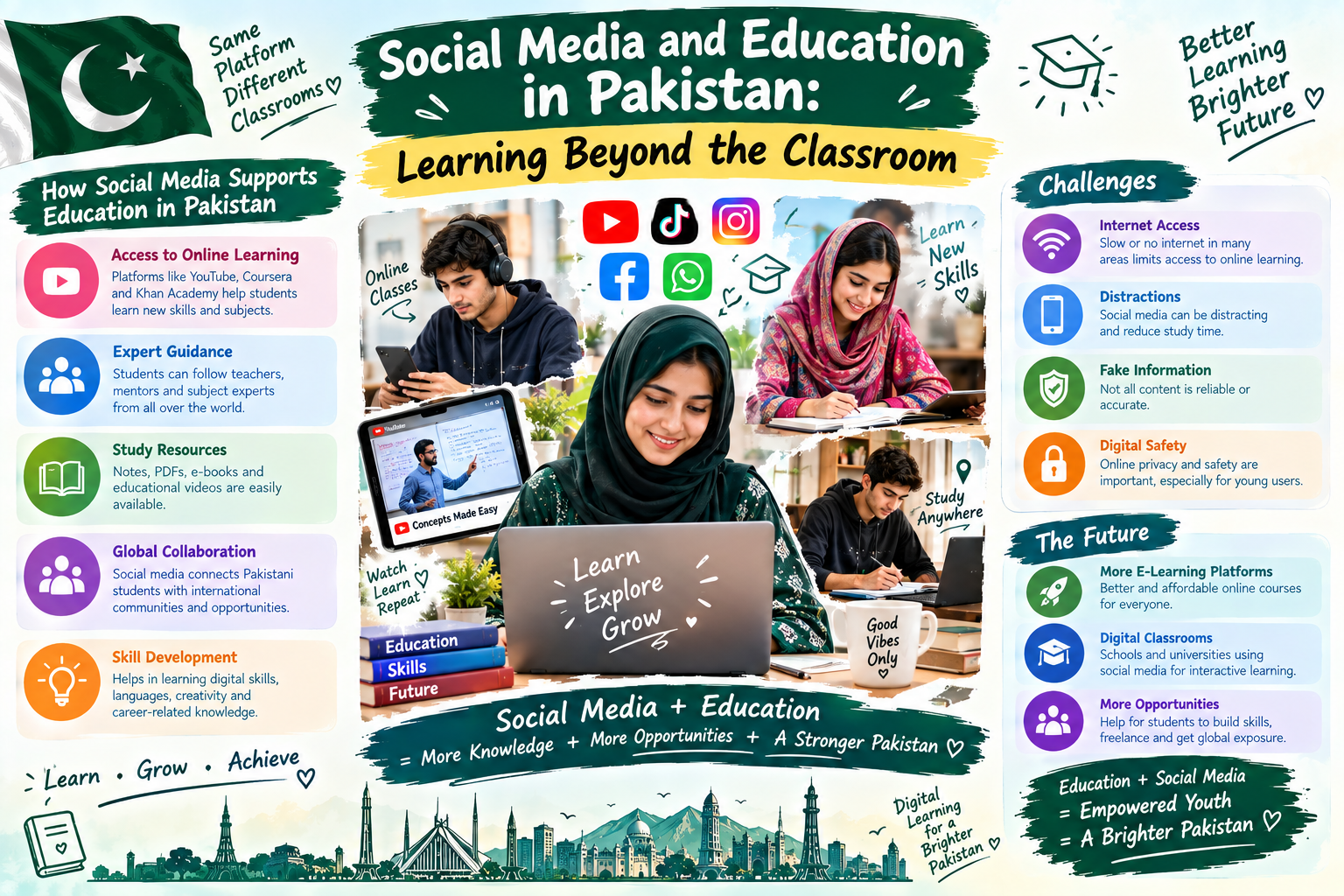
Social media has become an important part of everyday life in Pakistan. Platforms that were once mainly used for communication and entertainment are now also helping people learn new skills, discover educational information, connect with teachers, and explore career opportunities. For Pakistani students, social media can provide learning opportunities beyond the traditional classroom.
Education is no longer limited to textbooks, classrooms, libraries, and tuition centers. A student can now watch an educational video, join a study community, follow a teacher, learn a computer skill, improve English vocabulary, or explore a new career field using a smartphone or computer. This has created new possibilities for students across Pakistan.
Social media does not replace schools, colleges, universities, or qualified teachers. Instead, it can work as an additional learning resource. When used responsibly, it can make education more accessible, interactive, and interesting.
From students in major cities such as Lahore, Karachi, and Islamabad to learners in smaller towns and rural areas, social media is creating new ways to access knowledge. Pakistani teachers, educational creators, institutions, and students are also contributing to this growing digital learning environment.
The Growing Role of Social Media in Pakistani Education
Traditional education provides students with structured lessons and direct interaction with teachers. Social media adds another layer by allowing students to continue learning outside the classroom.
A student may not fully understand a topic during a classroom lecture. At home, the student can search for another explanation through an educational video or discussion. Different teachers may explain the same topic in different ways, helping students find an explanation that matches their learning style.
Social media can also make education more flexible. Students can learn according to their own schedules and revisit educational material whenever necessary.
For example, a student studying mathematics can find step-by-step explanations of mathematical problems. A physics student can watch demonstrations of scientific concepts. A computer student can learn programming through tutorials and practical examples.
This flexibility is especially useful for students who want additional practice alongside their regular studies.
Learning Beyond the Classroom
The biggest educational benefit of social media is the opportunity to continue learning beyond school or college hours.
Classroom learning usually follows a timetable. Once a lesson ends, students may need additional resources to understand or practice it. Social media can provide supplementary material at almost any time.
Students can use digital platforms to:
Review difficult lessons
Watch educational explanations
Practice questions
Learn languages
Develop computer skills
Discover career options
Follow educational institutions
Participate in study communities
Learn about scholarships and opportunities
Improve communication skills
This creates a learning environment that extends beyond the physical classroom.
A student sitting at home can explore educational material created by teachers and professionals from different parts of Pakistan. In this way, social media can connect learners with a wider educational community.
Educational Content Created by Pakistani Teachers
Pakistani teachers are increasingly using digital platforms to share educational knowledge. Many teachers explain academic concepts through videos, short lessons, presentations, and question-solving sessions.
This type of content can be particularly helpful when a student needs a second explanation.
For example, a physics teacher may explain a difficult formula using a practical example. A mathematics teacher may solve a problem step by step. An English teacher may explain grammar through simple sentences.
Pakistani teachers can also create content according to the needs of local students. They understand the education system, examination patterns, textbooks, and common difficulties faced by students.
This makes locally created educational content valuable for Pakistani learners.
Helping Students Understand Difficult Concepts
Some academic concepts can be difficult to understand from written textbooks alone. Social media can make these concepts easier through visual and interactive learning.
Science subjects are a good example.
A physics concept involving motion, electricity, waves, or energy may become easier when students see an animation or demonstration. Similarly, chemistry concepts can be explained through diagrams and visual examples.
Mathematics can also benefit from step-by-step digital explanations.
Instead of simply reading a formula, students can watch how the formula is applied to a question. They can pause the explanation, repeat it, and practice the same method themselves.
This does not mean that textbooks are unnecessary. Instead, digital content can support textbook learning.
Social Media and English Language Learning
English is an important subject for Pakistani students and can also be useful for higher education and professional opportunities.
Social media provides many opportunities for students to improve their English.
Students can follow educational pages that teach:
Vocabulary
Grammar
Pronunciation
Sentence formation
Speaking skills
Writing skills
Common English expressions
Short educational lessons can make language learning more approachable.
For students who find English difficult, repeated exposure to simple English content can gradually improve understanding. They can read short posts, listen to spoken English, and practice new words.
Students should still verify meanings and learn proper grammar from reliable educational resources. Social media can provide practice, but structured education remains important.
Study Communities for Pakistani Students
Another positive development is the growth of online study communities.
Students can join groups or communities related to their subjects, examinations, or educational interests. These communities can provide opportunities to discuss questions and exchange useful study material.
For example, students preparing for board examinations may discuss:
Important chapters
Practice questions
Past-paper preparation
Study techniques
Time management
Difficult concepts
Such communities can help students feel connected to other learners.
However, students should be careful about relying on unverified examination information. Official announcements from educational boards and institutions should remain the primary source for examination dates, syllabuses, results, and other important information.
Social Media and Examination Preparation
Examination preparation is another area where social media can provide supplementary support.
Students preparing for Pakistani board examinations can find explanations of textbook chapters, practice questions, revision techniques, and educational discussions.
A student can use social media as part of a larger study plan.
For example, a student may:
Read the textbook chapter.
Understand the basic concepts.
Watch a supplementary explanation.
Solve textbook questions.
Practice past questions.
Review mistakes.
Revise important formulas or definitions.
This approach combines traditional study methods with digital learning.
The important point is that social media should support preparation rather than become a distraction.
Supporting Computer and Digital Skills
Pakistan's growing digital economy has increased interest in computer-related skills.
Social media can introduce students to areas such as:
Programming
Graphic design
Website development
Digital marketing
Video editing
Artificial intelligence
Cybersecurity
Data analysis
Freelancing
E-commerce
Students can discover these fields through educational videos and professional communities.
A young student who is interested in computers may begin with a basic tutorial and gradually develop more advanced skills.
This is particularly valuable because digital skills can complement formal education and help students understand possible career paths.
Career Awareness Through Social Media
Many students are uncertain about what they want to study or what careers are available to them.
Social media can expose Pakistani students to different professions and educational fields.
Students can learn about:
Law
Medicine
Engineering
Computer science
Business
Teaching
Design
Journalism
Digital marketing
Entrepreneurship
Science and research
Professionals can share information about their educational journeys, daily work, skills, and experiences.
This can help students explore possibilities before making educational decisions.
Career information should still be checked through universities, professional organizations, and official sources because social media posts may not always provide complete or accurate information.
Educational Opportunities for Girls in Pakistan
Social media can also support educational opportunities for girls and young women in Pakistan.
Digital learning allows students to access supplementary educational material from home. Girls interested in subjects such as science, technology, business, arts, languages, and other fields can explore educational communities and resources online.
Female teachers, professionals, entrepreneurs, researchers, and creators can also provide examples of different educational and professional paths.
This can encourage students to take an interest in learning and skill development.
At the same time, responsible digital use is important. Students should protect their privacy, use trusted educational resources, and communicate safely online.
Connecting Students With Pakistani Educational Culture
Social media is not only about international information. It can also promote Pakistani educational and cultural content.
Teachers and creators can produce content about:
Pakistani history
Urdu literature
Pakistani scientists
National achievements
Local languages
Art and culture
Pakistani geography
Historical places
Important national personalities
Such content can make learning more connected to local society.
Students can discover interesting information about their own country while developing broader knowledge.
Making Learning More Interactive
Traditional learning often depends heavily on reading and writing. Digital platforms can introduce more interactive methods.
Educational creators can use:
Questions
Quizzes
Diagrams
Animations
Demonstrations
Short explanations
Visual examples
Discussion sessions
Interactive content can encourage students to think about a topic rather than simply memorize information.
For example, a science lesson can begin with a question, followed by an explanation and a practical example. A mathematics lesson can present a problem and then demonstrate the solution.
This style can make revision more engaging.
Social Media and Teachers
Social media can also provide teachers with new ways to communicate with students.
Teachers may use digital platforms to share:
Homework reminders
Educational material
Revision tips
Announcements
Practice questions
Explanatory videos
Additional reading material
Digital communication can make it easier to distribute information to a large number of students.
Teachers can also learn from other educators by following professional educational content. They can discover new teaching methods, classroom activities, and digital tools.
Therefore, social media can benefit both students and teachers.
Supporting Parents in Education
Parents can also use social media to become more informed about education.
Educational content can help parents understand modern learning methods, digital skills, study habits, and career possibilities.
Parents can also follow official educational institutions and schools for announcements and information.
However, parents should guide younger students in their digital activities. A balanced approach can help children benefit from educational technology without spending excessive time online.
Social Media and Rural Education
Pakistan has large urban centers as well as many smaller towns and rural communities.
Digital platforms can provide supplementary educational resources to students who may not have access to the same range of physical learning resources available in major cities.
A student in a smaller town may be able to watch a lesson created by a teacher from another part of Pakistan. This can expand access to explanations and educational ideas.
Digital learning cannot solve every educational challenge, but it can provide an additional source of knowledge.
Better internet access, affordable devices, digital literacy, and quality educational content can further strengthen this opportunity.
Promoting Self-Learning
One of the most valuable educational habits is the ability to learn independently.
Social media can encourage students to become curious about subjects outside their textbooks.
A student interested in astronomy can explore space-related educational content. Someone interested in computers can learn programming. A student interested in history can explore historical discussions and documentaries.
This creates a culture of curiosity.
Self-learning does not mean studying without teachers. Instead, it means developing the habit of asking questions, searching for reliable information, and continuing to learn.
Digital Literacy and Responsible Learning
The benefits of social media education also come with responsibility.
Students should learn how to identify reliable information. Not every educational-looking post is accurate.
Good digital learning habits include:
Checking information from reliable sources
Comparing important facts
Avoiding misleading educational claims
Respecting copyright
Protecting personal information
Avoiding unnecessary distractions
Maintaining a healthy study schedule
Using educational platforms responsibly
Digital literacy is becoming an important part of modern education.
Students who know how to evaluate online information can make better use of digital resources.
Balancing Social Media and Traditional Education
Social media should not be viewed as a complete replacement for schools, colleges, universities, teachers, or textbooks.
Traditional education provides structure, assessment, direct guidance, practical activities, and social interaction.
Social media can complement these resources.
A balanced student can use textbooks for detailed study, teachers for guidance, practice questions for preparation, and social media for supplementary explanations and additional knowledge.
The goal should not be to spend more time online. The goal should be to use digital platforms more effectively.
Social Media and Creativity in Education
Education is not only about memorizing information. Creativity is also important.
Social media gives students opportunities to create educational content of their own.
Students can prepare:
Educational presentations
Science demonstrations
Book reviews
Historical discussions
Art projects
Programming projects
Educational videos
Infographics
Creating content can help students understand subjects more deeply.
For example, a student who creates a simple educational presentation about a physics concept may understand that concept better because they have to organize and explain the information themselves.
Encouraging Pakistani Educational Creators
Pakistan has a large population of talented teachers, students, writers, designers, programmers, and professionals.
Social media provides a space where these people can share knowledge with wider audiences.
Educational creators can contribute by producing accurate, simple, and useful content in English, Urdu, and regional languages.
Content in familiar languages can make difficult subjects easier for many learners.
This creates an opportunity for Pakistan's digital education community to continue growing.
The Future of Social Media and Education in Pakistan
The relationship between social media and education is likely to continue developing.
Future educational content may increasingly include artificial intelligence, interactive lessons, virtual demonstrations, digital classrooms, educational communities, and personalized learning tools.
Pakistani students may have more opportunities to connect with teachers and educational resources through digital platforms.
Schools and colleges may also continue integrating technology into teaching.
The most important factor will remain responsible use.
Technology can provide opportunities, but students still need discipline, critical thinking, teachers, and quality educational resources.
Conclusion
Social media is creating new opportunities for education in Pakistan. It allows students to explore knowledge beyond the traditional classroom, access supplementary explanations, learn digital skills, improve languages, discover careers, and connect with educational communities.
Pakistani teachers and educational creators are also playing an important role by sharing useful knowledge through digital platforms. Students from cities as well as smaller towns can benefit from these resources when they use them responsibly.
The future of education in Pakistan can combine traditional teaching with modern digital opportunities. Schools, teachers, textbooks, libraries, and universities will continue to provide the foundation of education, while social media can serve as an additional tool for learning and exploration.
With responsible use, digital literacy, reliable educational content, and a strong focus on learning, social media can contribute positively to Pakistan's growing educational environment.
FAQs
1. How is social media helping education in Pakistan?
Social media provides students with supplementary lessons, educational videos, study communities, language-learning resources, and information about skills and careers.
2. Can social media replace schools and teachers?
No. Social media works best as a supplementary learning resource. Teachers, schools, colleges, textbooks, and universities remain important parts of formal education.
3. Can Pakistani students learn skills through social media?
Yes. Students can explore skills such as programming, graphic design, digital marketing, video editing, communication, and other digital skills through educational content.
4. How can students use social media for examination preparation?
Students can use educational videos, practice questions, revision material, and study communities alongside their textbooks, classroom lessons, and past-paper practice.
5. Why is responsible social media use important for students?
Responsible use helps students avoid misinformation, protect their privacy, manage their time, and focus on useful educational content.