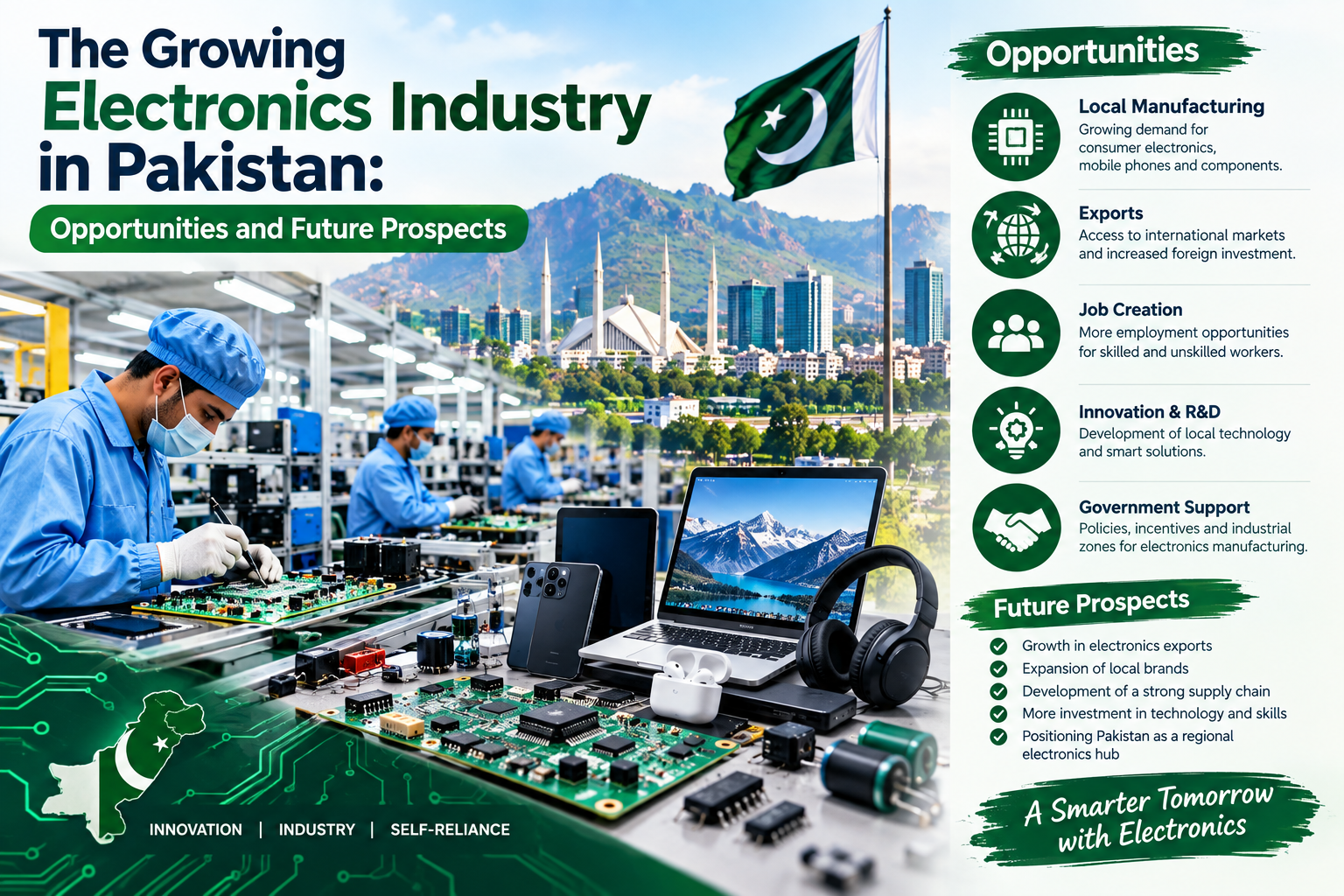
Introduction
Electronics have become an essential part of modern life in Pakistan. From smartphones and computers to refrigerators, televisions, air conditioners, solar inverters, security cameras, and industrial equipment, electronic products are used in homes, schools, offices, businesses, hospitals, factories, and many other places.
The electronics industry is not limited to the production of finished products. It includes many different activities such as importing components, assembling devices, manufacturing selected parts, repairing equipment, selling electronic products, providing technical services, developing software, and maintaining electronic systems.
As digital technology continues to develop, demand for electronic products and services is also changing. Consumers increasingly use smartphones and internet-connected devices, while businesses are adopting digital systems and automation. Renewable energy technologies are also creating new opportunities for electronic equipment such as solar inverters, charge controllers, monitoring systems, and energy-management devices.
Pakistan has a large consumer market and a growing population of technology users. These factors create opportunities for businesses involved in electronics. However, the industry also faces challenges including dependence on imported components, production costs, energy requirements, technical skills, research limitations, and changing global technology.
Understanding the current structure, opportunities, challenges, and future direction of the electronics industry can help explain its importance to Pakistan's economy.
What Is the Electronics Industry?
The electronics industry includes businesses and organizations involved in designing, manufacturing, assembling, distributing, selling, repairing, and maintaining electronic products and systems.
The industry covers many areas, including:
Mobile phones
Computers and laptops
Televisions
Home appliances
Communication equipment
Electronic components
Solar electronics
Security systems
Industrial electronics
Medical electronics
Automotive electronics
Networking equipment
Automation systems
Some companies may manufacture products, while others specialize in assembly, distribution, retail, repair, or technical support.
This wide range makes electronics an interconnected industry with links to manufacturing, information technology, telecommunications, energy, education, and services.
Development of Electronics in Pakistan
Pakistan's electronics sector has developed gradually over many decades.
Early electronic products were largely imported. As demand increased, local businesses developed around distribution, retail, maintenance, and repair.
The growth of television, radio, telecommunications, computers, mobile phones, and household appliances expanded the electronics market.
Later, digital technology and internet connectivity created additional demand for smartphones, computers, networking devices, software-enabled electronics, and digital services.
Today, electronics are closely connected with many other industries in Pakistan.
Mobile Phone Market
Mobile phones are one of the most visible parts of the electronics market.
Smartphones are used for communication, education, banking, entertainment, business, social interaction, navigation, photography, and many other activities.
The mobile phone ecosystem includes more than device sales. It also involves:
Mobile accessories
Chargers
Batteries
Repair services
Software
Mobile applications
Network services
Protective products
Refurbished devices
This creates opportunities for retailers, technicians, distributors, software developers, and other businesses.
Computers and IT Hardware
Computers remain important for education, offices, businesses, engineering, software development, research, and professional work.
The computer market includes desktops, laptops, monitors, printers, keyboards, storage devices, networking equipment, and accessories.
Pakistan's growing technology sector also increases demand for computer hardware.
Students studying computer science, engineering, design, and other fields often require suitable devices for practical work.
Businesses also need computers for accounting, communication, data management, customer services, and digital operations.
Home Electronics and Appliances
Household electronics represent another major part of the industry.
Pakistani households use products such as:
Refrigerators
Washing machines
Air conditioners
Fans
Microwaves
Electric ovens
Water dispensers
Televisions
Vacuum cleaners
Blenders
Water heaters
As household needs and consumer preferences change, manufacturers and retailers continue to introduce new models.
Energy efficiency is becoming an important factor in appliance selection because electricity consumption is a major consideration for many households.
Solar Electronics
Solar technology is creating new opportunities in Pakistan's electronics sector.
Solar systems use electronic equipment such as:
Inverters
Charge controllers
Monitoring devices
Batteries
Protection equipment
Solar pumps
Energy-management systems
The growth of solar installations can create demand for technicians, installers, engineers, distributors, and maintenance services.
Solar electronics also connect the electronics industry with the energy sector.
Consumer Electronics
Consumer electronics include products primarily designed for personal and household use.
Televisions, speakers, headphones, cameras, smart watches, gaming devices, and other digital products fall within this broad category.
The market changes quickly as new technologies are introduced.
Smart devices are increasingly connected to the internet, creating an overlap between electronics and software.
This means future electronics businesses may need knowledge of both hardware and digital services.
Electronics Retail Business
Retail is an important part of Pakistan's electronics industry.
Electronics shops sell devices to consumers, businesses, educational institutions, and other organizations.
Retailers may specialize in particular product categories or offer a broad range of electronics.
Online shopping has also created new opportunities.
Customers can compare products, specifications, prices, warranties, and reviews before making purchasing decisions.
Businesses that provide accurate product information and reliable customer service can build stronger relationships with consumers.
Electronics Repair Industry
Repair services are an important part of Pakistan's electronics ecosystem.
Mobile phones, televisions, computers, appliances, and other devices can develop technical problems.
Repair technicians can diagnose faults and replace damaged components where practical.
The repair sector creates employment for people with technical skills.
It also contributes to sustainability by extending the useful life of electronic products.
Instead of replacing every damaged device, consumers can sometimes repair and continue using their existing equipment.
Importance of Technical Skills
The electronics industry depends heavily on skilled workers.
Technicians, engineers, installers, designers, software developers, and maintenance professionals all contribute to the sector.
Technical skills may include:
Circuit analysis
Soldering
Electronics troubleshooting
Computer hardware
Networking
Embedded systems
Programming
Electrical safety
Solar system installation
Automation
Technical and vocational education can help students develop these skills.
Electronics Education in Pakistan
Educational institutions have an important role in developing the electronics workforce.
Schools and colleges can introduce students to basic electronics and digital technology.
Universities and technical institutes can provide more advanced training in electrical engineering, electronics engineering, computer engineering, telecommunications, robotics, and related fields.
Practical projects are particularly useful.
Students can learn more effectively when they combine theoretical concepts with practical activities such as circuit building, programming, sensor projects, and troubleshooting.
Electronics and Engineering
Engineering is closely connected with electronics.
Electrical and electronics engineers can work on circuits, communication systems, control systems, power electronics, embedded systems, industrial automation, and other technologies.
Computer engineers may work at the intersection of hardware and software.
Telecommunication engineers contribute to communication networks.
These fields can support the development of Pakistan's technology ecosystem.
Embedded Systems
Embedded systems are electronic systems designed to perform specific functions.
They can be found in many modern products, including:
Washing machines
Cars
Medical equipment
Industrial machines
Security systems
Smart appliances
Solar equipment
Embedded systems combine hardware and software.
Learning microcontrollers and programming can therefore provide students with practical skills relevant to modern electronics.
Automation and Industrial Electronics
Industrial automation uses electronic and computer-based systems to control machines and processes.
Factories can use sensors, controllers, motors, monitoring systems, and other electronic equipment.
Automation can improve consistency and help organizations monitor production processes.
Pakistan's manufacturing sector can benefit from skilled professionals who understand automation and industrial electronics.
This area can also create opportunities for local businesses that provide installation, maintenance, and technical support.
Medical Electronics
Healthcare increasingly depends on electronic equipment.
Hospitals and clinics use many types of electronic systems for monitoring, diagnosis, communication, and administration.
Medical electronics require high standards of reliability and safety.
Developing technical expertise in this field can create opportunities for engineers, technicians, healthcare technology companies, and maintenance services.
Local expertise can also help institutions maintain equipment more effectively.
Automotive Electronics
Modern vehicles contain many electronic systems.
Examples include electronic control units, sensors, infotainment systems, cameras, navigation systems, safety systems, and battery-management technology.
As vehicle technology develops, electronics will become increasingly important to the automotive sector.
Pakistan's automotive industry can benefit from professionals trained in automotive electronics and embedded systems.
Telecommunications and Electronics
Telecommunications depends heavily on electronic equipment.
Mobile networks, fiber-optic systems, routers, antennas, transmission equipment, and data centers all require electronic and digital technologies.
The expansion of internet connectivity creates continuing demand for network equipment and technical expertise.
Businesses and educational institutions also need reliable communication systems.
Electronics and Small Businesses
The electronics sector provides opportunities for small businesses.
An entrepreneur can start a business in areas such as:
Electronics repair
Mobile accessories
Computer services
Solar installation
Home security systems
Smart home installation
Electronic components
Refurbished devices
Technical training
The required investment varies by business type.
Technical knowledge, customer service, reliable products, and proper business management are important factors.
E-Commerce and Electronics
Online commerce has changed how electronics are bought and sold.
Customers can search for products online, compare specifications, read reviews, and order devices from digital marketplaces or company websites.
This has created opportunities for businesses that operate primarily online.
However, online electronics sellers need to provide accurate product descriptions and clear information about warranties, returns, delivery, and product condition.
Trust is particularly important when customers purchase expensive electronic products.
Import Dependence
One of the challenges facing electronics businesses is dependence on imported components and products.
Many electronic devices require components manufactured in international supply chains.
Changes in exchange rates, international prices, shipping costs, trade policies, and supply disruptions can affect local businesses.
Developing stronger local manufacturing and component-production capabilities could reduce some forms of dependence over time.
However, building competitive manufacturing capacity requires investment, technical knowledge, infrastructure, and access to markets.
Local Manufacturing Opportunities
Pakistan has opportunities to expand manufacturing and assembly in selected electronics categories.
Local businesses can potentially participate in:
Device assembly
Electronic components
Cables
Chargers
Power supplies
Solar equipment
Industrial electronics
Home appliances
Electronic accessories
Manufacturing requires quality control and reliable supply chains.
Companies must also compete with international products on price, performance, reliability, and after-sales service.
Research and Development
Research and development is important for the long-term growth of the electronics industry.
Universities, research organizations, and companies can work together on new technologies.
Research areas may include:
Renewable energy electronics
Robotics
Automation
Embedded systems
Artificial intelligence hardware
Communication systems
Energy storage
Sensors
Medical technology
Research can help create locally relevant solutions for Pakistan's needs.
Electronics and Artificial Intelligence
Artificial intelligence is increasingly connected with electronic hardware.
AI systems require computing equipment, sensors, cameras, processors, storage, and communication systems.
AI-enabled devices may be used in areas such as security, agriculture, manufacturing, healthcare, transportation, and smart homes.
Pakistan's electronics industry can potentially benefit from professionals who understand both hardware and AI-related software.
Smart Home Market
Smart home technology is another developing area.
Consumers can use connected devices such as:
Smart lights
Security cameras
Smart plugs
Smart locks
Sensors
Smart televisions
Automated appliances
Smart home systems combine electronics, networking, software, and mobile applications.
Local businesses can provide installation and technical support for these systems.
Renewable Energy and Electronics
Pakistan's energy sector creates opportunities for power electronics.
Solar inverters, battery systems, controllers, monitoring devices, and other electronic equipment are important components of modern renewable energy systems.
As more households and businesses explore alternative energy solutions, demand for technical expertise can increase.
This creates opportunities for engineers, electricians, technicians, installers, and entrepreneurs.
E-Waste and the Electronics Industry
Industry growth also creates a responsibility to manage electronic waste.
Old mobile phones, computers, appliances, batteries, and other equipment should be repaired, reused, refurbished, or recycled where possible.
A stronger recycling industry could recover valuable materials and reduce environmental problems.
Electronics businesses can contribute by informing customers about responsible disposal and participating in appropriate take-back or recycling programs.
Challenges Facing Pakistan's Electronics Industry
The industry has significant opportunities but also several challenges.
High Production Costs
Manufacturing electronic products can require expensive machinery, energy, components, and skilled workers.
Imported Components
Dependence on international supply chains can expose businesses to external market changes.
Energy Requirements
Factories and electronic production facilities require reliable electricity.
Skilled Workforce
Advanced electronics require specialized technical knowledge.
Research Limitations
Limited research investment can slow innovation.
Competition
Local businesses compete with international manufacturers and imported products.
Rapid Technological Change
Companies must continuously update their knowledge and products.
Importance of Quality Control
Quality is essential in electronics.
Poor-quality components can cause devices to fail and may create safety problems.
Manufacturers and sellers should follow appropriate standards and testing procedures.
Customers also benefit from checking product specifications, warranty information, and the reputation of sellers.
Reliable products can improve consumer confidence in locally produced electronics.
Role of Government and Industry Support
Government policies and industry cooperation can influence the development of the electronics sector.
Areas that can support growth include:
Technical education
Research and development
Manufacturing infrastructure
Investment opportunities
Industry training
Export development
Quality standards
Digital infrastructure
Long-term development requires cooperation among educational institutions, businesses, engineers, investors, and policymakers.
Export Opportunities
Pakistan's electronics industry can potentially explore export markets.
Products that are competitively manufactured and meet international quality requirements may have opportunities in regional and global markets.
Potential areas include specialized components, software-integrated electronics, solar equipment, cables, accessories, and selected manufactured products.
Export development requires consistent quality, competitive pricing, reliable supply chains, and understanding of international market requirements.
Electronics and Employment
The electronics industry can create employment at multiple levels.
Jobs can exist in:
Manufacturing
Assembly
Engineering
Repair
Retail
Sales
Distribution
Installation
Research
Software development
Technical support
Quality control
The industry can therefore provide opportunities for people with different educational and technical backgrounds.
Opportunities for Young People
Young people in Pakistan can develop skills relevant to the electronics industry.
Students can begin with basic electronics and computer knowledge and gradually explore more advanced areas.
Useful skills include programming, circuit design, computer hardware, networking, robotics, solar technology, and automation.
Online educational resources can also help students practice technical concepts.
Practical projects can strengthen learning and build problem-solving abilities.
Entrepreneurship in Electronics
The electronics industry offers many possibilities for entrepreneurship.
A small business does not necessarily need to begin with large-scale manufacturing.
Entrepreneurs can start with services such as repair, installation, technical support, accessories, solar solutions, or smart home systems.
As experience and customer demand grow, a business may expand into distribution, product development, or manufacturing.
Good business planning, technical knowledge, customer service, and financial management are essential.
Future Prospects of the Electronics Industry
The future of electronics in Pakistan will likely be influenced by several major trends.
Smart Devices
More household and business products are becoming connected.
Renewable Energy
Solar and energy-management electronics are becoming increasingly relevant.
Automation
Factories and businesses are exploring more automated systems.
Artificial Intelligence
AI will increasingly interact with hardware and electronic devices.
Electric Mobility
Electric vehicles and charging systems may create new electronics-related opportunities.
Digital Healthcare
Healthcare technology may create demand for advanced electronic equipment.
Robotics
Education and industry may increasingly use robotics and automation.
These developments can create opportunities for businesses and skilled professionals.
Building a Strong Electronics Ecosystem
A successful electronics industry requires more than individual businesses.
A complete ecosystem can include:
Universities
Technical institutes
Manufacturers
Component suppliers
Software developers
Repair technicians
Retailers
Research organizations
Investors
Government institutions
When these parts work together, knowledge and innovation can move more effectively between education and industry.
Importance of Practical Education
Pakistan can strengthen its electronics industry by giving students more opportunities for practical learning.
Laboratories, technical workshops, robotics clubs, electronics projects, and internships can help students understand how technology works in real situations.
Practical education can also help students identify their interests before choosing professional careers.
Sustainable Growth
The electronics industry should grow in a responsible way.
Businesses can consider energy efficiency, product durability, repairability, recycling, and responsible waste management.
Consumers can support longer product life by repairing and reusing devices where practical.
Sustainable practices can reduce waste while also creating new economic opportunities in repair and recycling.
Conclusion
The electronics industry in Pakistan is a broad and developing sector connected with technology, manufacturing, energy, telecommunications, education, healthcare, transportation, and business.
Mobile phones, computers, household appliances, solar equipment, security systems, industrial electronics, and smart devices have become important parts of everyday life.
The industry provides opportunities in manufacturing, assembly, repair, retail, technical services, engineering, software, renewable energy, automation, and entrepreneurship.
Pakistan also faces challenges. Dependence on imported components, production costs, energy requirements, limited research capacity, skill gaps, and international competition can affect the growth of the sector.
Education and technical training can play an important role in addressing some of these challenges. Students who develop practical skills in electronics, programming, networking, automation, robotics, and renewable energy can contribute to the future workforce.
Research and development can also help Pakistan develop solutions suited to local needs. Collaboration between universities, businesses, technical institutions, and investors can strengthen the country's electronics ecosystem.
The future may bring greater use of smart homes, solar electronics, artificial intelligence, automation, robotics, electric mobility, and digital healthcare. These trends can create new opportunities for Pakistani businesses and professionals.
At the same time, responsible growth is important. Quality control, cybersecurity, energy efficiency, product durability, repair, reuse, and e-waste management should remain part of the industry's development.
Pakistan has the opportunity to strengthen its electronics sector by investing in skills, innovation, infrastructure, manufacturing, research, and entrepreneurship.
The electronics industry can therefore become an important part of Pakistan's technology and economic development, particularly when technological progress is combined with education, practical skills, responsible business practices, and long-term planning.
FAQs
1. What is the electronics industry in Pakistan?
The electronics industry includes businesses involved in manufacturing, assembling, selling, repairing, distributing, and maintaining electronic products such as mobile phones, computers, appliances, solar equipment, communication devices, and industrial electronics.
2. What are the major opportunities in Pakistan's electronics industry?
Important opportunities include electronics repair, mobile technology, solar electronics, smart homes, automation, manufacturing, computer hardware, telecommunications, technical services, and electronic entrepreneurship.
3. What skills are useful for working in the electronics industry?
Useful skills include circuit design, electronics troubleshooting, computer hardware, programming, networking, embedded systems, solar technology, automation, robotics, and electrical safety.
4. What challenges does Pakistan's electronics industry face?
Major challenges include dependence on imported components, production costs, energy requirements, limited research capacity, shortage of specialized skills, rapid technological change, and competition from international products.
5. What is the future of electronics in Pakistan?
The future may include greater development of smart devices, solar electronics, automation, artificial intelligence hardware, robotics, electric mobility, digital healthcare, and locally developed electronic products and services.